EV Charging Adapter Market Size, Share Demand Report By Type (CCS Adapters, CHAdeMO Adapters, Type 2 Adapters, Others), By Application (Residential Charging, Commercial Charging, Public Charging), By End-Use (Individual Users, Commercial Fleets, Industrial Users), By Region & Segment Forecasts, 2025–2034
USD 3950
Market Overview
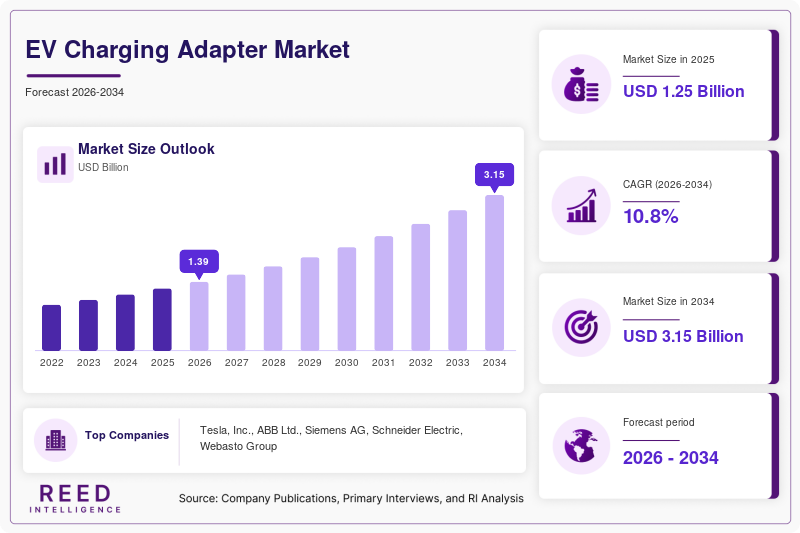
The Ev Charging Adapter Market size was estimated at approximately USD 1.25 billion in 2025 and is projected to reach USD 1.42 billion in 2026. Over the forecast period from 2025 to 2034, the market is expected to grow at a compound annual growth rate (CAGR) of 10.8%, reaching nearly USD 3.75 billion by 2034. This growth reflects increasing interoperability requirements among different EV charging standards and the growing need for flexible charging solutions across regions and vehicle types.
One of the primary growth factors is the rapid expansion of EV infrastructure, which includes both public and private charging stations. As different countries adopt varying connector standards, EV charging adapters have become essential to ensure compatibility across charging networks. Another important factor is the rising number of EV models entering the market, many of which support different charging protocols, increasing the need for universal or multi-standard adapters. Additionally, government incentives and regulatory frameworks supporting EV adoption are driving demand for accessories that enhance charging convenience and accessibility.
Key Highlights
- The market size reached USD 1.25 billion in 2025, driven by increasing adoption of electric vehicles across key regions. Growing investments in charging infrastructure further supported overall market expansion.
- The market is expected to grow at a CAGR of 10.8% from 2025 to 2034, reflecting steady demand for charging compatibility solutions. This growth is supported by continuous advancements in EV technology and infrastructure.
- The market is projected to reach USD 3.75 billion by 2034, indicating strong long-term growth potential. Expanding EV ecosystems and supportive government policies are contributing to this upward trajectory.
Market Trends
Increasing Standardization and Interoperability Initiatives
A significant trend shaping the Ev Charging Adapter Market is the growing push toward standardization and interoperability across charging systems. Governments and industry organizations are working to reduce fragmentation in charging infrastructure by promoting unified standards. However, complete standardization is still evolving, which sustains the demand for adapters that bridge compatibility gaps. Automakers and charging network providers are collaborating to ensure seamless charging experiences, but regional differences persist. As a result, adapters that support multiple connector types, including CCS, CHAdeMO, and Type 2, are gaining traction. This trend is expected to continue as global EV adoption increases and cross-border travel becomes more common.
Rising Demand for Fast-Charging Compatible Adapters
Another notable trend is the growing demand for adapters capable of supporting high-power fast charging. With advancements in battery technology, EV users increasingly prefer rapid charging solutions to reduce downtime. This has led to the development of adapters that can handle higher voltage and current levels without compromising safety. Manufacturers are investing in materials and designs that improve heat dissipation and durability. Additionally, the integration of smart electronics in adapters is enabling better performance monitoring and fault detection. This trend is particularly strong in regions with dense charging infrastructure, where users expect efficient and quick charging experiences.
Market Drivers
Expansion of Global EV Charging Infrastructure
The rapid expansion of EV charging infrastructure is a major driver of the Ev Charging Adapter Market. Governments and private companies are investing heavily in building charging networks to support the growing number of electric vehicles. However, the diversity of charging standards across regions creates compatibility challenges. EV charging adapters address this issue by enabling vehicles to connect to different types of charging stations. This flexibility is particularly important for long-distance travel and cross-border mobility. As infrastructure continues to expand, the demand for adapters that ensure seamless connectivity is expected to increase significantly.
Increasing Diversity of EV Models and Connector Types
The growing variety of EV models with different charging specifications is another key driver. Automakers use various connector standards depending on regional regulations and design preferences. This diversity creates a need for adapters that allow users to access multiple charging networks. Consumers are increasingly seeking solutions that provide convenience and flexibility, especially in regions with mixed infrastructure. The rise of imported EVs in several markets further amplifies this need. As the EV ecosystem becomes more complex, adapters play a critical role in ensuring compatibility and enhancing the overall user experience.
Market Restraint
Safety Concerns and Technical Limitations
One of the primary restraints in the Ev Charging Adapter Market is the concern related to safety and technical limitations. High-power charging involves significant electrical loads, and improper adapter usage can lead to overheating, short circuits, or damage to the vehicle and charging station. Regulatory bodies have imposed strict safety standards, which increase the complexity and cost of manufacturing compliant adapters. Additionally, not all adapters are compatible with fast-charging systems, limiting their usability. For example, using a low-capacity adapter with a high-power charger can reduce efficiency and pose risks. These challenges may hinder adoption, especially among cost-sensitive consumers, and slow down market growth in certain regions.
Market Opportunities
Growth in Emerging EV Markets
Emerging markets present significant opportunities for the Ev Charging Adapter Market. Countries in Asia, Latin America, and Africa are witnessing increasing EV adoption, supported by government initiatives and urbanization. However, charging infrastructure in these regions is still developing and often lacks standardization. This creates a strong demand for adapters that enable compatibility across different systems. Manufacturers can capitalize on this opportunity by offering cost-effective and durable solutions tailored to local conditions. The expansion of ride-sharing and electric fleet services in these markets further enhances the need for adaptable charging solutions.
Integration of Smart and Connected Features
The integration of smart features into EV charging adapters offers another promising opportunity. Advanced adapters equipped with sensors and connectivity options can provide real-time data on charging performance, temperature, and energy consumption. These features enhance safety and efficiency, making them attractive to both individual users and commercial operators. Additionally, smart adapters can be integrated with mobile applications, allowing users to monitor and control charging remotely. As the EV ecosystem becomes more digitalized, the demand for intelligent charging accessories is expected to grow, creating new revenue streams for manufacturers.
Segmental Analysis
By Type
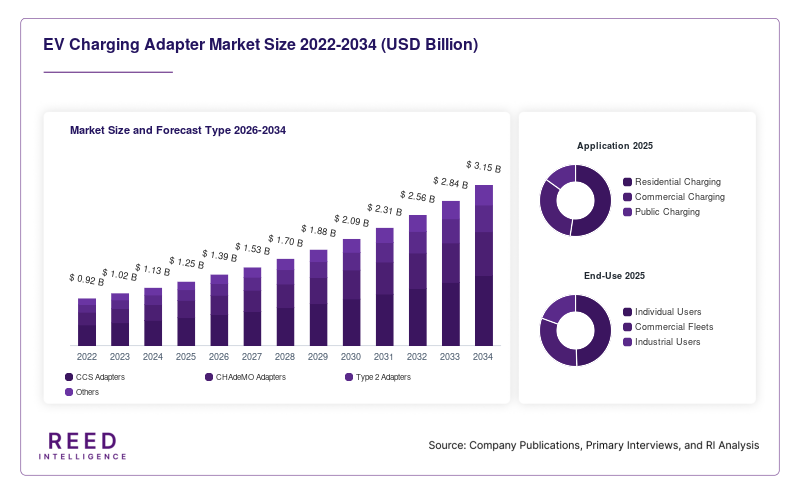
The Type segment includes CCS adapters, CHAdeMO adapters, Type 2 adapters, and others. CCS adapters dominated the market in 2024, accounting for approximately 38% of the total share. This dominance is attributed to the widespread adoption of CCS standards in North America and Europe. These adapters are widely used due to their compatibility with fast-charging infrastructure and increasing support from automakers. The growing number of public charging stations equipped with CCS connectors further strengthens this segment’s position. Additionally, advancements in CCS technology have improved charging efficiency and reliability, making it a preferred choice among EV users.
CHAdeMO adapters are expected to be the fastest-growing subsegment, with a projected CAGR of 11.2% during the forecast period. This growth is driven by the continued presence of CHAdeMO-compatible vehicles, particularly in Asia. The demand for these adapters is also supported by the need for cross-standard compatibility in regions with mixed infrastructure. As older EV models remain in use, the requirement for CHAdeMO adapters continues to grow. Manufacturers are focusing on improving performance and safety features to meet evolving consumer expectations.
By Application
The Application segment includes residential charging, commercial charging, and public charging. Public charging dominated the market in 2024, accounting for approximately 45% of the total share. The increasing number of public charging stations and the need for universal compatibility drive demand in this segment. EV users often rely on public infrastructure for long-distance travel, making adapters essential for accessing different charging networks. The expansion of fast-charging stations further boosts this segment’s growth, as users seek efficient and convenient charging solutions.
Residential charging is expected to be the fastest-growing subsegment, with a CAGR of 10.9%. The rising adoption of EVs among individual consumers is driving demand for home charging solutions. Adapters play a crucial role in ensuring compatibility with existing electrical systems and charging equipment. The increasing availability of compact and user-friendly adapters supports this growth. Additionally, government incentives for home charging installations contribute to the expansion of this segment.
By End-Use
The End-Use segment includes individual users, commercial fleets, and industrial users. Individual users dominated the market in 2024, accounting for approximately 52% of the total share. The growing number of EV owners and the need for flexible charging solutions drive demand in this segment. Consumers prefer adapters that offer convenience and compatibility with multiple charging standards. The availability of portable and easy-to-use adapters further enhances adoption among individual users.
Commercial fleets are expected to be the fastest-growing subsegment, with a CAGR of 11.6%. The electrification of logistics and transportation services is driving demand for adaptable charging solutions. Fleet operators require efficient and reliable charging systems to minimize downtime. Adapters enable fleets to access various charging networks, improving operational efficiency. The increasing adoption of electric buses and delivery vehicles further supports the growth of this segment.
Regional Analysis
North America
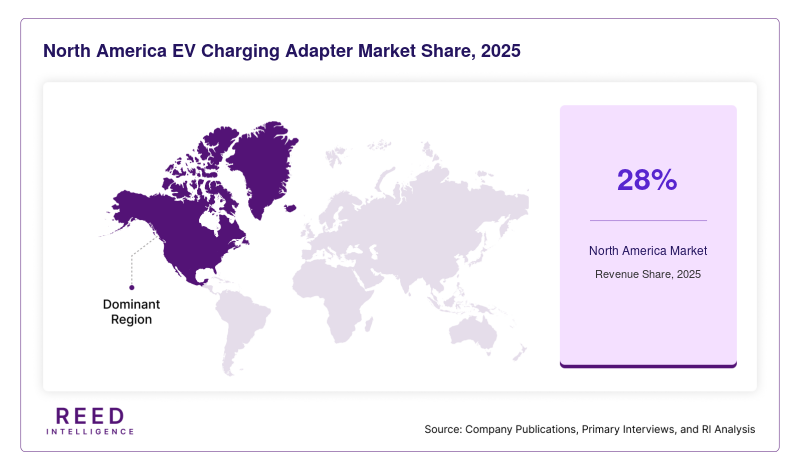
North America accounted for approximately 28% of the Ev Charging Adapter Market share in 2025 and is expected to grow at a CAGR of 10.2% during the forecast period. The region benefits from a well-established EV ecosystem and strong government support for clean energy initiatives. Investments in charging infrastructure and the presence of major EV manufacturers contribute to steady market growth. Increasing consumer awareness and adoption of electric vehicles further support demand for charging adapters.
The United States dominates the regional market due to its extensive charging network and high EV adoption rates. A unique growth factor is the increasing number of interstate EV travel routes, which require compatibility across different charging standards. This drives demand for versatile adapters that enable seamless long-distance travel.
Europe
Europe held around 26% market share in 2025 and is projected to grow at a CAGR of 10.5%. The region’s strong regulatory framework and commitment to reducing carbon emissions support EV adoption. Countries across Europe are investing in expanding charging infrastructure, creating opportunities for adapter manufacturers. The presence of diverse charging standards also contributes to steady demand.
Germany leads the European market due to its advanced automotive industry and high EV penetration. A unique growth factor is the integration of renewable energy sources with charging infrastructure, which increases the need for efficient and adaptable charging solutions.
Asia Pacific
Asia Pacific accounted for the largest market share of 32% in 2025 and is expected to grow at a CAGR of 11.5%. Rapid urbanization, government incentives, and increasing EV production drive market growth in this region. Countries such as China, Japan, and India are investing heavily in EV infrastructure, boosting demand for charging adapters.
China dominates the region due to its large EV market and extensive charging network. A unique growth factor is the high volume of domestic EV production, which results in diverse charging standards and increases the need for compatible adapters.
Middle East & Africa
The Middle East & Africa region held approximately 7% market share in 2025 and is projected to grow at a CAGR of 9.8%. The market is in the early stages of development, with increasing investments in EV infrastructure. Governments are focusing on diversifying energy sources and reducing dependence on fossil fuels.
The United Arab Emirates leads the regional market due to its focus on sustainable transportation. A unique growth factor is the development of smart cities, which includes the integration of EV charging infrastructure and supports demand for advanced charging adapters.
Latin America
Latin America accounted for around 7% of the market share in 2025 and is expected to grow at a CAGR of 10.1%. The region is gradually adopting electric vehicles, supported by government initiatives and rising environmental awareness. Infrastructure development remains a key focus area.
Brazil dominates the market in this region due to its large automotive sector. A unique growth factor is the increasing adoption of electric buses and commercial fleets, which require adaptable charging solutions to operate efficiently.
Competitive Landscape
The Ev Charging Adapter Market is moderately fragmented, with several global and regional players competing based on product quality, compatibility, and pricing. Leading companies focus on innovation and strategic partnerships to strengthen their market position. One of the key leaders in the market is Tesla, Inc., known for its proprietary charging solutions and expanding adapter offerings. The company continues to invest in improving charging compatibility across its network.
Other major players are actively developing advanced adapters with enhanced safety features and fast-charging capabilities. A recent development in the market includes the introduction of multi-standard adapters that support multiple connector types in a single device. This innovation addresses the growing need for interoperability and simplifies the charging process for users. Companies are also expanding their distribution networks to reach emerging markets and capitalize on growing EV adoption.
Key Players
- Tesla, Inc.
- ABB Ltd.
- Siemens AG
- Schneider Electric
- Webasto Group
- Delta Electronics, Inc.
- Leviton Manufacturing Co., Inc.
- Eaton Corporation
- EVBox Group
- ChargePoint, Inc.
- AeroVironment, Inc.
- Blink Charging Co.
- Alfen N.V.
- ClipperCreek, Inc.
- Phoenix Contact
Recent Developments
- A leading manufacturer launched a multi-standard EV charging adapter compatible with CCS and CHAdeMO connectors to enhance interoperability.
- Several companies introduced smart adapters with real-time monitoring features to improve safety and efficiency.
- Strategic partnerships between automakers and charging solution providers have led to the development of advanced adapter technologies.
EV Charging Adapter Market Segments
Type
- CCS Adapters
- CHAdeMO Adapters
- Type 2 Adapters
- Others
Application
- Residential Charging
- Commercial Charging
- Public Charging
End-Use
- Individual Users
- Commercial Fleets
- Industrial Users
By Region
- North America
- Europe
- APAC
- Middle East and Africa
- LATAM