Everything As A Service (XaaS) Market Size, Share & Growth Report By Service Type (Software as a Service, Infrastructure as a Service, Platform as a Service, Security as a Service, Database as a Service, Analytics as a Service, Others), By Deployment Model (Public Cloud, Private Cloud, Hybrid Cloud), By End-Use Industry (BFSI, Healthcare, IT & Telecommunications, Retail & E-commerce, Manufacturing, Government, Media & Entertainment), By Region & Segment Forecasts, 2026–2034
USD 3950
Market Overview
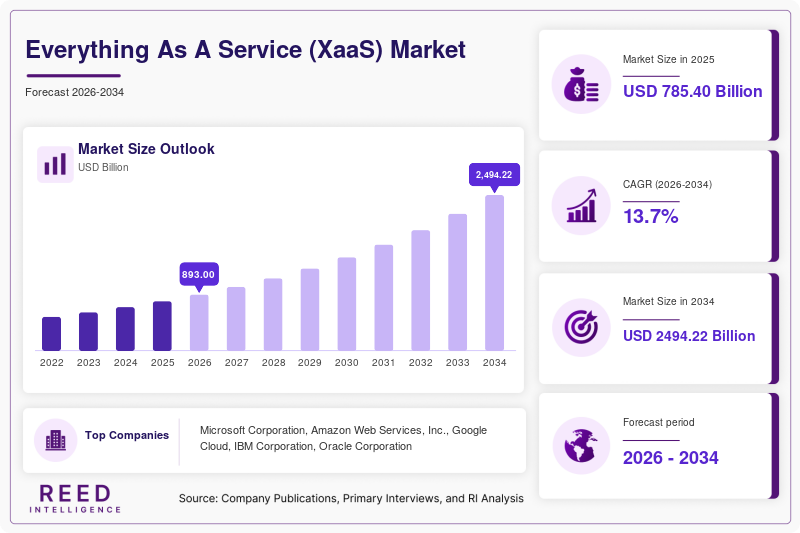
The global Everything As A Service Market size was valued at USD 785.4 billion in 2026 and is projected to reach USD 2,184.6 billion by 2034, expanding at a compound annual growth rate (CAGR) of 13.7% during 2026–2034. The market continues to evolve as organizations across industries shift from capital-intensive technology investments toward flexible subscription-based consumption models. XaaS enables enterprises to access software, infrastructure, platforms, cybersecurity, analytics, and business applications through cloud-based delivery frameworks, improving operational agility and cost efficiency.
A major global factor supporting market growth is the accelerating digital transformation of enterprises. Organizations are increasingly adopting cloud-native architectures to support remote workforces, improve scalability, and modernize legacy systems. Businesses are prioritizing on-demand services that reduce deployment complexity and allow rapid access to advanced technologies such as artificial intelligence, machine learning, edge computing, and automation. The growing reliance on hybrid cloud environments has further strengthened demand for integrated service-based technology ecosystems.
Key Highlights
- North America dominated the market with a 35.4% share in 2025, while Asia Pacific is expected to grow at the fastest CAGR of 16.1% during 2026–2034.
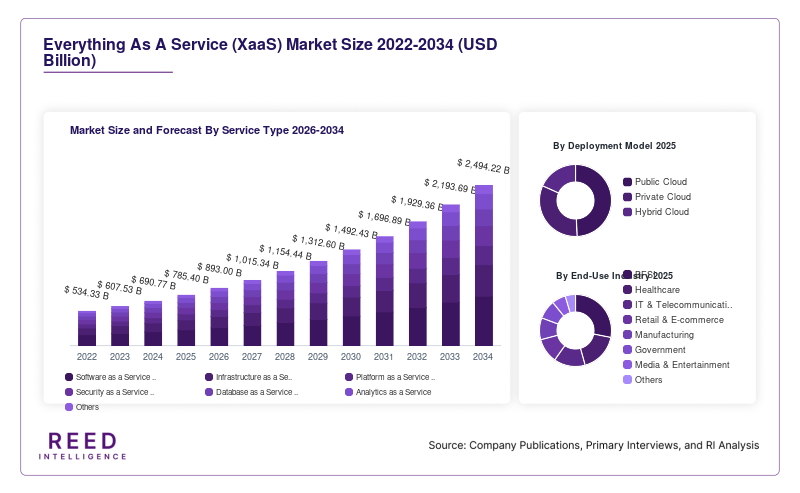
- By service type, Software as a Service (SaaS) accounted for the largest share of 42.8%, while Security as a Service (SECaaS) is projected to grow at a CAGR of 17.5%.
- By deployment model, Public Cloud led with a 58.7% share, whereas Hybrid Cloud is expected to expand at a CAGR of 16.8%.
- By end-use industry, BFSI held the largest share of 24.3%, while Healthcare is anticipated to grow at a CAGR of 17.2%.
- The United States remained the dominant country, with market values of USD 228.6 billion in 2024 and USD 257.8 billion in 2025.
Market Trends
Expansion of AI-Powered Service Delivery Models
Artificial intelligence is becoming an integral component of the Everything As A Service (XaaS) Market. Service providers are embedding AI capabilities into cloud platforms, software solutions, cybersecurity tools, and infrastructure management services. Organizations increasingly seek intelligent services that automate workflows, improve decision-making, and enhance customer experiences. AI-driven monitoring systems can predict infrastructure failures, optimize resource allocation, and reduce operational costs. As enterprises generate larger volumes of business data, demand for analytics-as-a-service and AI-as-a-service solutions continues to rise. Vendors are responding by integrating generative AI, machine learning algorithms, and automated orchestration capabilities into subscription-based offerings. This trend is enabling businesses to gain advanced technology capabilities without significant investments in internal development resources.
Growing Adoption of Industry-Specific XaaS Platforms
Organizations are increasingly favoring specialized service platforms designed for the unique requirements of individual industries. Financial institutions require compliance-focused cloud services, healthcare providers seek secure patient data management solutions, and manufacturing companies demand industrial IoT service platforms. This trend has encouraged vendors to develop vertical-specific XaaS offerings that address operational, regulatory, and performance requirements. Industry-focused services provide faster deployment, reduced customization costs, and improved business outcomes. As regulatory frameworks become more complex, enterprises are selecting providers with deep domain expertise and specialized service portfolios. The emergence of sector-oriented platforms is creating new revenue opportunities while helping businesses accelerate digital transformation initiatives with lower implementation risks.
Market Drivers
Increasing Enterprise Migration Toward Cloud-Based Infrastructure
The widespread migration of enterprises from traditional on-premise environments to cloud-based infrastructure is a major growth driver for the Everything As A Service (XaaS) Market. Businesses seek flexible technology environments that can scale according to changing operational demands. Cloud-based services eliminate the need for substantial hardware investments and reduce maintenance burdens. Organizations benefit from improved accessibility, enhanced collaboration, and faster deployment cycles. As remote and hybrid work models become standard across industries, demand for cloud-delivered applications and infrastructure continues to increase. Enterprises are also leveraging cloud environments to support data analytics, artificial intelligence workloads, and digital customer engagement initiatives. These advantages are encouraging organizations of all sizes to adopt service-based technology models.
Rising Demand for Cost Optimization and Operational Agility
Businesses face increasing pressure to improve efficiency while controlling operational expenditures. XaaS solutions offer predictable subscription pricing structures that replace large upfront capital investments. This financial flexibility enables organizations to allocate resources more effectively and respond rapidly to market changes. Companies can scale services up or down according to demand, improving utilization rates and reducing waste. The ability to access advanced technologies without extensive internal infrastructure investments is particularly attractive to small and medium-sized enterprises. Furthermore, service providers continuously update their platforms, allowing customers to benefit from innovation without managing complex upgrade cycles. These advantages are accelerating the transition toward consumption-based technology ecosystems across global industries.
Market Restraint
Data Security, Privacy, and Regulatory Compliance Challenges
Despite strong adoption momentum, concerns related to data security and regulatory compliance continue to restrain growth in the Everything As A Service (XaaS) Market. Organizations increasingly store critical business information, customer records, financial data, and operational assets within cloud-based environments. While service providers invest heavily in security technologies, concerns regarding unauthorized access, data breaches, and service disruptions remain significant among enterprises operating in highly regulated sectors. Industries such as banking, healthcare, and government face strict compliance requirements related to data residency, privacy protection, and information governance. The complexity of managing multiple service providers across different jurisdictions can increase compliance risks and administrative burdens. For example, multinational organizations often encounter challenges when transferring sensitive information across geographic regions with varying data protection regulations. These concerns can delay implementation decisions, increase due diligence requirements, and limit adoption among organizations with stringent security policies. As cyber threats continue to evolve, enterprises require stronger governance frameworks and transparency from service providers before expanding their XaaS investments.
Market Opportunities
Expansion of Security as a Service Solutions
Growing cybersecurity risks are creating substantial opportunities within the Everything As A Service (XaaS) Market. Organizations face increasingly sophisticated cyberattacks targeting cloud environments, connected devices, and remote work infrastructures. Many enterprises lack the resources required to maintain comprehensive in-house cybersecurity teams. Security as a Service solutions provide access to advanced threat detection, vulnerability management, identity protection, and incident response capabilities through subscription-based models. As regulatory requirements become more stringent, businesses are investing in managed security platforms that simplify compliance and reduce operational complexity. The increasing adoption of digital business models across sectors is expected to drive strong demand for scalable and continuously updated security services throughout the forecast period.
Emerging Demand from Small and Medium-Sized Enterprises
Small and medium-sized enterprises represent a significant growth opportunity for XaaS providers. Historically, many smaller businesses faced barriers to adopting advanced technology due to budget constraints and limited technical expertise. Service-based delivery models remove these obstacles by offering affordable subscription plans and simplified deployment processes. SMEs increasingly require cloud applications, infrastructure services, customer relationship management tools, and analytics platforms to remain competitive. As internet connectivity improves across emerging economies, smaller organizations are gaining access to enterprise-grade technology capabilities through XaaS solutions. Vendors are introducing flexible pricing structures and industry-specific offerings tailored to the needs of this customer segment, creating a large and expanding addressable market.
Segmental Analysis
By Service Type
Software as a Service (SaaS) remained the dominant subsegment within the Everything As A Service (XaaS) Market and accounted for 42.8% of global revenue in 2024. The widespread adoption of cloud-based business applications continues to support segment leadership. Organizations increasingly deploy SaaS solutions for enterprise resource planning, customer relationship management, collaboration tools, human resource management, and business intelligence functions. The subscription-based delivery model reduces implementation complexity while improving accessibility and scalability. Enterprises benefit from automatic updates, predictable pricing structures, and reduced maintenance requirements. Growing demand for digital workplace solutions and cloud-based productivity platforms further strengthens SaaS adoption across organizations of all sizes and industry verticals.
Security as a Service (SECaaS) is projected to be the fastest-growing subsegment, expanding at a CAGR of 17.5% through 2034. The increasing frequency of cyber threats and regulatory compliance requirements is encouraging organizations to adopt managed security services. Businesses seek advanced threat detection, endpoint protection, identity management, and security monitoring capabilities without maintaining extensive internal cybersecurity teams. Remote work environments and growing cloud adoption have increased the attack surface for organizations, creating demand for specialized security expertise. Vendors continue to enhance service portfolios with artificial intelligence-driven threat intelligence and automated response capabilities, supporting rapid segment growth.
By Deployment Model
Public Cloud emerged as the dominant deployment model and held a 58.7% market share in 2024. Organizations continue to favor public cloud environments because of their scalability, flexibility, and cost advantages. Public cloud platforms enable businesses to access computing resources on demand while avoiding substantial infrastructure investments. Enterprises can rapidly deploy applications, support remote workforces, and scale operations according to changing business requirements. The availability of extensive service ecosystems, including analytics, artificial intelligence, and database management capabilities, further contributes to public cloud adoption. Growing confidence in cloud security and reliability continues to strengthen demand across global markets.
Hybrid Cloud is anticipated to register the fastest growth, achieving a CAGR of 16.8% during the forecast period. Organizations increasingly seek deployment models that combine the flexibility of public cloud environments with the control and security advantages of private infrastructure. Hybrid cloud architectures enable businesses to optimize workloads, improve compliance management, and enhance operational resilience. Companies operating in highly regulated sectors often require flexible deployment strategies that balance performance and governance requirements. The increasing need for seamless integration between legacy systems and modern cloud applications is expected to drive substantial adoption of hybrid cloud solutions in the coming years.
By End-Use Industry
The BFSI segment accounted for the largest share of the Everything As A Service (XaaS) Market, representing 24.3% of global revenue in 2024. Financial institutions increasingly rely on cloud-based services to modernize operations, improve customer experiences, and enhance regulatory compliance capabilities. Banks, insurance providers, and investment firms utilize XaaS solutions for digital banking, fraud detection, customer analytics, and risk management applications. The need for operational efficiency and rapid innovation has accelerated cloud adoption across the financial sector. Service-based delivery models provide access to advanced technologies while reducing infrastructure management burdens, supporting continued dominance of the BFSI segment.
Healthcare is expected to emerge as the fastest-growing end-use industry, expanding at a CAGR of 17.2% through 2034. Healthcare organizations increasingly adopt cloud-based platforms to improve patient care, streamline administrative processes, and support data-driven decision-making. Electronic health records, telemedicine platforms, analytics solutions, and cybersecurity services are driving demand for XaaS offerings. The growing volume of healthcare data requires scalable infrastructure and advanced management capabilities. Furthermore, healthcare providers are investing in digital transformation initiatives to improve operational efficiency and enhance patient engagement, creating significant growth opportunities for service providers.
Regional Analysis
North America
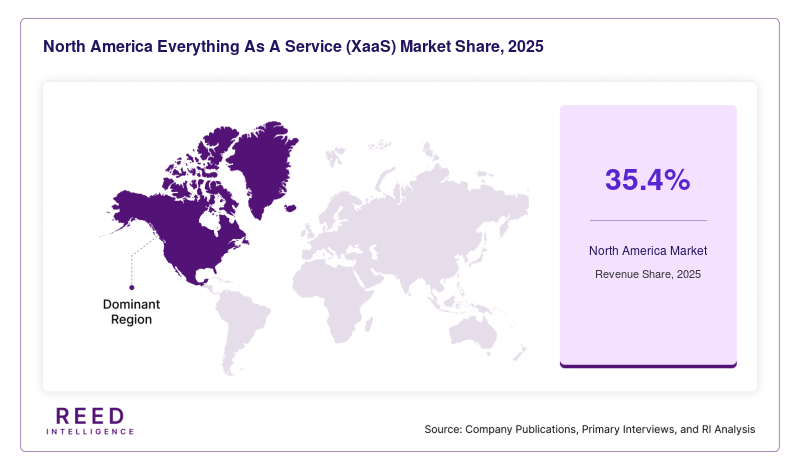
North America accounted for 35.4% of the global Everything As A Service (XaaS) Market in 2025 and maintained its position as the leading regional market. The region benefits from advanced digital infrastructure, high cloud adoption rates, and strong enterprise spending on technology modernization initiatives. Organizations across financial services, healthcare, retail, and manufacturing sectors continue to invest in cloud-based services to improve operational efficiency. The regional market is expected to expand at a CAGR of 12.8% through 2034, supported by continuous innovation in cloud computing and cybersecurity services.
The United States remains the dominant country within North America. A key growth factor is the extensive presence of major cloud service providers and technology innovators. Enterprises are increasingly adopting multi-cloud and hybrid cloud strategies to improve resilience and scalability. Strong investments in artificial intelligence, edge computing, and advanced analytics platforms continue to create favorable conditions for XaaS adoption across both private and public sector organizations.
Europe
Europe represented 27.1% of the global market in 2025 and continues to demonstrate steady growth in cloud-based service adoption. Organizations across the region are accelerating digital transformation efforts to improve competitiveness and operational flexibility. Demand for software, infrastructure, and platform services remains strong across manufacturing, healthcare, financial services, and government sectors. The European market is projected to grow at a CAGR of 13.2% during the forecast period, supported by increasing investments in digital infrastructure and cloud modernization initiatives.
Germany leads the European market due to its strong industrial base and extensive adoption of Industry 4.0 technologies. A unique growth factor is the integration of cloud services with advanced manufacturing operations. Enterprises are deploying connected systems, predictive maintenance solutions, and industrial analytics platforms delivered through XaaS models. These investments are helping organizations optimize productivity while supporting broader digitalization objectives across the region.
Asia Pacific
Asia Pacific held 23.6% of the global market share in 2025 and is expected to record the fastest growth through 2034. Rapid economic development, increasing internet penetration, and growing investments in digital technologies are supporting regional expansion. Enterprises across developing and developed economies are adopting cloud services to improve efficiency, support innovation, and reduce infrastructure costs. The regional market is forecast to grow at a CAGR of 16.1%, significantly outpacing other regions during the study period.
China dominates the Asia Pacific market due to its large enterprise base and substantial investments in cloud infrastructure. A key growth factor is the rapid expansion of digital commerce ecosystems requiring scalable technology platforms. Businesses increasingly depend on cloud-delivered services for data management, customer engagement, and supply chain optimization. Government initiatives promoting digital transformation further contribute to strong market growth across the country.
Middle East & Africa
The Middle East & Africa accounted for 7.1% of the global market in 2025 and is emerging as an important growth region. Governments and enterprises are investing heavily in digital transformation programs aimed at diversifying economic activities and improving public services. Adoption of cloud platforms, software services, and cybersecurity solutions continues to increase across sectors including energy, banking, healthcare, and telecommunications. The regional market is expected to expand at a CAGR of 14.3% through 2034.
The United Arab Emirates remains the leading country within the region. A distinctive growth factor is the implementation of smart city initiatives that rely extensively on cloud-based service architectures. Public and private organizations are deploying connected technologies, data analytics platforms, and digital citizen services. These developments are creating sustained demand for scalable and secure XaaS solutions across multiple industries.
Latin America
Latin America captured 6.8% of the global market in 2025 and continues to experience increasing adoption of service-based technology models. Businesses throughout the region are seeking cost-effective solutions that support digital transformation while minimizing capital expenditures. Cloud applications, managed infrastructure services, and cybersecurity offerings are gaining traction among organizations of all sizes. The market is projected to register a CAGR of 13.9% during the forecast period, driven by growing awareness of cloud-based business benefits.
Brazil is the dominant country in Latin America. One unique growth factor is the rapid modernization of financial services and digital payment ecosystems. Financial institutions increasingly rely on cloud-delivered platforms to enhance customer experiences, strengthen security, and improve operational efficiency. The growing fintech sector is further supporting demand for scalable XaaS solutions throughout the country.
Competitive Landscape
The Everything As A Service (XaaS) Market is characterized by intense competition among global cloud providers, software vendors, and managed service companies. Market participants focus on expanding service portfolios, strengthening cybersecurity capabilities, and developing industry-specific solutions to increase market penetration. Strategic partnerships, acquisitions, and investments in artificial intelligence technologies remain common competitive strategies.
Among leading companies, Microsoft Corporation continues to hold a strong competitive position due to its broad cloud ecosystem, enterprise software portfolio, and global infrastructure footprint. Recent developments include expanded AI-powered cloud service capabilities and enhanced security offerings integrated across enterprise platforms.
Key Players
- Microsoft Corporation
- Amazon Web Services, Inc.
- Google Cloud
- IBM Corporation
- Oracle Corporation
- Cisco Systems, Inc.
- Salesforce, Inc.
- SAP SE
- Hewlett Packard Enterprise
- Dell Technologies Inc.
- VMware LLC
- Alibaba Cloud
- Tencent Cloud
- ServiceNow, Inc.
- Rackspace Technology
Recent Developments
- In 2026, major cloud service providers expanded their AI-driven XaaS platforms by integrating generative AI copilots into SaaS, PaaS, and analytics services to improve enterprise automation and decision-making efficiency.
- In 2026, several leading technology vendors introduced unified XaaS management platforms that enable enterprises to centrally manage multi-cloud environments, improving visibility, cost optimization, and workload orchestration.
- In 2025, key hyperscale cloud companies expanded regional data center infrastructure across Asia Pacific and the Middle East to enhance service latency, data sovereignty compliance, and hybrid cloud adoption.
- In 2025, cybersecurity-focused XaaS providers launched advanced Security as a Service (SECaaS) solutions featuring AI-based threat detection, automated incident response, and zero-trust architecture integration.
- In 2024, enterprise software leaders enhanced subscription-based XaaS portfolios with industry-specific cloud suites targeting BFSI, healthcare, and manufacturing sectors to accelerate vertical digital transformation.
Everything As A Service (XaaS) Market Segments
By Service Type
- Software as a Service (SaaS)
- Infrastructure as a Service (IaaS)
- Platform as a Service (PaaS)
- Security as a Service (SECaaS)
- Database as a Service (DBaaS)
- Analytics as a Service
- Others
By Deployment Model
- Public Cloud
- Private Cloud
- Hybrid Cloud
By End-Use Industry
- BFSI
- Healthcare
- IT & Telecommunications
- Retail & E-commerce
- Manufacturing
- Government
- Media & Entertainment
- Others
By Region
- North America
- Europe
- APAC
- Middle East and Africa
- LATAM