Examination Gown Market Size, Share Demand Report By Type (Disposable Gowns, Reusable Gowns), By Material (Nonwoven Fabrics, Cotton Blends, Polyethylene-Coated Materials), By End-Use (Hospitals, Clinics, Ambulatory Surgical Centers, Diagnostic Laboratories), By Distribution Channel (Direct Sales, Distributors) By Region & Segment Forecasts, 2026–2034
USD 3950
Market Overview
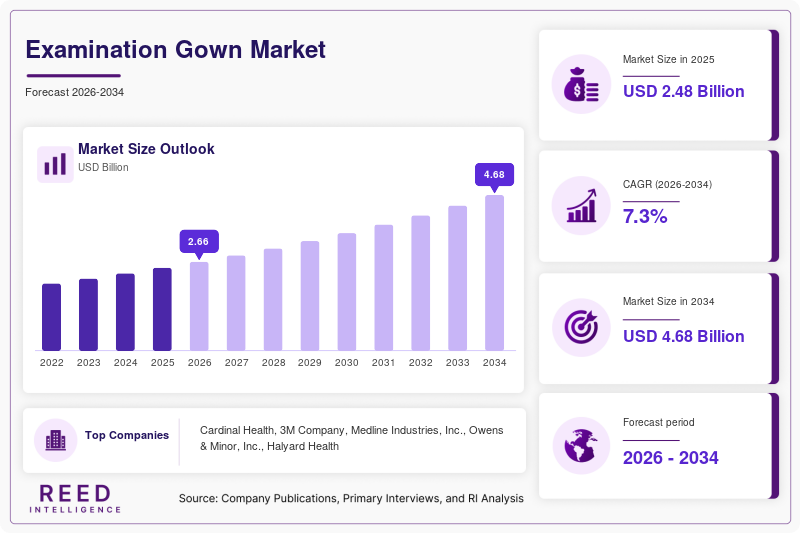
The Examination Gown Market size was valued at USD 2.48 billion in 2026 and is projected to reach USD 4.36 billion by 2034, expanding at a CAGR of 7.3% during the forecast period (2026–2034). The market is experiencing steady growth due to the increasing emphasis on infection prevention and control across healthcare facilities worldwide. Examination gowns are widely used in hospitals, clinics, and diagnostic centers to maintain hygiene standards and protect both patients and healthcare professionals.
A key global factor supporting the growth of the Examination Gown Market is the rising awareness of healthcare-associated infections (HAIs). Governments and healthcare institutions are implementing stricter safety protocols, leading to increased adoption of disposable and reusable examination gowns across medical settings.
Key Highlights
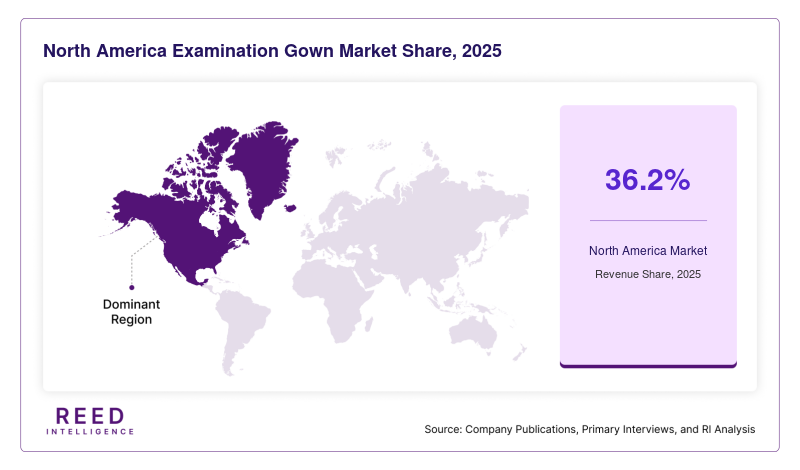
- Dominant region: North America held 36.2% market share in 2025, while Asia Pacific is projected to grow fastest at a CAGR of 8.5% (2026–2034).
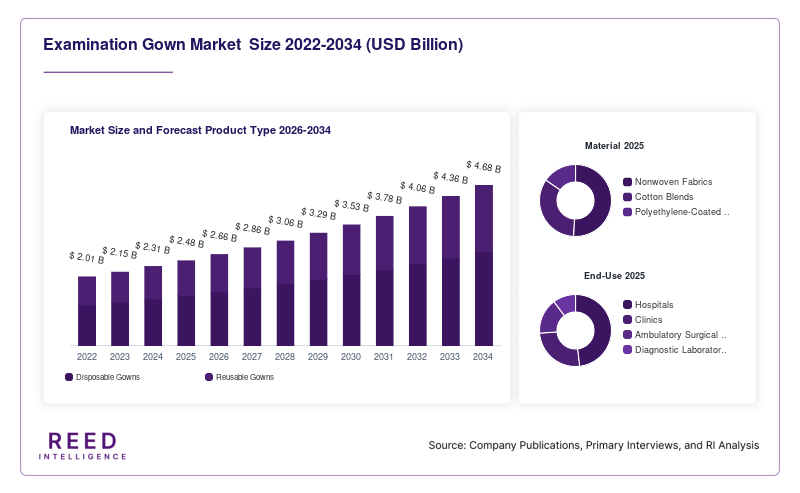
- Leading subsegments: Disposable gowns dominated the type segment with 64.5% share in 2025, while reusable gowns are expected to grow fastest at a CAGR of 8.1%.
- Material insights: Nonwoven materials accounted for 58.9% share in 2025, while polyethylene-coated fabrics are projected to grow at a CAGR of 8.4%.
- End-use insights: Hospitals held 52.3% share in 2025, while ambulatory surgical centers are expected to grow at a CAGR of 8.7%.
- Dominant country: The U.S. market was valued at USD 598 million in 2024 and USD 631 million in 2025.
Market Trends
Sustainability Shift Toward Reusable Gowns
Healthcare providers are increasingly adopting reusable examination gowns to reduce medical waste and operational costs. Advances in fabric durability and sterilization techniques are supporting this transition, particularly in developed healthcare systems.
Integration of Advanced Barrier Technologies
Manufacturers are incorporating multilayer fabrics and fluid-resistant coatings to improve protection levels. These innovations are enhancing gown performance in high-risk environments, driving demand for technologically advanced products.
Market Drivers
Rising Focus on Infection Control Practices
The increasing implementation of infection prevention protocols across healthcare facilities is driving the demand for examination gowns. Hospitals and clinics are prioritizing protective apparel to minimize cross-contamination risks.
Growth in Healthcare Infrastructure
Expansion of healthcare facilities, especially in emerging economies, is fueling demand for examination gowns. The establishment of new hospitals, diagnostic centers, and outpatient clinics is contributing to market growth.
Market Restraint
Environmental Concerns Related to Disposable Gowns
The extensive use of disposable examination gowns generates significant medical waste. Environmental concerns and regulatory pressures regarding waste management are restraining market growth to some extent.
Market Opportunities
Expansion in Emerging Healthcare Markets
Developing regions are witnessing rapid growth in healthcare investments, creating opportunities for manufacturers to expand their footprint and cater to increasing demand.
Development of Eco-Friendly Materials
The introduction of biodegradable and recyclable gown materials presents new opportunities for sustainable product innovation and market expansion.
Segmental Analysis
By Type
The Examination Gown Market is segmented into disposable gowns and reusable gowns.
- Dominant Subsegment: Disposable gowns held 64.5% share in 2025 due to their convenience and widespread use in infection control.
- Fastest-Growing Subsegment: Reusable gowns are expected to grow at a CAGR of 8.1%, driven by sustainability initiatives and cost efficiency.
By Material
The market includes nonwoven fabrics, cotton blends, and polyethylene-coated materials.
- Dominant Subsegment: Nonwoven materials accounted for 58.9% share in 2025 due to their lightweight and cost-effective properties.
- Fastest-Growing Subsegment: Polyethylene-coated materials are projected to grow at a CAGR of 8.4%, supported by enhanced barrier protection.
By End-Use
Segments include hospitals, clinics, ambulatory surgical centers, and diagnostic laboratories.
- Dominant Subsegment: Hospitals held 52.3% share in 2025 due to high patient volume and strict safety protocols.
- Fastest-Growing Subsegment: Ambulatory surgical centers are expected to grow at a CAGR of 8.7%, driven by increasing outpatient procedures.
By Distribution Channel
The market is segmented into direct sales and distributors.
- Dominant Subsegment: Direct sales accounted for 61.8% share in 2025 due to strong supplier relationships with healthcare institutions.
- Fastest-Growing Subsegment: Distributors are projected to grow at a CAGR of 7.9%, supported by expanding supply networks.
Regional Analysis
North America
North America accounted for 36.2% of the Examination Gown Market share in 2025. The region is expected to grow at a CAGR of 6.9% during 2026–2034. The United States dominated the region due to advanced healthcare infrastructure and strict infection control standards.
Europe
Europe held 28.4% market share in 2025 and is projected to grow at a CAGR of 6.7%. Germany emerged as the dominant country, supported by strong regulatory frameworks and increasing healthcare expenditure.
Asia Pacific
Asia Pacific represented 21.6% share in 2025 and is anticipated to grow at the fastest CAGR of 8.5%. China led the regional market due to expanding healthcare facilities and increasing awareness of hygiene standards.
Middle East & Africa
The region captured 7.1% market share in 2025 and is expected to grow at a CAGR of 6.4%. Saudi Arabia dominated due to rising healthcare investments and infrastructure development.
Latin America
Latin America accounted for 6.7% share in 2025 and is forecast to grow at a CAGR of 6.6%. Brazil led the region, driven by improving healthcare access and growing demand for medical protective equipment.
Competitive Landscape
The Examination Gown Market is moderately competitive, with key players focusing on product innovation, regulatory compliance, and geographic expansion. Cardinal Health is recognized as a leading player, leveraging its extensive distribution network and strong product portfolio. The company recently introduced advanced fluid-resistant gowns to enhance protection in clinical settings.
Other prominent players include 3M Company, Medline Industries, Inc., Owens & Minor, Inc., and Halyard Health. These companies are actively investing in research and development to improve material performance and sustainability. Strategic partnerships and mergers are also shaping the competitive landscape, enabling companies to expand their market presence.
Manufacturers are increasingly focusing on eco-friendly solutions and reusable products to address environmental concerns. Additionally, efforts to strengthen supply chains and ensure consistent product availability are influencing competitive strategies in the global market.
Key Players List
- Cardinal Health
- 3M Company
- Medline Industries, Inc.
- Owens & Minor, Inc.
- Halyard Health
- Kimberly-Clark Corporation
- Mölnlycke Health Care AB
- Paul Hartmann AG
- Ansell Limited
- Superior Uniform Group
- Lakeland Industries, Inc.
- Alpha Pro Tech, Ltd.
- TIDI Products, LLC
- Priontex
- Standard Textile Co., Inc.
Recent Developments
- In 2025, Cardinal Health launched a new line of fluid-resistant examination gowns for improved safety.
- Medline Industries expanded its manufacturing capacity to meet rising global demand.
- 3M Company introduced innovative material technologies for enhanced barrier protection.
- Owens & Minor strengthened its distribution network across North America and Europe.
- Mölnlycke Health Care AB focused on developing sustainable and reusable gown solutions.
Examination Gown Market Segments
Product Type
- Disposable Gowns
- Reusable Gowns
Material
- Nonwoven Fabrics
- Cotton Blends
- Polyethylene-Coated Materials
End-Use
- Hospitals
- Clinics
- Ambulatory Surgical Centers
- Diagnostic Laboratories
Distribution Channel
- Direct Sales
- Distributors
By Region
- North America
- Europe
- APAC
- Middle East and Africa
- LATAM