Executive Search Market Size, Share & Trends Analysis Report by Search Type, Function Level, End-User, Industry Vertical, and Region, Forecasts, 2026–2034
USD 3950
Executive Search Market Size
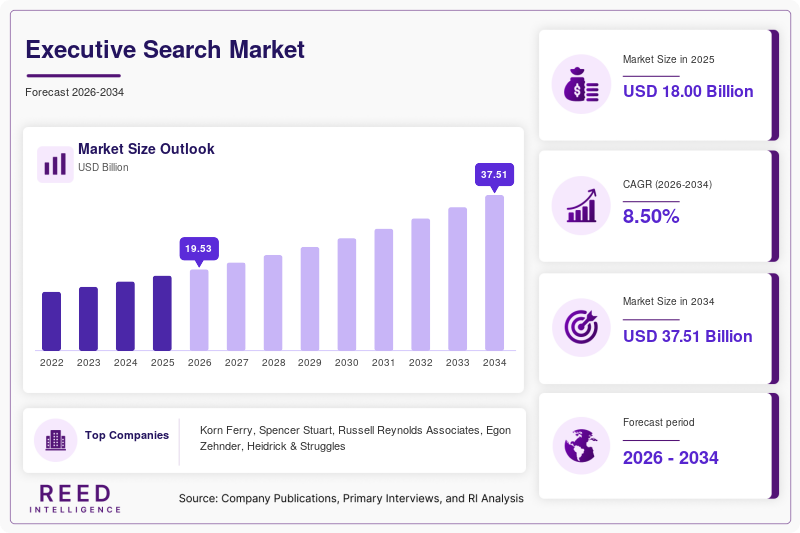
The global executive search market size was valued at USD 18.00 billion in 2025 and is projected to grow from USD 19.53 billion in 2026 to USD 37.51 billion by 2034, registering a CAGR of 8.50% during the forecast period from 2026 to 2034.
The executive search market comprises specialized talent acquisition services that help organizations identify, assess, and recruit senior executives and other high-impact leadership professionals. These services commonly cover chief executive officers, chief financial officers, chief operating officers, board-level appointments, functional heads, and senior leaders in technology, finance, healthcare, manufacturing, and other industries. Unlike high-volume recruitment, executive search typically involves confidential candidate mapping, targeted outreach, leadership assessment, and close consultation with the client organization.
Demand is shaped by leadership succession, business transformation, international expansion, mergers and acquisitions, digitalization, and competition for specialized management talent. Organizations use external executive search firms when a position requires access to passive candidates, discretion, or a search process beyond the reach of internal recruitment teams. Retained search remains an established model for complex senior appointments, while contingency and hybrid arrangements serve different hiring requirements and fee structures.
Executive Search Market Drivers
Increasing Demand for Experienced Executive Leadership
Organizations face leadership requirements shaped by business expansion, succession planning, restructuring, digital transformation, and changing competitive conditions. Executive search firms help employers reach senior candidates who may not be actively seeking new positions. Their access to established leadership networks and ability to conduct confidential searches make them relevant for board, C-suite, and other strategic appointments. Demand can be especially strong when a vacancy carries significant operational, financial, or governance responsibilities.
Digital Transformation and Specialized Leadership Requirements
The adoption of artificial intelligence, cloud computing, cybersecurity, data analytics, and automation is changing the capabilities expected of senior leaders. Employers increasingly seek executives who can connect technology investments with business performance, manage organizational change, and develop specialist teams. Executive search firms with established technology and functional practices can support these searches by assessing both technical knowledge and leadership experience.
Globalization and Organizational Expansion
Companies entering new markets need leaders with regional knowledge, cross-cultural management skills, and experience navigating different regulatory and commercial environments. Executive search firms provide access to candidates across geographies and help organizations evaluate leadership experience against local market requirements. International assignments, private-equity investments, acquisitions, and regional expansion strategies can create demand for senior recruitment and board advisory services.
Executive Search Market Restraints
High Service Fees and Extended Search Timelines
Executive search involves research, candidate engagement, interviews, assessment, client consultation, and often several rounds of evaluation. These activities can make the service expensive compared with standard recruitment channels. Clients with limited hiring budgets may defer leadership appointments, conduct searches internally, or use alternative recruitment arrangements. Searches for highly specialized or confidential roles may also take longer when the eligible candidate pool is limited.
Competition from Internal Recruitment and Digital Platforms
Large organizations increasingly use internal talent acquisition teams, professional networks, talent databases, and recruitment technology to identify candidates. These resources may reduce the need for external firms for some roles, particularly where organizations already have strong internal leadership pipelines. Executive search providers must therefore demonstrate the value of their specialist networks, assessment expertise, confidentiality, and ability to reach candidates who are not readily accessible through conventional channels.
Executive Search Market Opportunities
Expansion of AI and Technology Leadership Searches
Businesses developing AI products, implementing automation, and strengthening cybersecurity need leaders who understand emerging technologies and their commercial implications. Executive search firms can expand specialist practices focused on AI, machine learning, data, digital product development, and technology governance. This opportunity depends on firms maintaining current industry knowledge and access to credible candidates with relevant leadership experience.
Leadership Advisory and Succession Planning
Executive search providers can expand beyond candidate placement into leadership assessment, succession planning, board effectiveness, executive onboarding, and organizational advisory. Integrating these services allows firms to support clients before, during, and after a leadership transition. It can also support longer-term client relationships where leadership needs recur across several functions or geographies.
Executive Search Market Segmental Analysis
By Search Type
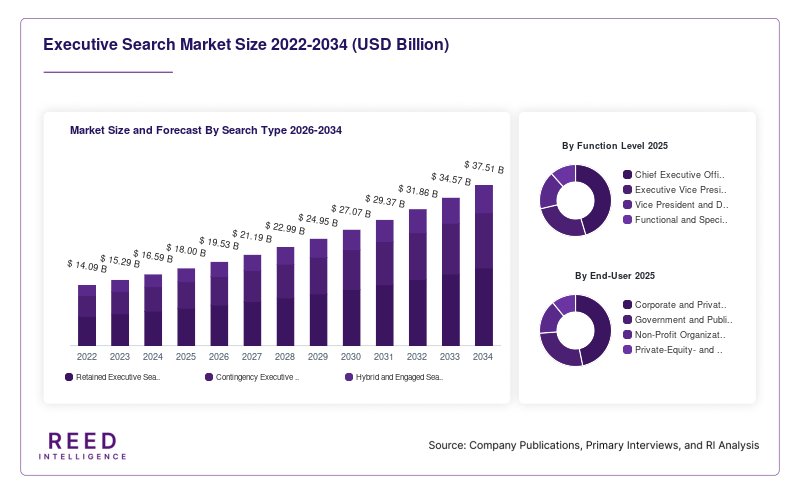
Retained executive search is an established model for senior, confidential, and strategically important appointments. Under this arrangement, a client generally engages a search firm for a defined mandate, with fees structured around the engagement rather than solely around a successful placement. The model supports extensive research, targeted candidate outreach, assessment, and client consultation. Its use is particularly relevant for C-suite and board-level appointments where the cost of a poor hiring decision can be substantial.
Contingency executive search generally links payment to successful placement and may be used where clients prefer a success-based fee structure. Hybrid and engaged search combine elements of retained and contingent approaches, with arrangements varying by provider and client. The choice of model depends on the role’s seniority, urgency, exclusivity, candidate availability, and the depth of research required. A definitive numerical market-share leader among these models is not established by the supplied market figures.
By Function Level
C-suite and board-level recruitment covers positions such as chief executive officer, chief financial officer, chief operating officer, chief technology officer, and other enterprise-wide leadership roles. These searches require assessment of strategic judgment, governance experience, financial responsibility, leadership capability, and organizational fit. Confidentiality and stakeholder alignment are often important because these appointments can influence corporate strategy and investor confidence.
Vice president, director-level, and specialist leadership searches address senior roles within individual functions or business units. Demand may arise from the creation of new functions, leadership succession, geographic expansion, and changes in operating models. Roles in AI, cybersecurity, data, risk, sustainability, and digital transformation may require particularly specialized candidate assessment. A numerical ranking of function-level segments by market share or CAGR cannot be confirmed from the supplied market-size data alone.
By End-User
Corporate and private-sector organizations use executive search for leadership succession, expansion, restructuring, and the recruitment of executives with specialized industry knowledge. Large multinational businesses may need global candidate coverage, while smaller or investor-backed companies may require leaders experienced in scaling operations, managing capital, and preparing businesses for new growth stages.
Government and public-sector bodies may use executive search for senior administrative, institutional, and specialist leadership appointments, subject to the applicable recruitment and procurement rules. Non-profit organizations and NGOs may require leaders with experience in governance, fundraising, program management, and stakeholder engagement. Private-equity- and venture-backed firms often seek executives who can lead growth, manage transformation, and meet defined investment or operational objectives. The largest end-user segment by share is not numerically verified for the supplied market estimate.
By Industry Vertical
Technology and digital services require leadership in areas such as software, AI, cybersecurity, cloud platforms, and digital product development. Financial services generate demand for executives in banking, investment management, risk, compliance, and financial technology. Life sciences and healthcare require leaders who understand scientific innovation, clinical or healthcare operations, quality systems, and regulation.
Industrial and manufacturing organizations seek leaders in operations, engineering, supply chains, industrial technology, and international business management. Consumer and retail businesses may recruit executives in omnichannel commerce, brand strategy, marketing, and customer experience. Professional and business services use executive search for leadership positions requiring client management, specialized expertise, and business development. Although technology leadership has attracted focused search activity, the fastest-growing industry vertical cannot be conclusively identified from the supplied market data.
Executive Search Market Regional Analysis
North America Executive Search Market
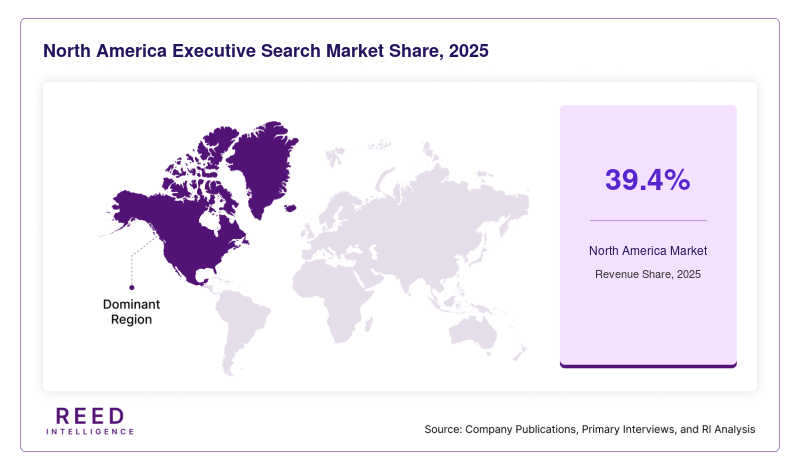
North America is identified as the leading regional market in the TrendX Insights estimate, which reports a 39.40% share of global revenue in 2025. The region benefits from an established corporate sector, a concentration of major executive search firms, active private-equity markets, and demand for senior leadership across technology, financial services, healthcare, and industrial businesses. The United States is a major center for board and C-suite recruitment, while Canada contributes demand across financial services, technology, natural resources, and professional services. The reported 39.40% is a third-party estimate and should be interpreted in the context of that publisher’s market definition.
The region’s executive search activity is influenced by leadership transitions, digital transformation, mergers and acquisitions, and demand for executives with experience in complex or regulated environments. Search firms also face competition from internal recruitment teams and technology-enabled talent platforms. North America’s exact forecast CAGR for this specific market estimate is not established by the supplied data; therefore, a numerical regional growth rate is not assigned here.
Europe Executive Search Market
Europe has an established executive search sector serving multinational companies, family-owned businesses, financial institutions, industrial groups, and professional services organizations. The United Kingdom, Germany, France, Switzerland, and other major business centers generate demand for senior appointments across financial services, manufacturing, technology, healthcare, and consumer markets. Cross-border recruitment is relevant because organizations may need leaders who can operate across multiple countries and business cultures.
Regional demand is influenced by succession planning, board governance, organizational restructuring, digital transformation, and the need for leaders with international operating experience. Differences in employment regulation, language, compensation structures, and corporate governance can make regional knowledge valuable in candidate assessment. A verified market-share percentage and forecast CAGR for Europe under the supplied USD 18.00 billion market baseline are not available from the cited data.
Asia Pacific Executive Search Market
Asia Pacific is a significant executive search market, supported by corporate expansion, the development of regional business hubs, and increasing demand for leaders across technology, financial services, manufacturing, healthcare, and consumer industries. China, India, Japan, Australia, Singapore, and South Korea have different hiring conditions, but multinational and domestic businesses alike may require executives who can manage growth, transformation, and cross-border operations.
TrendX Insights identifies Asia Pacific as the fastest-growing region in its published outlook, reporting a 11.20% CAGR for 2025–2034. This is the publisher’s estimate, not an independently established growth rate for every executive search market definition. Regional opportunities include technology leadership, succession planning, and executive appointments associated with international investment. The precise regional market share is not established by the supplied market-size data.
Latin America Executive Search Market
Latin America’s executive search market serves companies operating in financial services, consumer industries, manufacturing, energy, technology, and professional services. Brazil and Mexico are important business centers, while other countries contribute demand according to their corporate structures and sector specializations. Executive recruitment may support market expansion, regional management, operational improvement, and leadership changes in locally headquartered and multinational companies.
Demand can be affected by economic volatility, currency fluctuations, differences in labor markets, and variations in the size of the senior executive talent pool. Search providers with regional networks can help employers identify candidates with local expertise as well as experience managing international businesses. A reliable numerical share or forecast CAGR for Latin America matching the supplied global market valuation could not be verified.
Middle East & Africa Executive Search Market
The Middle East & Africa region includes executive search demand associated with financial services, energy, infrastructure, healthcare, government-linked organizations, and diversification initiatives. The Gulf Cooperation Council markets, including the United Arab Emirates and Saudi Arabia, attract leadership recruitment for expanding businesses and large transformation programs. African markets also require senior leaders in financial services, telecommunications, consumer industries, resources, and development-related organizations.
Search requirements vary substantially by country and sector. Clients may look for regional operating experience, regulatory familiarity, international management capabilities, and the ability to lead culturally diverse teams. Local talent development and succession planning can coexist with demand for international candidates. A verified market-share percentage and forecast CAGR for the region under the supplied market definition are not available from the cited sources.
Competitive Landscape
The executive search market is characterized by global search firms, specialist executive recruitment businesses, and regional boutiques. Competition is influenced by the strength of candidate networks, sector specialization, geographic reach, research capabilities, client relationships, and the quality of leadership assessment. Providers also compete through their understanding of organizational strategy and their ability to conduct confidential searches for high-impact positions.
Large firms can offer international coverage and access to multiple functional practices, while boutique firms may focus on particular industries, leadership functions, or geographies. Competition also comes from corporate talent acquisition teams and digital platforms that enable direct sourcing. As firms adopt AI-supported research and talent intelligence, they must continue to address data privacy, candidate consent, fairness, and the limits of automated evaluation.
Key Market Players
- Korn Ferry
- Spencer Stuart
- Russell Reynolds Associates
- Egon Zehnder
- Heidrick & Struggles
- Odgers
- ZRG
- Riviera Partners
- Hanover Search Group
- Boyden
- Hunt Scanlon
Recent Market Developments
June 24, 2026 - Riviera Partners acquired Lateral Labs. Riviera Partners announced the acquisition to expand its AI and machine-learning talent search capabilities. The announcement describes coverage spanning technical and leadership hiring for AI companies at different stages of growth.
April 9, 2026 ZRG acquired Howard Fischer Associates. The acquisition expanded ZRG’s executive and board search capabilities, including experience across technology, media, consumer and business services, and industrial sectors. ZRG said the integration would begin immediately while maintaining client continuity.
Executive Search Market Segments
By Search Type
- Retained Executive Search
- Contingency Executive Search
- Hybrid and Engaged Search
By Function Level
- Chief Executive Officer and C-Suite
- Executive Vice President and Senior Vice President
- Vice President and Director-Level Leadership
- Functional and Specialist Leadership Roles
By End-User
- Corporate and Private-Sector Organizations
- Government and Public-Sector Bodies
- Non-Profit Organizations and NGOs
- Private-Equity- and Venture-Backed Firms
By Industry Vertical
- Technology and Digital Services
- Financial Services
- Life Sciences and Healthcare
- Industrial and Manufacturing
- Consumer and Retail
- Professional and Business Services
- Other Industry Verticals
By Region
- North America
- Europe
- APAC
- Middle East and Africa
- LATAM