Exophthalmos Treatment Market Size, Share & Demand Report By Treatment Type (Corticosteroid Therapy, Biologic Therapies, Radiation Therapy), By Disease Indication (Thyroid Eye Disease, Orbital Tumors, Inflammatory Orbital Disorders), By Route of Administration (Injectable Therapies, Oral Therapies, Topical Therapies), By End User (Hospitals, Specialty Ophthalmology Clinics, Ambulatory Surgical Centers) By Region & Segment Forecasts, 2026–2034
USD 3950
Market Overview
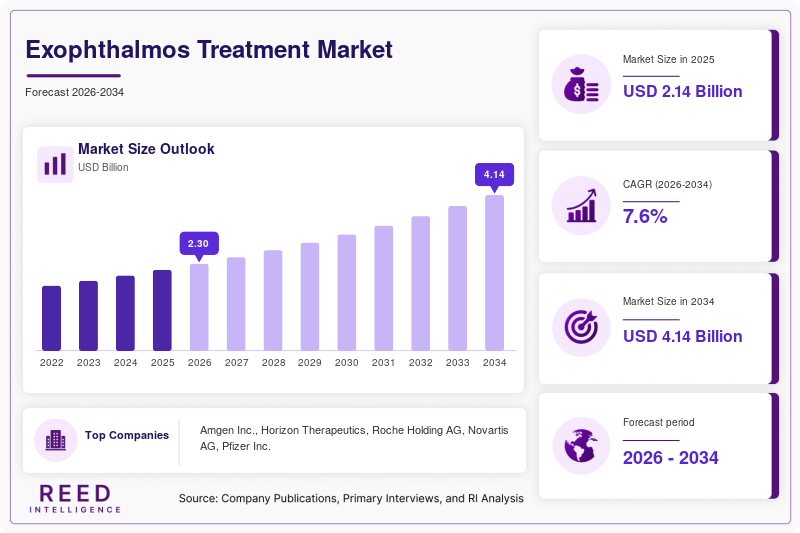
The Exophthalmos Treatment Market size was valued at USD 2.14 billion in 2026 and is projected to reach USD 3.86 billion by 2034, expanding at a CAGR of 7.6% during the forecast period of 2026–2034. The market growth has been supported by the increasing prevalence of thyroid-related disorders, particularly Graves’ disease, which remains one of the leading causes of exophthalmos worldwide. Rising awareness regarding early ophthalmic diagnosis and growing access to specialized endocrine care have further accelerated market expansion.
Exophthalmos, also referred to as proptosis, involves abnormal protrusion of the eyeball caused by inflammation, tumors, infections, or thyroid eye disease. The condition often requires multidisciplinary treatment involving endocrinologists, ophthalmologists, and orbital surgeons. Increasing healthcare expenditure and advancements in biologic therapies have significantly improved treatment outcomes for moderate and severe cases.
Key Highlights
- North America accounted for 39.8% of the global Exophthalmos Treatment Market share in 2025, while Asia Pacific is projected to witness the fastest CAGR of 8.4% during 2026–2034.
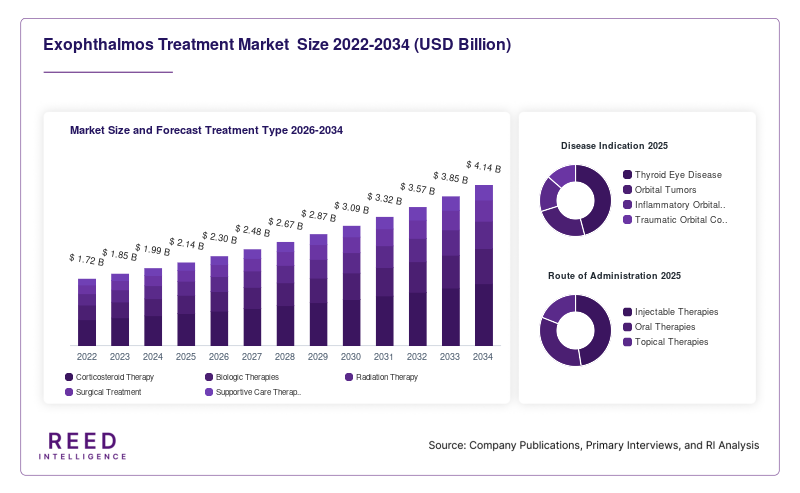
- By treatment type, corticosteroid therapy held the dominant share of 36.7% in 2025, whereas biologic therapies are anticipated to grow at the fastest CAGR of 9.1%.
- By disease indication, thyroid eye disease represented the leading segment with 58.9% market share in 2025, while inflammatory orbital disorders are expected to expand at a CAGR of 8.0%.
- By end user, hospitals accounted for 47.3% of the market share in 2025, whereas specialty ophthalmology clinics are forecast to register a CAGR of 8.5%.
- By route of administration, injectable treatments dominated with 44.8% share in 2025, while oral therapies are projected to grow at a CAGR of 7.9%.
- The United States remained the dominant country market and was valued at USD 682.5 million in 2024 and USD 731.8 million in 2025.
Market Trends
Rising Adoption of Biologic Therapies
The increasing use of biologic therapies has emerged as a major trend shaping the Exophthalmos Treatment Market. Biologics targeting inflammatory pathways associated with thyroid eye disease are gaining clinical acceptance due to their ability to reduce orbital inflammation and improve ocular function.
Healthcare providers are increasingly prescribing targeted immunotherapies for patients with moderate-to-severe disease progression. The trend has encouraged pharmaceutical companies to accelerate research activities focused on monoclonal antibodies and immune-modulating drugs designed for orbital inflammatory conditions.
Growing Preference for Minimally Invasive Surgical Procedures
Minimally invasive orbital decompression and corrective surgical procedures are becoming increasingly popular across ophthalmology centers. Surgeons are adopting advanced imaging-guided techniques to improve treatment precision and reduce recovery time for patients with severe exophthalmos.
Technological advancements in ophthalmic surgical tools and robotic-assisted procedures are also supporting this trend. Patients increasingly prefer minimally invasive interventions due to lower postoperative complications and improved cosmetic outcomes.
Market Drivers
Increasing Prevalence of Thyroid Eye Disease
The rising prevalence of thyroid-related autoimmune disorders has significantly driven the Exophthalmos Treatment Market. Graves’ disease continues to remain a major contributor to orbital inflammation and eye protrusion globally.
Lifestyle-related hormonal imbalances, increasing stress levels, and improved disease screening programs have contributed to a higher diagnosis rate of thyroid eye disease. Growing awareness regarding the importance of early treatment has further accelerated demand for advanced therapeutic solutions.
Expansion of Specialized Ophthalmic Care Infrastructure
The rapid expansion of specialty eye care centers and endocrinology clinics has strengthened market growth worldwide. Healthcare systems are increasingly investing in integrated ophthalmic treatment facilities capable of managing complex orbital disorders.
Improved access to specialized healthcare professionals and advanced diagnostic imaging technologies has supported early disease identification and treatment initiation. This trend continues to improve patient outcomes and increase treatment adoption rates.
Market Restraint
High Cost of Advanced Biologic Treatments
The high cost associated with biologic therapies and specialized orbital surgeries remains a major restraint for the Exophthalmos Treatment Market. Many advanced immunotherapy drugs involve substantial treatment expenses, limiting accessibility in cost-sensitive healthcare systems.
Patients in developing regions often face financial barriers due to limited insurance coverage and reimbursement challenges. These factors may restrict widespread adoption of advanced therapies in some markets.
Market Opportunities
Development of Personalized Immunotherapy Solutions
The growing focus on personalized medicine presents significant opportunities for the Exophthalmos Treatment Market. Pharmaceutical companies are increasingly developing targeted therapies tailored to individual inflammatory profiles and disease severity.
Personalized treatment approaches may improve therapeutic effectiveness while reducing adverse effects. Continued research into immune pathway modulation is expected to support future innovation within the market.
Increasing Teleophthalmology and Remote Monitoring Adoption
The expansion of teleophthalmology services is creating new opportunities for early diagnosis and treatment management. Remote monitoring technologies are enabling healthcare providers to track disease progression and improve patient follow-up efficiency.
Digital healthcare integration is expected to enhance treatment accessibility in underserved regions and improve coordination between ophthalmologists and endocrinologists. This trend may support broader market penetration over the forecast period.
Segmental Analysis
By Treatment Type
Based on treatment type, the Exophthalmos Treatment Market is segmented into corticosteroid therapy, biologic therapies, radiation therapy, surgical treatment, and supportive care therapies.
Corticosteroid therapy dominated the market with a 36.7% share in 2025 due to its widespread clinical usage for reducing inflammation and managing moderate disease symptoms. Physicians frequently prescribed corticosteroids because of their rapid anti-inflammatory effects and broad treatment accessibility.
Biologic therapies are expected to witness the fastest CAGR of 9.1% during the forecast period. Increasing clinical success rates and targeted immune modulation capabilities will support growing adoption among patients with severe thyroid eye disease. Pharmaceutical innovation is expected to strengthen segment expansion.
By Disease Indication
Based on disease indication, the market is categorized into thyroid eye disease, orbital tumors, inflammatory orbital disorders, and traumatic orbital conditions.
Thyroid eye disease accounted for the largest market share of 58.9% in 2025 owing to its high prevalence among autoimmune endocrine disorders. Increasing awareness regarding thyroid-related ocular complications supported strong treatment demand.
Inflammatory orbital disorders are projected to grow at a CAGR of 8.0% during 2026–2034. Rising diagnostic accuracy and expanding access to specialized orbital imaging technologies will contribute to increasing segment growth.
By Route of Administration
Based on route of administration, the Exophthalmos Treatment Market is segmented into injectable therapies, oral therapies, and topical therapies.
Injectable therapies held the dominant share of 44.8% in 2025 due to increasing utilization of biologic drugs and hospital-administered immunotherapy treatments. Healthcare providers preferred injectable formulations for managing severe inflammatory conditions requiring rapid therapeutic response.
Oral therapies are expected to register the fastest CAGR of 7.9% through 2034. Improved patient convenience and increasing availability of oral immunomodulatory drugs will support segment growth. Expanding outpatient treatment models are also expected to increase oral therapy adoption.
By End User
Based on end user, the market is divided into hospitals, specialty ophthalmology clinics, ambulatory surgical centers, and research institutes.
Hospitals dominated the market with a 47.3% share in 2025 due to the availability of multidisciplinary treatment teams and advanced imaging infrastructure. Complex orbital surgeries and biologic treatment administration were primarily conducted within hospital settings.
Specialty ophthalmology clinics are expected to witness the fastest CAGR of 8.5% during the forecast period. Growing patient preference for specialized eye care facilities and shorter consultation waiting times will support increasing segment demand. Expansion of private ophthalmology networks is expected to further accelerate growth.
Regional Analysis
North America
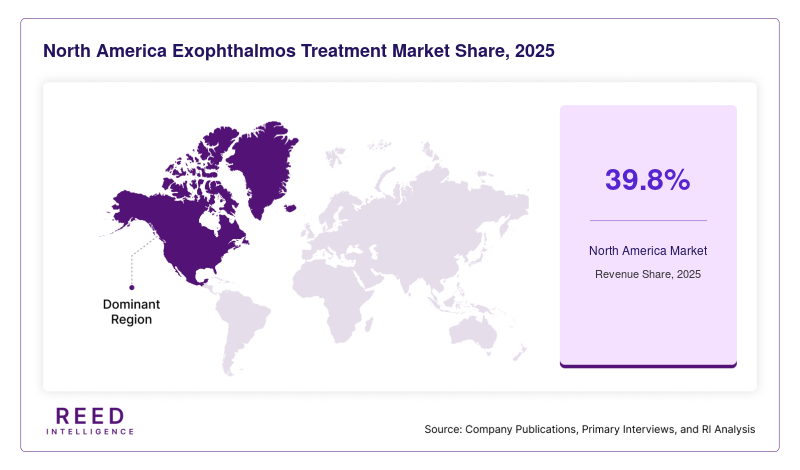
North America accounted for 39.8% of the global Exophthalmos Treatment Market share in 2025 and is projected to grow at a CAGR of 7.1% during 2026–2034. The region maintained a dominant position due to strong healthcare infrastructure and high adoption of advanced biologic therapies.
The United States remained the leading country market because of increasing prevalence of thyroid eye disease and growing availability of specialized ophthalmic treatment centers. Expanding investment in clinical research further supported regional market growth.
Europe
Europe represented 27.2% of the global Exophthalmos Treatment Market share in 2025 and is anticipated to expand at a CAGR of 7.0% during the forecast period. The region benefited from rising awareness regarding autoimmune eye disorders and increasing adoption of advanced diagnostic technologies.
Germany dominated the regional market owing to strong ophthalmology research capabilities and growing use of targeted immunotherapies in endocrine-related eye conditions. The country’s established healthcare reimbursement framework supported treatment accessibility.
Asia Pacific
Asia Pacific captured 21.9% of the global Exophthalmos Treatment Market share in 2025 and is forecast to witness the fastest CAGR of 8.4% through 2034. Rapid healthcare infrastructure expansion and increasing diagnosis rates contributed to regional market growth.
China emerged as the dominant country market due to rising healthcare expenditure and growing awareness regarding thyroid-related eye disorders. Expanding urban healthcare facilities and improving ophthalmic care access further supported treatment demand.
Middle East & Africa
Middle East & Africa accounted for 6.4% of the global Exophthalmos Treatment Market share in 2025 and is expected to grow at a CAGR of 7.3% during 2026–2034. Increasing healthcare modernization initiatives and growing specialty clinic networks supported regional development.
Saudi Arabia remained the dominant country market owing to rising investments in advanced healthcare infrastructure and increasing availability of specialized endocrine treatment services. Government-led healthcare transformation initiatives further accelerated market expansion.
Latin America
Latin America held 4.7% of the global Exophthalmos Treatment Market share in 2025 and is projected to expand at a CAGR of 6.8% during the study period. The region experienced steady growth due to increasing awareness regarding ocular inflammatory disorders and improving healthcare access.
Brazil led the regional market because of expanding ophthalmology services and rising diagnosis rates of autoimmune thyroid conditions. Investments in urban healthcare systems contributed to higher treatment adoption.
Competitive Landscape
The Exophthalmos Treatment Market remains moderately competitive with pharmaceutical companies and specialty healthcare providers focusing on targeted therapy development, biologic innovation, and strategic collaborations. Companies are increasingly investing in research programs aimed at improving treatment efficacy and reducing disease progression.
Amgen Inc. remained a leading participant due to its expanding biologic therapy portfolio and continued investment in inflammatory disease research. The company recently strengthened its ophthalmology-focused pipeline through clinical development initiatives targeting autoimmune orbital disorders.
Horizon Therapeutics continued to expand its thyroid eye disease treatment portfolio through biologic therapy commercialization strategies. Roche Holding AG focused on immunology-based therapeutic development, while Novartis AG strengthened its ophthalmic research collaborations. Pfizer Inc. emphasized advanced inflammatory disease treatment programs and global market expansion initiatives.
Key Players List
- Amgen Inc.
- Horizon Therapeutics
- Roche Holding AG
- Novartis AG
- Pfizer Inc.
- AbbVie Inc.
- Johnson & Johnson
- Sanofi S.A.
- Bausch Health Companies Inc.
- Regeneron Pharmaceuticals Inc.
- Eli Lilly and Company
- Merck & Co., Inc.
- Bayer AG
- Takeda Pharmaceutical Company Limited
- AstraZeneca plc
Recent Developments
- In 2025, Amgen Inc. expanded its autoimmune ophthalmology research pipeline focused on targeted biologic therapies.
- In 2024, Horizon Therapeutics strengthened commercialization strategies for thyroid eye disease treatment products across global markets.
- In 2025, Novartis AG increased investments in ophthalmology-focused immunotherapy clinical trials.
- In 2024, Pfizer Inc. announced research collaborations targeting inflammatory orbital disease therapies.
- In 2025, Roche Holding AG expanded biologic drug development initiatives for autoimmune inflammatory disorders.
Exophthalmos Treatment Market Segments
Treatment Type
- Corticosteroid Therapy
- Biologic Therapies
- Radiation Therapy
- Surgical Treatment
- Supportive Care Therapies
Disease Indication
- Thyroid Eye Disease
- Orbital Tumors
- Inflammatory Orbital Disorders
- Traumatic Orbital Conditions
Route of Administration
- Injectable Therapies
- Oral Therapies
- Topical Therapies
End User
- Hospitals
- Specialty Ophthalmology Clinics
- Ambulatory Surgical Centers
- Research Institutes
By Region
- North America
- Europe
- APAC
- Middle East and Africa
- LATAM