Exterior Foils Market Size, Share & Demand Report By Material Type (PVC Exterior Foils, Acrylic Exterior Foils, Fluoropolymer Foils, Polypropylene Foils), By Application (Windows and Doors, Facade Cladding, Outdoor Furniture, Balconies and Railings, Garage Doors), By End Use (Residential Construction, Commercial Infrastructure, Industrial Buildings), By Finish Type (Matte Finish, Gloss Finish, Textured Finish), By Region & Segment Forecasts, 2026–2034
USD 3950
Market Overview
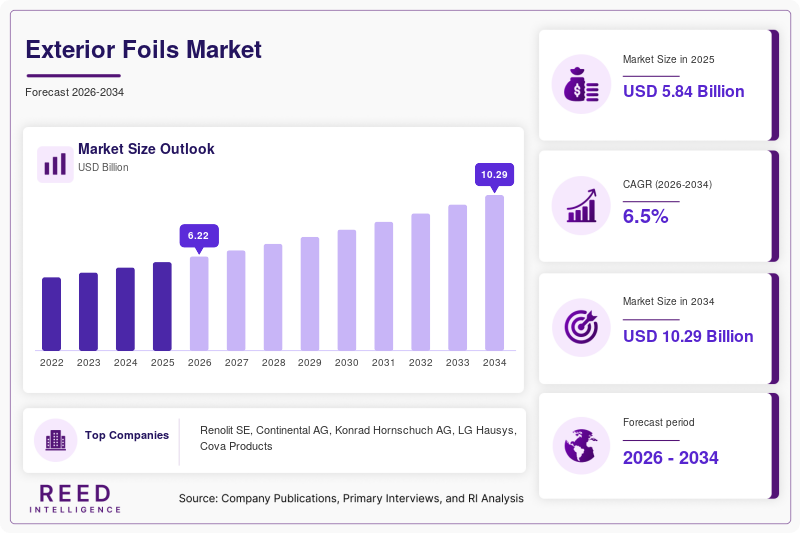
The global Exterior Foils Market was valued at approximately USD 5.84 billion in 2026 and is projected to reach USD 9.67 billion by 2034, expanding at a CAGR of 6.5% during the forecast period from 2026 to 2034. The market growth has been supported by increasing construction and renovation activities across residential and commercial infrastructure projects worldwide. Rising preference for durable, weather-resistant, and aesthetically appealing exterior surface materials has accelerated the adoption of exterior foils across doors, windows, facades, and outdoor furniture applications.
The Exterior Foils Market has gained momentum due to growing demand for low-maintenance decorative materials capable of withstanding harsh environmental conditions. Manufacturers are increasingly developing advanced polymer-based foils with UV resistance, thermal stability, and enhanced scratch protection to address evolving consumer and industrial requirements. In addition, the expansion of sustainable building practices has encouraged the use of recyclable and energy-efficient foil materials in modern construction applications.
Key Highlights
- Europe accounted for 36.4% of the global Exterior Foils Market share in 2025, while Asia Pacific is projected to register the fastest CAGR of 7.9% during 2026–2034.
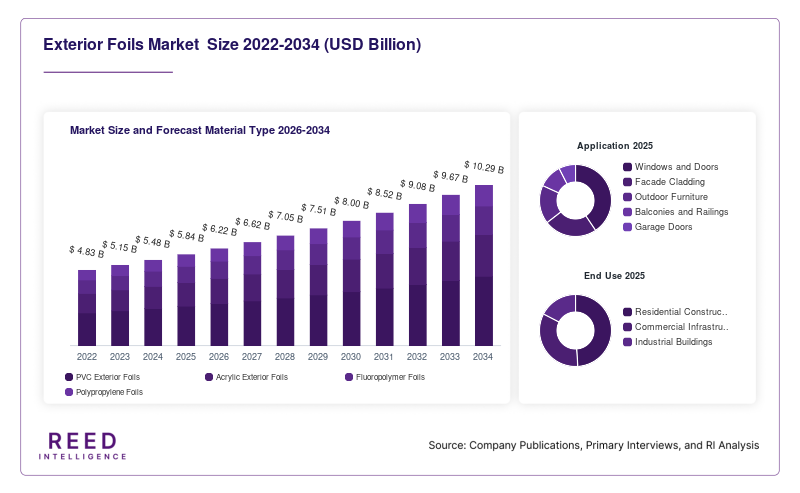
- By material type, PVC exterior foils dominated the market with a 48.7% share in 2025, while fluoropolymer foils are expected to grow at a CAGR of 8.5%.
- By application, windows and doors represented the leading segment with 41.2% market share in 2025, whereas facade cladding applications are forecast to expand at a CAGR of 8.1%.
- By end use, residential construction held 57.6% of the market share in 2025, while commercial infrastructure is projected to grow at a CAGR of 7.4%.
- Germany remained the dominant country market, valued at USD 712 million in 2024 and USD 748 million in 2025.
Market Trends
Rising Adoption of Sustainable Decorative Materials
Sustainability has become a major trend shaping the Exterior Foils Market. Construction companies and property developers are increasingly adopting recyclable and environmentally compatible exterior finishing materials to align with green building initiatives. Manufacturers are introducing low-emission foils with reduced volatile organic compound content and improved recyclability.
This trend has encouraged innovation in bio-based polymer technologies and energy-efficient production methods. Demand for eco-friendly exterior materials is expected to continue increasing as environmental regulations become stricter across developed economies.
Growing Preference for Wood-Texture and Matte Finishes
Consumers and architects are increasingly favoring natural-looking exterior designs for residential and commercial buildings. This trend has boosted demand for wood-grain textures, matte finishes, and premium decorative patterns in the Exterior Foils Market. Advanced printing technologies now allow manufacturers to replicate realistic wood and metal appearances while maintaining the durability of polymer-based foils.
The trend is particularly strong in modern urban housing projects where visually appealing exteriors are becoming an important factor in property value enhancement.
Market Drivers
Expansion of Global Construction Activities
The growth of residential and commercial construction projects has significantly contributed to the expansion of the Exterior Foils Market. Rapid urban development and infrastructure investments have increased the installation of windows, facades, doors, and outdoor decorative surfaces that utilize exterior foils for protection and aesthetics.
Government-backed housing programs and rising private real estate investments have further strengthened product demand across emerging and developed economies.
Increasing Demand for Weather-Resistant Materials
Exterior surfaces are continuously exposed to sunlight, moisture, temperature fluctuations, and pollution. As a result, builders and manufacturers are increasingly selecting high-performance foil materials capable of delivering long-term durability and appearance retention. The Exterior Foils Market has benefited from rising adoption of UV-resistant and scratch-resistant materials in modern construction applications.
Demand for maintenance-efficient building materials has also increased among homeowners and commercial property managers, supporting broader market expansion.
Market Restraint
Volatility in Raw Material Prices
The Exterior Foils Market faces challenges related to fluctuations in polymer and chemical raw material prices. Variations in crude oil prices and supply chain disruptions can increase production costs for manufacturers. These pricing uncertainties may affect profit margins and limit adoption among cost-sensitive construction projects.
Market Opportunities
Development of Smart Surface Technologies
The emergence of smart exterior materials presents new opportunities for the Exterior Foils Market. Manufacturers are exploring advanced foil technologies with self-cleaning, anti-bacterial, and heat-reflective properties. These innovations are expected to gain attention in energy-efficient and premium construction projects.
Growth in Modular Construction Industry
The increasing popularity of modular and prefabricated construction systems is creating opportunities for foil manufacturers. Exterior foils are widely used in prefabricated wall panels, modular housing units, and factory-finished building components because of their lightweight properties and installation efficiency.
Segmental Analysis
By Material Type
PVC Exterior Foils Dominated the Market
PVC exterior foils held 48.7% of the Exterior Foils Market share in 2025. Their dominance was attributed to strong durability, moisture resistance, and cost efficiency. Manufacturers widely adopted PVC foils for doors, windows, and facade systems due to their compatibility with diverse architectural designs.
Fluoropolymer Foils to Witness Fastest Growth
Fluoropolymer foils are projected to expand at a CAGR of 8.5% through 2034. Growth will be driven by increasing demand for premium weather-resistant materials in high-rise commercial buildings. Their superior UV stability and chemical resistance are expected to support broader adoption.
By Application
Windows and Doors Segment Held Largest Share
Windows and doors accounted for 41.2% of the Exterior Foils Market share in 2025 due to increasing installation of decorative and protective surface materials in residential buildings. Exterior foils improved durability and reduced maintenance requirements for modern window systems.
Facade Cladding Applications to Grow Rapidly
Facade cladding applications are forecast to grow at a CAGR of 8.1% during the forecast period. Growth will be supported by increasing demand for visually appealing and thermally efficient building exteriors in urban commercial developments.
By End Use
Residential Construction Dominated the Market
Residential construction represented 57.6% of the Exterior Foils Market share in 2025. Rising housing projects and renovation activities supported widespread use of exterior foils in doors, windows, balconies, and outdoor decorative surfaces.
Commercial Infrastructure to Register Strong Growth
Commercial infrastructure is expected to expand at a CAGR of 7.4% through 2034. Growth will be driven by increasing construction of office buildings, shopping centers, hotels, and institutional facilities requiring durable decorative exterior materials.
By Finish Type
Matte Finish Segment Led the Market
Matte finish exterior foils captured 46.3% of the market share in 2025 because of rising consumer preference for contemporary architectural aesthetics. Matte surfaces offered improved scratch concealment and premium visual appeal.
Textured Finish Segment to Expand Significantly
Textured finish foils are anticipated to grow at a CAGR of 7.7% during the forecast period. Their growth will be supported by increasing demand for wood-grain and natural-looking decorative surfaces in residential and hospitality applications.
Regional Analysis
North America
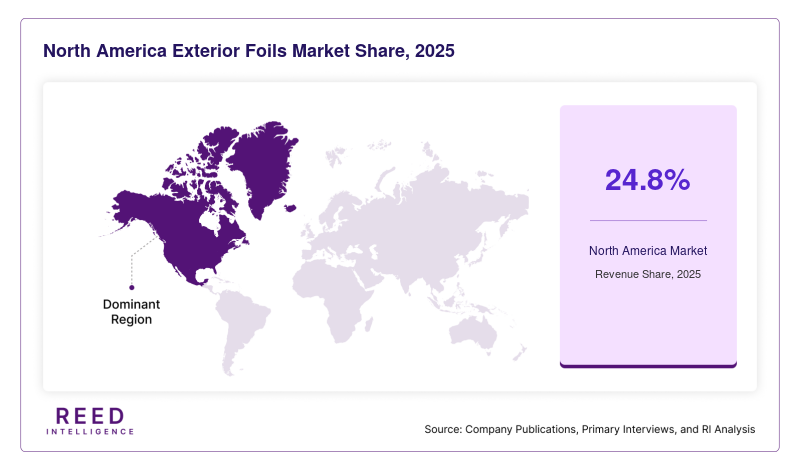
North America held 24.8% of the global Exterior Foils Market share in 2025 and will grow at a CAGR of 5.8% through 2034. The regional market expanded steadily because of rising residential remodeling activities and increasing adoption of decorative exterior surfaces in urban housing projects.
The United States dominated the region due to strong demand for energy-efficient building materials and advanced exterior renovation solutions. Increasing investments in premium residential construction also supported product adoption.
Europe
Europe accounted for 36.4% of the Exterior Foils Market share in 2025 and will expand at a CAGR of 6.1% during the forecast period. The region maintained its leading position due to extensive adoption of exterior foils in architectural renovation and facade modernization projects.
Germany emerged as the dominant country because of strong manufacturing capabilities and rising use of decorative foils in high-performance window systems. Growing emphasis on sustainable construction materials further supported regional demand.
Asia Pacific
Asia Pacific represented 22.6% of the global Exterior Foils Market share in 2025 and will witness the fastest CAGR of 7.9% through 2034. Rapid urbanization and infrastructure development projects accelerated the demand for decorative and protective exterior materials across the region.
China led the regional market due to large-scale residential construction activities and increasing investments in modern commercial buildings. Expansion of domestic manufacturing facilities also contributed to market growth.
Middle East & Africa
Middle East & Africa captured 9.1% of the Exterior Foils Market share in 2025 and will grow at a CAGR of 5.7% through 2034. Increasing commercial infrastructure projects and tourism-related developments contributed to market expansion.
Saudi Arabia dominated the regional market because of rising smart city projects and large-scale urban development initiatives. Demand for weather-resistant construction materials remained strong due to harsh climatic conditions.
Latin America
Latin America accounted for 7.1% of the global Exterior Foils Market share in 2025 and will register a CAGR of 5.4% during the forecast period. The regional market experienced stable growth because of increasing investments in residential housing and public infrastructure modernization.
Brazil remained the dominant country due to growth in urban construction activities and rising use of decorative exterior finishing materials in residential projects.
Competitive Landscape
The Exterior Foils Market remains moderately competitive, with manufacturers focusing on product innovation, sustainable materials, and geographic expansion strategies. Companies are investing in advanced printing technologies and high-performance polymer coatings to strengthen their product portfolios.
Renolit SE remained one of the leading companies in the Exterior Foils Market due to its broad decorative foil portfolio and strong presence in architectural applications. The company recently expanded its exterior foil manufacturing capabilities to address growing demand for weather-resistant facade materials.
Continued investment in recyclable materials and advanced surface technologies is expected to intensify competition among global and regional manufacturers.
Key Players List
- Renolit SE
- Continental AG
- Konrad Hornschuch AG
- LG Hausys
- Cova Products
- Alkor Draka
- Kuraray Co., Ltd.
- Avery Dennison Corporation
- 3M Company
- Eastman Chemical Company
- Omnova Solutions
- BASF SE
- Teijin Limited
- DuPont
- Mitsubishi Chemical Group
Exterior Foils Market Segments
Material Type
- PVC Exterior Foils
- Acrylic Exterior Foils
- Fluoropolymer Foils
- Polypropylene Foils
Application
- Windows and Doors
- Facade Cladding
- Outdoor Furniture
- Balconies and Railings
- Garage Doors
End Use
- Residential Construction
- Commercial Infrastructure
- Industrial Buildings
Finish Type
- Matte Finish
- Gloss Finish
- Textured Finish
By Region
- North America
- Europe
- APAC
- Middle East and Africa
- LATAM