Extra Neutral Alcohol (ENA) Market Size, Share & Trends Analysis Report By Feedstock Type (Molasses-Based, Grain-Based, Sugarcane Juice/Syrup-Based, Other Feedstocks), By Application (Alcoholic Beverages, Pharmaceuticals, Flavors & Fragrance), By Grade (Beverage Grade, Pharmaceutical Grade, Industrial Grade), By Distribution Channel (Direct Sales, Distributors & Traders) Forecasts, 2026-2034
USD 3950
Extra Neutral Alcohol (ENA) Market Size
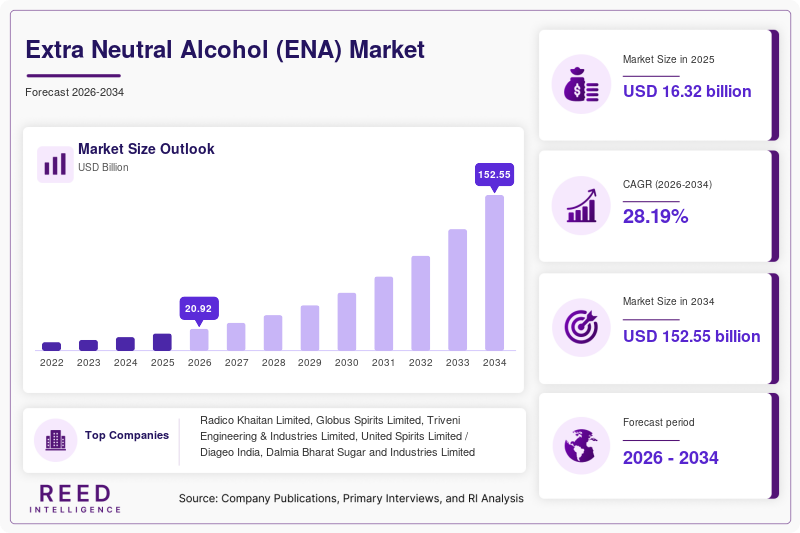
The global Extra Neutral Alcohol (ENA) Market was valued at USD 16.32 billion in 2025 and is estimated to reach USD 17.34 billion in 2026. Based on the supplied forecast, the market is projected to reach USD 152.55 billion by 2034, representing a 6.26% CAGR during 2026–2034.
ENA is a high-purity neutral spirit produced through fermentation, distillation and rectification. India's Food Safety and Standards Authority defines neutral spirit/ENA as a product obtained through distillation and rectification with a minimum alcoholic strength of 96% ABV, using agricultural carbohydrate sources such as cereal grains, fruits, vegetables and molasses.
The market is closely connected to beverage-alcohol production but also serves pharmaceutical, flavor and fragrance, food and industrial applications. India's GST Council has specifically recognized these multiple uses, including potable alcohol, pharmaceuticals, flavors and fragrances, food extracts and industrial chemicals.
ENA is primarily a high-purity ethanol intermediate rather than a finished consumer product. Its largest commercial role is as a neutral base for alcoholic beverages, where it can be diluted and blended with other ingredients to produce vodka, gin, liqueurs, Indian-made spirits and other products. FSSAI's regulatory definition establishes a minimum 96% ABV for ENA, while the GST Council identifies beverage alcohol, pharmaceuticals, flavors, fragrances, food extracts and industrial chemicals as application areas.
Feedstock flexibility is becoming more important to producers. Companies such as Radico Khaitan produce ENA from both sugarcane molasses and grain, while its Sitapur facility includes separate molasses, grain and malt ENA production capabilities.
Extra Neutral Alcohol Market Drivers
Beverage Alcohol Remains the Core Demand Mechanism
Beverage alcohol is the most important application for ENA because neutral alcohol provides a consistent high-purity base for numerous spirits. United Spirits Limited identifies Extra Neutral Alcohol as one of its products/services and reported that ENA and other raw materials form part of its responsible-sourcing program.
The commercial mechanism is direct: higher sales of spirits increase demand for neutral alcohol, while premiumization can increase requirements for higher-quality and more tightly controlled ENA. Radico Khaitan also identifies itself as a major producer of ethyl alcohol and ENA from both molasses and grain.
Feedstock Diversification Is Becoming More Important
ENA producers are increasingly using multiple feedstocks to manage raw-material availability and economics. Radico Khaitan's Sitapur distillery, commissioned in September 2023, has annual alcohol-production capacity that includes 19.3 million liters of molasses ENA, 82.5 million liters of grain ENA and 2.6 million liters of malt ENA.
Triveni Engineering & Industries has similarly developed molasses and grain-based capabilities, including a grain-based facility producing ethanol and ENA. The company's disclosed expansion program also includes multi-feedstock distilleries.
This flexibility allows producers to switch production according to feedstock economics and market demand, although it also links ENA margins more closely to sugar, grain and ethanol-market conditions.
Ethanol-Blending Policies Affect the ENA Supply Environment
India's E20 program has materially expanded ethanol demand. The government reported that blending increased from less than 1.5% in 2013–14 to 20% in 2025–26, while ethanol production capacity reached approximately 2,000 crore liters in 2026.
For ENA producers, the effect is mixed. Higher ethanol demand supports investment in fermentation and distillation infrastructure, but fuel-ethanol procurement can compete for feedstocks and production capacity that could otherwise serve beverage or industrial alcohol markets. Producers with flexible distilleries have greater ability to adjust their product mix.
Energy-Efficient Distillation Is Becoming a Production Differentiator
The production of ENA requires energy-intensive distillation and rectification. Praj Industries offers multipressure distillation technology specifically for beverage-grade and extra neutral alcohol and highlights lower steam and water consumption in its modern distillation systems.
The commercial significance is that producers can improve ENA economics through lower energy consumption, higher recovery and better process control. This is particularly relevant where feedstock costs are volatile and energy represents a meaningful part of production expenses.
Extra Neutral Alcohol Market Restraints
Feedstock Price Volatility Can Compress Producer Margins
ENA producers are exposed to the cost of molasses, grains, sugarcane-derived feedstocks and energy. Diageo India reported in its FY2025 results that gross-margin expansion was partially offset by ENA inflation, demonstrating the direct effect of ENA pricing on downstream beverage producers.
This creates a two-sided risk: higher ENA prices can improve distiller margins but increase costs for beverage manufacturers, while lower ENA prices can pressure producers when feedstock or energy costs remain elevated.
Competition With Fuel Ethanol Can Tighten Feedstock Availability
India's rapid expansion of fuel ethanol has increased the strategic importance of distillery capacity. Government data show that ethanol production capacity expanded to about 2,000 crore liters in 2026, while the country achieved the 20% blending target.
The limitation for ENA producers is that feedstock and distillation capacity can be redirected toward fuel ethanol when returns are attractive. Multi-feedstock and multi-product plants therefore have an advantage, but smaller single-purpose facilities can be more exposed to market changes.
Regulatory Differences Increase Market Complexity
ENA is subject to different tax and regulatory treatment depending on its end use. The GST Council recommended excluding ENA used for manufacturing alcoholic liquor for human consumption from GST while applying an 18% GST rate to rectified spirits/ENA for industrial use under the relevant tariff classification. Goods & Services Tax Council
State-level excise rules also influence how ENA is used in alcoholic beverages. Haryana's 2025–27 excise policy, for example, requires specified country liquor to be manufactured from ENA.
Extra Neutral Alcohol Market Opportunities
Grain-Based ENA Provides Feedstock Flexibility
Grain-based ENA is becoming strategically important as distillers diversify beyond sugar-based feedstocks. Radico Khaitan's facilities demonstrate the ability to produce ENA from both molasses and grain, while Triveni has also invested in grain-based distillation capacity.
The opportunity is particularly relevant in markets with large grain-processing industries, because maize, rice and other grains can provide alternative raw-material sources when molasses availability or pricing becomes unfavorable.
Pharmaceutical and Flavor Applications Provide Diversification
ENA is not limited to beverage alcohol. The GST Council identifies pharmaceuticals, flavors and fragrances, distilled vinegar, food extracts and industrial chemicals among its applications.
These applications provide producers with additional outlets when beverage-alcohol demand weakens. However, different applications require different quality, documentation and regulatory specifications, meaning producers must maintain consistent purity and process control.
Multi-Feedstock Distilleries Can Improve Capacity Utilization
The ability to switch between molasses, sugarcane juice, syrup and grain allows distilleries to respond to raw-material availability and market prices. Triveni's disclosed production platform includes molasses, sugarcane juice/syrup and grain capabilities, while Radico Khaitan also operates multi-feedstock ENA production.
This creates an opportunity for producers to optimize plant utilization instead of depending on a single agricultural feedstock.
Segmental Analysis
By Feedstock Type
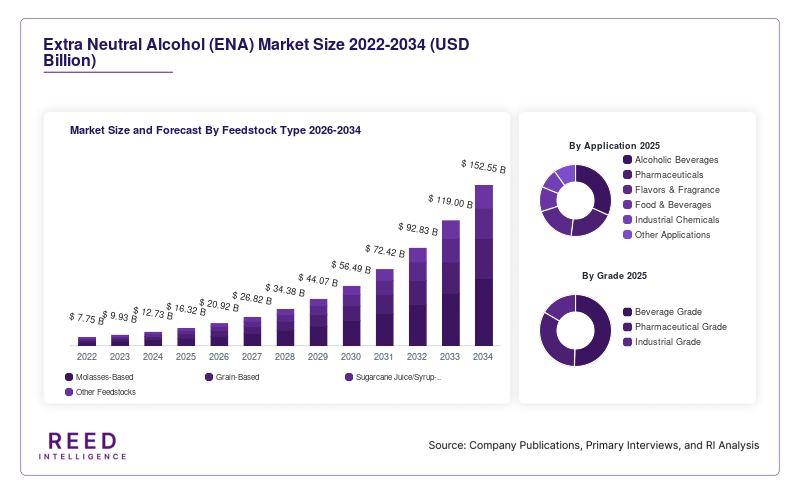
Molasses-Based ENA represents approximately 45% of the 2025 market, equivalent to about USD 7.34 billion under the internal analytical allocation. It is modeled at approximately 5.80% CAGR through 2034, producing an indicative 2034 value of about USD 12.20 billion. Molasses remains an established feedstock for distilleries integrated with sugar production, while its economics are influenced by sugar output, molasses availability and competing ethanol demand.
Grain-Based ENA accounts for approximately 35%, or USD 5.71 billion, of the 2025 market under the internal allocation. It is modeled at approximately 6.70% CAGR through 2034, reaching an indicative USD 10.24 billion. Grain-based production provides distillers with an alternative to sugar-derived feedstocks and is increasingly relevant in facilities designed to switch between beverage-grade ENA and other ethanol products. Radico Khaitan and Triveni both demonstrate grain-based ENA production capabilities.
Sugarcane Juice/Syrup-Based ENA represents approximately 12%, equivalent to USD 1.96 billion in 2025 under the internal analytical allocation. It is modeled at approximately 7.20% CAGR through 2034, producing an indicative value of about USD 3.66 billion. The segment benefits from integrated sugar-and-distillery operations where sugarcane juice or syrup can be diverted into alcohol production according to prevailing economics and government policy.
Other Feedstocks represent approximately 8%, or USD 1.31 billion, of the 2025 market and are modeled at approximately 5.50% CAGR through 2034, reaching an indicative USD 2.11 billion. This category includes other agricultural carbohydrate sources used where local feedstock availability, processing infrastructure or regulatory conditions support production.
By Application
Alcoholic Beverages represent approximately 68% of the 2025 market, equivalent to about USD 11.10 billion under the internal analytical allocation. The segment is modeled at approximately 6.00% CAGR through 2034, reaching an indicative value of about USD 18.75 billion. Beverage production remains the principal commercial outlet for ENA because its high purity and neutral sensory characteristics make it suitable as a base for spirits and other alcoholic products. FSSAI specifically defines ENA as a neutral spirit with a minimum 96% ABV.
Pharmaceuticals account for approximately 10%, or USD 1.63 billion, of the 2025 market under the internal allocation. The segment is modeled at approximately 7.00% CAGR through 2034, producing an indicative USD 3.02 billion. Pharmaceutical applications require consistent purity and controlled manufacturing because ethanol can be used in formulations, extraction and processing.
Flavors & Fragrance represent approximately 8%, equivalent to USD 1.31 billion, of the 2025 market. The segment is modeled at approximately 7.00% CAGR through 2034, reaching about USD 2.40 billion. ENA's neutral odor and high purity make it suitable for applications where the alcohol should not introduce unwanted sensory characteristics. The GST Council identifies flavors and fragrance among ENA's recognized uses.
Food & Beverages account for approximately 5%, or USD 0.82 billion, of the 2025 market under the internal allocation. It is modeled at approximately 6.00% CAGR through 2034, reaching an indicative USD 1.39 billion. Applications include flavor extracts, concentrates and related food-processing uses where high-purity alcohol is required.
Industrial Chemicals represent approximately 6%, equivalent to USD 0.98 billion, and are modeled at approximately 7.00% CAGR through 2034. ENA can serve as a feedstock or intermediate for selected industrial chemicals and chemical derivatives. The GST Council identifies chemical applications including pyridine, ethyl acetate and acetic-acid-related products.
Other Applications account for approximately 3%, or USD 0.49 billion, of the 2025 market and are modeled at approximately 5.50% CAGR through 2034. This category covers smaller applications where high-purity neutral alcohol is required.
By Grade
Beverage Grade ENA represents approximately 64% of the 2025 market, equivalent to about USD 10.44 billion under the internal analytical allocation. It is modeled at approximately 6.10% CAGR through 2034, reaching an indicative value of about USD 17.87 billion. Demand is closely connected with spirits production and quality requirements for neutral alcohol used in beverage formulations.
Pharmaceutical Grade ENA accounts for approximately 12%, or USD 1.96 billion, of the 2025 market. It is modeled at approximately 7.00% CAGR through 2034, reflecting the requirement for controlled purity and consistent specifications in pharmaceutical applications.
Industrial Grade ENA represents approximately 24%, equivalent to USD 3.92 billion, and is modeled at approximately 6.40% CAGR through 2034. The segment serves applications in flavors, fragrances, food processing and chemical manufacturing where the required specifications differ from beverage and pharmaceutical uses.
Regional Analysis
North America Extra Neutral Alcohol Market
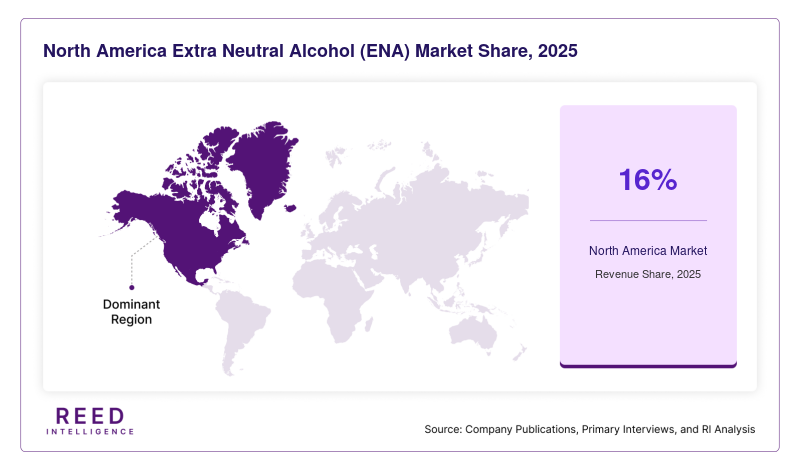
North America represents approximately 16% of the 2025 market, equivalent to about USD 2.61 billion under the internal allocation. It is modeled at approximately 5.40% CAGR through 2034, producing an indicative value of about USD 4.19 billion.
The regional market is supported by established beverage-alcohol manufacturing and demand for high-purity ethanol in pharmaceutical, flavor and industrial applications. Producers also face strict quality, safety and traceability requirements, which favor suppliers with consistent production and documentation systems.
Europe Extra Neutral Alcohol Market
Europe accounts for approximately 20%, or USD 3.26 billion, of the 2025 market under the internal analytical allocation. It is modeled at approximately 5.70% CAGR through 2034, reaching an indicative USD 5.38 billion.
The region has established spirits, fragrance, pharmaceutical and food-processing industries. Demand for high-purity alcohol is therefore diversified across multiple downstream applications rather than being dependent only on beverage production.
APAC Extra Neutral Alcohol Market
APAC represents approximately 42% of the 2025 market, equivalent to USD 6.85 billion, under the internal allocation. It is modeled at approximately 6.90% CAGR through 2034, producing an indicative value of about USD 12.47 billion.
The region's large internal allocation reflects the scale of Indian and Asian beverage-alcohol production, expanding pharmaceutical manufacturing and increasing distillation capacity. India is particularly important because ENA is widely used in the domestic spirits industry while its distillery infrastructure is also being expanded for the broader ethanol economy. Government data show ethanol capacity reaching approximately 2,000 crore liters in 2026.
Middle East and Africa Extra Neutral Alcohol Market
Middle East and Africa represents approximately 10%, equivalent to USD 1.63 billion, of the 2025 market under the internal analytical allocation. It is modeled at approximately 6.10% CAGR through 2034, reaching about USD 2.78 billion.
The region presents opportunities in beverage production, pharmaceuticals, fragrances and industrial alcohol. Local agricultural feedstocks and new distillation investments can also influence the availability of neutral alcohol.
Latin America Extra Neutral Alcohol Market
Latin America accounts for approximately 12%, or USD 1.96 billion, of the 2025 market under the internal allocation. It is modeled at approximately 6.40% CAGR through 2034, reaching an indicative value of about USD 3.42 billion.
The region benefits from established sugarcane industries and alcohol-production infrastructure. Integrated sugar and distillery operations provide producers with the ability to convert agricultural feedstocks into ethanol and related alcohol products.
Competitive Landscape
The ENA market is characterized by a combination of integrated sugar-and-distillery companies, grain-based distillers, beverage-alcohol companies with captive or affiliated alcohol production, and specialized ethanol technology providers.
Radico Khaitan has a diversified ENA platform using molasses and grain and operates the Sitapur distillery with dedicated grain, molasses and malt ENA capabilities. Radico Khaitan
Globus Spirits has historically emphasized the ability to switch production between ENA and ethanol depending on market economics, reflecting the importance of flexible distillery configurations. Globus Spirits
Triveni Engineering & Industries operates molasses- and grain-based alcohol production and has developed multi-feedstock distillation capacity.
Key Market Players
- Radico Khaitan Limited
- Globus Spirits Limited
- Triveni Engineering & Industries Limited
- United Spirits Limited / Diageo India
- Dalmia Bharat Sugar and Industries Limited
- Praj Industries Limited
- Balrampur Chini Mills Limited
- EID Parry (India) Limited
- Shree Renuka Sugars Limited
- John Distilleries
- Mohan Meakin Limited
- Piccadily Agro Industries Limited
Recent Market Developments
July 2026 – India Maintained 20% Ethanol Blending
In July 2026, India's Ministry of Petroleum and Natural Gas reported 20% ethanol blending for the November 2025–June 2026 ethanol supply year. The government also stated that any increase beyond 20% would require further scientific and technical studies, while E85 had been introduced for appropriately designed flex-fuel vehicles.
May 2026 – United Spirits Completed ENA Co-Location Program
In May 2026, United Spirits reported that its ENA co-location initiatives were 100% complete as part of its multi-year supply-agility program. The company stated that the program was also progressing on footprint optimization and cost initiatives.
Extra Neutral Alcohol (ENA) Market Segments
By Feedstock Type
- Molasses-Based
- Grain-Based
- Sugarcane Juice/Syrup-Based
- Other Feedstocks
By Application
- Alcoholic Beverages
- Pharmaceuticals
- Flavors & Fragrance
- Food & Beverages
- Industrial Chemicals
- Other Applications
By Grade
- Beverage Grade
- Pharmaceutical Grade
- Industrial Grade
By Distribution Channel
- Direct Sales
- Distributors & Traders
By Region
- North America
- Europe
- APAC
- Middle East and Africa
- LATAM