Extracorporeal Co2 Removal Device Market Size, Share & Demand Report By Type (Veno-Venous ECCO2R, Arterio-Venous ECCO2R, Portable ECCO2R Systems), By Application (Critical Care, Emergency Care, Chronic Respiratory Management), By End-Use (Hospitals, Ambulatory Surgical Centers, Specialty Clinics), By Region & Segment Forecasts, 2026–2034
USD 3950
Market Overview
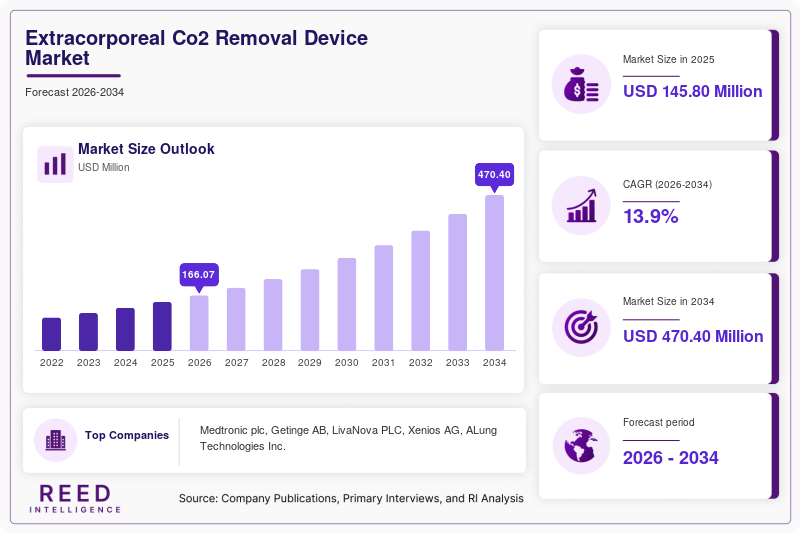
The Extracorporeal Co2 Removal Device Market size was valued at USD 145.8 million in 2026 and is projected to reach USD 412.6 million by 2034, growing at a CAGR of 13.9% from 2026 to 2034. The market is gaining traction due to the increasing incidence of acute respiratory failure conditions such as chronic obstructive pulmonary disease (COPD) and acute respiratory distress syndrome (ARDS), which require advanced respiratory support systems. Extracorporeal CO2 removal (ECCO2R) devices are emerging as a minimally invasive alternative to traditional mechanical ventilation, enabling effective carbon dioxide removal while reducing lung injury risks.
A key global factor supporting market growth is the rising demand for lung-protective ventilation strategies in critical care settings. Healthcare providers are increasingly adopting ECCO2R systems to improve patient outcomes, particularly in intensive care units (ICUs), where reducing ventilator-induced lung injury is a clinical priority. Technological advancements, including portable and low-flow ECCO2R systems, are also expanding the application scope and accessibility of these devices across hospitals.
Key Highlights
- North America dominated the market with a 38.4% share
- Asia Pacific is projected to grow at the fastest CAGR of 15.6%.
- The veno-venous ECCO2R segment held the largest share, while portable systems are expected to grow at a CAGR of 16.2%.
- The critical care application segment led the market, whereas emergency care is the fastest-growing segment with a CAGR of 15.1%.
- The U.S. market was valued at USD 48.2 million in 2024 and USD 52.9 million in 2025.
Market Trends
Integration of ECCO2R with Advanced ICU Technologies
Healthcare systems are increasingly integrating extracorporeal CO2 removal devices with advanced ICU monitoring platforms and digital health systems. This trend is driven by the need for real-time patient data, enabling clinicians to optimize respiratory management and improve treatment outcomes. The incorporation of AI-based monitoring tools and predictive analytics allows for early detection of respiratory deterioration, facilitating timely intervention. Additionally, interoperability with electronic health records enhances clinical workflows and supports data-driven decision-making. This integration is particularly beneficial in high-acuity settings where precision and rapid response are critical, contributing to improved patient survival rates and reduced ICU stay durations.
Growing Adoption of Portable and Low-Flow Devices
The development of compact and portable ECCO2R systems is transforming the market landscape. These devices are designed for ease of use, reduced invasiveness, and improved patient mobility, making them suitable for both ICU and non-ICU settings. Low-flow systems require less blood circulation, minimizing complications and expanding their applicability among high-risk patient populations. This trend is particularly relevant in emerging markets where healthcare infrastructure may be limited. The shift toward portable devices is also enabling early intervention in emergency care and facilitating patient transfers, thereby improving accessibility and clinical outcomes across diverse healthcare environments.
Market Drivers
Rising Prevalence of Respiratory Disorders
The increasing global burden of respiratory diseases such as COPD, asthma, and ARDS is a primary driver of the Extracorporeal Co2 Removal Device Market. Factors such as air pollution, smoking prevalence, and aging populations are contributing to the growing incidence of these conditions. ECCO2R devices offer a critical solution for managing hypercapnia in patients who are unresponsive to conventional therapies. As healthcare systems focus on improving critical care outcomes, the demand for advanced respiratory support technologies continues to rise. This trend is particularly significant in developed regions with well-established healthcare infrastructure and high ICU admission rates.
Advancements in Medical Device Technology
Continuous innovation in medical device engineering is accelerating the adoption of ECCO2R systems. Manufacturers are focusing on improving device efficiency, safety, and ease of use through innovations such as biocompatible materials, enhanced membrane technology, and automated control systems. These advancements reduce complications such as clotting and infection, thereby increasing clinician confidence and patient acceptance. Furthermore, regulatory approvals and clinical trials supporting the efficacy of ECCO2R devices are encouraging wider adoption. As a result, technological progress is playing a vital role in expanding the clinical applications and market penetration of these devices.
Market Restraint
High Cost and Limited Accessibility
One of the major restraints impacting the Extracorporeal Co2 Removal Device Market is the high cost associated with these systems and their limited accessibility in low- and middle-income regions. ECCO2R devices require significant capital investment, along with specialized training for healthcare professionals to operate them effectively. Additionally, the cost of consumables and maintenance further increases the overall expenditure for healthcare facilities. This financial burden limits adoption, particularly in regions with constrained healthcare budgets.
The high cost also affects reimbursement scenarios, as not all healthcare systems provide adequate coverage for ECCO2R procedures. For example, smaller hospitals and rural healthcare centers often lack the financial resources and infrastructure to implement such advanced technologies. This creates disparities in patient access to life-saving treatments. As a result, despite their clinical benefits, the widespread adoption of ECCO2R devices remains restricted, highlighting the need for cost-effective solutions and supportive healthcare policies to drive market growth.
Market Opportunities
Expansion in Emerging Markets
Emerging economies present significant growth opportunities for the Extracorporeal Co2 Removal Device Market. Rapid urbanization, increasing healthcare expenditure, and improving medical infrastructure are driving the demand for advanced critical care solutions. Governments in countries such as India and China are investing in healthcare modernization, including the expansion of ICU facilities. This creates a favorable environment for the adoption of ECCO2R devices. Additionally, rising awareness about advanced respiratory therapies among healthcare professionals is contributing to market expansion. Companies that focus on cost-effective solutions and local partnerships can capitalize on these opportunities to establish a strong presence in these high-growth regions.
Increasing Clinical Research and Applications
Ongoing clinical research is expanding the potential applications of ECCO2R devices beyond traditional indications. Studies are exploring their use in conditions such as COVID-19-related respiratory failure, post-surgical care, and chronic respiratory management. These developments are broadening the clinical utility of ECCO2R systems, creating new avenues for market growth. Furthermore, collaborations between research institutions and medical device companies are accelerating innovation and regulatory approvals. As clinical evidence supporting the efficacy of ECCO2R continues to grow, the adoption of these devices is expected to increase across a wider range of medical applications.
Segmental Analysis
By Type
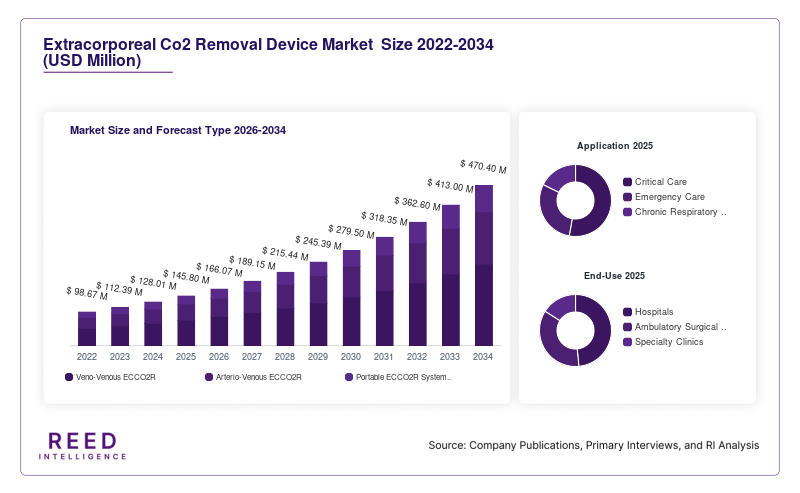
The veno-venous ECCO2R segment dominated the market in 2024, accounting for approximately 62.3% of the total share. This dominance is attributed to its widespread use in managing patients with severe respiratory failure. Veno-venous systems are preferred due to their ability to provide efficient CO2 removal with relatively lower risk compared to other configurations. These systems are commonly used in ICUs for patients requiring prolonged respiratory support. Their compatibility with existing ventilation systems further enhances their adoption across hospitals.
The portable ECCO2R systems segment is projected to grow at the fastest CAGR of 16.2% during the forecast period. The increasing demand for mobility and flexibility in patient care is a key growth factor. Portable devices enable treatment outside traditional ICU settings, making them suitable for emergency care and patient transport. Technological advancements in miniaturization and user-friendly designs are further driving their adoption, particularly in regions with limited healthcare infrastructure.
By Application
The critical care segment held the largest share of 58.7% in 2024, driven by the high utilization of ECCO2R devices in ICUs. These devices play a crucial role in managing patients with severe respiratory conditions, enabling lung-protective ventilation strategies. The growing number of ICU admissions and the increasing prevalence of respiratory diseases are key factors supporting the dominance of this segment.
The emergency care segment is expected to grow at the fastest CAGR of 15.1%. The need for rapid intervention in acute respiratory failure cases is driving the adoption of ECCO2R devices in emergency settings. These devices provide immediate CO2 removal, improving patient outcomes and reducing mortality rates. The development of portable systems is further enhancing their applicability in emergency care.
By End-Use
Hospitals accounted for the largest market share of 64.5% in 2024, owing to the availability of advanced infrastructure and skilled healthcare professionals. Hospitals are the primary users of ECCO2R devices, particularly in ICUs and critical care units. The increasing number of hospital admissions for respiratory conditions is driving demand in this segment.
Ambulatory surgical centers (ASCs) are projected to grow at a CAGR of 14.8%. The shift toward outpatient care and the increasing adoption of minimally invasive procedures are key growth factors. ASCs are increasingly incorporating advanced medical technologies to improve patient outcomes and reduce healthcare costs, supporting the adoption of ECCO2R devices.
Regional Analysis
North America
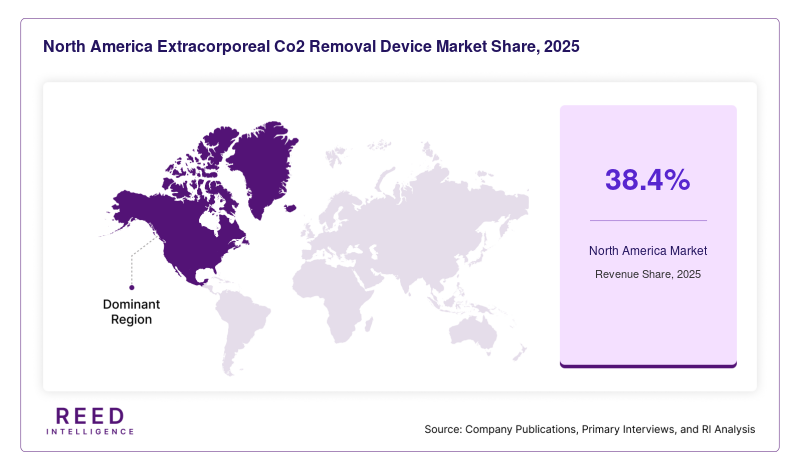
North America accounted for the largest share of the Extracorporeal Co2 Removal Device Market in 2025, holding approximately 38.4% of the global market. The region is expected to maintain its dominance, growing at a CAGR of 13.2% during the forecast period. The presence of advanced healthcare infrastructure, high adoption of innovative medical technologies, and strong reimbursement frameworks are key factors driving market growth in this region.
The United States dominates the North American market, supported by a high prevalence of respiratory disorders and a well-established critical care ecosystem. A unique growth factor in this region is the strong focus on clinical research and early adoption of emerging medical technologies. Hospitals and research institutions actively participate in clinical trials, accelerating the commercialization of advanced ECCO2R systems.
Europe
Europe held a significant market share of 27.6% in 2025 and is projected to grow at a CAGR of 13.5%. The region benefits from well-developed healthcare systems and increasing government initiatives to improve critical care services. Countries such as Germany, France, and the UK are leading adopters of ECCO2R devices due to their strong focus on patient safety and advanced treatment options.
Germany is the dominant country in the European market, driven by its robust healthcare infrastructure and high healthcare spending. A unique growth factor is the increasing emphasis on reducing ICU stays and improving patient outcomes through advanced respiratory support technologies. This focus is encouraging hospitals to invest in ECCO2R systems.
Asia Pacific
Asia Pacific is the fastest-growing region, with a CAGR of 15.6%, and accounted for 18.9% of the market in 2025. Rapid economic development, increasing healthcare investments, and rising awareness about advanced medical technologies are driving growth in this region.
China is the dominant country in Asia Pacific, supported by large patient populations and government initiatives to enhance healthcare infrastructure. A unique growth factor is the increasing adoption of cost-effective medical devices, which is encouraging the use of ECCO2R systems in both public and private healthcare facilities.
Middle East & Africa
The Middle East & Africa region held a market share of 8.1% in 2025 and is expected to grow at a CAGR of 12.8%. The market is driven by improving healthcare infrastructure and increasing investments in advanced medical technologies, particularly in Gulf Cooperation Council (GCC) countries.
Saudi Arabia leads the market in this region, driven by government initiatives to modernize healthcare systems. A unique growth factor is the increasing number of specialized healthcare facilities equipped with advanced ICU technologies, which is supporting the adoption of ECCO2R devices.
Latin America
Latin America accounted for 7.0% of the global market in 2025 and is projected to grow at a CAGR of 12.6%. The region is experiencing gradual improvements in healthcare infrastructure and increasing awareness about advanced respiratory care solutions.
Brazil dominates the Latin American market, supported by a large patient base and expanding healthcare services. A unique growth factor is the growing focus on public healthcare reforms aimed at improving access to critical care treatments, which is expected to drive the adoption of ECCO2R devices.
Competitive Landscape
The Extracorporeal Co2 Removal Device Market is moderately consolidated, with several global and regional players competing based on technology innovation, product quality, and pricing strategies. Leading companies are focusing on research and development to introduce advanced ECCO2R systems with improved efficiency and safety features. Strategic collaborations, mergers, and acquisitions are also common as companies aim to expand their market presence.
A leading player in the market is Medtronic plc, which has established a strong position through its extensive product portfolio and global distribution network. The company recently introduced an advanced ECCO2R system designed to enhance patient outcomes in critical care settings. Other key players are also investing in technological advancements and expanding their product offerings to cater to the growing demand for extracorporeal CO2 removal devices.
Key Players
- Medtronic plc
- Getinge AB
- LivaNova PLC
- Xenios AG
- ALung Technologies Inc.
- Hemovent GmbH
- Fresenius Medical Care AG & Co. KGaA
- Baxter International Inc.
- Terumo Corporation
- Eurosets S.r.l.
- Nipro Corporation
- Medica S.p.A.
- Senko Medical Instrument Mfg. Co., Ltd.
- Braile Biomédica
- MicroPort Scientific Corporation
Recent Developments
- In 2025, Medtronic plc launched a next-generation ECCO2R system featuring enhanced membrane efficiency and reduced complication rates.
- In 2024, Getinge AB expanded its production capacity to meet the growing demand for extracorporeal life support devices.
- In 2025, ALung Technologies Inc. entered a strategic partnership with a research institute to develop advanced ECCO2R solutions for emerging applications.
Extracorporeal Co2 Removal Device Market Segments
Type
- Veno-Venous ECCO2R
- Arterio-Venous ECCO2R
- Portable ECCO2R Systems
Application
- Critical Care
- Emergency Care
- Chronic Respiratory Management
End-Use
- Hospitals
- Ambulatory Surgical Centers
- Specialty Clinics
By Region
- North America
- Europe
- APAC
- Middle East and Africa
- LATAM