Extruded Activated Carbon Market Size, Share & Demand Report By Raw Material (Coal-Based, Coconut Shell-Based, Wood-Based, Petroleum Coke-Based), By Application (Air Purification, Water Treatment, Solvent Recovery, Industrial Gas Purification), By End-Use Industry (Industrial Manufacturing, Pharmaceuticals, Food & Beverage, Automotive, Municipal Utilities, Electronics & Semiconductors), By Region & Segment Forecasts, 2026–2034
USD 3950
Market Overview
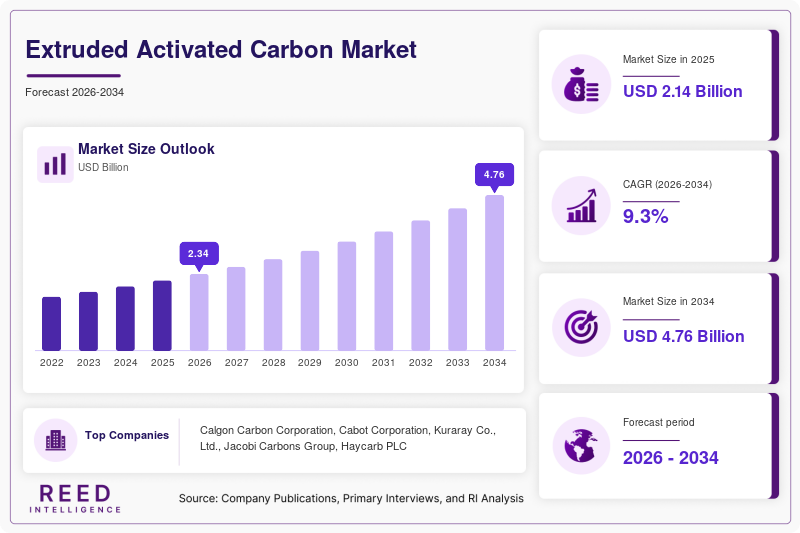
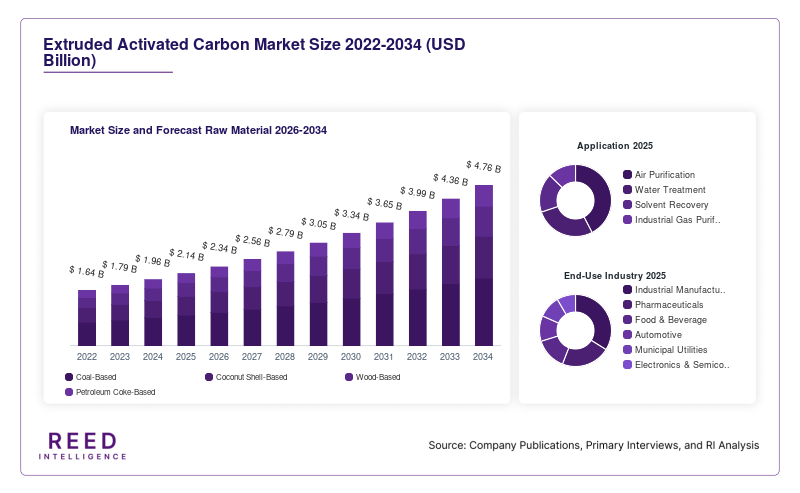
The global Extruded Activated Carbon Market size was valued at USD 2.14 billion in 2026 and is projected to reach USD 4.36 billion by 2034, expanding at a CAGR of 9.3% during the forecast period from 2026 to 2034. The market is witnessing stable expansion due to the growing demand for air purification, industrial emission control, and water treatment technologies across developed and emerging economies. Extruded activated carbon, commonly manufactured in cylindrical pellet form, offers strong adsorption capacity, high mechanical strength, and low-pressure drop characteristics, making it suitable for industrial gas purification and solvent recovery systems.
One of the major global factors supporting market growth is the tightening of environmental regulations related to industrial emissions and wastewater treatment. Governments across North America, Europe, and Asia Pacific continue to implement stricter pollution control norms for manufacturing facilities, power plants, and chemical processing industries. This has increased the adoption of activated carbon filtration technologies in sectors such as automotive, pharmaceuticals, food processing, mining, and municipal water treatment. Rising investments in clean air infrastructure and sustainable industrial operations are also contributing to higher product penetration.
Key Highlights
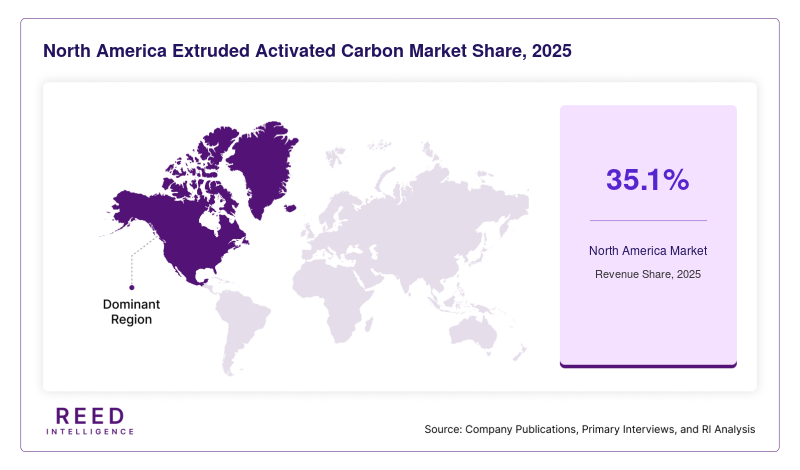
- North America dominated the market with a 35.1% share in 2025, while Asia Pacific is expected to grow at the fastest CAGR of 10.8% during 2026–2034.
- By raw material, coal-based extruded activated carbon accounted for the largest share of 43.7%, while coconut shell-based products are projected to grow at a CAGR of 11.4%.
- By application, air purification led with a 39.5% share, whereas water treatment is expected to expand at a CAGR of 10.9%.
- By end-use industry, industrial manufacturing held the largest share of 36.8%, while pharmaceutical processing is forecast to grow at a CAGR of 11.1%.
- The United States remained the dominant country, with market values of USD 480 million in 2024 and USD 525 million in 2025.
Market Trends
Increasing Integration of Activated Carbon in Industrial Air Filtration Systems
Industrial manufacturers are increasingly integrating extruded activated carbon into advanced air filtration systems to comply with emission standards and improve workplace safety. Industries such as chemicals, cement, automotive coatings, and electronics manufacturing are deploying pelletized activated carbon units to capture volatile organic compounds, sulfur compounds, and hazardous gases. The cylindrical structure of extruded activated carbon allows higher adsorption efficiency and lower operational resistance, which improves the performance of industrial ventilation systems. The trend is particularly visible in countries with aggressive environmental targets, where industrial operators are replacing conventional filtration media with more durable and high-capacity adsorption materials. Demand is also increasing in commercial buildings and healthcare facilities focused on indoor air quality management.
Expansion of Sustainable Raw Material Processing Technologies
Manufacturers are increasingly investing in sustainable production technologies for extruded activated carbon using renewable feedstocks such as coconut shells and wood biomass. This trend is gaining traction as industrial buyers seek environmentally responsible sourcing practices and lower carbon footprints across supply chains. Companies are also adopting energy-efficient activation technologies and waste heat recovery systems to reduce manufacturing costs and emissions. The growing preference for sustainable filtration materials among water treatment operators and food processing companies is further accelerating this transition. In Asia Pacific and Latin America, abundant agricultural waste availability is encouraging regional manufacturers to expand coconut shell-based activated carbon production capacity, improving competitiveness and supporting long-term market growth.
Market Drivers
Rising Demand for Industrial Wastewater Treatment Solutions
The increasing requirement for industrial wastewater treatment is a major driver for the Extruded Activated Carbon Market. Industries such as textiles, chemicals, pharmaceuticals, and food processing generate wastewater containing heavy metals, organic compounds, and toxic contaminants that require effective purification before discharge. Extruded activated carbon offers high adsorption efficiency and long operational life, making it suitable for continuous industrial filtration systems. Governments across multiple regions are strengthening wastewater discharge regulations, which is encouraging industries to adopt advanced treatment technologies. Municipal authorities are also investing in water recycling infrastructure to address freshwater shortages. As a result, demand for pelletized activated carbon products is increasing steadily in both industrial and public utility sectors.
Growth in Air Pollution Control Regulations Across Major Economies
The implementation of strict air pollution control regulations is significantly supporting market expansion. Environmental agencies in North America, Europe, China, and India are imposing tighter restrictions on industrial emissions, including mercury, sulfur dioxide, and volatile organic compounds. Extruded activated carbon is widely used in gas-phase filtration systems due to its mechanical durability and adsorption performance under high-temperature conditions. The rise in industrialization and urban air quality concerns has accelerated investments in emission control infrastructure. Power plants, waste incineration facilities, and petrochemical industries are among the largest consumers of activated carbon-based purification systems. Increasing public awareness regarding air pollution and occupational health standards is further strengthening long-term product demand.
Market Restraint
Fluctuating Raw Material Prices and High Production Costs
The Extruded Activated Carbon Market faces challenges associated with fluctuating raw material prices and energy-intensive manufacturing processes. Coal, coconut shell, wood, and petroleum coke are widely used as feedstocks for activated carbon production, and price instability in these materials directly impacts manufacturing costs. In addition, the activation and extrusion processes require substantial energy consumption, increasing operational expenses for manufacturers. Smaller companies often struggle to maintain competitive pricing during periods of raw material shortages or rising energy costs. These factors can limit profit margins and reduce adoption among cost-sensitive industries. For example, wastewater treatment facilities in developing economies may delay large-scale filtration upgrades due to budget limitations, affecting short-term market penetration in emerging regions.
Market Opportunities
Growing Adoption in Pharmaceutical and Healthcare Applications
The pharmaceutical and healthcare sectors are creating new opportunities for extruded activated carbon manufacturers. Pharmaceutical production facilities require advanced purification systems to maintain contamination-free environments and comply with strict regulatory standards. Extruded activated carbon is increasingly used in solvent recovery, gas purification, and cleanroom filtration systems due to its high adsorption capacity and operational reliability. The expansion of biotechnology manufacturing and vaccine production facilities is also supporting market demand. Healthcare institutions are investing in air purification technologies to improve indoor air quality and infection control measures. As pharmaceutical manufacturing activities continue to expand in Asia Pacific and North America, suppliers are expected to benefit from increased procurement of specialized activated carbon filtration materials.
Expansion of Semiconductor and Electronics Manufacturing Facilities
Rapid expansion in semiconductor fabrication and electronics manufacturing is generating strong growth opportunities for the Extruded Activated Carbon Market. Semiconductor facilities require ultra-clean environments with strict control over airborne molecular contaminants and volatile chemicals. Extruded activated carbon is used extensively in cleanroom air filtration systems and gas purification processes to maintain production quality and reduce contamination risks. Countries such as China, South Korea, Taiwan, and the United States are investing heavily in domestic semiconductor manufacturing capacity, increasing demand for advanced filtration solutions. In addition, rising production of electric vehicle batteries and electronic components is supporting the need for industrial purification technologies, creating long-term growth prospects for activated carbon suppliers worldwide.
Segmental Analysis
By Raw Material
Coal-based extruded activated carbon dominated the market and accounted for 43.7% of total revenue in 2024. The segment benefits from strong adsorption performance, high mechanical strength, and cost efficiency in large-scale industrial applications. Coal-based products are widely used in power plants, industrial gas purification, wastewater treatment, and solvent recovery systems because they offer stable operational durability under demanding conditions. Industries requiring continuous filtration processes prefer coal-derived activated carbon due to its ability to handle high contaminant loads and maintain long service life. Manufacturers also favor this raw material because of established supply chains and large-scale production capabilities. Demand remains particularly strong in North America and Europe, where industrial pollution control regulations continue to drive adoption of advanced adsorption technologies.
Coconut shell-based extruded activated carbon is projected to grow at the fastest CAGR of 11.4% during the forecast period. The growth is primarily driven by increasing demand for sustainable and renewable filtration materials across water purification and food processing industries. Coconut shell products provide high microporosity and superior adsorption efficiency for organic compounds, making them suitable for sensitive purification applications. Governments and industrial buyers are increasingly emphasizing environmentally responsible sourcing practices, encouraging manufacturers to expand bio-based activated carbon production. Asia Pacific countries with abundant agricultural waste resources are emerging as key production hubs. In addition, rising investments in residential water filtration systems and indoor air purification technologies are creating strong long-term opportunities for coconut shell-based product manufacturers.
By Application
Air purification represented the leading application segment with a market share of 39.5% in 2024. Extruded activated carbon is extensively used in industrial ventilation systems, gas treatment units, automotive cabin filters, and commercial air purification systems. The segment benefits from growing global concerns regarding industrial emissions, volatile organic compounds, and indoor air quality management. Industrial sectors such as petrochemicals, cement manufacturing, pharmaceuticals, and electronics rely heavily on activated carbon-based gas filtration technologies to comply with environmental standards. The increasing deployment of cleanroom facilities and commercial air handling systems is also contributing to segment expansion. Demand is particularly strong in urban industrial regions where air pollution mitigation remains a major public policy priority.
Water treatment is expected to register the fastest CAGR of 10.9% from 2026 to 2034. Rising industrial wastewater generation, freshwater scarcity, and stricter discharge regulations are accelerating investments in advanced water purification systems globally. Extruded activated carbon is increasingly used in municipal water treatment plants, desalination facilities, and industrial recycling systems due to its high adsorption efficiency and operational stability. The pharmaceutical, textile, and food processing industries are among the largest consumers of activated carbon-based water filtration technologies. Developing economies are also expanding investments in clean drinking water infrastructure, creating significant growth opportunities for market participants. Increasing awareness regarding chemical contamination and waterborne pollutants is further supporting product adoption across residential and industrial sectors.
By End-Use Industry
Industrial manufacturing emerged as the dominant end-use industry and held 36.8% of the market share in 2024. Manufacturing facilities across chemicals, automotive, metal processing, and electronics sectors utilize extruded activated carbon for air purification, solvent recovery, and wastewater treatment applications. The segment benefits from increasing industrial automation and stronger environmental compliance requirements across developed economies. Activated carbon systems are widely integrated into production facilities to control emissions, reduce contamination risks, and improve operational sustainability. Rising industrial output in Asia Pacific and North America continues to support strong product demand. Additionally, manufacturers are adopting advanced adsorption technologies to enhance process efficiency and comply with stricter workplace safety regulations.
Pharmaceutical processing is anticipated to grow at the fastest CAGR of 11.1% during the forecast period. The expansion of pharmaceutical manufacturing, biotechnology research, and vaccine production is significantly increasing the demand for high-purity filtration systems. Extruded activated carbon plays a critical role in maintaining contamination-free environments, purifying gases, and supporting solvent recovery processes within pharmaceutical facilities. Regulatory agencies continue to enforce stringent quality standards for pharmaceutical production, encouraging manufacturers to deploy advanced purification technologies. The growing number of biologics manufacturing plants and cleanroom facilities across Asia Pacific and Europe is further accelerating segment growth. Increased healthcare investments and rising pharmaceutical exports are also expected to strengthen long-term market opportunities.
Regional Analysis
North America
North America accounted for 35.1% of the global Extruded Activated Carbon Market share in 2025 and is expected to maintain steady growth at a CAGR of 8.7% through 2034. The region benefits from strong environmental regulations governing industrial emissions, water purification, and hazardous waste treatment. Demand remains high across power generation, pharmaceutical manufacturing, and municipal water treatment sectors. The United States and Canada continue investing in industrial air quality systems and sustainable wastewater infrastructure, which supports stable consumption of pelletized activated carbon products across industrial and commercial applications.
The United States remained the dominant country in the regional market due to extensive industrial infrastructure and strong regulatory enforcement related to pollution control. Rising investments in semiconductor manufacturing and clean energy projects are generating additional demand for high-performance filtration materials. Industrial facilities are increasingly upgrading emission control systems to comply with federal environmental standards. The presence of major activated carbon producers and advanced research capabilities further supports product innovation and commercialization throughout the region.
Europe
Europe represented 27.4% of the global market in 2025 and is forecast to expand at a CAGR of 8.4% during the forecast period. The region has witnessed increasing adoption of activated carbon technologies across chemical processing, food production, and automotive industries. European environmental policies focusing on carbon emissions and industrial sustainability are encouraging manufacturers to deploy efficient air and water filtration systems. Growing awareness regarding indoor air quality and industrial hygiene standards is also contributing to stable market demand across commercial and institutional facilities.
Germany dominated the European market due to its strong industrial manufacturing base and advanced environmental compliance infrastructure. The country continues to invest in industrial emission control technologies and sustainable production systems across automotive, chemicals, and engineering sectors. Rising demand for solvent recovery systems and industrial air purification solutions is supporting product adoption. In addition, the transition toward green manufacturing practices and renewable energy initiatives is encouraging industries to integrate efficient filtration technologies using extruded activated carbon materials.
Asia Pacific
Asia Pacific held 24.8% of the Extruded Activated Carbon Market in 2025 and is projected to register the fastest CAGR of 10.8% through 2034. Rapid industrialization, urban population growth, and expanding environmental regulations are key factors driving regional demand. Countries including China, India, Japan, and South Korea are investing heavily in wastewater treatment plants, industrial air purification systems, and sustainable manufacturing infrastructure. The growth of electronics production, mining activities, and pharmaceutical manufacturing is further increasing the use of activated carbon technologies across industrial applications.
China remained the dominant country within Asia Pacific due to large-scale manufacturing operations and extensive industrial pollution control initiatives. The country has implemented stricter environmental standards for industrial emissions and wastewater management, accelerating adoption of advanced filtration systems. Strong growth in semiconductor production and electric vehicle battery manufacturing is also generating additional demand for purification technologies. Furthermore, the availability of raw materials and cost-effective manufacturing capabilities supports regional production expansion and export competitiveness.
Middle East & Africa
The Middle East & Africa market accounted for 6.9% of global revenue in 2025 and is expected to grow at a CAGR of 8.1% during the forecast period. Increasing investments in desalination plants, industrial water treatment projects, and oil refinery modernization are supporting demand for extruded activated carbon products. Governments across Gulf countries are focusing on sustainable water management and industrial diversification, which is contributing to higher adoption of advanced filtration technologies. Mining operations and petrochemical facilities are also expanding their use of activated carbon-based purification systems.
Saudi Arabia emerged as the leading market in the region due to extensive investments in industrial infrastructure and water treatment capacity expansion. The country’s focus on economic diversification and environmental sustainability initiatives is encouraging the adoption of modern purification systems across oil, gas, and manufacturing industries. Rising demand for clean water solutions in urban areas is also driving municipal investments in filtration technologies. Additionally, industrial operators are increasingly prioritizing emission reduction systems to align with evolving environmental objectives.
Latin America
Latin America captured 5.8% of the global Extruded Activated Carbon Market share in 2025 and is projected to expand at a CAGR of 7.9% through 2034. Increasing awareness regarding industrial pollution and water contamination is supporting market growth across the region. Governments are gradually strengthening environmental standards for wastewater discharge and industrial emissions, creating opportunities for filtration technology providers. Mining, agriculture processing, and food manufacturing industries are among the key end users contributing to rising demand for activated carbon solutions in regional markets.
Brazil dominated the Latin American market owing to its large industrial base and expanding municipal water treatment investments. The country is experiencing rising demand for industrial purification systems across mining, chemicals, and food processing industries. Increasing urbanization and concerns related to water quality are encouraging authorities to improve treatment infrastructure. Moreover, Brazil’s growing focus on sustainable industrial operations and environmental compliance is supporting the integration of advanced adsorption technologies across multiple end-use sectors.
Competitive Landscape
The Extruded Activated Carbon Market is moderately consolidated, with leading companies focusing on production expansion, raw material diversification, and advanced adsorption technology development. Major manufacturers are strengthening their global distribution networks and investing in sustainable production practices to improve competitiveness. Companies are also expanding customized product portfolios designed for industrial air filtration, water purification, and specialty chemical applications. Strategic partnerships with municipal utilities and industrial manufacturers remain common across the market.
Calgon Carbon Corporation emerged as one of the leading participants due to its extensive activated carbon product portfolio and strong global presence in industrial filtration applications. The company recently expanded its production capabilities to address increasing demand from water treatment and air purification industries. Other major players are focusing on research initiatives aimed at improving adsorption efficiency and operational durability. Competitive rivalry is expected to intensify as regional manufacturers in Asia Pacific increase production capacity and target export markets with cost-competitive offerings.
Key Players
- Calgon Carbon Corporation
- Cabot Corporation
- Kuraray Co., Ltd.
- Jacobi Carbons Group
- Haycarb PLC
- Osaka Gas Chemicals Co., Ltd.
- Donau Carbon GmbH
- Silcarbon Aktivkohle GmbH
- Boyce Carbon
- Carbon Activated Corporation
- Ingevity Corporation
- Adsorbent Carbons Pvt. Ltd.
- Universal Carbons
- Activated Carbon Technologies Pty Ltd
- Datong Coal Jinding Activated Carbon Co., Ltd.
Recent Developments
- In 2025, Calgon Carbon Corporation expanded its activated carbon production capacity in North America to support growing demand from municipal water treatment facilities.
- In 2024, Kuraray Co., Ltd. introduced advanced high-density extruded activated carbon products designed for semiconductor cleanroom applications.
- In 2025, Haycarb PLC announced investments in coconut shell processing facilities to strengthen sustainable activated carbon production capabilities.
- In 2024, Cabot Corporation increased research funding for industrial emission control technologies utilizing advanced adsorption materials.
Extruded Activated Carbon Market Segments
Raw Material
- Coal-Based
- Coconut Shell-Based
- Wood-Based
- Petroleum Coke-Based
Application
- Air Purification
- Water Treatment
- Solvent Recovery
- Industrial Gas Purification
End-Use Industry
- Industrial Manufacturing
- Pharmaceuticals
- Food & Beverage
- Automotive
- Municipal Utilities
- Electronics & Semiconductors
By Region
- North America
- Europe
- APAC
- Middle East and Africa
- LATAM