Fabricated Metal Product Market Size, Share Demand Report By Product Type (Structural Metal Products, Precision Components, Metal Containers, Hardware and Fasteners), By Application (Construction, Automotive, Aerospace & Defense, Industrial Equipment), By End-Use Industry (Industrial Manufacturing, Construction, Energy, Transportation), By Region & Segment Forecasts, 2026–2034
USD 3950
Market Overview
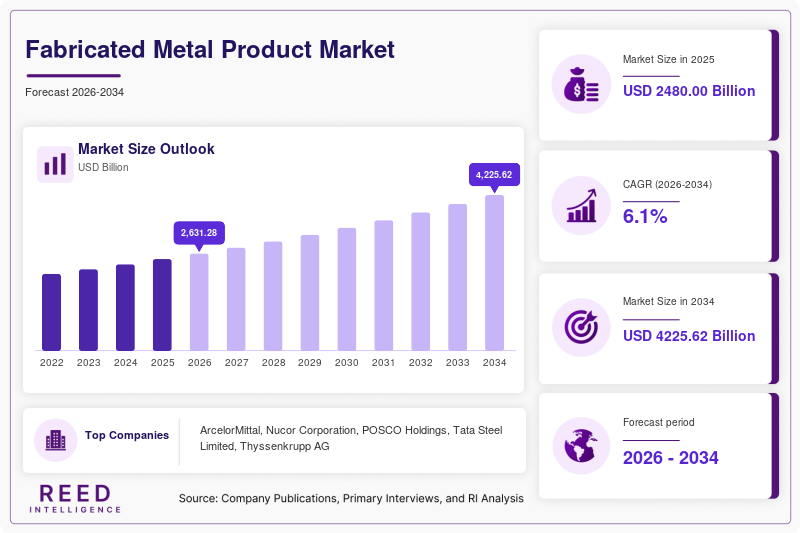
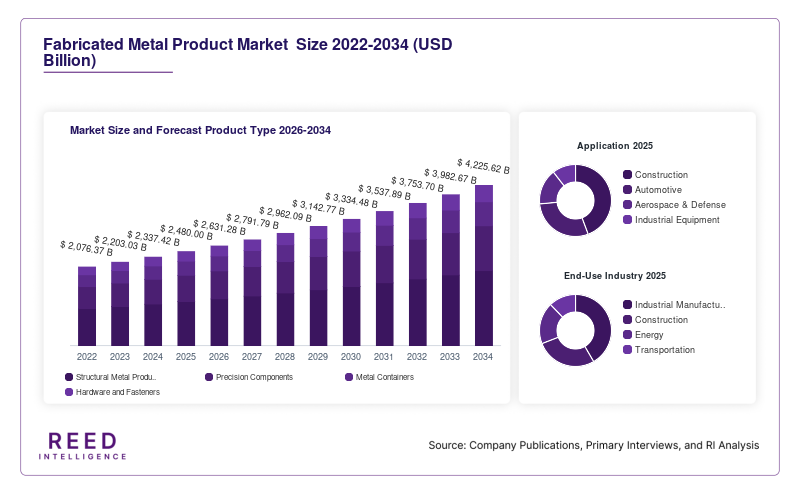
The global Fabricated Metal Product Market size was valued at approximately USD 2,480 billion in 2026 and is projected to reach around USD 3,980 billion by 2034, expanding at a CAGR of 6.1% during the forecast period (2026–2034). The market encompasses a wide range of products, including structural metal components, industrial machinery parts, cutlery, hardware, and prefabricated metal structures. Increasing demand from construction, automotive, aerospace, and industrial manufacturing sectors continues to drive steady growth across developed and emerging economies.
A key global factor supporting market expansion is the sustained growth of infrastructure development projects. Governments across regions are investing in transportation networks, energy infrastructure, and smart city initiatives, which require large volumes of fabricated metal products. Additionally, the shift toward lightweight yet durable materials in manufacturing industries is encouraging the use of precision-engineered metal components. The integration of automation and digital fabrication technologies is further enhancing production efficiency and product quality, strengthening the market outlook.
Key Highlights
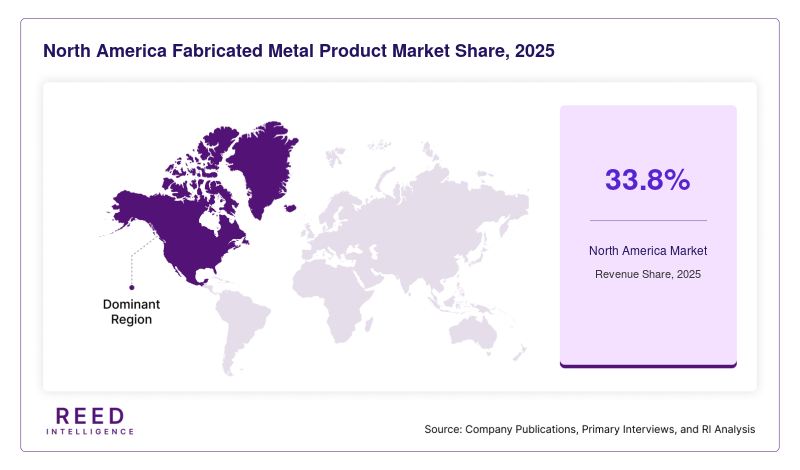
- North America dominated the market with a 33.8% share in 2025.
- Asia Pacific is expected to grow at the fastest CAGR of 7.4% during 2026–2034.
- By product type, structural metal products accounted for the largest share of 42.6%.
- while precision components are projected to grow at a CAGR of 7.9%.
- By end-use industry, construction led with a 38.2% share, whereas aerospace & defense is expected to expand at a CAGR of 7.6%.
- The United States remained the dominant country, with market values of USD 510 billion in 2024 and USD 548 billion in 2025.
Market Trends
Rising adoption of automation and smart manufacturing
The fabricated metal product market is experiencing a shift toward automation and smart manufacturing technologies. Manufacturers are increasingly integrating robotics, computer numerical control (CNC) machines, and industrial Internet of Things (IIoT) systems into production processes. These technologies enable higher precision, reduced material waste, and improved operational efficiency. The use of predictive maintenance tools and real-time monitoring systems also minimizes downtime and enhances production output. Small and medium-sized enterprises are gradually adopting cost-effective automation solutions, which is broadening the overall market base. This transition toward Industry 4.0 is expected to redefine manufacturing workflows and increase competitiveness among global players.
Growing preference for lightweight and high-strength materials
There is a noticeable trend toward the use of lightweight yet durable fabricated metal products across industries such as automotive, aerospace, and construction. Manufacturers are focusing on advanced alloys, including aluminum and high-strength steel, to reduce overall product weight while maintaining structural integrity. This trend aligns with sustainability goals, as lighter components contribute to improved fuel efficiency and reduced emissions in transportation sectors. Additionally, innovations in metal forming and fabrication techniques are enabling the production of complex geometries without compromising strength. The growing emphasis on energy efficiency and environmental compliance continues to drive the adoption of such advanced materials globally.
Market Drivers
Expansion of global construction and infrastructure projects
The rapid expansion of construction and infrastructure projects worldwide is a major driver of the fabricated metal product market. Urbanization and population growth are leading to increased demand for residential, commercial, and industrial structures. Governments are investing heavily in roads, bridges, railways, and energy facilities, all of which require fabricated metal components. Structural steel, beams, and prefabricated metal systems are widely used due to their durability and cost-effectiveness. Additionally, the trend toward modular construction is boosting demand for precision-fabricated components that can be easily assembled on-site. This sustained growth in construction activities is expected to maintain strong demand for fabricated metal products over the forecast period.
Growth in automotive and industrial manufacturing sectors
The expansion of the automotive and industrial manufacturing sectors significantly contributes to market growth. Fabricated metal products are essential for producing vehicle components, machinery parts, and industrial equipment. The rising demand for electric vehicles is also driving the need for specialized metal components, including battery enclosures and lightweight structural parts. Industrial automation and the development of advanced manufacturing facilities further increase the demand for precision-fabricated products. As manufacturers focus on enhancing product performance and durability, the need for high-quality fabricated metal components continues to rise, supporting steady market expansion.
Market Restraint
Volatility in raw material prices and supply chain disruptions
Fluctuations in raw material prices, particularly steel and aluminum, pose a significant restraint to the fabricated metal product market. Price volatility affects production costs and profit margins for manufacturers, making it challenging to maintain stable pricing strategies. Additionally, global supply chain disruptions caused by geopolitical tensions, trade restrictions, and logistics challenges can lead to delays in raw material availability. These factors impact production schedules and increase operational risks. For example, sudden spikes in steel prices can force manufacturers to renegotiate contracts or absorb additional costs, affecting overall profitability. Smaller manufacturers are particularly vulnerable to such fluctuations, which can limit their ability to compete with larger players.
Market Opportunities
Increasing demand for customized and precision-engineered products
The growing demand for customized and precision-engineered fabricated metal products presents significant opportunities for market players. Industries such as aerospace, healthcare, and electronics require highly specialized components tailored to specific applications. Advances in fabrication technologies, including laser cutting and 3D metal printing, are enabling manufacturers to produce complex designs with high accuracy. This capability allows companies to cater to niche markets and offer value-added solutions. As customers seek products that meet exact specifications, manufacturers investing in advanced fabrication techniques and design capabilities are likely to gain a competitive edge in the market.
Rising investments in renewable energy infrastructure
The expansion of renewable energy infrastructure is creating new growth avenues for the fabricated metal product market. Wind turbines, solar panel mounting structures, and energy storage systems require a wide range of metal components. Governments and private organizations are increasing investments in renewable energy projects to meet sustainability goals and reduce carbon emissions. Fabricated metal products play a critical role in ensuring the structural stability and efficiency of these installations. Additionally, the development of offshore wind farms and large-scale solar projects is driving demand for corrosion-resistant and high-strength metal components, further supporting market growth.
Segmental Analysis
By Product Type
Structural metal products held the dominant share of approximately 42.6% in 2024, driven by their extensive use in construction and infrastructure projects. These products include beams, columns, and prefabricated structures that provide strength and stability to buildings and industrial facilities. The increasing adoption of modular construction techniques has further boosted demand for structural metal components. Their durability, cost-effectiveness, and ease of installation make them a preferred choice across various applications. Additionally, advancements in fabrication technologies enable the production of customized structural components, enhancing their utility in complex construction projects.
Precision components are expected to be the fastest-growing subsegment, with a CAGR of 7.9% during the forecast period. The growth is driven by increasing demand from industries such as aerospace, automotive, and electronics, where high accuracy and performance are critical. Technological advancements in CNC machining and laser cutting are enabling manufacturers to produce intricate components with tight tolerances. The rising adoption of automation in manufacturing processes further supports the growth of this subsegment. As industries continue to prioritize quality and efficiency, demand for precision-fabricated metal components is expected to increase significantly.
By Application
Construction accounted for the largest share of approximately 38.2% in 2024, driven by increasing infrastructure development and urbanization. Fabricated metal products are widely used in residential, commercial, and industrial construction projects. Their strength, durability, and versatility make them suitable for various structural applications. The growing trend toward sustainable construction practices also supports the use of recyclable metal materials. Additionally, government investments in infrastructure projects continue to drive demand for fabricated metal products in this segment.
Aerospace & defense is projected to be the fastest-growing application segment, with a CAGR of 7.6% during the forecast period. The demand for lightweight and high-strength components in aircraft manufacturing is a key growth factor. Fabricated metal products play a crucial role in ensuring the structural integrity and performance of aerospace systems. Increasing defense spending and the development of advanced military equipment further contribute to market growth. Additionally, technological advancements in metal fabrication enable the production of complex components required for modern aerospace applications.
By End-Use Industry
Industrial manufacturing held the largest share of approximately 36.5% in 2024, driven by the widespread use of fabricated metal products in machinery and equipment production. These products are essential for manufacturing processes across various industries, including automotive, electronics, and heavy machinery. The increasing adoption of automation and advanced manufacturing technologies further supports demand for fabricated metal components. Additionally, the need for durable and high-performance machinery drives the use of precision-fabricated metal products in industrial applications.
Renewable energy is expected to be the fastest-growing end-use industry, with a CAGR of 7.8% during the forecast period. The growth is driven by increasing investments in wind, solar, and other renewable energy projects. Fabricated metal products are used in the construction of energy infrastructure, including turbines and mounting systems. The global focus on reducing carbon emissions and transitioning to sustainable energy sources further supports the growth of this segment. As renewable energy projects continue to expand, demand for fabricated metal products is expected to increase significantly.
Regional Analysis
North America
North America held a significant share of approximately 33.8% in 2025 and is expected to grow at a CAGR of 5.8% during the forecast period. The region benefits from a well-established industrial base and strong demand from construction, automotive, and aerospace sectors. Technological advancements and the adoption of automation in manufacturing processes further contribute to market growth. The presence of major industry players and continuous investments in infrastructure development support steady demand for fabricated metal products.
The United States dominates the regional market, driven by large-scale infrastructure projects and a robust manufacturing sector. A key growth factor is the increasing adoption of advanced manufacturing technologies, including robotics and digital fabrication systems. These innovations enhance production efficiency and product quality, enabling manufacturers to meet evolving industry requirements. Additionally, government initiatives aimed at modernizing infrastructure continue to create opportunities for market expansion.
Europe
Europe accounted for around 25.4% of the market share in 2025 and is projected to grow at a CAGR of 5.6% through 2034. The region’s focus on sustainable construction practices and energy-efficient manufacturing processes supports demand for fabricated metal products. Stringent environmental regulations are encouraging the use of recyclable materials and advanced fabrication techniques. The automotive and aerospace industries also play a significant role in driving market growth across the region.
Germany leads the European market, supported by its strong industrial and engineering capabilities. A unique growth factor is the country’s emphasis on precision manufacturing and high-quality standards. German manufacturers are known for producing advanced metal components used in automotive and industrial applications. The integration of Industry 4.0 technologies further enhances production efficiency, contributing to the overall growth of the fabricated metal product market in Europe.
Asia Pacific
Asia Pacific is the fastest-growing region, with a CAGR of 7.4% during the forecast period and a market share of approximately 28.6% in 2025. Rapid industrialization, urbanization, and infrastructure development are key factors driving market growth. Countries in the region are investing heavily in construction projects, manufacturing facilities, and transportation networks. The availability of low-cost labor and raw materials also attracts global manufacturers to establish production bases in the region.
China dominates the Asia Pacific market due to its large-scale manufacturing capabilities and extensive infrastructure development. A key growth factor is the government’s focus on expanding industrial output and modernizing manufacturing processes. The country’s strong export-oriented economy further supports demand for fabricated metal products. Additionally, increasing investments in renewable energy projects contribute to market expansion in the region.
Middle East & Africa
The Middle East & Africa region held a market share of around 6.8% in 2025 and is expected to grow at a CAGR of 6.2% during the forecast period. The region’s growth is driven by ongoing infrastructure development and investments in construction projects. Countries are focusing on diversifying their economies, leading to increased demand for fabricated metal products in industrial and commercial applications.
Saudi Arabia is a key contributor to regional growth, supported by large-scale infrastructure and development projects. A unique growth factor is the country’s focus on economic diversification through initiatives aimed at reducing dependence on oil revenues. These initiatives include investments in construction, manufacturing, and renewable energy sectors, all of which require fabricated metal components.
Latin America
Latin America accounted for approximately 5.4% of the market share in 2025 and is projected to grow at a CAGR of 5.9% during the forecast period. The region’s growth is supported by increasing investments in infrastructure development and industrialization. Governments are focusing on improving transportation networks and energy facilities, which drives demand for fabricated metal products.
Brazil dominates the Latin American market, driven by its large construction and manufacturing sectors. A key growth factor is the country’s focus on infrastructure modernization and urban development. Investments in transportation and energy projects are creating steady demand for fabricated metal components. Additionally, the expansion of the automotive industry further supports market growth in the region.
Competitive Landscape
The fabricated metal product market is characterized by intense competition, with the presence of both global and regional players. Companies focus on expanding production capacities, adopting advanced manufacturing technologies, and forming strategic partnerships to strengthen their market positions. Product innovation and customization capabilities are key factors that differentiate leading players in the market.
ArcelorMittal is recognized as a leading player, leveraging its extensive product portfolio and global presence. The company has recently invested in advanced fabrication technologies to enhance production efficiency and meet growing demand from construction and automotive sectors. Other major players are also focusing on sustainability initiatives, including the use of recycled materials and energy-efficient manufacturing processes. Strategic acquisitions and collaborations are common approaches adopted by companies to expand their market reach and enhance technological capabilities.
Key Players
- ArcelorMittal
- Nucor Corporation
- POSCO Holdings
- Tata Steel Limited
- Thyssenkrupp AG
- JFE Steel Corporation
- United States Steel Corporation
- Baosteel Group
- Hyundai Steel Company
- Gerdau S.A.
- SSAB AB
- Voestalpine AG
- Commercial Metals Company
- Steel Dynamics Inc.
- Outokumpu Oyj
Recent Developments
- Several companies have announced capacity expansion projects to meet increasing demand from construction and industrial sectors.
- Manufacturers are investing in digital fabrication technologies, including automation and smart manufacturing systems, to enhance production efficiency and reduce operational costs.
- Strategic partnerships and acquisitions are being undertaken to strengthen supply chains and expand market presence across emerging economies.
Fabricated Metal Product Market Segments
Product Type
- Structural Metal Products
- Precision Components
- Metal Containers
- Hardware and Fasteners
Application
- Construction
- Automotive
- Aerospace & Defense
- Industrial Equipment
End-Use Industry
- Industrial Manufacturing
- Construction
- Energy
- Transportation
By Region
- North America
- Europe
- APAC
- Middle East and Africa
- LATAM