FAKRA Connectors Market Size, Share & Demand Report By Connector Type (Standard FAKRA Connectors, Mini FAKRA Connectors, Customized FAKRA Connectors), By Application (Infotainment Systems, GPS and Navigation Systems, Telematics, Antenna Systems, ADAS and Autonomous Driving Systems, Vehicle Communication Modules), By End-Use (Passenger Vehicles, Commercial Vehicles, Electric Vehicles, Industrial Equipment, Transportation Infrastructure), By Region & Segment Forecasts, 2026–2034
USD 3950
Market Overview
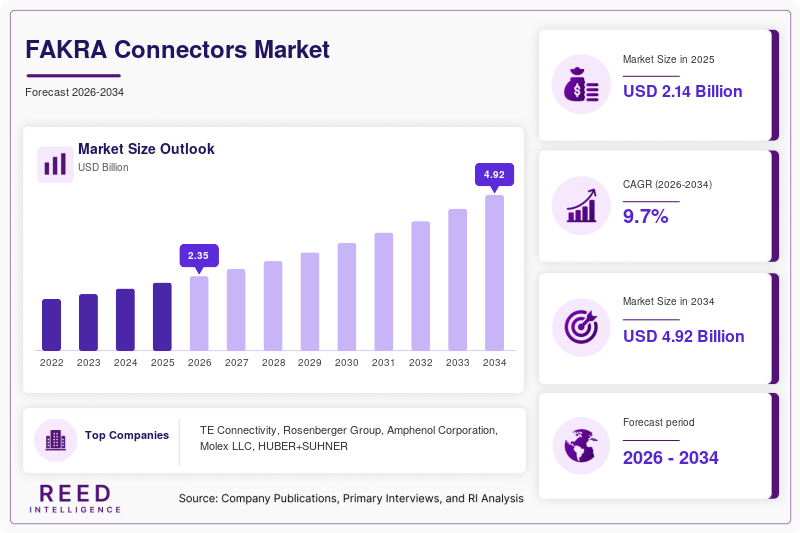
The global FAKRA Connectors Market size was valued at approximately USD 2.14 billion in 2026 and is projected to reach USD 4.48 billion by 2034, expanding at a CAGR of 9.7% during 2026–2034. The market continues to gain momentum due to the increasing integration of advanced connectivity systems across automotive, transportation, telecommunications, and industrial applications. FAKRA connectors are widely recognized for providing reliable high-frequency signal transmission, making them suitable for applications such as GPS modules, infotainment systems, telematics, antennas, cameras, radar systems, and autonomous driving platforms.
One of the primary global factors supporting market expansion is the rapid adoption of connected and software-defined vehicles. Automotive manufacturers are integrating a growing number of electronic control units, sensors, and communication modules that require secure and interference-resistant connectivity solutions. FAKRA connectors have become an industry-standard interface for high-speed data communication, particularly in modern passenger and commercial vehicles.
Key Highlights
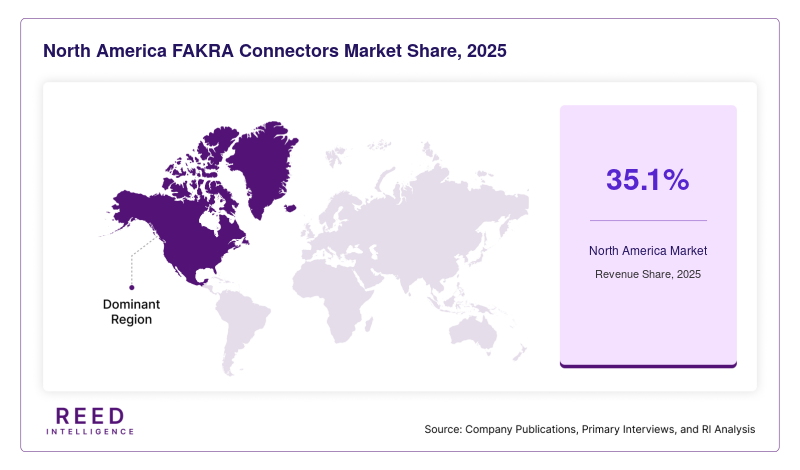
- North America dominated the market with a 35.1% share in 2025, while Asia Pacific is expected to grow at the fastest CAGR of 11.4% during 2026–2034.
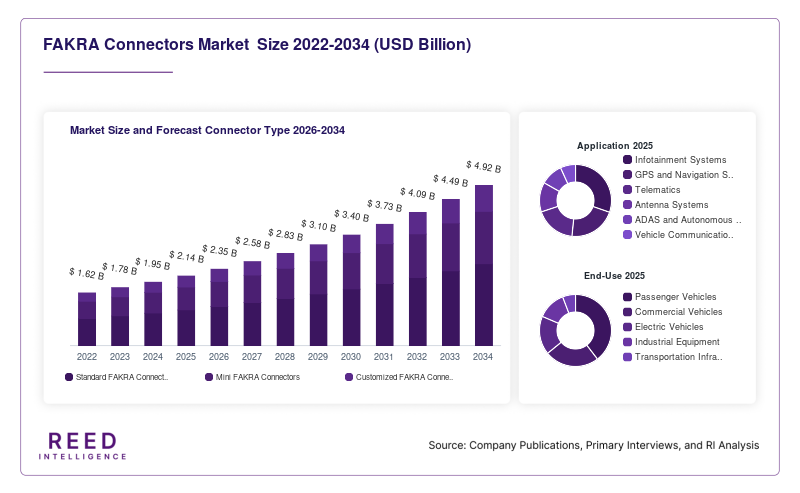
- By connector type, Standard FAKRA Connectors accounted for the largest share of 44.6%, while Mini FAKRA Connectors are projected to grow at a CAGR of 12.8%.
- By application, Infotainment Systems led with a 39.8% share, whereas ADAS and Autonomous Driving Systems are expected to expand at a CAGR of 13.1%.
- By end-use, Passenger Vehicles represented the largest share of 63.4%, while Electric Vehicles are forecast to grow at a CAGR of 14.2%.
- The United States remained the dominant country, with market values of USD 612 million in 2024 and USD 672 million in 2025.
Market Trends
Expansion of Miniaturized High-Speed Connectivity Solutions
A notable trend shaping the FAKRA Connectors Market is the transition toward compact and lightweight connectivity architectures. Automotive manufacturers are continuously increasing the number of electronic systems installed in vehicles while simultaneously attempting to reduce overall vehicle weight. This objective has accelerated the adoption of miniaturized connector technologies capable of supporting high-frequency signal transmission without compromising performance. Mini FAKRA connectors are gaining significant acceptance because they occupy less installation space while enabling multiple high-speed communication channels. The trend is particularly visible in premium vehicles equipped with advanced infotainment, telematics, camera systems, and sensor networks. Suppliers are investing heavily in compact connector designs that improve signal integrity and simplify cable management requirements.
Growing Integration of Autonomous Driving Technologies
The increasing deployment of advanced driver assistance systems and autonomous driving technologies is influencing product development across the industry. Modern vehicles rely on a complex ecosystem of cameras, radar modules, lidar sensors, GPS systems, and vehicle communication networks. Each of these technologies requires stable and interference-resistant data transmission. FAKRA connectors have become an important component within these architectures because they provide secure and high-frequency connectivity under demanding operating conditions. As automotive manufacturers progress toward higher levels of vehicle automation, connector density and bandwidth requirements continue to rise. This trend is encouraging suppliers to introduce next-generation products designed to support higher data rates, enhanced shielding performance, and improved reliability for autonomous mobility platforms.
Market Drivers
Rising Production of Connected and Electric Vehicles
The growing global production of connected and electric vehicles represents a major growth driver for the FAKRA Connectors Market. Vehicle manufacturers are increasingly integrating advanced communication systems, navigation platforms, telematics units, and remote diagnostic technologies. These features require robust connectivity components capable of maintaining stable signal transmission under varying environmental conditions. FAKRA connectors are widely preferred because they offer standardized interfaces and reliable RF performance. Electric vehicles further strengthen market demand due to their dependence on sophisticated electronic architectures. As governments continue promoting vehicle electrification through incentives and emission regulations, automotive manufacturers are expanding production capacities, creating sustained demand for high-performance connector solutions across multiple vehicle platforms.
Increasing Demand for Advanced Driver Assistance Systems
Advanced driver assistance systems have become a standard feature in many vehicle categories, supporting market expansion significantly. Features such as adaptive cruise control, lane departure warning, automatic emergency braking, parking assistance, and surround-view monitoring rely on a network of sensors and communication modules. These systems generate substantial volumes of data that must be transmitted accurately and efficiently. FAKRA connectors provide the electromagnetic shielding and signal integrity required for reliable system performance. Growing consumer awareness regarding vehicle safety and regulatory requirements mandating advanced safety technologies are encouraging manufacturers to integrate more ADAS features. This development directly contributes to rising demand for specialized RF connectivity components throughout the automotive sector.
Market Restraint
High Dependence on Automotive Industry Cycles
One of the primary restraints affecting the FAKRA Connectors Market is its strong dependence on automotive manufacturing activity. A substantial portion of connector demand originates from passenger vehicles, commercial vehicles, and emerging electric mobility platforms. As a result, fluctuations in vehicle production volumes can significantly influence market performance. Economic slowdowns, supply chain disruptions, semiconductor shortages, and changing consumer purchasing behavior can reduce vehicle output and delay technology investments. These conditions often impact procurement activities throughout the automotive electronics supply chain. For example, temporary production reductions at major automotive manufacturing facilities can lead to lower demand for infotainment systems, telematics units, and ADAS modules, ultimately affecting connector shipments. Additionally, automotive manufacturers frequently exert pricing pressure on suppliers, creating margin challenges for connector producers. The need to comply with evolving technical standards while maintaining competitive pricing further increases operational complexity. These factors collectively limit market expansion potential, particularly during periods of economic uncertainty and industry-wide production adjustments.
Market Opportunities
Expansion of Vehicle-to-Everything Communication Infrastructure
The development of vehicle-to-everything communication networks presents significant growth opportunities for market participants. Governments and transportation authorities worldwide are investing in intelligent transportation systems designed to improve traffic management, road safety, and mobility efficiency. These ecosystems require continuous communication between vehicles, infrastructure, and cloud-based platforms. FAKRA connectors support high-frequency data transmission needed for reliable communication modules and antenna systems. As connected mobility projects expand across urban and highway networks, manufacturers can benefit from increasing deployment of communication-enabled vehicles. The growing emphasis on smart transportation infrastructure is expected to create long-term demand for advanced connector technologies capable of supporting evolving connectivity requirements.
Rising Adoption in Commercial and Industrial Applications
Although automotive applications remain the largest revenue contributor, commercial and industrial sectors are creating new opportunities for market growth. High-frequency connectivity solutions are increasingly being utilized in industrial automation equipment, transportation systems, agricultural machinery, and specialized communication devices. These applications require durable connectors capable of maintaining performance in harsh operating environments. Manufacturers are developing customized FAKRA connector solutions tailored to industry-specific requirements, including vibration resistance, environmental protection, and enhanced electromagnetic compatibility. As digitalization initiatives accelerate across industrial sectors, demand for reliable communication infrastructure is expected to increase. This diversification beyond traditional automotive applications provides suppliers with opportunities to expand revenue streams and reduce dependence on a single end-use industry.
Segmental Analysis
By Connector Type
Standard FAKRA Connectors represented the dominant subsegment, accounting for approximately 44.6% of market share in 2024. These connectors continue to serve as the preferred solution across numerous automotive communication applications due to their proven reliability, standardized design, and broad compatibility with existing vehicle architectures. Automotive manufacturers extensively utilize standard connectors in infotainment systems, GPS modules, radio antennas, and telematics devices. Their widespread acceptance within the industry has resulted in significant economies of scale and established supply chains. Additionally, their ability to deliver consistent signal performance under challenging environmental conditions makes them suitable for both passenger and commercial vehicle applications. Continued integration of communication technologies into vehicles further reinforces their market position.
Mini FAKRA Connectors are projected to be the fastest-growing subsegment, advancing at a CAGR of 12.8% during the forecast period. The increasing complexity of automotive electronic architectures is encouraging manufacturers to adopt smaller and lighter connectivity solutions. Mini FAKRA products provide comparable performance while reducing installation space requirements, making them ideal for modern vehicles containing numerous communication modules and sensors. Growing deployment of advanced driver assistance systems, high-resolution cameras, and autonomous driving technologies is accelerating demand. Furthermore, vehicle manufacturers are focusing on reducing weight and optimizing internal packaging efficiency. These factors are encouraging broader adoption of miniaturized connector platforms across emerging mobility solutions and next-generation automotive designs.
By Application
Infotainment Systems held the largest market share, accounting for approximately 39.8% of global revenue in 2024. Modern consumers increasingly expect vehicles to provide seamless connectivity, navigation capabilities, multimedia functionality, and smartphone integration. As a result, automotive manufacturers continue to expand infotainment system capabilities across all vehicle categories. FAKRA connectors play a critical role in ensuring stable communication between displays, antennas, navigation modules, and communication units. The widespread deployment of connected infotainment platforms has generated substantial demand for reliable RF connectors. Continuous improvements in user experience, digital services, and in-vehicle entertainment technologies are expected to sustain the segment's leadership position throughout the forecast period.
ADAS and Autonomous Driving Systems are anticipated to register the fastest CAGR of 13.1% between 2026 and 2034. The rapid adoption of safety technologies and automated driving features is driving increased deployment of cameras, radar modules, lidar sensors, and communication systems. These components require high-performance connectivity solutions capable of maintaining data integrity and minimizing signal interference. FAKRA connectors provide the reliability necessary for mission-critical applications where system accuracy directly affects vehicle safety. Regulatory support for advanced safety features and ongoing investments in autonomous mobility research continue to stimulate demand. As vehicles progress toward higher automation levels, connectivity requirements are expected to increase significantly, supporting long-term growth within this segment.
By End-Use
Passenger Vehicles dominated the market with approximately 63.4% share in 2024. The segment benefits from high production volumes and increasing consumer demand for connected mobility features. Manufacturers are integrating advanced infotainment systems, navigation technologies, telematics solutions, and safety features into passenger vehicles across multiple price categories. This trend has significantly increased the number of communication modules and RF connections required per vehicle. FAKRA connectors are extensively utilized to support these systems, ensuring stable and secure signal transmission. Rising consumer expectations regarding convenience, safety, and digital connectivity continue to encourage automakers to adopt more sophisticated electronic architectures, reinforcing demand within the passenger vehicle segment.
Electric Vehicles are projected to be the fastest-growing end-use subsegment, expanding at a CAGR of 14.2% during 2026–2034. EV manufacturers are heavily focused on software-driven functionality, connectivity, remote diagnostics, and intelligent energy management systems. These vehicles typically incorporate a higher concentration of electronic components and communication modules compared with conventional vehicles. As governments continue implementing policies supporting vehicle electrification, global EV production is expected to increase substantially. This growth creates favorable conditions for connector manufacturers supplying high-frequency communication solutions. The increasing integration of autonomous capabilities, connected services, and advanced battery monitoring systems further strengthens the demand outlook for FAKRA connectors within the electric vehicle ecosystem.
Regional Analysis
North America
North America accounted for approximately 35.1% of the global FAKRA Connectors Market in 2025, making it the largest regional market. The region benefits from strong automotive technology adoption, extensive research activities, and growing investments in connected mobility solutions. Demand for advanced infotainment systems, telematics platforms, and vehicle communication technologies continues to support market expansion. The region is projected to register a CAGR of approximately 8.9% during 2026–2034, supported by increasing vehicle electronics integration and continued investment in automotive innovation.
The United States remains the dominant country in the region. A key growth factor is the country's strong focus on autonomous vehicle development and connected transportation ecosystems. Automotive manufacturers and technology providers are collaborating extensively to introduce advanced safety systems and vehicle communication platforms. These initiatives are creating sustained demand for high-performance RF connectors capable of supporting next-generation mobility architectures.
Europe
Europe represented around 28.7% of global market revenue in 2025 and continues to be a significant contributor to industry growth. The region's automotive sector emphasizes technological innovation, premium vehicle production, and stringent safety regulations. Demand for advanced connectivity solutions is increasing as manufacturers integrate additional sensors, communication modules, and electronic systems into vehicles. The regional market is expected to grow at a CAGR of 8.6% through 2034, supported by expanding electrification initiatives.
Germany dominates the European market due to its strong automotive manufacturing base and leadership in engineering innovation. A unique growth factor is the country's extensive investment in electric vehicle platforms and digital vehicle architectures. Automakers are integrating increasingly sophisticated communication systems, which require dependable connector technologies capable of supporting high-speed data transmission and enhanced system reliability.
Asia Pacific
Asia Pacific held approximately 24.8% market share in 2025 and is anticipated to record the fastest growth during the forecast period. Rapid urbanization, rising vehicle production, and increasing consumer demand for technologically advanced vehicles are supporting market expansion. The region is forecast to achieve a CAGR of 11.4% between 2026 and 2034. Significant investments in automotive electronics manufacturing and communication technologies continue to strengthen regional demand.
China remains the leading country within Asia Pacific. A major growth factor is the country's large-scale electric vehicle manufacturing ecosystem. Domestic and international automotive companies are rapidly expanding production capacities while integrating sophisticated infotainment and autonomous driving technologies. This trend is generating substantial demand for FAKRA connectors across both conventional and electric vehicle platforms.
Middle East & Africa
The Middle East & Africa accounted for approximately 5.4% of global revenue in 2025. Although relatively smaller in market size, the region is witnessing steady adoption of connected transportation technologies and advanced vehicle systems. Growing investments in transportation infrastructure and increasing demand for premium vehicles are supporting market development. The regional market is projected to expand at a CAGR of 7.8% during the forecast period, reflecting gradual technological advancement across key economies.
United Arab Emirates represents the leading country in the region. A distinctive growth factor is the government's emphasis on smart city development and intelligent mobility initiatives. Investments in connected infrastructure, digital transportation systems, and advanced communication networks are encouraging adoption of high-frequency connectivity components, including FAKRA connectors, across various transportation applications.
Latin America
Latin America captured approximately 6.0% of the global market in 2025 and is expected to experience moderate but consistent growth. The region's automotive industry continues to recover and modernize, with manufacturers increasing integration of electronic systems and safety technologies. Demand for connectivity solutions is rising as consumers seek vehicles equipped with advanced infotainment and navigation features. The regional market is forecast to register a CAGR of 8.1% through 2034.
Brazil remains the dominant country within Latin America. A significant growth factor is the gradual modernization of domestic vehicle production facilities and increasing adoption of connected vehicle technologies. Automotive manufacturers are introducing newer vehicle models equipped with enhanced communication systems, creating opportunities for connector suppliers seeking expansion in emerging regional markets.
Competitive Landscape
The FAKRA Connectors Market is characterized by the presence of established connector manufacturers competing through product innovation, technological expertise, and strategic partnerships with automotive OEMs. Companies are increasingly investing in high-speed connectivity solutions designed to address the evolving requirements of connected and autonomous vehicles. Competition is centered on product reliability, miniaturization capabilities, electromagnetic shielding performance, and compliance with automotive industry standards.
Among leading participants, TE Connectivity maintains a strong market position due to its extensive product portfolio, global manufacturing footprint, and long-standing relationships with automotive manufacturers. The company continues to expand its advanced RF connectivity offerings to support next-generation vehicle architectures.
Key Players
- TE Connectivity
- Rosenberger Group
- Amphenol Corporation
- Molex LLC
- HUBER+SUHNER
- Yazaki Corporation
- Sumitomo Wiring Systems
- Japan Aviation Electronics Industry Ltd.
- Radiall SA
- IMS Connector Systems
- Hirose Electric Co., Ltd.
- Delphi Technologies
- Aptiv PLC
- Luxshare Precision Industry
- Würth Elektronik
Recent Developments
- In 2025, a leading connector manufacturer introduced a new Mini FAKRA connector series designed to support higher bandwidth requirements for autonomous driving applications.
- In 2025, an automotive electronics supplier expanded production capacity for RF connectivity components to meet increasing demand from electric vehicle manufacturers.
- In 2024, a major connector company launched enhanced shielding technologies aimed at improving signal integrity in advanced driver assistance systems.
- In 2024, several automotive OEMs collaborated with connectivity solution providers to standardize next-generation communication architectures for connected vehicles.
- In 2025, industry participants increased investments in lightweight connector materials to support vehicle weight reduction and improved energy efficiency.
FAKRA Connectors Market Segments
Connector Type
- Standard FAKRA Connectors
- Mini FAKRA Connectors
- Customized FAKRA Connectors
Application
- Infotainment Systems
- GPS and Navigation Systems
- Telematics
- Antenna Systems
- ADAS and Autonomous Driving Systems
- Vehicle Communication Modules
End-Use
- Passenger Vehicles
- Commercial Vehicles
- Electric Vehicles
- Industrial Equipment
- Transportation Infrastructure
By Region
- North America
- Europe
- APAC
- Middle East and Africa
- LATAM