Family Entertainment Centers Market Size, Share & Trends Analysis Report By Attraction Type (Arcade & Redemption Games, Indoor Play & Active Entertainment, Bowling & Skill-Based Attractions, VR/AR & Simulation Attractions, Mixed/Multi-Attraction Centers, Other Attractions), By Revenue Source (Admission & Tickets, Games & Attractions, Food & Beverage, Parties & Events, Merchandise & Other), By Visitor Demographic (Families With Children 0–8, Families With Children 9–12, Teenagers, Young Adults &
USD 3950
Family Entertainment Centers Market Size
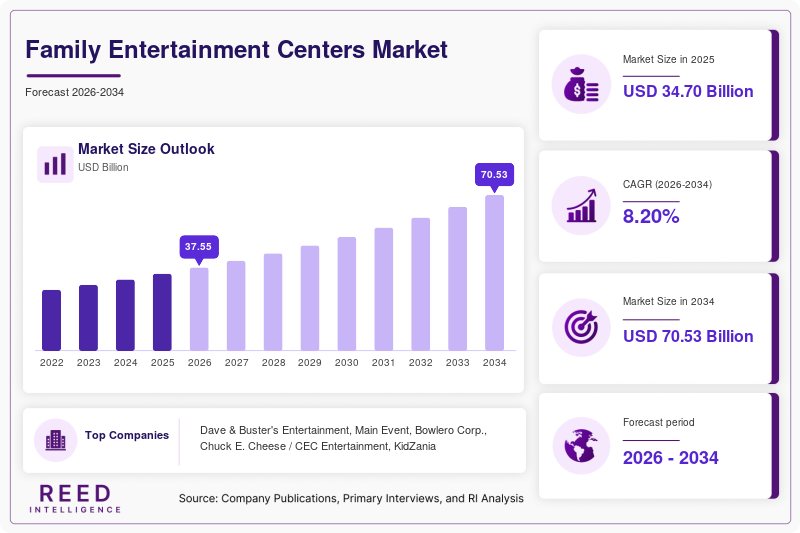
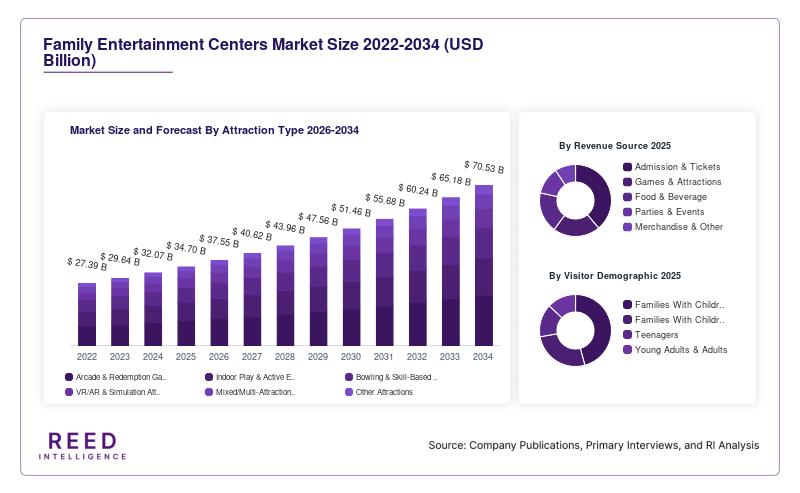
The global family entertainment centers market is valued at USD 34.70 Billion in 2025 and USD 37.55 Billion in 2026. The market is projected to reach USD 70.53 Billion by 2034, registering a 8.20% CAGR during the forecast period.
The family entertainment centers market is evolving from traditional arcade-led venues into diversified indoor leisure destinations that combine gaming, active play, bowling, immersive technology, food and beverage, birthday celebrations, social activities and other experiences under one roof.
The shift toward multi-attraction formats is becoming a defining feature of the industry. The International Association of Amusement Parks and Attractions reported in September 2026 that hybrid entertainment was becoming a durable FEC trend, with operators increasingly combining arcades, bowling, active play, competitive socializing, mini-golf, simulators and darts rather than depending on a single headline attraction. IAAPA also highlighted the increasing importance of food and beverage, connected operations, memberships and bundled-value offers.
Family Entertainment Centers Market Drivers
Consumers increasingly prefer multi-activity experiential destinations
The shift away from single-purpose entertainment is widening the role of FECs. Families and groups increasingly want venues where different members can participate in different activities without leaving the facility.
IAAPA's September 2026 FEC analysis identifies this hybrid model as a persistent trend, noting that successful facilities increasingly combine arcade games, bowling, active play, competitive socializing, mini-golf, simulators and other activities.
The commercial mechanism is higher dwell time and more opportunities to capture spending during the same visit. A family can combine arcade play with food, a birthday package, bowling or an immersive attraction, increasing the number of monetization points available to operators.
Dave & Buster's current reimagined format illustrates the strategy through High-Tech Darts, The Arena, Social Shuffle and large-format sports viewing integrated with its existing arcade and restaurant model.
Memberships, bundled packages and food services are increasing revenue per visit
FEC operators are increasingly moving away from purely transactional admission and game spending toward recurring or bundled customer relationships.
IAAPA reports increasing use of memberships, unlimited-play offers, bundled experiences and value-oriented packages as operators respond to more selective consumer spending. Food and beverage is also becoming a more significant part of the visitor proposition rather than simply an ancillary amenity.
Chuck E. Cheese's 2026 Summer Fun Pass is an example of this shift. The three-tier program combines repeated access with gameplay allowances, food discounts, Adventure Zone savings and member events.
The mechanism is important for customer economics: memberships encourage repeat visitation while food, parties and additional attractions generate more spending opportunities during each visit.
Immersive and technology-enabled attractions are broadening the FEC audience
VR, simulation, digital sports experiences, interactive floors and connected games are expanding the range of activities available inside family entertainment centers.
Chuck E. Cheese and asmodee's June 2026 partnership brought Spot It! into more than 500 Chuck E. Cheese locations through interactive floor activations, digital content, social engagement and location-based gameplay.
At the same time, IAAPA notes that the role of technology is expanding beyond attractions themselves. AI and data systems are increasingly being used to optimize pricing, labor, marketing, inventory and customer engagement.
Technology therefore affects both the front-end visitor experience and the back-end economics of operating a venue.
Family Entertainment Centers Market Restraints
High operating costs make attraction utilization and revenue per square foot increasingly important
FECs carry significant fixed and semi-fixed costs across rent, utilities, labor, equipment maintenance, food operations, technology, insurance and attraction replacement.
IAAPA's 2026 industry commentary indicates that guests have become more selective and operators are increasingly focused on experience, value, labor efficiency and revenue per square foot. It also notes that expensive attractions with weak throughput can face greater scrutiny because operators must manage labor and maintenance economics alongside the guest experience.
This places pressure on operators to continuously optimize attraction mix, staffing and pricing.
Competition for discretionary leisure spending can affect visitation patterns
FEC spending is discretionary and competes with cinemas, restaurants, outdoor attractions, digital entertainment, sports activities, shopping and home-based gaming.
This makes demand sensitive to household budgets and perceived value. IAAPA's current FEC analysis specifically highlights value as an increasing priority for families and points to the importance of packages and memberships that make entertainment spending easier to justify.
Operators therefore need continuous attraction refreshes and flexible pricing without allowing promotions to erode unit economics.
Family Entertainment Centers Market Opportunities
Hybrid FECs can combine family entertainment with hospitality and social experiences
The strongest structural opportunity is the development of FECs that operate as complete social destinations rather than simple gaming venues.
IAAPA's 2026 outlook describes the emerging convergence of entertainment and hospitality, with facilities increasingly combining eating, competing, celebrating, playing and socializing.
This creates opportunities for concepts that combine bowling, arcade gaming, food halls, competitive socializing, karaoke, mini-golf, sports viewing, VR, party rooms and event spaces.
The model can also extend into adult-oriented sessions during non-peak family hours, allowing venues to increase utilization across different parts of the day.
Inclusive, educational and family-oriented programming can increase repeat visitation
FECs can broaden their audience by adding experiences for different age groups and accessibility needs.
Chuck E. Cheese introduced Sensory Sensitive Birthdays in 2026 and continued accessibility programming with the American Society for Deaf Children, while KidZania has expanded its offer to include adult participation in role-play activities.
Educational programming also creates additional demand outside conventional weekend leisure. KidZania offers school visits and STEAM-oriented experiences, creating a bridge between recreation and structured learning.
These models can support weekday utilization, group bookings, school excursions, birthday events and corporate activities.
Attraction Type Analysis
Arcade & Redemption Games remain the dominant attraction category
Arcade and redemption games continue to form the core of the traditional FEC model because they offer repeatable gameplay, relatively flexible floor layouts and direct monetization through credits, play cards and prize redemption.
The Arcade & Redemption Games segment accounts for 32% of the global market in 2026 and is projected to register a 7.40% CAGR.
The segment is increasingly being integrated with loyalty systems, cashless payments and digital rewards rather than operating as a standalone arcade area. IAAPA identifies connected operations that link attractions, redemption, food, parties and loyalty as a continuing industry trend.
VR/AR & Simulation Attractions are the fastest-growing major attraction category
Immersive technology is expanding the FEC proposition by offering experiences that cannot easily be replicated through conventional arcade games.
The VR/AR & Simulation Attractions segment accounts for 15% of the global market in 2026 and is projected to register a 10.20% CAGR, making it the fastest-growing major attraction category.
Growth is supported by improved immersive hardware, shorter experience formats, multiplayer systems and the ability to refresh content without rebuilding the entire venue.
Revenue Source Analysis
Admission & Tickets remain the dominant revenue source
Admission and ticket revenue remains central because visitors typically enter an FEC through paid access, attraction tickets, bundled packages or activity-based charges.
The Admission & Tickets segment accounts for 34% of the global market in 2026 and is projected to register a 7.60% CAGR.
The category continues to evolve through bundled admissions, all-day passes, timed-entry attractions and membership-linked access.
Food & Beverage is the fastest-growing major revenue source
Food and beverage is increasingly becoming a core component of the FEC economics rather than an ancillary service.
The Food & Beverage segment accounts for 19% of the global market in 2026 and is projected to register a 9.40% CAGR, making it the fastest-growing major revenue category.
IAAPA identifies food and beverage as an increasingly important contributor to visitor experience, dwell time and profitability, with operators improving menus, shareable formats and higher-speed service models.
Regional Analysis
North America Family Entertainment Centers Market
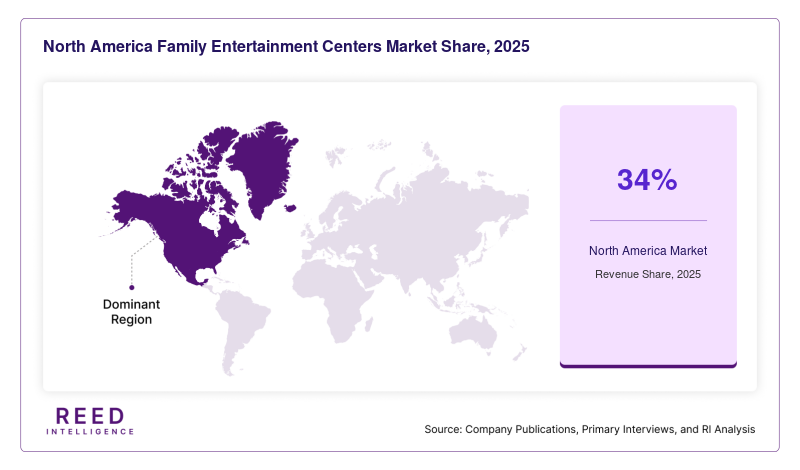
North America retains the largest share because of its established FEC operator base, mature indoor-entertainment ecosystem, high penetration of arcade and bowling formats and concentration of large multi-attraction brands.
The North America region accounts for 34% of the global market in 2026 and is projected to register a 7.40% CAGR.
Dave & Buster's and Main Event together operate 250 North American venues, while Bowlero reported 366 locations across the United States, Canada and Mexico as of June 28, 2026, including 9 Boomers and other FEC locations.
The region is also a major testing ground for membership programs, active-play formats, cashless gaming, food-led entertainment and technologically enhanced attractions.
APAC is the fastest-growing regional market Market
APAC is expanding rapidly because of urbanization, rising organized leisure participation, mall-based entertainment development, growing middle-class consumption and increasing availability of indoor recreational formats.
The APAC region accounts for 27% of the global market in 2026 and is projected to register a 10.10% CAGR, making it the fastest-growing region.
The region includes expanding markets such as China, India, Southeast Asia, Japan, South Korea and Australia. KidZania's operations in India and its increasing use of educational, family and adult-oriented programming illustrate how operators can broaden utilization beyond traditional children's entertainment.
Europe Family Entertainment Centers Market
Europe benefits from established leisure infrastructure, strong shopping-center ecosystems and increasing demand for experiential entertainment.
The region is projected to register a 7.80% CAGR, with operators increasingly combining food, gaming, active play and social experiences.
Middle East and Africa Family Entertainment Centers Market
Middle East and Africa demand is being supported by mall development, tourism, urban entertainment projects and growing interest in indoor family recreation.
The region is projected to register a 9.00% CAGR, with opportunities concentrated in high-traffic shopping and leisure destinations.
LATAM Family Entertainment Centers Market
LATAM is developing through shopping-center expansion, urbanization, family-oriented leisure demand and growing investment in organized entertainment.
The region is projected to register a 8.60% CAGR, with major opportunities in Brazil, Mexico and other large urban markets.
Competitive Landscape
The family entertainment centers market is fragmented across large multi-location operators, bowling and social-entertainment groups, children's entertainment brands, edutainment concepts, indoor adventure operators and regional independent venues.
Dave & Buster's Entertainment operates the Dave & Buster's and Main Event brands. As of September 2026, the company reported 250 North American venues, including 184 Dave & Buster's locations and 66 Main Event locations. Main Event combines bowling, laser tag, arcade games and virtual reality, while Dave & Buster's continues to expand its reimagined format with High-Tech Darts, The Arena, Social Shuffle and enhanced sports viewing.
Key Market Players
- Dave & Buster's Entertainment
- Main Event
- Bowlero Corp.
- Chuck E. Cheese / CEC Entertainment
- KidZania
- Round1 Bowling & Amusement
- Urban Air Adventure Park
- Sky Zone
- Scene75 Entertainment Centers
- Andretti Indoor Karting & Games
- Altitude Trampoline Park
- LEGOLAND Discovery Center
- Big Thrill Factory
- Punch Bowl Social
- Major Regional and Independent FEC Operators
Recent Developments
September 2026 – Dave & Buster's reported continued venue expansion and remodeling in its second-quarter fiscal 2026 results. The company opened six new domestic stores during the second quarter, expected to complete eight fiscal-2026 remodels in total, and reported six international franchise stores with at least one additional international franchise opening expected during the remainder of the fiscal year. The update also highlighted continued investment in food and beverage, special events and remodeled locations.
September 2026 – Chuck E. Cheese published its inaugural State of the Birthday Party Report. The report provides research into children's preferences and parents' expectations around birthday celebrations, reinforcing the importance of birthday parties as a recurring FEC demand and monetization channel.
Family Entertainment Centers Market Segments
By Attraction Type
- Arcade & Redemption Games
- Indoor Play & Active Entertainment
- Bowling & Skill-Based Attractions
- VR/AR & Simulation Attractions
- Mixed/Multi-Attraction Centers
- Other Attractions
By Revenue Source
- Admission & Tickets
- Games & Attractions
- Food & Beverage
- Parties & Events
- Merchandise & Other
By Visitor Demographic
- Families With Children 0–8
- Families With Children 9–12
- Teenagers
- Young Adults & Adults
By Region
- North America
- Europe
- APAC
- Middle East and Africa
- LATAM