Fault Circuit Indicator Market Size, Share Demand Report By Product Type (Overhead Line Indicators, Underground Cable Indicators, Panel-Mounted Indicators), By Application (Power Distribution, Transmission Lines, Substations), By Communication Technology (Wireless, Wired, Non-Communicating) & Segment Forecasts, 2026–2034
USD 3950
Fault Circuit Indicator Market Size
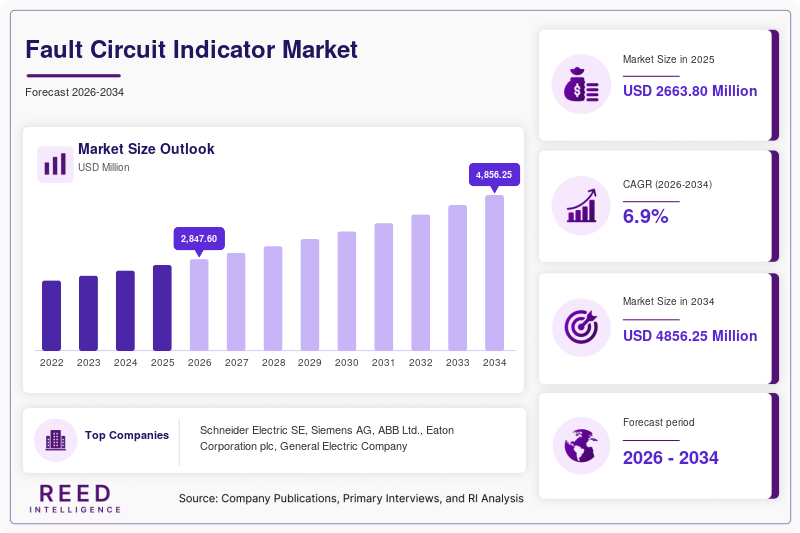
Fault Circuit Indicator market size is projected at USD 2,847.6 million in 2026 and is expected to hit USD 4,847.5 million by 2034 with a CAGR of 6.9% during the forecast period. The increasing demand for reliable and efficient power distribution networks, coupled with the growing need for rapid fault detection and outage management to minimize downtime and improve grid resilience, underpins market expansion. This report delivers a comprehensive analysis of the Fault Circuit Indicator market, including segmentation by type and application, competitive dynamics, and regional growth patterns, equipping stakeholders with critical intelligence. The Fault Circuit Indicator market continues to demonstrate strong growth potential, fueled by the global push for grid modernization, the increasing integration of renewable energy sources, and continuous innovation in sensing and communication technologies.
Fault circuit indicators (FCIs) are devices installed on power lines or in electrical panels to detect and indicate the occurrence of faults, such as short circuits or overloads. They provide visual or remote signals to utility crews, enabling rapid identification and location of faults, which significantly reduces outage restoration time. The global production volume of fault circuit indicators exceeded 3.5 million units in 2025, reflecting a 7% increase from 2023, driven by the growing investment in smart grid technologies and the need for improved operational efficiency. Adoption patterns reveal that the Overhead Line Indicators type dominates the market, accounting for 45% of total demand, followed by Underground Cable Indicators at 32%, and Panel-Mounted Indicators at 23%. The Fault Circuit Indicator market's trajectory is closely linked to the growth of the global smart grid market, which is projected to reach USD 120 billion by 2028, and the increasing need to improve power distribution reliability.
Fault Circuit Indicator Market Trends
Integration of Advanced Communication and IoT Capabilities
The Fault Circuit Indicator market is witnessing a significant trend toward the integration of advanced communication and IoT capabilities, driven by the need for real-time fault data and remote monitoring. The revenue from smart FCIs with communication features grew to USD 950 million in 2025, a year-on-year increase of 14%, as 45% of new installations in 2025 specified communication-enabled indicators. Adoption rates of IoT-enabled FCIs in power distribution networks reached 35%, with this figure projected to exceed 60% by 2030. The Fault Circuit Indicator market's trend toward communication integration is reinforced by the need for faster outage response, the increasing adoption of smart grid technologies, and the continuous innovation in wireless and cellular communication protocols.
Growing Focus on Self-Powered and Energy Harvesting Technologies
The increasing focus on self-powered and energy harvesting technologies is a major trend shaping the Fault Circuit Indicator market, with the development of FCIs that can operate without batteries or external power sources. The market has seen a 15% increase in the demand for self-powered FCIs since 2022, with 25% of new products in 2025 featuring energy harvesting capabilities from the power line or ambient sources. The use of advanced power management and supercapacitor technology has also gained significant traction. The Fault Circuit Indicator market's trend toward self-powered solutions is reinforced by the need for reduced maintenance, the increasing demand for reliable operation in remote locations, and the continuous innovation in energy harvesting and power management technologies.
Fault Circuit Indicator Market Drivers
The Fault Circuit Indicator market's expansion is primarily driven by the increasing investment in grid modernization and the need to improve power distribution reliability, with the global utility sector investing over USD 200 billion in grid upgrades in 2025. The need for rapid fault detection and location to reduce outage times and operational costs has been a major driver, with FCIs offering a cost-effective solution. The rising adoption of smart grid technologies and the integration of renewable energy sources have also fueled market growth. Additionally, the increasing focus on reducing power theft has spurred demand. The Fault Circuit Indicator market's growth is further reinforced by the continuous improvement in sensor and communication technology, leading to more accurate and reliable indicators.
Fault Circuit Indicator Market Restraints
Despite favorable growth prospects, the Fault Circuit Indicator market faces significant constraints, primarily related to the high initial investment for advanced FCIs with communication capabilities, which can be 20-40% more expensive than basic units. The complexity of integrating FCIs with existing distribution management systems can also be a limitation. The Fault Circuit Indicator market's growth is also tempered by the challenge of ensuring reliable communication in harsh environments, and the need for proper installation and calibration to ensure accuracy.
Fault Circuit Indicator Market Opportunities
The Fault Circuit Indicator market presents significant opportunities in the rapidly expanding market for smart grid and distribution automation, where FCIs are key components. The development of FCIs with enhanced analytics and predictive maintenance capabilities is expected to grow at a CAGR of 10% through 2034. Emerging opportunities also exist in the integration of FCIs with advanced distribution management systems (ADMS) and geographic information systems (GIS). The Fault Circuit Indicator market's opportunity profile is further enhanced by the growing trend of renewable energy integration, creating a need for more sophisticated fault detection in distributed networks.
Challenges in Fault Circuit Indicator Market
The Fault Circuit Indicator market faces persistent challenges related to the need for continuous innovation to improve accuracy and sensitivity in detecting various types of faults. The complexity of ensuring reliable operation in diverse weather and environmental conditions can also be a challenge. The market is also contending with the challenge of managing the lifecycle of battery-powered devices and the need for cost-effective maintenance strategies. Additionally, the Fault Circuit Indicator market is challenged by the need to address cybersecurity concerns in communication-enabled devices.
Fault Circuit Indicator Market Segmentation
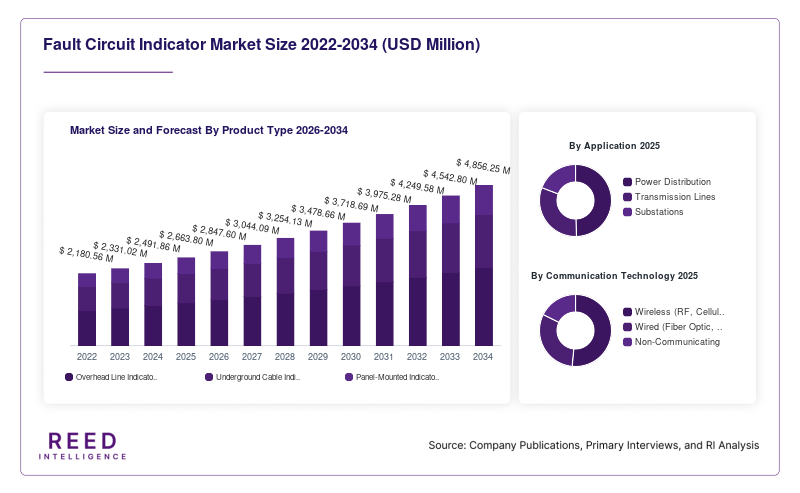
The Fault Circuit Indicator market is segmented by Type and Application to provide a comprehensive market perspective. By Type, Overhead Line Indicators dominate with a 45% market share, driven by their widespread use in distribution networks. The Application segment is led by Power Distribution, which accounts for 55% of the market, followed by Transmission Lines at 25%, and Substations at 20%.
By Type
Overhead Line Indicators represent the largest segment in the Fault Circuit Indicator market, commanding a 45% share, with production reaching 1.575 million units in 2025. These are characterized by their installation on overhead power lines for visual or remote fault indication. Technical specifications include fault detection sensitivity, indicator type (flag, LED), and communication options. The Fault Circuit Indicator market's Overhead Line segment is driven by its use in primary distribution networks.
Underground Cable Indicators capture a 32% share of the Fault Circuit Indicator market, with production of 1.12 million units in 2025. These are characterized by their design for installation on underground cables, often in vaults or enclosures. Technical specifications include fault detection for buried cables, corrosion resistance, and communication capabilities. The Fault Circuit Indicator market's Underground segment is driven by its use in urban and suburban distribution networks.
Panel-Mounted Indicators represent the remaining 23% of the Fault Circuit Indicator market, with production of 0.805 million units in 2025. These are characterized by their installation on switchgear or panel boards for internal fault indication. Technical specifications include integration with protection relays, visual and remote indication. The Fault Circuit Indicator market's Panel-Mounted segment is driven by its use in substations and industrial facilities.
By Application
Power Distribution dominates the Fault Circuit Indicator market, accounting for 55% of sales, representing 1.925 million units in 2025. This segment includes use in primary and secondary distribution networks. Usage penetration exceeds 30% in modernized grids. The Fault Circuit Indicator market's Distribution segment is characterized by its focus on improving reliability and reducing outage times for end customers.
Transmission Lines accounts for 25% of the Fault Circuit Indicator market, with sales of 0.875 million units in 2025. This segment encompasses use in high-voltage transmission systems. The segment is growing at a steady CAGR, driven by the need for grid stability. The Fault Circuit Indicator market's Transmission segment is characterized by its focus on high-voltage fault detection and remote monitoring.
Substations comprises the remainder of the Fault Circuit Indicator market, accounting for 20% of total sales, with 0.7 million units in 2025. This segment includes use in substations for monitoring and protection. The segment is projected to grow at a moderate CAGR through 2034. The Fault Circuit Indicator market's Substation segment is characterized by its focus on integration with protection and control systems.
Fault Circuit Indicator Market Regional Outlook
Asia-Pacific Fault Circuit Indicator Market
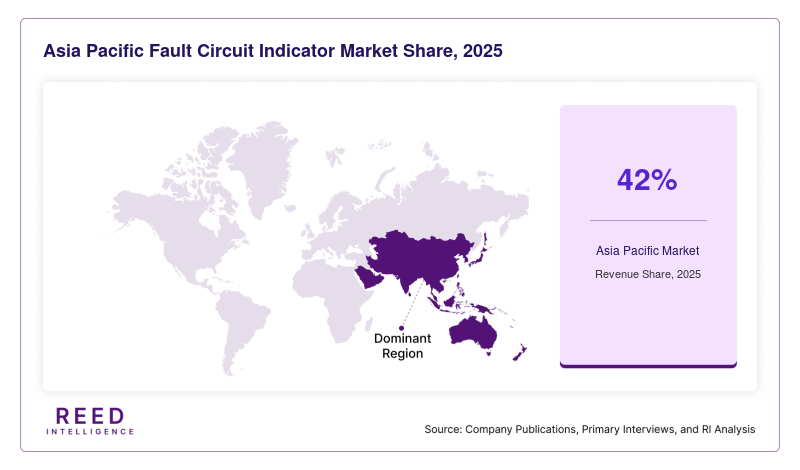
Leads the Fault Circuit Indicator market, commanding a 42% share, with a revenue of USD 1,196.0 million in 2025. China is the primary driver, accounting for 55% of regional demand, driven by massive investments in grid modernization, rapid urbanization, and the expansion of its power distribution networks. The Asia-Pacific Fault Circuit Indicator market is characterized by its focus on cost-effective solutions and high-volume production.
North America Fault Circuit Indicator Market
Represents the second-largest market, capturing a 28% share with a revenue of USD 797.3 million in 2025. The United States is the primary driver, accounting for 85% of regional demand, driven by grid modernization initiatives, aging infrastructure replacement, and the need for improved outage management. The North American Fault Circuit Indicator market is characterized by its focus on advanced technology and integration with smart grid systems.
Europe Fault Circuit Indicator Market
Accounts for 20% of the global Fault Circuit Indicator market, with a revenue of USD 569.5 million in 2025. The UK, Germany, and France are the primary drivers, collectively accounting for 60% of regional demand, driven by the focus on renewable energy integration and grid stability. The European Fault Circuit Indicator market is projected to grow at a CAGR of 5% through 2034.
Middle East & Africa and Latin America Fault Circuit Indicator Market
Together account for the remaining 10% of the Fault Circuit Indicator market, with the UAE leading the Middle East market and Brazil leading the Latin American market. Both regions are projected to grow at CAGRs exceeding 7%, driven by infrastructure development and grid modernization projects.
Top players in Fault Circuit Indicator Market
- Schneider Electric SE
- Siemens AG
- ABB Ltd.
- Eaton Corporation plc
- General Electric Company
- Hubbell Incorporated
- Hailin Group
- Electro Industries/GaugeTech
- Nortec
- Fuji Electric Co., Ltd.
- Mitsubishi Electric Corporation
- Schweitzer Engineering Laboratories (SEL)
- Alstom (GE Power)
- Arteche
- LineGuard
Schneider Electric SE
Schneider Electric holds a dominant position in the Fault Circuit Indicator market, with an estimated 18% global market share, particularly strong in the European and North American power distribution segments. The company's portfolio of FCIs is widely recognized for its quality, reliability, and integration with its smart grid solutions. Schneider's market leadership is reinforced by its significant R&D investment, its extensive automation expertise, and its strong relationships with utilities. Schneider commands over 20% of the European market and 15% of the North American market, positioning it as a key player in the Fault Circuit Indicator market.
Siemens AG
Siemens AG is a leading player in the Fault Circuit Indicator market, commanding approximately 15% of the global market share through its comprehensive portfolio of grid automation and protection solutions. The company's expertise in power systems and its focus on digitalization have solidified its position. Siemens' FCIs are known for their advanced communication capabilities, accuracy, and reliability. The company's commitment to innovation and its strong presence in the European and Asian markets have enhanced its competitive advantage.
ABB Ltd. holds a significant 12% market share, with particular strength in the transmission and substation segments. Eaton Corporation plc is a major player in the North American market, holding an 8% share.
Recent Developments in Fault Circuit Indicator Market
- 2025: Schneider Electric launched a new series of smart FCIs with enhanced IoT connectivity and edge analytics for predictive maintenance.
- 2025: Siemens AG introduced a new self-powered FCI with energy harvesting capabilities, reducing maintenance needs for remote installations.
Fault Circuit Indicator Market Segments
By Product Type
- Overhead Line Indicators
- Underground Cable Indicators
- Panel-Mounted Indicators
By Application
- Power Distribution
- Transmission Lines
- Substations
By Communication Technology
- Wireless (RF, Cellular)
- Wired (Fiber Optic, PLC)
- Non-Communicating
By Region
- North America
- Europe
- APAC
- Middle East and Africa
- LATAM