FCC Catalyst and Additives Market Size, Share & Trends Analysis Report By Type (FCC Catalysts, FCC Additives), By Product (Octane Number Improving Agents, Light Olefins Enhancing Agents, Sulfur-Reducing Agents, Metal Passivation Agents, and Other Products), By Application (Vacuum Gas Oil, Residue, Oil Refining, and Petrochemical Production) Forecasts 2026–2034
USD 3950
FCC Catalyst and Additives Market Size
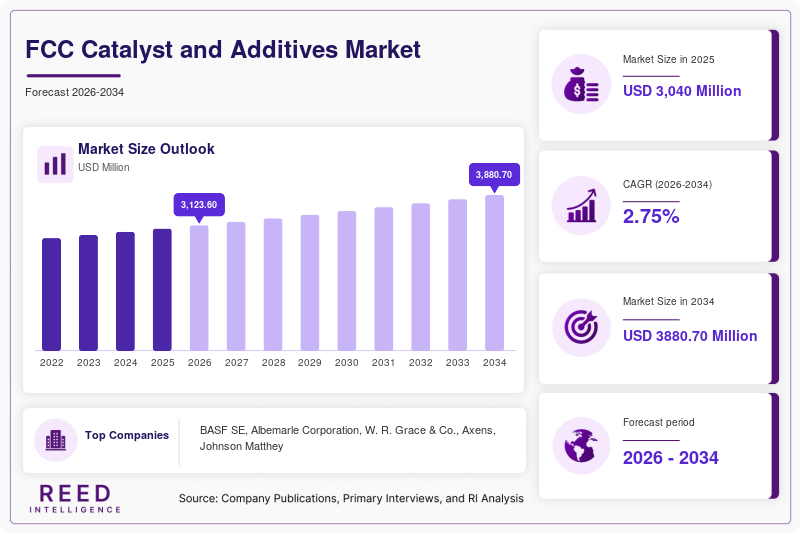
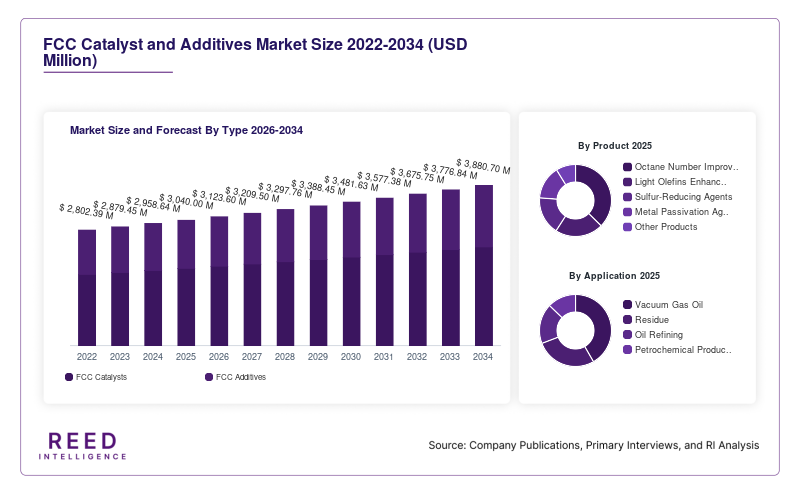
The global FCC catalyst and additives market size was valued at USD 3,040 million in 2025 and is projected to grow from USD 3,123.60 million in 2026 to USD 3,880.70 million by 2034, registering a CAGR of 2.75% during the forecast period from 2026 to 2034.
The FCC catalyst and additives market comprises catalysts and specialized chemical additives used in fluid catalytic cracking (FCC) units at petroleum refineries. FCC technology converts heavier hydrocarbon feedstocks, including vacuum gas oil and residue, into higher-value products such as gasoline, liquefied petroleum gas, light olefins, and petrochemical feedstocks. Catalysts facilitate the cracking reactions, while additives help refiners adjust product selectivity, manage contaminants, control emissions, and maintain operating performance.
Market demand is influenced by refinery utilization, crude-oil quality, the composition of feedstocks, fuel specifications, and the profitability of producing transportation fuels and petrochemical intermediates. Refiners use different catalyst formulations and additive combinations according to operating conditions and desired product yields. Suppliers compete through catalytic activity, selectivity, metals tolerance, hydrothermal stability, technical service, and the ability to support individual refinery configurations.
FCC Catalyst and Additives Market Drivers
Rising Demand for High-Performance Refining Catalysts
Refineries use FCC catalysts to convert heavier petroleum fractions into lighter, higher-value products. Catalyst performance influences conversion efficiency, gasoline and distillate yields, light-olefin production, and the formation of coke and other by-products. Refiners therefore evaluate catalyst formulations to meet operating targets and respond to changes in feedstock quality. Demand for specialized catalyst technologies is supported by the need to maintain productivity, improve product selectivity, and optimize refinery economics.
Increasing Processing of Heavy and Challenging Feedstocks
The processing of heavier crude oils and feedstocks containing higher levels of metals, sulfur, and other contaminants creates technical challenges for FCC units. Metal passivation agents, sulfur-reduction additives, and catalysts engineered for improved contaminant tolerance can help refiners manage these conditions. Catalyst suppliers are developing formulations intended to maintain activity and selectivity under demanding operating environments, supporting recurring demand for customized products and technical services.
Focus on Fuel Quality, Emissions, and Refinery Optimization
Refiners must balance product specifications, emissions requirements, operating costs, and production targets. FCC catalysts and additives can support efforts to improve conversion performance, reduce selected unwanted emissions, and adjust product yields. Sulfur-reduction additives, for example, can be used in suitable FCC configurations to help manage sulfur emissions. The level of demand depends on local regulations, refinery equipment, feedstock characteristics, and the economics of alternative compliance measures.
FCC Catalyst and Additives Market Restraints
High Research, Development, and Qualification Costs
Developing FCC catalysts and additives requires specialized materials expertise, laboratory testing, controlled pilot trials, and evaluation under representative refinery conditions. New formulations must demonstrate reliable performance without compromising the operation of the FCC unit. Refinery qualification can be time-consuming because operators must evaluate product yields, catalyst activity, equipment impacts, and process stability. These technical and commercial requirements create barriers for new suppliers and can extend the time needed to commercialize new products.
Dependence on Refinery Utilization and Feedstock Economics
Demand for FCC catalysts and additives is linked to refinery throughput, FCC-unit utilization, maintenance schedules, crude-oil selection, and product-market conditions. Refinery shutdowns, lower utilization, changing transportation-fuel demand, and shifts in refining margins can influence purchasing volumes. Catalyst suppliers may also face fluctuations in raw-material costs, logistics expenses, and customer inventory decisions, which can affect margins and demand visibility.
FCC Catalyst and Additives Market Opportunities
Development of Catalysts for Petrochemical-Focused Refining
Refiners are evaluating ways to increase the production of petrochemical feedstocks such as propylene and butylene. Specialized catalysts and light-olefin-enhancing additives can help adjust FCC product selectivity toward these higher-value outputs. Integrated refining and petrochemical complexes may create opportunities for suppliers offering formulations that match specific feedstocks, operating conditions, and product targets.
Sustainable Feedstock Processing and Advanced Additive Formulations
Renewable feedstock co-processing and changing crude-oil blends are creating demand for catalyst systems designed for variable operating conditions. Suitable additives can help refiners manage impurities and maintain performance when feedstock characteristics change. Opportunities also exist in improved metals passivation, sulfur management, and formulations intended to limit undesirable by-products. Commercial uptake depends on demonstrated performance, compatibility with existing units, and the economics of refinery conversion projects.
FCC Catalyst and Additives Market Segmental Analysis
By Type
FCC catalysts form the core material category in fluid catalytic cracking operations. They promote the conversion of heavier hydrocarbons into lighter products and influence conversion, selectivity, and catalyst activity. Zeolite-based formulations and catalyst matrices are selected according to feedstock characteristics, operating severity, desired product yields, and contaminant levels. Refiners generally evaluate catalyst performance in the context of the overall FCC unit rather than considering activity in isolation.
FCC additives are used to adjust specific operating characteristics, including octane quality, light-olefin production, sulfur management, and metals passivation. Their selection depends on refinery configuration, catalyst properties, crude-oil composition, and the desired product slate. A published 2025 estimate for the broader FCC catalyst and additives market places FCC catalysts at approximately 60.2% and FCC additives at 39.8% of market revenue. These figures are indicative of that source's definition and should not be treated as independently audited values.
By Product
Octane number improving agents help refiners manage gasoline quality and octane-related targets. Light olefins enhancing agents are used to adjust the yield of products such as propylene and butylene, which can be important feedstocks for petrochemical production. Their value depends on feedstock quality, operating conditions, and the relative economics of gasoline and petrochemical products.
Sulfur-reducing agents support sulfur management in suitable FCC operations, while metal passivation agents help mitigate the effects of contaminants such as nickel and vanadium on catalyst performance and product selectivity. Other products address specialized operating needs. A consistent, independently verified market-share breakdown and CAGR for each product category were not established for this report.
By Application
Oil refining is the principal application for FCC catalysts and additives because these materials are used in refinery cracking units to convert heavier hydrocarbon fractions into valuable products. Demand is associated with FCC-unit throughput, refinery utilization, crude-oil quality, maintenance cycles, and the need to meet product specifications.
Petrochemical production is an additional application, particularly where refiners use FCC configurations to increase light-olefin output or integrate refining with chemical production. The application may require specialized catalyst and additive combinations to achieve target yields. A published estimate for the broader FCC catalyst and additives market attributes approximately 93.7% of 2025 revenue to oil refining and 6.3% to petrochemical production. The application categories in that estimate may not map exactly to every product-based market definition.
By End User
Petroleum refineries represent the central customer group, purchasing catalysts and additives to support continuous FCC-unit operation, manage feedstock variability, and meet product-quality targets. Procurement decisions typically involve catalyst performance, refinery operating conditions, technical support, product consistency, and the supplier's ability to respond to changing feedstock requirements.
Integrated refining and petrochemical complexes may require formulations designed to increase the production of propylene, butylene, and other chemical feedstocks. Their requirements depend on downstream integration, product demand, feedstock flexibility, and refinery configuration. A verified market-share percentage and comparable CAGR for each end-user category were not established for this report.
FCC Catalyst and Additives Market Regional Analysis
Asia Pacific FCC Catalyst and Additives Market
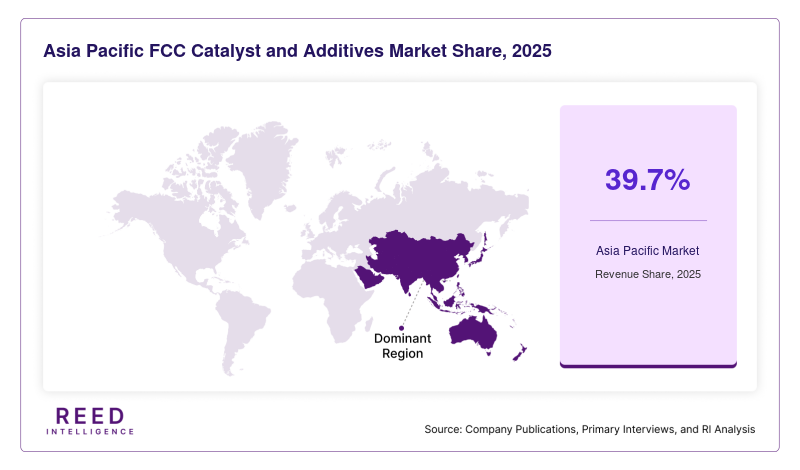
Asia Pacific is identified as the dominant region in a published estimate of the FCC catalyst and additives market, accounting for approximately 39.7% of global market revenue in 2025. This estimate is consistent with a reported market total of approximately USD 3.04 billion for 2025, although the regional percentage comes from a separate market-analysis source and should be treated as an estimate rather than an independently verified industry-wide figure. Regional demand is supported by refining capacity, refinery modernization, and the use of FCC units to produce transportation fuels and petrochemical feedstocks.
China and India are important contributors because of their large refining industries and investments in refinery and petrochemical integration. Japan and South Korea also have established refining and petrochemical sectors. Regional demand depends on refinery utilization, new and upgraded processing capacity, feedstock selection, and the need to optimize gasoline and light-olefin yields. A directly comparable forecast CAGR for Asia Pacific was not established for this report.
North America FCC Catalyst and Additives Market
A comparable, independently verified market-share percentage and forecast CAGR for North America were not established for this report. The region has an established refining industry and demand for catalysts and additives used to optimize FCC conversion, manage contaminants, and meet product specifications. Demand varies with refinery utilization, crude-oil quality, maintenance cycles, and investment in process optimization.
The United States is an important market for refining catalyst technologies and specialized additives. Refiners operating with varied crude slates may require products designed to manage metals, sulfur, and other feedstock-related challenges. Supplier technical support, product qualification, and the ability to improve yields without major changes to refinery equipment influence purchasing decisions.
Europe FCC Catalyst and Additives Market
A verified numerical market share and comparable forecast CAGR for Europe were not established for this report. Demand is associated with existing refining capacity, refinery modernization, fuel-quality requirements, and the use of FCC units to produce gasoline components and petrochemical feedstocks. Refinery restructuring and changes in regional fuel demand can affect catalyst consumption and purchasing patterns.
Germany, France, Italy, Spain, and the Netherlands have refining or petrochemical operations relevant to the market. European refiners must evaluate catalyst and additive choices against product specifications, operating costs, environmental requirements, and the economics of alternative feedstocks. Integrated petrochemical operations can also create demand for formulations targeting particular product yields.
Latin America FCC Catalyst and Additives Market
A verified market-share percentage and comparable regional CAGR for Latin America were not established for this report. Regional demand depends on refinery utilization, maintenance and modernization programs, feedstock characteristics, and investment in downstream processing. Catalyst and additive suppliers serve refineries seeking to maintain conversion performance and manage operating constraints.
Brazil and Mexico are relevant markets because of their refining infrastructure and demand for refined petroleum products. Other regional refineries may require tailored catalyst formulations depending on crude-oil quality and unit configuration. Investment constraints, refinery turnaround schedules, supply logistics, and changing product demand can influence purchasing volumes.
Middle East & Africa FCC Catalyst and Additives Market
A verified global market-share percentage and comparable forecast CAGR for the Middle East & Africa were not established for this report. The region has significant oil production and refining activity, with investment in refinery upgrades and integrated petrochemical projects creating potential demand for FCC catalysts and specialized additives. Local supply arrangements can also influence purchasing decisions.
Saudi Arabia, the United Arab Emirates, and other Gulf countries are investing in refining and petrochemical capabilities. African markets have more varied refining capacity and modernization needs. Demand depends on the commissioning and utilization of processing units, feedstock characteristics, refinery integration strategies, and access to qualified catalyst suppliers. Regional manufacturing and technical-service capabilities may influence supplier selection.
FCC Catalyst and Additives Market Competitive Landscape
The FCC catalyst and additives market is characterized by specialized technology, stringent product qualification requirements, and competition among established catalyst suppliers. Companies differentiate themselves through catalyst activity, selectivity, metals tolerance, hydrothermal stability, additive performance, technical service, and the ability to tailor formulations to individual refinery operating conditions.
BASF, Albemarle, and W. R. Grace & Co. are notable suppliers in the FCC catalyst and additives industry. Other participants include Axens, Johnson Matthey, and major refining and chemical companies with relevant catalyst technologies. Competitive strategies include research and development, formulation improvements, technical collaboration with refiners, regional supply arrangements, and solutions targeting gasoline quality, light-olefin yields, and emissions management.
Key Market Players
- BASF SE
- Albemarle Corporation
- W. R. Grace & Co.
- Axens
- Johnson Matthey
- Ketjen Corporation
- ExxonMobil Chemical Company
- Sinopec
- China National Petroleum Corporation (CNPC)
- Clariant
- Honeywell UOP
- JGC C&C
FCC Catalyst and Additives Market Recent Developments
-
March 2026 - Ketjen and Saudi Aramco Technologies Company signed a joint development agreement to co-develop, test, and deploy next-generation fluid catalytic cracking (FCC) catalysts and additives. The collaboration aims to improve refinery performance, optimize product yields, and reduce environmental impact.
-
May 2026 - BASF SE: BASF announced the opening of a new research and development center for refinery catalysts in Attapulgus, Georgia, co-located with its largest global refinery catalyst production site. The facility is intended to support further catalyst innovation and development for refining applications.
FCC Catalyst and Additives Market Segments
By Type
- FCC Catalysts
- FCC Additives
By Product
- Octane Number Improving Agents
- Light Olefins Enhancing Agents
- Sulfur-Reducing Agents
- Metal Passivation Agents
- Other Products
By Application
- Vacuum Gas Oil
- Residue
- Oil Refining
- Petrochemical Production
By End User
- Petroleum Refineries
- Integrated Refining and Petrochemical Complexes
By Region
- North America
- Europe
- APAC
- Middle East and Africa
- LATAM