Feed Acidifiers Market Size, Share & Demand Report By Type (Formic Acid, Propionic Acid, Lactic Acid, Citric Acid, Fumaric Acid, Blended Acidifiers), By Livestock (Poultry, Swine, Ruminants, Aquaculture, Others), By Form (Dry, Liquid) By Region & Segment Forecasts, 2026–2034
USD 3950
Market Overview
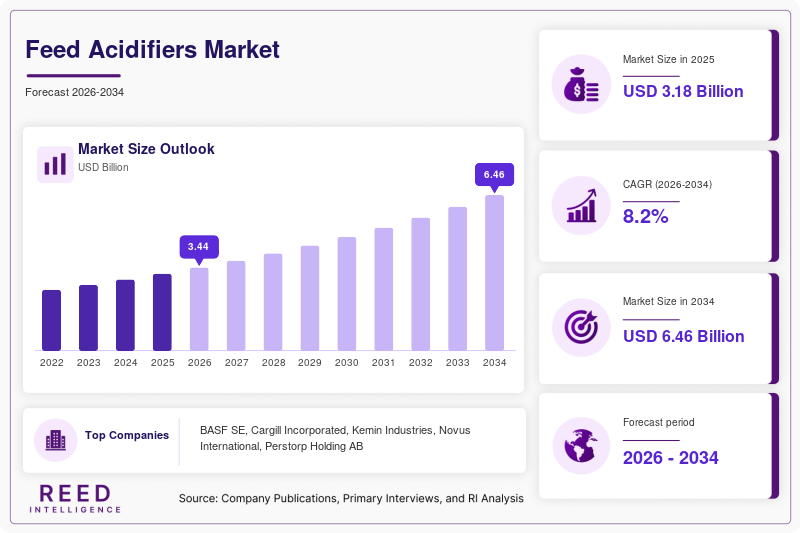
The global Feed Acidifiers Market size was valued at USD 3.18 billion in 2026 and is projected to reach USD 5.96 billion by 2034, expanding at a CAGR of 8.2% during the forecast period from 2026 to 2034. Feed acidifiers are widely used in livestock nutrition to improve feed quality, support gut health, enhance nutrient absorption, and reduce harmful microbial growth in animal feed. The growing focus on animal productivity and feed efficiency has increased the adoption of acidifier-based feed additives across poultry, swine, ruminant, and aquaculture industries. Rising demand for meat and dairy products, particularly in emerging economies, continues to strengthen the need for advanced feed solutions that improve animal health and production outcomes.
One major global factor supporting market growth is the increasing restriction on antibiotic growth promoters in livestock production. Regulatory authorities across several countries have implemented stricter guidelines on antibiotic usage due to concerns related to antimicrobial resistance and food safety. This shift has accelerated the adoption of feed acidifiers as a safer alternative for maintaining digestive health and improving feed conversion ratios. Manufacturers are also investing in blended organic acid solutions that provide better stability and enhanced antimicrobial performance in animal nutrition systems.
Key Highlights
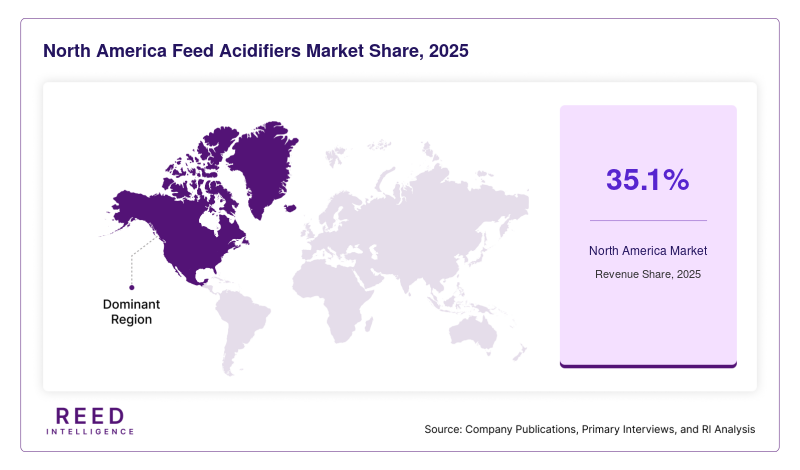
- North America dominated the market with a 35.1% share in 2025, while Asia Pacific is expected to grow at the fastest CAGR of 9.8% during 2026–2034.
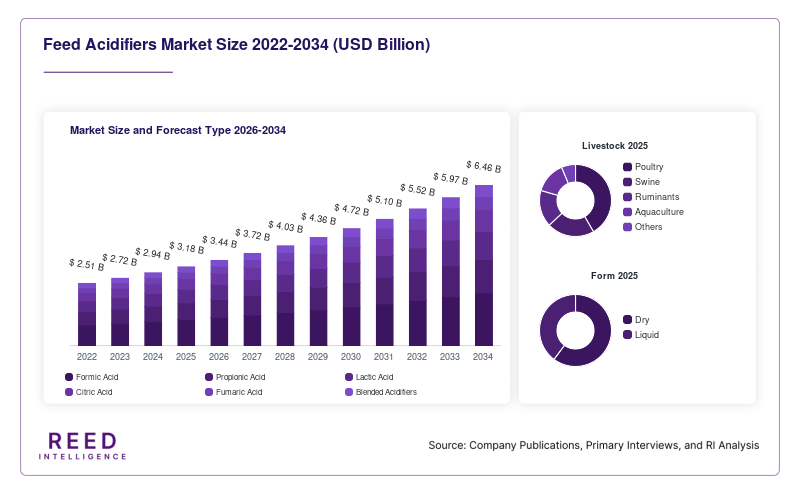
- By type, propionic acid accounted for the largest share of 31.4%, while blended acidifiers are projected to grow at a CAGR of 10.6%.
- By livestock, poultry led with a 42.8% share, whereas aquaculture is expected to expand at a CAGR of 11.1%.
- By form, dry acidifiers accounted for the highest share of 57.3%, while liquid acidifiers are anticipated to grow at a CAGR of 9.4%.
- The United States remained the dominant country, with market values of USD 620 million in 2024 and USD 675 million in 2025.
Market Trends
Rising Adoption of Organic Acid Blends in Animal Nutrition
Feed manufacturers are increasingly shifting toward blended acidifier formulations that combine multiple organic acids and their salts to achieve broader antimicrobial effectiveness and improved feed performance. These blended products are designed to enhance intestinal health, improve digestion, and optimize nutrient utilization across different livestock species. Poultry and swine producers are adopting these formulations to maintain animal productivity while complying with regulations that limit antibiotic growth promoters. The demand for customized acidifier blends has also increased because livestock producers prefer targeted solutions for different feed compositions and farming conditions. Manufacturers are developing encapsulated and coated acidifier technologies that improve acid release in the gastrointestinal tract, resulting in better feed efficiency and higher weight gain. This trend is expected to remain strong as commercial livestock operations continue to prioritize productivity and feed safety.
Expansion of Sustainable Livestock Production Practices
Sustainability has become an important focus area in the global livestock industry, and feed acidifiers are increasingly viewed as part of environmentally responsible animal nutrition strategies. Acidifiers help improve feed conversion efficiency, which reduces overall feed consumption and lowers waste generation in animal farming operations. In addition, improved gut health in animals contributes to lower disease occurrence and reduced dependency on antibiotics. Consumers are showing greater interest in meat and dairy products produced through cleaner and safer farming methods, encouraging livestock producers to adopt feed additives with lower environmental impact. Governments and agricultural organizations are also promoting sustainable feed management practices to reduce emissions and improve food safety standards. As a result, feed acidifiers are gaining wider acceptance in integrated livestock production systems focused on long-term operational efficiency and environmental compliance.
Market Drivers
Increasing Restrictions on Antibiotic Growth Promoters
The growing implementation of regulations restricting antibiotic growth promoters in animal feed is one of the major factors driving the Feed Acidifiers Market. Regulatory agencies in North America, Europe, and parts of Asia have introduced strict controls on antibiotic usage due to concerns about antimicrobial resistance and residue contamination in meat products. Feed acidifiers are increasingly being used as effective alternatives because they help maintain intestinal health, suppress harmful pathogens, and improve feed digestibility. Poultry and swine producers are particularly increasing acidifier usage to sustain productivity levels without relying heavily on antibiotics. In addition, food safety concerns among consumers are encouraging livestock companies to adopt natural and safer feed additives. The transition toward antibiotic-free animal production systems is expected to continue supporting strong demand for feed acidifiers across commercial farming operations worldwide.
Growing Global Demand for Meat and Dairy Products
The steady increase in global consumption of meat, eggs, milk, and seafood products is contributing significantly to the expansion of the Feed Acidifiers Market. Rapid urbanization, population growth, and changing dietary patterns are increasing protein consumption in both developed and emerging economies. Livestock producers are focusing on improving feed efficiency and animal health to meet rising food demand while maintaining profitability. Feed acidifiers play an important role in supporting animal growth performance and reducing feed spoilage, which makes them valuable additives in modern animal nutrition systems. Commercial poultry and swine farms are increasingly adopting acidifier-based feed solutions to maximize production output and improve feed conversion ratios. In addition, aquaculture producers are utilizing acidifiers to improve water stability and nutrient absorption in aquatic feed formulations, further expanding market demand globally.
Market Restraint
Volatility in Raw Material Prices and Limited Awareness in Small-Scale Farming
Fluctuations in the prices of raw materials used in the production of feed acidifiers remain a major challenge for market participants. Organic acids such as formic acid, citric acid, and propionic acid are derived from chemical and fermentation processes that are influenced by energy costs, supply chain conditions, and raw material availability. Variations in production costs can affect pricing stability and profit margins for manufacturers and feed producers. In addition, small-scale livestock farmers in developing regions often have limited awareness regarding the long-term benefits of feed acidifiers, leading to lower adoption rates. Many farmers continue to rely on traditional feed practices due to cost sensitivity and insufficient technical knowledge about feed optimization. This situation creates challenges for market penetration, particularly in rural agricultural economies where commercial livestock operations are still developing. Manufacturers must invest in farmer education programs and cost-effective product formulations to address these limitations and support wider market adoption.
Market Opportunities
Growth Potential in Aquaculture Feed Applications
The rapid expansion of the aquaculture industry presents a significant growth opportunity for feed acidifier manufacturers. Aquaculture producers are increasingly focusing on improving feed efficiency, maintaining water quality, and reducing disease outbreaks in fish and shrimp farming operations. Feed acidifiers help stabilize gut microbiota, enhance nutrient absorption, and support digestive health in aquatic species. The growing global demand for seafood products is encouraging commercial aquaculture farms to adopt advanced feed additives that improve productivity and reduce mortality rates. Countries in Asia Pacific and Latin America are witnessing strong investments in aquaculture infrastructure, creating favorable conditions for acidifier adoption. Manufacturers are also developing specialized acidifier blends designed specifically for aquatic feed formulations, which is expected to support further market expansion during the forecast period.
Increasing Demand for Natural and Clean-Label Feed Additives
The shift toward natural and clean-label animal nutrition solutions is creating new opportunities in the Feed Acidifiers Market. Livestock producers and food processing companies are increasingly seeking feed additives that align with consumer preferences for safer and more sustainable food production methods. Organic acids are gaining popularity because they are considered effective alternatives to synthetic growth promoters and antibiotic-based additives. Feed acidifiers also support food safety by reducing harmful bacterial contamination in animal feed and improving digestive health. The increasing popularity of organic livestock farming and premium-quality meat products is further encouraging the use of acidifier-based feed solutions. Manufacturers are introducing plant-based acidifier combinations and innovative delivery systems to address changing customer preferences and strengthen their market position in the evolving animal nutrition industry.
Segmental Analysis
By Type
Propionic acid accounted for the largest share of the Feed Acidifiers Market in 2024, representing approximately 31.4% of total market revenue. The dominance of this subsegment is primarily linked to its strong antimicrobial properties and effectiveness in preserving feed quality during storage and transportation. Propionic acid is widely used in poultry and cattle feed formulations because it helps control mold growth and reduces bacterial contamination. Feed manufacturers prefer this acidifier due to its cost-effectiveness and broad application range across different livestock categories. Increasing commercial feed production and the growing need for improved feed shelf life are supporting continued demand for propionic acid in the global animal nutrition industry. The product also plays an important role in reducing feed wastage and improving overall livestock productivity.
Blended acidifiers are projected to register the fastest CAGR of 10.6% during the forecast period due to rising demand for multifunctional feed additive solutions. These products combine multiple organic acids and salts to provide enhanced antimicrobial performance and improved nutrient utilization in livestock feed. Poultry and swine producers are increasingly adopting blended acidifiers because they offer better digestive health support and feed efficiency compared to single-acid formulations. Manufacturers are introducing coated and encapsulated blended acidifiers that improve acid release in the digestive tract and increase product stability. The rising focus on antibiotic-free animal production and the need for customized feed formulations are expected to continue driving strong growth for this subsegment across commercial livestock operations globally.
By Livestock
The poultry segment held the dominant share of the Feed Acidifiers Market in 2024, accounting for approximately 42.8% of global revenue. The increasing global consumption of chicken meat and eggs has significantly boosted demand for poultry feed additives that improve feed conversion efficiency and animal health. Feed acidifiers are widely used in poultry farming to reduce harmful bacterial growth, support gut health, and improve nutrient absorption. Commercial poultry producers are adopting acidifier-based nutrition programs to maintain productivity levels while reducing antibiotic dependency. The expansion of integrated poultry farming systems in Asia Pacific and Latin America has also contributed to increased adoption of feed acidifiers. Rising investments in commercial broiler production and growing export demand for poultry products continue to support the leading position of this subsegment.
Aquaculture is expected to emerge as the fastest-growing livestock subsegment, expanding at a CAGR of 11.1% during the forecast period. The rapid growth of fish and shrimp farming industries is increasing the need for specialized feed additives that improve digestive performance and maintain water quality. Feed acidifiers are becoming increasingly important in aquaculture nutrition because they help stabilize intestinal microbiota and enhance nutrient utilization in aquatic species. Producers are adopting acidifier-based feed solutions to reduce disease risks and improve feed efficiency in intensive farming environments. The growing popularity of seafood products and rising investments in commercial aquaculture infrastructure, particularly in Asia Pacific, are expected to accelerate market growth for this subsegment during the forecast period.
By Form
Dry acidifiers accounted for the largest market share in 2024, contributing approximately 57.3% of total revenue in the Feed Acidifiers Market. The dominance of this subsegment is mainly attributed to the ease of storage, transportation, and handling associated with dry feed additive formulations. Dry acidifiers are widely used in commercial feed manufacturing because they offer better product stability and can be easily blended with compound feed ingredients. Poultry and swine feed producers prefer dry formulations due to their longer shelf life and compatibility with automated feed processing systems. The growing industrialization of feed production and increasing demand for standardized animal nutrition products are supporting the continued expansion of this subsegment across developed and emerging livestock markets.
Liquid acidifiers are projected to witness the fastest growth, registering a CAGR of 9.4% during the forecast period. These formulations are gaining popularity because they can be easily applied in drinking water systems and liquid feed solutions, particularly in poultry and swine farming operations. Liquid acidifiers provide rapid antimicrobial action and improve feed hygiene by controlling pathogenic bacteria in water distribution systems. Livestock producers are increasingly adopting liquid acidifiers in intensive farming environments where maintaining animal digestive health is critical for production efficiency. Technological advancements in liquid acidifier delivery systems and the growing adoption of precision livestock management practices are expected to contribute significantly to the growth of this subsegment during the forecast period.
Regional Analysis
North America
North America accounted for 35.1% of the global Feed Acidifiers Market share in 2025 and is expected to maintain a stable growth trajectory during the forecast period. The regional market is projected to expand at a CAGR of 7.4% from 2026 to 2034 due to strong demand from the poultry and swine industries. Commercial livestock production in the region is highly industrialized, which supports the adoption of advanced feed additives that improve animal performance and feed efficiency. The growing focus on antibiotic-free meat production and stricter food safety regulations are also contributing to the increasing use of feed acidifiers across animal nutrition systems.
The United States remains the dominant country in the regional market due to its large-scale livestock industry and advanced feed manufacturing infrastructure. The country continues to witness rising demand for poultry meat and dairy products, encouraging producers to invest in feed optimization technologies. One unique growth factor supporting the market in the United States is the increasing adoption of precision livestock farming practices. Feed producers are integrating acidifier formulations with data-driven nutrition programs to improve feed conversion ratios and enhance overall production efficiency in commercial farming operations.
Europe
Europe represented a significant share of the Feed Acidifiers Market in 2025 and is anticipated to grow at a CAGR of 7.1% during the forecast period. The regional market is supported by strict regulations limiting antibiotic usage in animal feed and strong consumer demand for safe meat products. European livestock producers are increasingly using organic acid-based feed additives to improve animal health and reduce bacterial contamination risks. The poultry and swine sectors remain major contributors to regional demand, while investments in sustainable agriculture practices continue to encourage the use of environmentally responsible feed solutions.
Germany emerged as the leading country in the European market due to its advanced livestock farming industry and strong focus on feed quality standards. The country has a well-developed animal nutrition sector that actively invests in research and innovation related to feed additives. A unique growth factor in Germany is the increasing collaboration between feed manufacturers and agricultural research institutions to develop customized acidifier solutions. These partnerships are supporting the introduction of efficient feed formulations designed to improve nutrient utilization and reduce livestock production costs.
Asia Pacific
Asia Pacific is projected to register the fastest growth in the Feed Acidifiers Market, with a forecast CAGR of 9.8% from 2026 to 2034. The region is experiencing rapid growth in poultry, aquaculture, and swine production due to rising population levels and increasing protein consumption. Expanding commercial livestock farming operations in countries such as China, India, Vietnam, and Indonesia are contributing significantly to market demand. Feed acidifiers are increasingly being adopted to improve feed hygiene, support animal health, and enhance production efficiency. Rising awareness regarding feed safety and the prevention of livestock diseases is also strengthening market expansion across the region.
China dominates the Asia Pacific market because of its large livestock population and rapidly industrializing feed sector. The country continues to invest heavily in modern animal farming infrastructure and advanced feed production technologies. One unique growth factor supporting the market in China is the government’s increasing emphasis on food safety and livestock disease prevention following several disease outbreaks in the agricultural sector. This has encouraged feed producers to incorporate acidifier-based additives into feed formulations to improve biosecurity and production performance.
Middle East & Africa
The Middle East & Africa Feed Acidifiers Market is expected to grow steadily at a CAGR of 6.8% during the forecast period. The regional market is benefiting from increasing investments in poultry farming and rising demand for animal protein products. Several countries in the region are focusing on strengthening domestic livestock production to improve food security and reduce dependence on imported meat products. Feed acidifiers are increasingly being used to improve feed preservation and maintain animal digestive health in challenging climatic conditions. Commercial poultry farms are emerging as key consumers of acidifier-based feed additives across the region.
Saudi Arabia remains the dominant country in the Middle East & Africa market due to its expanding poultry industry and strong investments in agricultural modernization. The country is actively supporting domestic food production initiatives to enhance long-term food security. A unique growth factor in Saudi Arabia is the increasing use of climate-controlled livestock farming facilities, which require optimized feed formulations to maintain animal productivity. Feed acidifiers are gaining importance in these systems because they help improve nutrient absorption and support animal health under intensive farming conditions.
Latin America
Latin America accounted for a notable share of the Feed Acidifiers Market in 2025 and is projected to grow at a CAGR of 7.6% through 2034. The regional market is supported by strong meat export activities and increasing industrialization of livestock farming operations. Poultry and cattle production remain major sectors driving feed additive consumption in the region. Livestock producers are increasingly adopting acidifier-based feed solutions to improve feed quality, reduce microbial contamination, and enhance productivity. Growing export requirements for high-quality meat products are also encouraging the use of advanced feed additives in regional animal nutrition programs.
Brazil dominates the Latin American market due to its position as one of the world’s largest meat exporters. The country has a highly developed poultry and cattle industry supported by large-scale feed manufacturing operations. One unique growth factor driving the Brazilian market is the increasing focus on export-oriented livestock production standards. Meat exporters are adopting feed acidifiers to improve product quality and comply with international food safety requirements, particularly in North American and European export markets.
Competitive Landscape
The Feed Acidifiers Market is moderately consolidated, with several multinational feed additive manufacturers competing through product innovation, strategic partnerships, and regional expansion activities. Companies are increasingly focusing on developing blended organic acid formulations that provide enhanced antimicrobial performance and improved feed conversion efficiency. The market is also witnessing investments in research and development activities aimed at creating customized feed acidifier solutions for poultry, swine, ruminant, and aquaculture applications.
BASF SE remains one of the leading players in the market due to its broad feed additive portfolio and strong global distribution network. The company has continued to strengthen its position through investments in animal nutrition technologies and sustainable feed solutions. In 2025, BASF SE introduced an advanced blended acidifier product designed for poultry feed applications to improve gut health and nutrient absorption. Other major companies are also focusing on acquisitions, product launches, and collaborations with livestock producers to strengthen their competitive position in emerging agricultural markets. The increasing demand for antibiotic-free animal production systems is expected to intensify competition among market participants during the forecast period.
Key Players
- BASF SE
- Cargill Incorporated
- Kemin Industries
- Novus International
- Perstorp Holding AB
- DSM-Firmenich
- Adisseo
- Biomin GmbH
- Nutrex NV
- Impextraco NV
- Jefo Nutrition Inc.
- Corbion NV
- Anpario plc
- Pancosma SA
- Palital Feed Additives
Recent Developments
- In 2025, Kemin Industries expanded its feed additive manufacturing capacity in Asia Pacific to support rising poultry feed demand in the region.
- In 2024, DSM-Firmenich launched a new encapsulated acidifier formulation designed to improve nutrient absorption in swine feed applications.
- In 2025, Perstorp Holding AB introduced a blended organic acid solution for aquaculture feed aimed at improving digestive health and feed conversion efficiency in shrimp farming operations.
Feed Acidifiers Market Segments
Type
- Formic Acid
- Propionic Acid
- Lactic Acid
- Citric Acid
- Fumaric Acid
- Blended Acidifiers
Livestock
- Poultry
- Swine
- Ruminants
- Aquaculture
- Others
Form
- Dry
- Liquid
By Region
- North America
- Europe
- APAC
- Middle East and Africa
- LATAM