Feed Anticoccidials Market Size, Share Demand Report By Type (Ionophore Anticoccidials, Non-Ionophore Anticoccidials), By Application (Poultry, Livestock (Cattle, Swine, Others)), By Form (Dry Form, Liquid Form), By Region & Segment Forecasts, 2025–2034
USD 3950
Market Overview
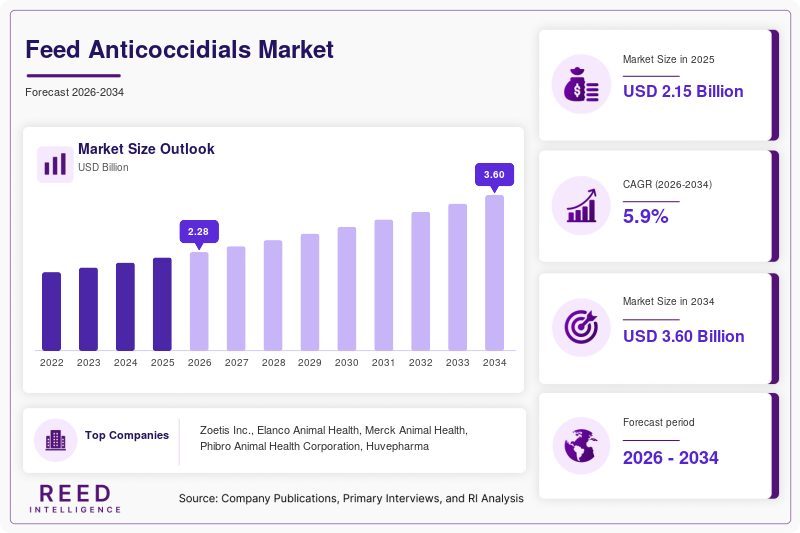
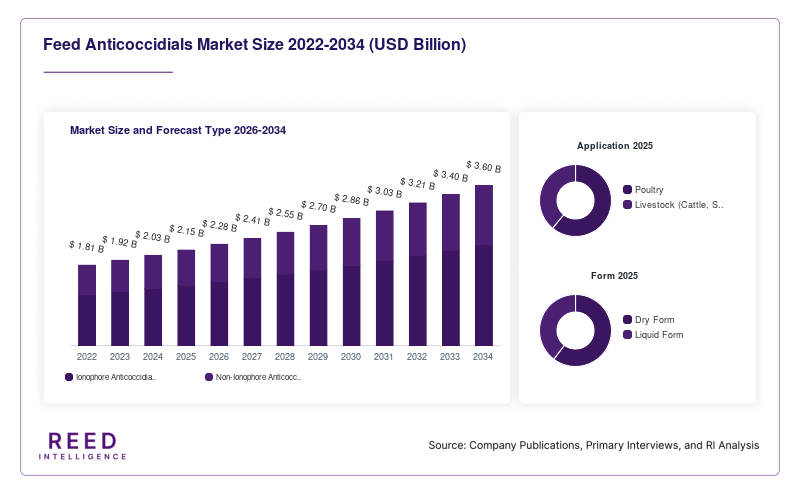
The Feed Anticoccidials Market size is estimated at USD 2.15 billion and is projected to reach approximately USD 2.28 billion in 2026. With continuous advancements in animal nutrition and disease prevention strategies, the market is forecast to grow at a CAGR of 5.9% from 2025 to 2034, reaching nearly USD 3.78 billion by the end of the forecast period.
Anticoccidials play a crucial role in controlling coccidiosis, a parasitic disease that affects the intestinal tracts of animals, especially poultry. The rising consumption of poultry meat and eggs globally is a key factor supporting market growth. Additionally, the expansion of intensive farming practices has increased the risk of disease outbreaks, further driving the demand for feed additives such as anticoccidials.
Key Highlights
- Asia Pacific dominated the market with a share of approximately 32% in 2025, driven by large-scale poultry production and rising protein consumption. The region benefits from expanding livestock farming and supportive government initiatives for modern feed practices.
- Asia Pacific is also the fastest-growing region, projected to register a CAGR of 6.8% during 2025–2034. Rapid urbanization and increasing demand for meat products are accelerating the adoption of anticoccidials across emerging economies.
- Ionophore anticoccidials held the dominant share of around 58% in 2024 due to their cost-effectiveness and strong efficacy in controlling coccidiosis. Their widespread use in poultry farming continues to support their leading position in the market.
- Non-ionophore anticoccidials are expected to grow at the fastest CAGR of 6.5% during the forecast period. Increasing regulatory restrictions and demand for antibiotic-free feed solutions are driving this segment’s growth.
- Poultry application accounted for the largest market share of nearly 65% in 2024 due to high disease susceptibility and intensive farming practices. The rising global demand for poultry meat and eggs continues to strengthen this segment.
- Livestock applications are projected to grow at a CAGR of 6.2% over the forecast period, supported by increasing awareness of animal health management. Expansion of commercial cattle and swine farming is further boosting segment demand.
Market Trends
Shift Toward Ionophore Alternatives and Natural Additives
A notable trend in the Feed Anticoccidials Market is the gradual shift toward non-ionophore and natural alternatives. Regulatory pressures and consumer demand for antibiotic-free animal products are encouraging producers to adopt herbal and probiotic-based anticoccidials. These alternatives are perceived as safer and more sustainable, aligning with global trends toward clean-label and organic food production. Feed manufacturers are increasingly investing in research to develop plant-based solutions that offer comparable efficacy to traditional anticoccidials. This trend is particularly strong in developed markets where regulatory scrutiny is higher and consumers are more aware of food safety concerns.
Integration of Advanced Feed Formulation Technologies
Another key trend shaping the market is the integration of advanced feed formulation technologies. Precision nutrition and digital tools are enabling more targeted use of anticoccidials, reducing overuse and improving efficiency. Automated feed systems and real-time health monitoring allow farmers to adjust formulations based on animal health conditions. This trend is driving innovation in product design, including controlled-release formulations and combination products. As livestock producers aim to maximize productivity while minimizing costs, technologically advanced feed solutions are gaining traction, thereby supporting the growth of the Feed Anticoccidials Market.
Market Drivers
Rising Demand for Poultry Products Worldwide
The increasing global consumption of poultry meat and eggs is a primary driver of the Feed Anticoccidials Market. Poultry is considered a cost-effective and widely accepted source of protein, leading to its growing demand across both developed and developing regions. As poultry farming intensifies to meet this demand, the risk of coccidiosis outbreaks rises significantly. Anticoccidials are essential in maintaining flock health and ensuring consistent production levels. Large-scale poultry operations rely heavily on these additives to prevent disease-related losses, making them indispensable in modern farming systems. This sustained demand directly contributes to the expansion of the market.
Growth of Intensive Livestock Farming Practices
The shift toward intensive livestock farming is another significant driver fueling market growth. High-density animal farming increases the likelihood of disease transmission, necessitating effective preventive measures. Anticoccidials are widely used to control parasitic infections in such environments. Additionally, the need to optimize feed conversion ratios and improve productivity further supports their adoption. Governments and industry stakeholders are also promoting efficient farming practices to enhance food security, which indirectly boosts the demand for feed additives. As livestock production continues to scale up globally, the reliance on anticoccidials is expected to grow steadily.
Market Restraint
Regulatory Restrictions and Concerns Over Drug Residues
One of the major restraints affecting the Feed Anticoccidials Market is the increasing regulatory scrutiny regarding the use of chemical additives in animal feed. Authorities in several regions have imposed strict guidelines to limit the use of certain anticoccidial compounds due to concerns about drug residues in animal products. These regulations can restrict product availability and increase compliance costs for manufacturers. For example, bans on specific ionophore compounds in certain markets have compelled producers to reformulate their products, leading to higher research and development expenses. Additionally, consumer concerns about food safety and antibiotic resistance are influencing purchasing decisions, further limiting market growth. This restraint is particularly significant in regions with stringent food safety standards, where manufacturers must invest heavily in testing and certification to meet regulatory requirements.
Market Opportunities
Development of Novel and Targeted Anticoccidial Solutions
The development of innovative and targeted anticoccidial solutions presents a strong growth opportunity for the market. Advances in biotechnology and animal health research are enabling the creation of more effective and selective compounds. These new solutions aim to minimize resistance development while improving efficacy. Companies are focusing on combination therapies and precision formulations that cater to specific livestock needs. Such innovations can enhance product differentiation and open new revenue streams. As the demand for efficient disease management increases, the introduction of advanced anticoccidials is expected to drive market expansion.
Expansion in Emerging Markets
Emerging economies offer significant growth opportunities due to their expanding livestock industries and increasing demand for animal protein. Countries in Asia Pacific, Latin America, and Africa are witnessing rapid growth in poultry and livestock farming. However, these regions often face challenges related to disease management and feed efficiency. The adoption of anticoccidials can help address these issues, making them a valuable addition to feed formulations. Moreover, government initiatives to improve agricultural productivity and food security are supporting market growth. As awareness about animal health increases in these regions, the demand for feed anticoccidials is expected to rise substantially.
Segmental Analysis
By Type
Ionophore anticoccidials dominated the market in 2024, accounting for approximately 58% of the total share. These compounds are widely used due to their effectiveness in controlling coccidiosis and improving feed efficiency. Ionophores are particularly popular in poultry farming, where disease prevention is critical for maintaining productivity. Their ability to reduce parasite load while enhancing nutrient absorption makes them a preferred choice among livestock producers. Additionally, their cost-effectiveness compared to alternative treatments further supports their widespread adoption. The dominance of this segment is also attributed to established usage patterns and strong distribution networks.
Non-ionophore anticoccidials are expected to be the fastest-growing segment, with a projected CAGR of 6.5% during the forecast period. The growth of this segment is driven by increasing regulatory restrictions on ionophores and rising demand for antibiotic-free animal products. Non-ionophore solutions, including synthetic chemicals and natural alternatives, are gaining traction due to their perceived safety and compliance with regulations. The development of innovative formulations and combination products is further boosting this segment. As consumer preferences shift toward safer food products, the demand for non-ionophore anticoccidials is expected to increase significantly.
By Application
Poultry applications dominated the Feed Anticoccidials Market in 2024, holding a share of around 65%. The high susceptibility of poultry to coccidiosis and the large-scale nature of poultry farming contribute to this dominance. Anticoccidials are essential in preventing disease outbreaks that can lead to significant economic losses. The growing global demand for poultry products further reinforces the importance of this segment. Producers rely heavily on feed additives to maintain flock health and ensure consistent production. The widespread use of anticoccidials in broiler and layer farming underscores their critical role in this segment.
The livestock segment, including cattle and swine, is expected to grow at the fastest CAGR of 6.2% during the forecast period. Increasing awareness about animal health and the need to improve productivity are driving the adoption of anticoccidials in this segment. Livestock producers are recognizing the benefits of preventive healthcare measures in reducing losses and enhancing feed efficiency. Additionally, the expansion of commercial livestock farming in emerging markets is contributing to the growth of this segment. As the industry continues to modernize, the demand for effective feed additives is expected to rise.
By Form
Dry form anticoccidials dominated the market in 2024, accounting for approximately 62% of the total share. These products are preferred due to their ease of handling, storage, and integration into feed formulations. Dry forms offer better stability and longer shelf life compared to liquid alternatives, making them suitable for large-scale operations. They are widely used in poultry and livestock farming, where consistent dosing is essential. The established infrastructure for dry feed production further supports the dominance of this segment.
Liquid anticoccidials are projected to be the fastest-growing segment, with a CAGR of 6.7%. The growth of this segment is driven by increasing adoption of advanced feeding systems that allow precise dosing. Liquid formulations are particularly useful in situations where rapid absorption and immediate action are required. They also offer flexibility in application, making them suitable for different farming conditions. As technology continues to evolve, the use of liquid anticoccidials is expected to increase, providing new growth opportunities for market players.
Regional Analysis
North America
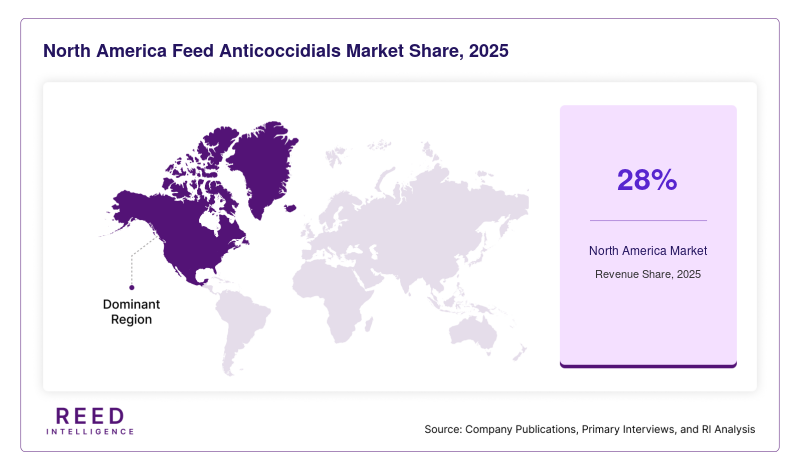
North America accounted for approximately 28% of the global Feed Anticoccidials Market share in 2025 and is projected to grow at a CAGR of 5.2% during the forecast period. The region benefits from well-established livestock farming practices and high adoption of advanced feed additives. Strong regulatory frameworks ensure product quality and safety, which supports market stability. The presence of major industry players also contributes to consistent innovation and product availability.
The United States dominates the regional market due to its large-scale poultry production and advanced farming infrastructure. A unique growth factor in this region is the widespread adoption of precision livestock farming technologies, which enable efficient use of anticoccidials. These technologies help optimize dosage and improve overall productivity, thereby supporting market growth.
Europe
Europe held a market share of around 24% in 2025 and is expected to grow at a CAGR of 5.0%. The region’s growth is influenced by stringent regulations regarding animal health and food safety. While these regulations pose challenges, they also encourage the development of safer and more effective anticoccidial products. The market is characterized by a strong focus on sustainability and animal welfare.
Germany leads the European market due to its advanced agricultural sector and emphasis on high-quality livestock production. A unique growth factor is the increasing demand for organic and antibiotic-free meat products. This trend is driving the adoption of alternative anticoccidials, including natural and plant-based solutions.
Asia Pacific
Asia Pacific dominated the market with a share of approximately 32% in 2025 and is projected to register the highest CAGR of 6.8%. Rapid urbanization, population growth, and rising income levels are driving the demand for animal protein in the region. This has led to the expansion of poultry and livestock farming, increasing the need for effective disease control solutions.
China is the leading country in this region, supported by its large poultry industry and growing focus on food security. A unique growth factor is the government’s support for modern farming practices, including the adoption of feed additives. These initiatives are encouraging farmers to use anticoccidials to improve productivity and reduce losses.
Middle East & Africa
The Middle East & Africa region held a market share of about 8% in 2025 and is expected to grow at a CAGR of 5.6%. The market is driven by increasing investments in the agricultural sector and rising demand for animal protein. However, limited awareness and infrastructure challenges may hinder growth in some areas.
South Africa dominates the regional market due to its relatively advanced livestock industry. A unique growth factor is the increasing focus on improving feed efficiency to address resource constraints. This has led to the adoption of anticoccidials as a cost-effective solution for disease prevention.
Latin America
Latin America accounted for nearly 8% of the market share in 2025 and is projected to grow at a CAGR of 5.7%. The region’s growth is supported by expanding poultry production and increasing exports of animal products. Favorable climatic conditions also contribute to livestock farming activities.
Brazil is the dominant country in this region, known for its large-scale poultry and meat production. A unique growth factor is the country’s strong export-oriented livestock industry, which requires strict quality standards. This drives the demand for effective anticoccidials to ensure product consistency and safety.
Competitive Landscape
The Feed Anticoccidials Market is moderately consolidated, with several key players focusing on product innovation and strategic collaborations to strengthen their market position. Leading companies are investing in research and development to introduce advanced formulations and expand their product portfolios. The competitive environment is characterized by a mix of global and regional players, each aiming to capture a larger market share through differentiation and quality improvements.
Zoetis Inc. is considered a market leader due to its extensive product range and strong global presence. The company has recently focused on developing innovative anticoccidial solutions that align with regulatory requirements and consumer preferences. Other major players are also adopting strategies such as mergers, acquisitions, and partnerships to enhance their capabilities and expand their geographic reach.
Key Players List
- Zoetis Inc.
- Elanco Animal Health
- Merck Animal Health
- Phibro Animal Health Corporation
- Huvepharma
- Vetoquinol
- Ceva Santé Animale
- Kemin Industries
- Impextraco NV
- Virbac
- Boehringer Ingelheim Animal Health
- Nutreco N.V.
- Alltech Inc.
- Biochem
- Zydus Animal Health
Recent Developments
- A leading animal health company introduced a new combination anticoccidial product designed to improve efficacy and reduce resistance development.
- A major industry player expanded its production facility to meet increasing global demand for feed additives.
- A strategic partnership between two companies focused on developing natural anticoccidial solutions for antibiotic-free livestock production.
Feed Anticoccidials Market Segments
Type
- Ionophore Anticoccidials
- Non-Ionophore Anticoccidials
Application
- Poultry
- Livestock (Cattle, Swine, Others)
Form
- Dry Form
- Liquid Form
By Region
- North America
- Europe
- APAC
- Middle East and Africa
- LATAM