Feed Pelletizing Agents Market Size, Share & Demand Report By Type (Lignosulfonate-Based Agents, Starch-Based Agents, Mineral & Clay-Based Agents, Enzyme-Assisted Binders, Other Specialty Pelletizing Agents), By Livestock (Poultry Feed, Swine Feed, Ruminant Feed, Aquaculture Feed, Other Specialty Feed), By Source (Synthetic & Mineral Blends, Plant-Based Bio Binders, Hybrid Formulations), By Region & Segment Forecasts, 2026–2034
USD 3950
Market Overview
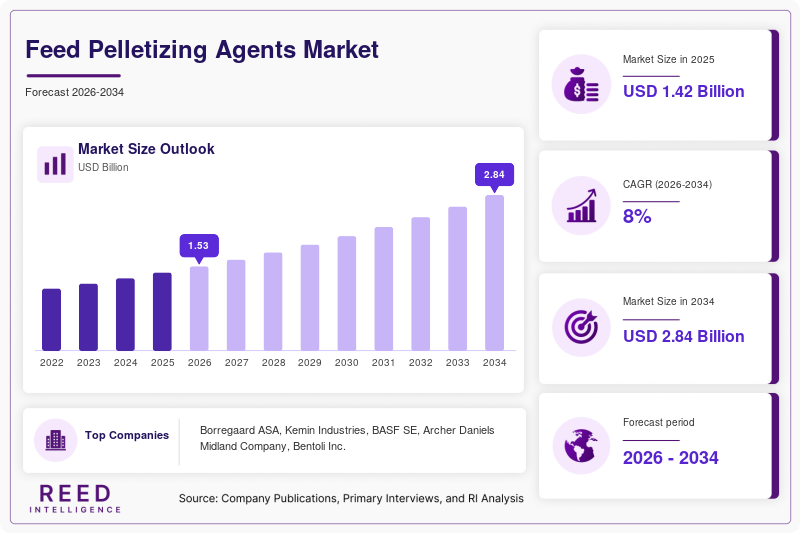
The Feed Pelletizing Agents Market size was valued at USD 1.42 billion in 2026 and is projected to reach USD 2.63 billion by 2034, expanding at a CAGR of 8.0% during 2026–2034. Feed pelletizing agents are functional additives used to improve pellet durability, binding strength, moisture stability, dust control, and processing efficiency in compound feed manufacturing. These agents are increasingly adopted across poultry, swine, ruminant, aquaculture, and specialty feed production as feed mills seek higher throughput and better pellet quality.
A major global factor supporting market growth is the steady rise in industrial livestock production. Growing meat, dairy, egg, and aquaculture consumption has increased the need for nutritionally balanced and easily transportable feed. Pelletized feed offers better feed conversion ratios, reduced wastage, and improved handling efficiency compared with mash feed. As commercial farms scale operations, manufacturers are using pelletizing agents to maintain pellet integrity across longer supply chains and changing climatic conditions.
Key Highlights
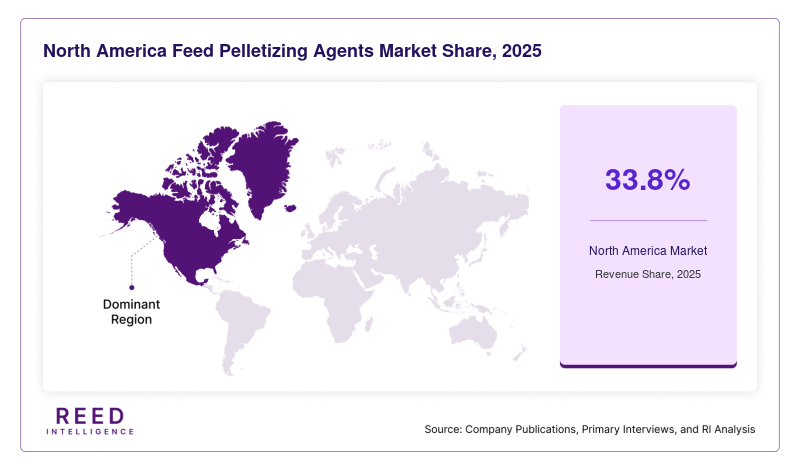
- North America dominated the market with a 33.8% share in 2025.
- Asia Pacific is expected to grow at the fastest CAGR of 9.8% during 2026–2034.
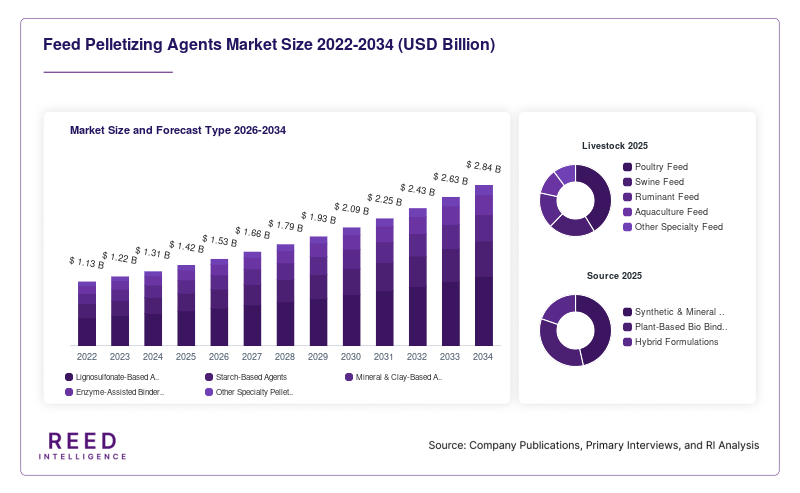
- By type, lignosulfonate-based agents held the leading share of 36.4%.
- while enzyme-assisted binders are projected to grow at a 10.6% CAGR.
- By livestock, poultry feed accounted for the largest share of 39.7%, whereas aquaculture feed is forecast to expand at a 10.9% CAGR.
- By source, synthetic/mineral blends led with a 58.2% share, while plant-based bio binders are expected to grow at a 10.2% CAGR.
- The United States remained the dominant country, with market values of USD 362 million in 2024 and USD 389 million in 2025.
Market Trends
Shift Toward Bio-Based and Clean-Label Pellet Binders
Feed producers are increasingly adopting plant-derived starches, gums, cellulose derivatives, and fermentation-based binders to reduce dependence on conventional chemical additives. This trend is driven by sustainability goals, tighter environmental regulations, and demand for traceable ingredient sourcing. Bio-based pelletizing agents can improve pellet hardness while supporting marketing claims around natural feed formulations. Large integrated poultry and dairy operators are requesting suppliers to align with ESG targets, encouraging innovation in renewable raw materials. Suppliers are also developing low-dosage formulas that maintain pellet strength without changing nutrient profiles or feed palatability.
Precision Feed Manufacturing and Process Optimization
Modern feed mills are integrating sensors, automated dosing systems, and data-driven quality control, which is increasing demand for consistent pelletizing agents. Manufacturers now require additives that perform predictably across different grains, moisture levels, and die configurations. Pellet durability index targets are becoming more standardized, especially for export-grade feed. As mills monitor energy use and downtime more closely, pelletizing agents that reduce friction and improve throughput are gaining traction. This trend is strong in North America and Europe, where operational efficiency and maintenance cost reduction are major procurement priorities.
Market Drivers
Expansion of Commercial Poultry and Swine Production
Rapid growth in poultry meat and egg production has significantly increased demand for pelletized feed. Pellets improve intake uniformity, reduce sorting losses, and simplify bulk handling in intensive farming systems. Swine integrators also prefer durable pellets for nursery and grower diets because feed wastage directly impacts margins. As livestock farms scale operations, they require reliable feed quality across multiple sites, which encourages the use of pelletizing agents. Developing countries are adding new feed mills, while established producers are upgrading capacity, both of which support steady market size expansion.
Rising Need for Better Feed Efficiency and Lower Production Costs
Feed represents the largest operating cost in animal production, making efficiency gains highly valuable. Pelletizing agents help reduce fines, improve pellet retention during transport, and enhance feed conversion by maintaining consistent intake. Many products also reduce energy consumption during pelleting by improving lubrication and die flow. This creates measurable savings for large mills processing thousands of tons monthly. As grain prices remain volatile, producers are seeking additives that protect margins through better processing performance, making pelletizing agents an important operational tool rather than a discretionary input.
Market Restraint
Raw Material Price Volatility and Formulation Complexity
The market faces restraint from fluctuating prices of lignin derivatives, starches, minerals, gums, and specialty chemicals used in pelletizing formulations. Cost instability can compress supplier margins and discourage smaller feed mills from using premium additives. Performance also varies depending on feed composition, moisture levels, fat inclusion, and pellet mill settings. A binder that works well in corn-soy poultry diets may perform differently in high-fiber ruminant feed or floating aquafeed. This creates a need for technical support, trials, and customized dosing, which can slow adoption. In price-sensitive regions, mills may reduce additive usage when grain costs rise, limiting near-term growth.
Market Opportunities
High-Growth Potential in Aquaculture Feed Processing
Aquaculture is creating a strong opportunity for specialized pelletizing agents because water stability, floatability, and nutrient retention are critical in fish and shrimp feed. Standard livestock binders often fail under prolonged water exposure, leading to nutrient loss and pond contamination. Manufacturers are developing marine-compatible binders using alginates, starch complexes, and functional gums. As fish farming expands in Asia and Latin America, feed mills are investing in extrusion and pellet systems that require advanced binding solutions. This niche offers higher margins than conventional livestock feed applications.
Customized Solutions for Regional Grain Formulations
Feed ingredients differ widely by region, including maize, wheat, sorghum, cassava, rice bran, sunflower meal, and by-products. This creates opportunity for suppliers that offer localized pelletizing solutions tailored to raw material behavior. Mills increasingly seek additives that compensate for seasonal grain quality changes or high-fat formulations. Suppliers with technical service teams can build long-term contracts by optimizing pellet durability and throughput at customer sites. Emerging markets with fragmented milling sectors present attractive demand for mid-priced, performance-tested products designed for local feed formulas.
Segmental Analysis
By Type
Lignosulfonate-based pelletizing agents dominated the type segment with a 36.4% share in 2024. These products are widely used because they provide strong binding action, cost efficiency, and compatibility with multiple feed formulations. They perform well in poultry and swine diets and are favored by large mills seeking dependable pellet hardness. Their established supply chain and ease of blending into premix systems also support broad adoption across developed and emerging markets.
Enzyme-assisted binders are projected to be the fastest-growing subsegment, advancing at a 10.6% CAGR through 2034. Growth is driven by demand for multifunctional additives that improve pellet quality while supporting digestibility and nutrient release. Feed producers increasingly prefer solutions that combine processing benefits with nutritional value. This dual-performance proposition is expected to accelerate uptake in premium feed programs.
By Livestock
Poultry feed led the livestock segment with a 39.7% share in 2024. The dominance reflects the scale of global broiler and layer production, where pellet feed is commonly used to improve intake and reduce wastage. Poultry producers value uniform pellet size and strength because flock performance is sensitive to feed consistency. Large integrators also rely on standardized feed quality across multiple farms and contract growers.
Aquaculture feed is anticipated to be the fastest-growing subsegment at a 10.9% CAGR over the forecast period. Expansion of fish and shrimp farming, especially in Asia Pacific, is increasing demand for specialized pelletizing systems. Water stability, floating behavior, and nutrient retention are major priorities. Suppliers able to deliver durable aquatic pellets with low disintegration rates are expected to gain share.
By Source
Synthetic and mineral blend pelletizing agents accounted for 58.2% share in 2024, making them the dominant source segment. Bentonite, clay minerals, and engineered chemical blends remain popular because of low cost, reliable binding performance, and broad availability. They are especially common in cost-sensitive markets where mills prioritize throughput and basic pellet durability. Their established technical familiarity also lowers switching barriers.
Plant-based bio binders are forecast to grow at the fastest 10.2% CAGR during 2026–2034. Rising sustainability targets, cleaner labeling preferences, and interest in renewable raw materials are encouraging adoption. Starch derivatives, guar gum, cellulose fibers, and fermentation-based solutions are being optimized for lower inclusion rates and stronger pellet performance. Premium feed brands are expected to drive this transition.
Regional Analysis
North America
North America accounted for 33.8% of the Feed Pelletizing Agents Market in 2025 and is projected to expand at a 7.1% CAGR through 2034. The region benefits from large commercial feed production, advanced milling infrastructure, and strong adoption of performance additives. High demand from poultry, swine, and dairy sectors supports stable consumption. Producers prioritize pellet durability, freight efficiency, and consistent nutritional delivery, which sustains recurring demand for premium pelletizing solutions.
The United States remains the dominant country due to its large integrated livestock industry and sophisticated feed manufacturing network. A unique growth factor is the strong focus on measurable return on investment. Feed mills actively test additives that reduce die wear, improve tonnage per hour, and lower fines during rail and truck transport. This performance-led buying behavior supports higher-value product adoption.
Europe
Europe held 25.6% market share in 2025 and is expected to grow at a 7.4% CAGR during the forecast period. The market is supported by high regulatory standards, widespread compound feed production, and increasing demand for sustainable additives. Feed producers in the region seek binders that meet environmental and traceability requirements while preserving pellet quality across diverse livestock diets.
Germany leads the regional market owing to its advanced feed technology base and strong livestock value chain. A unique growth factor is the region’s preference for bio-based and low-emission processing aids. Manufacturers are replacing traditional chemical-heavy systems with renewable raw material blends, creating favorable demand for innovative pelletizing agents with verified sourcing credentials.
Asia Pacific
Asia Pacific represented 22.4% of global share in 2025 and is forecast to register the fastest 9.8% CAGR through 2034. Rapid urbanization, rising protein consumption, and feed mill expansion in emerging economies are key contributors. Poultry and aquaculture growth is particularly strong, while regional players continue to modernize pelleting lines and improve feed consistency.
China dominates the regional market because of its scale in swine, poultry, and aquaculture production. A unique growth factor is the rapid consolidation of feed milling operations into larger, automated plants. These facilities prefer standardized additives that support high throughput and consistent pellet quality, accelerating the shift from basic binders to engineered pelletizing systems.
Middle East & Africa
Middle East & Africa captured 9.4% share in 2025 and is expected to grow at a 8.2% CAGR by 2034. Growth is linked to increasing poultry consumption, investment in food security, and import-dependent livestock sectors seeking efficient feed logistics. Pelletized feed is favored because it stores and transports better under challenging climate conditions.
Saudi Arabia is the leading country in the region. A unique growth factor is heavy investment in modern poultry farming and feed self-sufficiency programs. Producers require durable pellets that withstand hot weather warehousing and long inland transport distances, encouraging use of moisture-stable pelletizing additives with consistent performance.
Latin America
Latin America held 8.8% market share in 2025 and is projected to grow at a 8.5% CAGR through 2034. Strong livestock exports, expanding poultry operations, and abundant grain production support regional demand. Feed mills are increasingly upgrading pellet lines to meet export-quality standards and reduce handling losses.
Brazil leads the market due to its large poultry and beef supply chains. A unique growth factor is the country’s export-oriented meat sector, where feed efficiency and cost control are crucial. Mills use pelletizing agents to improve consistency across high-volume production and long domestic transport routes from grain belts to farming zones.
Competitive Landscape
The market is moderately consolidated, with multinational feed additive companies competing alongside regional binder specialists. Leading participants focus on formulation efficiency, technical service, and distribution reach. Customization capability is increasingly important because feed formulas vary by species and geography. Companies are also investing in bio-based solutions and multifunctional additives that combine binding with nutritional or processing benefits.
Borregaard remains a market leader due to its strong lignin-based product portfolio and global feed additive presence. A recent development includes expansion of sustainable lignosulfonate capacity to support feed and industrial customers. Other prominent companies include Kemin Industries, BASF, Bentoli, and ADM, each leveraging technical expertise and customer relationships. Competitive intensity is expected to rise as regional suppliers introduce lower-cost alternatives and global firms expand in Asia Pacific and Latin America.
Key Players List
- Borregaard
- Kemin Industries
- BASF SE
- Archer Daniels Midland Company
- Bentoli Inc.
- Novus International
- Alltech Inc.
- Cargill Inc.
- Nutriad
- Adisseo
- Evonik Industries
- Impextraco
- Amlan International
- Uniscope Inc.
- Clariant AG
Recent Developments
- Borregaard announced capacity enhancement for lignin-based binders to meet growing feed additive demand.
- Kemin Industries launched a next-generation pellet durability enhancer for poultry feed mills.
- ADM expanded technical feed solutions services in Southeast Asia to support commercial feed manufacturers.
Feed Pelletizing Agents Market Segments
Type
- Lignosulfonate-Based Agents
- Starch-Based Agents
- Mineral & Clay-Based Agents
- Enzyme-Assisted Binders
- Other Specialty Pelletizing Agents
Livestock
- Poultry Feed
- Swine Feed
- Ruminant Feed
- Aquaculture Feed
- Other Specialty Feed
Source
- Synthetic & Mineral Blends
- Plant-Based Bio Binders
- Hybrid Formulations
Distribution Channel
- Direct Sales
- Feed Additive Distributors
- Online B2B Platforms
- Regional Dealers
By Region
- North America
- Europe
- APAC
- Middle East and Africa
- LATAM