Femtocell Market Size, Share Demand Report By Technology (3G Femtocells, 4G/LTE Femtocells, 5G Femtocells), By Deployment Mode (Residential Femtocells, Enterprise Femtocells), By Application (Indoor Coverage Enhancement, Network Capacity Offloading, IoT Connectivity Support), By End User (Telecom Operators, Enterprises, Government Institutions), By Region & Segment Forecasts, 2026–2034
USD 3950
Market Overview
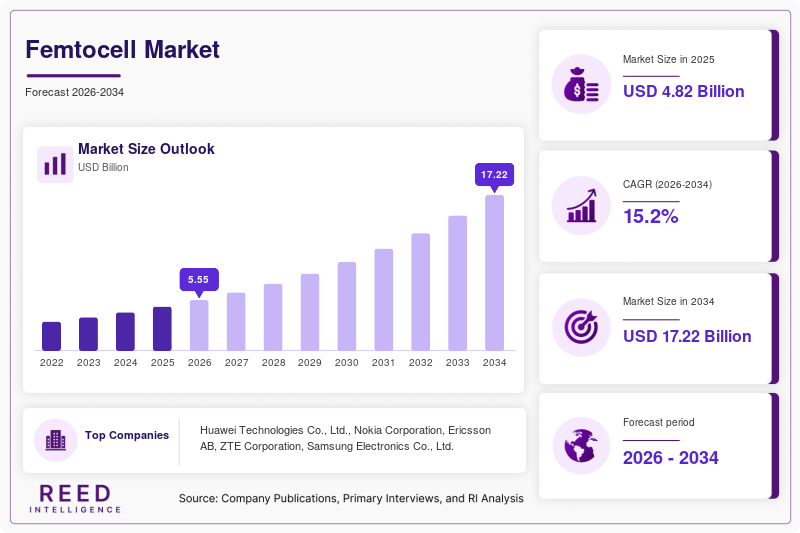
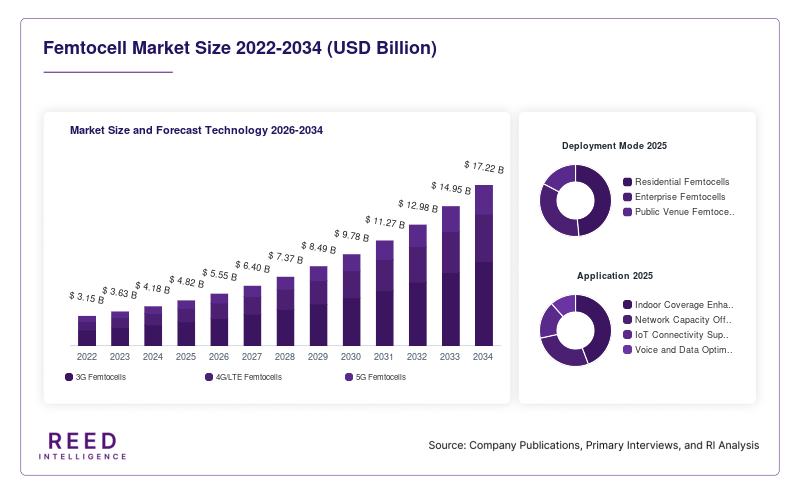
The global Femtocell Market size size was valued at USD 4.82 billion in 2026 and is projected to reach USD 14.96 billion by 2034, expanding at a CAGR of 15.2% during the forecast period of 2026–2034. The market has gained steady momentum as telecom operators and enterprises continue to strengthen indoor wireless coverage, network efficiency, and data capacity. Femtocells are low-power cellular base stations designed to improve signal quality inside homes, offices, hospitals, retail stores, and industrial facilities.
A major global factor supporting the expansion of the Femtocell Market has been the rapid rise in indoor mobile data consumption. With users increasingly relying on video streaming, cloud collaboration, gaming, and IoT-enabled devices indoors, service providers have invested in small-cell solutions that reduce congestion on macro networks while improving customer experience.
Key Highlights
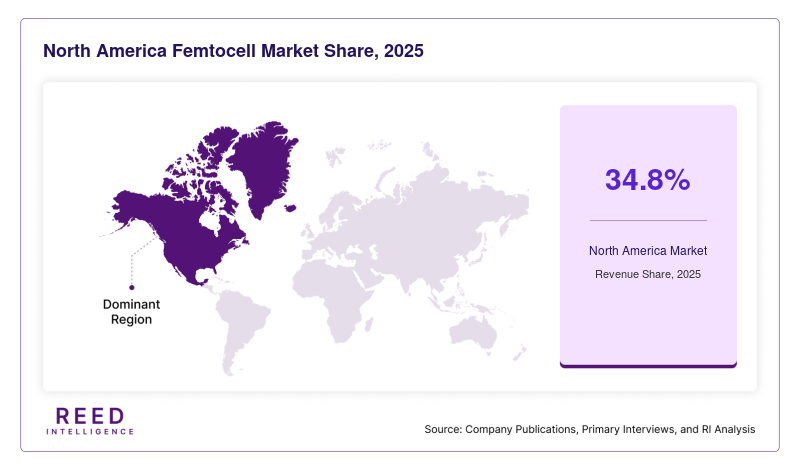
- North America accounted for the dominant 34.8% share of the global Femtocell Market in 2025, while Asia Pacific is expected to register the fastest CAGR of 17.6% through 2034.
- By deployment mode, Residential Femtocells led with 41.3% share in 2025, while Enterprise Femtocells are forecast to grow at 16.9% CAGR.
- By technology, 4G/LTE Femtocells held the largest share at 52.6%, while 5G Femtocells are projected to expand at 22.4% CAGR.
- By application, Indoor Coverage Enhancement remained the leading subsegment with 46.7% share, while IoT Connectivity Support is expected to grow at 19.1% CAGR.
- The United States remained the dominant country, with market values of USD 1.21 billion in 2024 and USD 1.38 billion in 2025.
Market Trends
Integration of 5G Small Cell Infrastructure
The transition toward 5G architecture is reshaping the Femtocell Market. Operators are deploying compact indoor cells to support ultra-low latency services, private wireless networks, and seamless in-building connectivity. These solutions are becoming essential for offices, hospitals, and smart campuses.
Rise of Smart Home Connectivity
Consumer demand for uninterrupted voice and data services inside homes has increased adoption of plug-and-play femtocells. Smart TVs, home security systems, connected appliances, and remote work applications are driving higher usage in residential environments.
Market Drivers
Growing Need for Reliable Indoor Mobile Coverage
Many buildings experience signal loss due to concrete walls, metallic structures, and dense urban layouts. Femtocells solve this challenge by creating localized cellular coverage zones. Businesses and households are adopting these systems to improve call quality and mobile broadband performance.
Telecom Network Cost Optimization
Expanding macro towers in dense urban zones often involves high capital expenditure. Femtocells offer a lower-cost alternative for boosting network capacity in targeted indoor areas. This cost efficiency has encouraged mobile operators to integrate small-cell layers into broader network strategies.
Market Restraint
Interference and Spectrum Management Challenges
Improper placement or poor synchronization of femtocells may create interference with macro cells or neighboring devices. This can affect network quality and increase deployment complexity, especially in multi-tenant buildings.
Market Opportunities
Private Enterprise Networks
Large enterprises are investing in secure private cellular systems for manufacturing plants, logistics hubs, and corporate campuses. Femtocells provide localized coverage, mobility, and device management benefits in these environments.
Rural Broadband Enhancement
Remote communities often face weak indoor mobile signals. Telecom operators can use femtocells connected through broadband backhaul to improve service quality in underserved residential and commercial zones.
Segmental Analysis
By Technology
4G/LTE Femtocells: 4G/LTE femtocells held the dominant 52.6% share in 2025. Their installed base remained strong because operators continued supporting LTE voice and data traffic while upgrading networks gradually.
5G Femtocells: 5G femtocells are expected to grow at 22.4% CAGR through 2034. Growth will be driven by demand for high-speed indoor connectivity, low latency, and enterprise automation use cases.
By Deployment Mode
Residential Femtocells: Residential femtocells accounted for 41.3% of the Femtocell Market in 2025. Home users preferred compact solutions that improved signal strength in apartments and suburban homes.
Enterprise Femtocells: Enterprise femtocells will expand at 16.9% CAGR over the forecast period. Offices and campuses will adopt these systems to support hybrid workforces, secure communication, and indoor mobility.
By Application
Indoor Coverage Enhancement: Indoor coverage enhancement led with 46.7% share in 2025. Commercial buildings, hospitals, and shopping centers relied on femtocells to reduce dead zones and dropped calls.
IoT Connectivity Support: IoT connectivity support is projected to grow at 19.1% CAGR through 2034. Growth will stem from rising demand for connected sensors, smart meters, and asset tracking systems operating indoors.
By End User
Telecom Operators: Telecom operators held 48.2% share in 2025 as they deployed femtocells to improve subscriber experience and relieve macro network congestion.
Enterprises: Enterprises are anticipated to grow at 17.3% CAGR through 2034. Businesses will adopt private cellular environments for productivity, security, and smart building management.
Regional Analysis
North America
North America held 34.8% of the global Femtocell Market in 2025 and will grow at a CAGR of 14.1% through 2034. The United States dominated the region due to high smartphone penetration and extensive enterprise mobility usage. Strong demand for seamless indoor video conferencing and cloud applications has supported adoption.
Europe
Europe represented 24.6% market share in 2025 and will expand at a CAGR of 13.8% during the forecast period. Germany led the regional market as industrial facilities and logistics centers adopted advanced indoor wireless systems to support connected operations.
Asia Pacific
Asia Pacific captured 22.9% share in 2025 and is expected to record the fastest CAGR of 17.6% through 2034. China remained the leading country due to rapid 5G infrastructure rollout and dense urban populations requiring stronger indoor connectivity.
Middle East & Africa
Middle East & Africa accounted for 9.4% of the Femtocell Market in 2025 and will grow at a CAGR of 15.0%. The United Arab Emirates led regional demand as commercial real estate developments increasingly integrated modern telecom systems.
Latin America
Latin America held 8.3% share in 2025 and is projected to expand at a CAGR of 14.4% through 2034. Brazil dominated the region due to increasing mobile broadband usage and demand for better signal quality in urban apartment complexes.
Competitive Landscape
The global Femtocell Market remains moderately consolidated, with established telecom equipment providers and wireless infrastructure companies competing through product innovation, software integration, and operator partnerships. Leading vendors focus on compact 5G-ready indoor small cells, cloud-based management systems, and scalable deployment models.
Huawei Technologies Co., Ltd. remained a market leader due to its broad telecom portfolio and strong operator relationships across Asia and Europe. In 2025, the company introduced an upgraded indoor small-cell platform supporting multi-band deployments and centralized orchestration.
Nokia Corporation has strengthened its presence through enterprise wireless solutions and private network offerings. Ericsson AB continues to focus on carrier-grade indoor coverage platforms integrated with 5G core systems. ZTE Corporation has expanded in emerging markets through cost-efficient deployment packages. Samsung Electronics Co., Ltd. has gained traction in North America through advanced 5G indoor radio solutions.
Competition is expected to intensify as software-defined networks, AI-based optimization, and private wireless demand accelerate across commercial sectors.
Key Players List
- Huawei Technologies Co., Ltd.
- Nokia Corporation
- Ericsson AB
- ZTE Corporation
- Samsung Electronics Co., Ltd.
- Cisco Systems, Inc.
- CommScope Holding Company, Inc.
- Airspan Networks Inc.
- NEC Corporation
- Fujitsu Limited
- Casa Systems, Inc.
- Radisys Corporation
- Mavenir Systems, Inc.
- Parallel Wireless, Inc.
- Juniper Networks, Inc.
Recent Developments
- In 2025, Huawei launched a new cloud-managed indoor femtocell platform for enterprise campuses.
- In 2025, Nokia expanded its private wireless femtocell portfolio for manufacturing facilities.
- In 2024, Ericsson partnered with telecom operators to improve in-building 5G coverage across urban centers.
- In 2024, Samsung introduced compact indoor radios for high-density commercial buildings.
- In 2025, Airspan Networks announced software upgrades for remote femtocell optimization.
Femtocell Market Segments
Technology
- 3G Femtocells
- 4G/LTE Femtocells
- 5G Femtocells
Deployment Mode
- Residential Femtocells
- Enterprise Femtocells
- Public Venue Femtocells
Application
- Indoor Coverage Enhancement
- Network Capacity Offloading
- IoT Connectivity Support
- Voice and Data Optimization
End User
- Telecom Operators
- Enterprises
- Government Institutions
- Healthcare Facilities
By Region
- North America
- Europe
- APAC
- Middle East and Africa
- LATAM