Ferrofluid Market Size, Share & Demand Report By Type (Hydrocarbon-Based Ferrofluids, Water-Based Ferrofluids, Ester-Based Ferrofluids), By Application (Electronics, Mechanical Systems, Medical Devices, Sensors & Instrumentation), By End-Use Industry (Electronics Industry, Healthcare Industry, Aerospace & Defense, Industrial Manufacturing), By Region & Segment Forecasts, 2025–2033
USD 3950
Market Overview
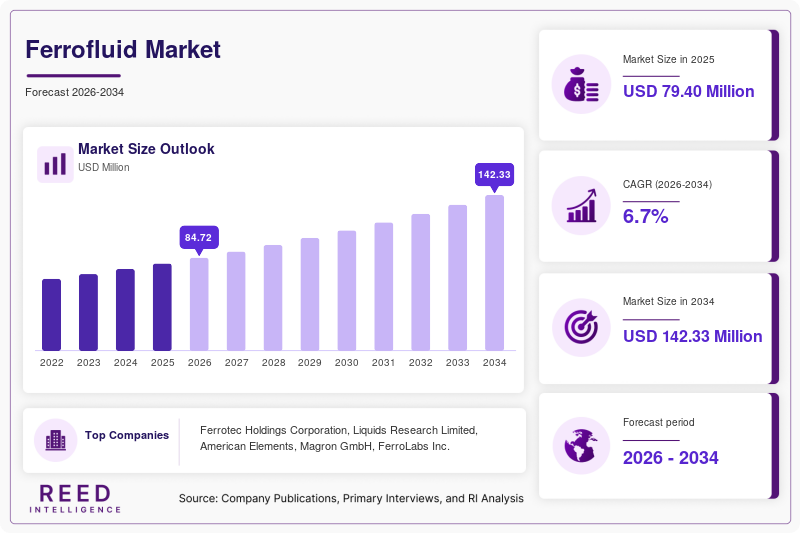
The global Ferrofluid Market was valued at USD 79.4 million in 2024 and is projected to reach USD 142.6 million by 2033, registering a CAGR of 6.7% during the forecast period (2025–2033). Ferrofluids are stable colloidal suspensions of magnetic nanoparticles dispersed in carrier liquids such as oil or water. These materials exhibit strong magnetic responsiveness while maintaining liquid properties, enabling their use in various precision technologies including electronics, healthcare devices, aerospace components, and industrial sealing systems.
One key global factor supporting the expansion of the Ferrofluid Market is the increasing demand for high-performance electronics and precision components. Ferrofluids are widely utilized in loudspeakers, hard disk drives, sensors, and damping systems where controlled magnetic properties improve device stability, heat dissipation, and acoustic performance. As electronics become more compact and technologically advanced, the need for materials that provide magnetic control and thermal management continues to rise.
Technological progress in nanomaterial synthesis has also enhanced ferrofluid stability and magnetic performance. Manufacturers are increasingly developing specialized ferrofluids tailored for advanced medical imaging, microfluidic systems, and precision engineering applications. These innovations are broadening the market scope across both research and industrial applications.
Growing adoption in emerging sectors such as robotics, biomedical engineering, and smart fluid technologies is expected to support steady growth in the coming years. As industries prioritize performance optimization and miniaturization, ferrofluid-based solutions are becoming increasingly relevant.
Key Highlights
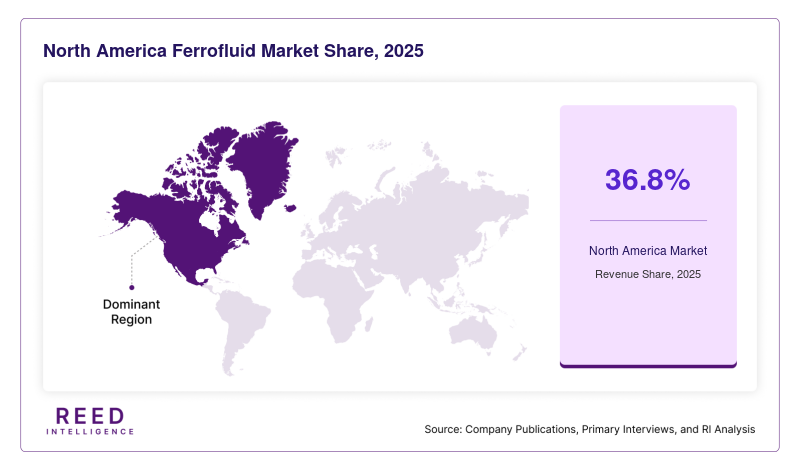
- North America held the dominant regional share of 36.8% in 2025, while Asia Pacific will record the fastest CAGR of 7.9% through 2033.
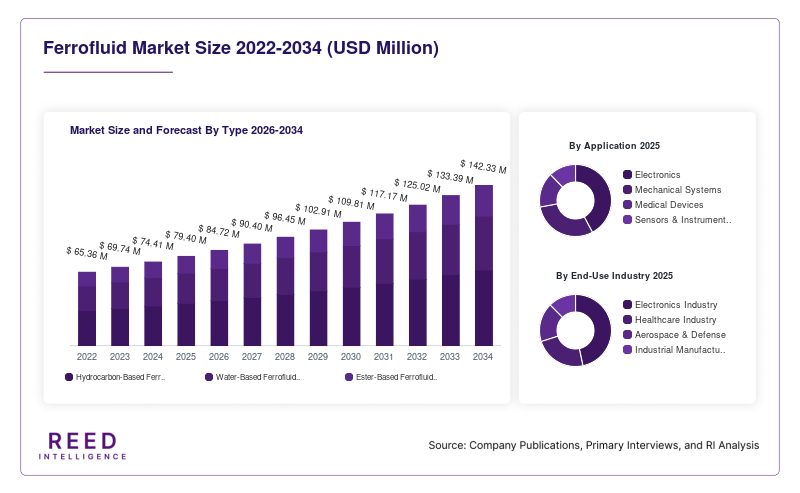
- Hydrocarbon-based ferrofluids led the type segment with 44.6% share in 2024, while water-based ferrofluids will expand fastest at a CAGR of 7.5%.
- Electronics applications accounted for 39.3% of market share in 2024, while medical devices will grow fastest at 8.1% CAGR.
- The United States remained the dominant country with a market value of USD 22.5 million in 2024 and USD 24.1 million in 2025.
Market Trends
Integration of Ferrofluids in Precision Electronics
One significant trend shaping the Ferrofluid Market is the growing use of ferrofluids in precision electronic components and acoustic systems. Ferrofluids are commonly used in loudspeaker voice coils to improve heat dissipation, reduce distortion, and enhance sound clarity. With rising consumer demand for high-quality audio equipment and compact electronic devices, manufacturers are integrating ferrofluid technology into advanced designs.
In addition, ferrofluids play a role in vibration damping and sealing in rotating electronic systems. As devices continue to shrink in size while increasing in performance, materials capable of maintaining stability under electromagnetic influence are gaining attention. The electronics industry is therefore expected to remain a key innovation hub for ferrofluid applications.
Expanding Research in Biomedical and Microfluidic Applications
Another emerging trend is the growing research focus on biomedical and microfluidic ferrofluid technologies. Scientists are exploring ferrofluid use in targeted drug delivery, magnetic resonance imaging (MRI) contrast enhancement, and cell separation techniques. These applications rely on the ability of ferrofluids to respond to external magnetic fields with high precision.
In parallel, microfluidic systems increasingly incorporate ferrofluids for controlled fluid manipulation in lab-on-chip devices. Such technologies support advanced diagnostics, biotechnology experiments, and medical testing. As research institutions and medical technology companies expand development programs, ferrofluid-based innovations are likely to influence the long-term market outlook.
Market Drivers
Growing Demand for High-Performance Magnetic Materials
The increasing need for advanced magnetic materials across industrial sectors is a major driver of the Ferrofluid Market. Ferrofluids offer unique characteristics such as controlled magnetization, fluid mobility, and stability under varying environmental conditions. These features make them suitable for sealing systems, rotary shaft applications, and damping mechanisms.
Industries including aerospace, electronics, and manufacturing rely on precision components that require reliable sealing and lubrication. Ferrofluids provide a non-contact sealing solution capable of preventing contamination and maintaining system integrity. As industrial equipment becomes more technologically complex, demand for such specialized materials is expected to increase.
Expansion of Nanotechnology Research
The continued growth of nanotechnology research and material science innovation is another key driver supporting market expansion. Ferrofluids consist of nanoscale magnetic particles stabilized with surfactants, making them an important product of nanomaterial engineering.
Research institutions and technology companies are investing in advanced nanoparticle synthesis techniques that improve ferrofluid uniformity, magnetic response, and thermal stability. These improvements are enabling new commercial applications across robotics, fluid control systems, and precision instrumentation. As nanotechnology adoption increases worldwide, ferrofluid demand will likely follow a similar trajectory.
Market Restraints
High Production Costs and Stability Challenges
A major restraint affecting the Ferrofluid Market is the high cost associated with production and stability management. Manufacturing ferrofluids requires complex synthesis processes involving magnetic nanoparticles, carrier liquids, and stabilizing surfactants. Maintaining long-term stability while preventing particle aggregation presents technical challenges.
In addition, certain applications require highly customized ferrofluid formulations with precise magnetic and thermal characteristics. These specialized formulations increase production complexity and overall cost. Small-scale industries and emerging markets may therefore face limitations in adopting ferrofluid technology due to budget constraints.
Furthermore, ferrofluids may experience performance degradation if exposed to extreme temperatures or incompatible environments. These limitations can restrict their use in some industrial conditions, slowing adoption in cost-sensitive sectors.
Market Opportunities
Growth in Medical and Diagnostic Technologies
The increasing development of advanced medical diagnostics and therapeutic technologies represents a notable opportunity for the Ferrofluid Market. Researchers are exploring ferrofluids for targeted drug delivery systems where magnetic fields guide medication to specific regions within the body. This approach could improve treatment efficiency while minimizing side effects.
Ferrofluids are also under investigation for imaging enhancement and magnetic hyperthermia therapy in cancer treatment. As healthcare systems invest in precision medicine and minimally invasive technologies, demand for specialized ferrofluid formulations could increase.
Emerging Applications in Robotics and Smart Materials
Another promising opportunity lies in robotics and adaptive material systems. Ferrofluids are capable of changing shape or movement patterns under magnetic influence, making them suitable for soft robotics, fluid actuators, and smart surface technologies.
These properties allow engineers to develop flexible robotic components and adaptive interfaces for industrial automation. Research into magnetically responsive materials is expanding rapidly, and ferrofluids are expected to play a role in future intelligent mechanical systems.
Segmental Analysis
By Type
Hydrocarbon-based ferrofluids dominated the Ferrofluid Market, accounting for 44.6% of the total share in 2024. These ferrofluids utilize hydrocarbon carrier liquids that offer strong chemical stability and compatibility with industrial machinery. Their resistance to oxidation and ability to perform under mechanical stress made them widely used in sealing systems, rotary shafts, and industrial equipment.
Water-based ferrofluids will emerge as the fastest-growing subsegment with a projected CAGR of 7.5% during the forecast period. These formulations will gain attention due to their environmental compatibility and suitability for biomedical and laboratory applications. Water-based ferrofluids will increasingly be used in medical research, diagnostic systems, and microfluidic technologies where biocompatibility is essential.
By Application
Electronics applications represented the dominant segment in 2024, accounting for 39.3% of the Ferrofluid Market share. Ferrofluids have been widely used in speakers, cooling systems, and electronic sensors. Their ability to manage heat dissipation and vibration control has made them essential in high-performance audio equipment and electronic components.
Medical device applications will grow at the fastest CAGR of 8.1% between 2025 and 2033. Growth in this segment will be supported by increasing exploration of ferrofluid-based technologies in targeted drug delivery, diagnostic imaging, and biomedical instrumentation. Healthcare researchers will continue investigating the use of magnetic nanoparticles in therapeutic procedures and imaging systems.
By End-Use Industry
The electronics industry dominated the Ferrofluid Market in 2024 with 41.8% share. Consumer electronics manufacturers and audio equipment producers extensively used ferrofluids in speaker cooling systems and vibration damping mechanisms. The integration of ferrofluid technology improved product reliability and acoustic performance in electronic devices.
The healthcare sector will represent the fastest-growing end-use segment with a CAGR of 8.3% through 2033. This growth will be driven by expanding research into magnetic nanoparticle applications for diagnostic and therapeutic technologies. As medical device innovation accelerates, ferrofluid materials will gain importance in experimental medical systems and specialized treatment methods.
Regional Analysis
North America
North America accounted for 36.8% of the Ferrofluid Market share in 2025 and maintained a strong presence due to its advanced technological infrastructure. The region will expand at a CAGR of 6.4% through 2033. Market growth in this region is supported by widespread adoption of ferrofluids in electronics manufacturing, research laboratories, and industrial sealing systems.
The United States represented the dominant country within North America. Growth in the country has been influenced by strong research activity in nanotechnology and material science. Universities, national laboratories, and technology companies have continued to explore ferrofluid applications in aerospace systems, precision instrumentation, and acoustic engineering. These research initiatives have created a steady demand for specialized ferrofluid products across the domestic market.
Europe
Europe held 24.5% of the global Ferrofluid Market share in 2025 and will grow at a CAGR of 6.1% during the forecast period. The region has maintained consistent demand for ferrofluids in industrial manufacturing, automotive components, and scientific instrumentation.
Germany remained the dominant country within the European market. The country's engineering-focused industrial sector has utilized ferrofluid technology in precision sealing systems for rotating machinery and vacuum equipment. German manufacturers emphasize high-performance mechanical systems used in industrial automation and laboratory environments. This focus on advanced engineering materials has supported steady demand for ferrofluid solutions in the region.
Asia Pacific
Asia Pacific represented 22.7% of the Ferrofluid Market share in 2025 and will expand at the fastest CAGR of 7.9% between 2025 and 2033. The region's growth outlook is linked to expanding electronics manufacturing and technological innovation across emerging economies.
China dominated the Asia Pacific market. The country’s large-scale electronics production ecosystem has generated significant demand for ferrofluids used in speakers, sensors, and microelectronic components. China’s growing semiconductor and precision device manufacturing industries have also contributed to increased consumption of ferrofluid-based materials in specialized equipment.
Middle East & Africa
The Middle East & Africa accounted for 8.3% of the Ferrofluid Market share in 2025 and will grow at a CAGR of 5.6% through 2033. Market development in the region has been gradual due to the early-stage adoption of advanced nanomaterials.
Saudi Arabia emerged as the dominant country in this regional market. Growth in the country has been associated with increasing investments in scientific research centers and industrial technology initiatives. Academic institutions and innovation hubs have started exploring nanomaterial applications, including ferrofluids for experimental engineering and laboratory technologies.
Latin America
Latin America held 7.7% of the Ferrofluid Market share in 2025 and is projected to expand at a CAGR of 5.9% during the forecast period. Industrial modernization and research development have gradually supported ferrofluid adoption across the region.
Brazil represented the dominant country in Latin America. The country's academic research institutions and industrial engineering programs have investigated ferrofluid-based solutions for fluid dynamics experiments and mechanical systems. As Brazil continues to expand its scientific infrastructure, demand for specialized nanomaterials such as ferrofluids is expected to increase.
Competitive Landscape
The Ferrofluid Market is moderately consolidated, with several specialized material science companies involved in production and research. Leading manufacturers focus on customized ferrofluid formulations, research collaborations, and technological advancements to maintain their market position.
Ferrotec Holdings Corporation remains a key market participant due to its extensive ferrofluid product portfolio and research capabilities. The company recently expanded its advanced materials division to support emerging applications in electronics and precision engineering.
Other companies are investing in nanomaterial synthesis improvements and expanding application-specific product offerings. Partnerships with research institutes and electronics manufacturers continue to play an important role in product innovation and commercialization strategies.
Key Players
- Ferrotec Holdings Corporation
- Liquids Research Limited
- FerroLabs Inc.
- American Elements
- Ioniqa Technologies
- Magron GmbH
- Ferrolabs Corporation
- Grimag Magnetics
- Sigma-Aldrich (Merck KGaA)
- Cytodiagnostics Inc.
- NanoMagnetics Instruments
- Nanoshel LLC
- Magnatech LLC
- BGI Ferrofluidics
- K&J Magnetics
Recent Developments
- In 2024, Ferrotec Holdings Corporation introduced a new ferrofluid formulation designed for advanced acoustic systems and precision electronics.
- In 2023, American Elements expanded its nanomaterial production facility to increase output of magnetic nanoparticles used in ferrofluid synthesis.
- In 2024, several research institutions collaborated with material science companies to explore ferrofluid applications in targeted drug delivery systems.
- In 2025, manufacturers initiated development programs focused on environmentally compatible ferrofluid formulations for laboratory and biomedical applications.
Ferrofluid Market Segments
By Type
- Hydrocarbon-Based Ferrofluids
- Water-Based Ferrofluids
- Ester-Based Ferrofluids
By Application
- Electronics
- Mechanical Systems
- Medical Devices
- Sensors & Instrumentation
By End-Use Industry
- Electronics Industry
- Healthcare Industry
- Aerospace & Defense
- Industrial Manufacturing
By Region
- North America
- Europe
- Asia Pacific
- Middle East & Africa
- Latin America
By Region
- North America
- Europe
- APAC
- Middle East and Africa
- LATAM