Ferrofluid Suspensions Market Size, Share & Demand Report By Type (Oil-Based Ferrofluid Suspensions, Water-Based Ferrofluid Suspensions, Synthetic Carrier Fluid Ferrofluid Suspensions), By Application (Electronic Components, Sealing Systems, Sensors, Biomedical Applications, Audio Devices, Others), By End-Use Industry (Electronics and Semiconductors, Healthcare and Medical Devices, Aerospace and Defense, Automotive, Energy and Utilities, Industrial Manufacturing), By Region & Segment Forecasts,
USD 3950
Market Overview
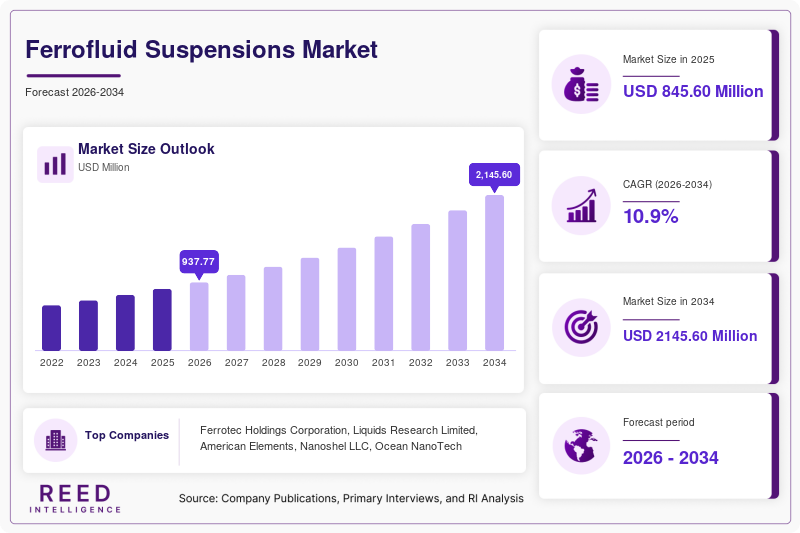
The global Ferrofluid Suspensions Market size was valued at USD 845.6 million in 2026 and is projected to reach USD 1.94 billion by 2034, expanding at a CAGR of 10.9% during 2026–2034. Ferrofluid suspensions are colloidal liquids composed of nanoscale ferromagnetic particles dispersed within carrier fluids. These advanced materials exhibit unique magnetic responsiveness while maintaining fluid behavior, making them suitable for a broad range of industrial, medical, electronic, automotive, aerospace, and energy applications.
Growing demand for precision engineering materials has significantly influenced market expansion. Industries increasingly require smart fluids capable of delivering controlled motion, heat dissipation, vibration damping, and sealing performance under demanding operating conditions. Ferrofluid suspensions provide these benefits while enabling miniaturization and enhanced system efficiency. Their adoption in sensors, loudspeakers, rotating shaft seals, medical diagnostics, and advanced electronics continues to expand across developed and emerging economies.
Key Highlights
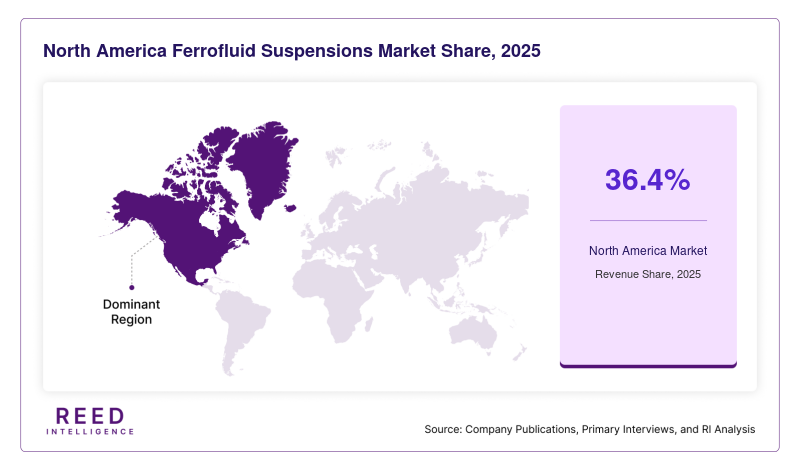
- North America dominated the market with a 36.4% share in 2025, while Asia Pacific is expected to grow at the fastest CAGR of 12.1% during 2026–2034.
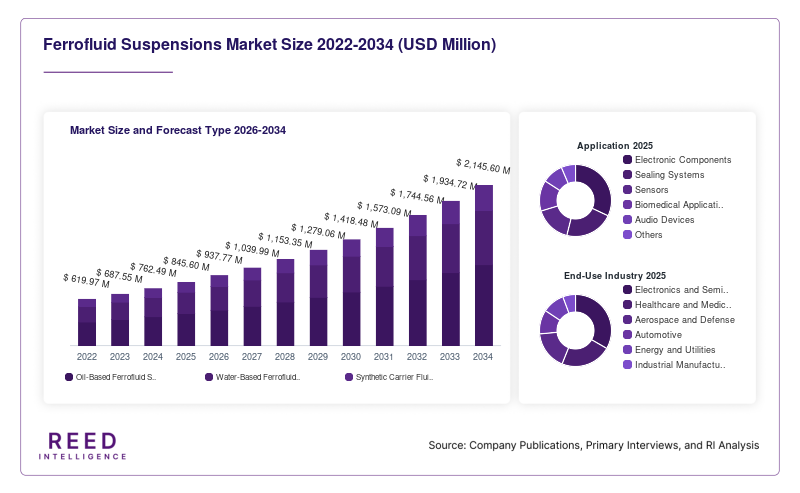
- By type, oil-based ferrofluid suspensions accounted for the largest share of 44.8%, while water-based ferrofluid suspensions are projected to grow at a CAGR of 11.9%.
- By application, electronic components led with a 39.6% share, whereas biomedical applications are expected to expand at a CAGR of 12.8%.
- By end-use industry, electronics and semiconductors held the largest share of 34.9%, while healthcare and medical devices are forecast to grow at a CAGR of 13.2%.
- The United States remained the dominant country, with market values of USD 265 million in 2024 and USD 292 million in 2025.
Market Trends
Expansion of Ferrofluid Integration in Advanced Electronics
The adoption of ferrofluid suspensions within advanced electronics is increasing as manufacturers pursue compact and efficient designs. Ferrofluids are increasingly utilized for thermal management, vibration reduction, and magnetic control applications in high-performance devices. Semiconductor equipment manufacturers are incorporating these materials into precision systems where operational stability is critical. As electronic devices become smaller and more powerful, efficient heat transfer and mechanical protection have become essential design requirements. Ferrofluid suspensions provide a practical solution by improving performance while reducing component wear. Continuous investments in consumer electronics, industrial automation systems, and smart manufacturing technologies are expected to support sustained growth in this application area throughout the forecast period.
Rising Utilization in Medical and Biomedical Technologies
Healthcare applications are emerging as a significant trend within the Ferrofluid Suspensions Market. Researchers and medical device manufacturers are exploring ferrofluids for targeted drug delivery, diagnostic imaging enhancement, biosensors, and minimally invasive treatment procedures. The magnetic responsiveness of ferrofluids enables precise control within biological environments, supporting innovative therapeutic techniques. Growing healthcare expenditure and increasing focus on advanced treatment solutions are accelerating research activities. Universities, biotechnology firms, and healthcare technology providers continue to expand development programs involving magnetic nanoparticles and ferrofluid formulations. As regulatory frameworks mature and commercialization progresses, biomedical applications are expected to become a major contributor to future market demand.
Market Drivers
Increasing Demand for Precision Sealing and Rotational Equipment
Ferrofluid suspensions are widely used in sealing systems for rotating machinery operating in sensitive environments. Industries such as semiconductor manufacturing, aerospace, and industrial automation require contamination-free operations and highly reliable sealing performance. Ferrofluids create magnetic liquid seals that reduce leakage while maintaining operational efficiency. Their ability to perform under challenging conditions makes them attractive for critical applications. The growth of advanced manufacturing facilities and increasing automation investments have amplified demand for specialized sealing technologies. As industrial systems become more sophisticated and performance standards continue to rise, the utilization of ferrofluid-based sealing solutions is expected to increase steadily across multiple sectors.
Growth of Semiconductor and Electronics Manufacturing
The rapid expansion of semiconductor fabrication and electronics production has become a major growth driver for the Ferrofluid Suspensions Market. Ferrofluids support various electronic applications including thermal management systems, damping mechanisms, and precision positioning equipment. The increasing complexity of semiconductor manufacturing processes requires advanced materials capable of supporting accuracy and reliability. Rising demand for artificial intelligence hardware, data centers, consumer electronics, and communication infrastructure is encouraging manufacturers to adopt innovative materials. Ferrofluid suspensions help improve performance, extend equipment lifespan, and enhance production efficiency. Continued investments in semiconductor capacity expansion across North America, Europe, and Asia Pacific are expected to sustain market growth.
Market Restraint
High Production Costs and Technical Complexity
Despite strong growth prospects, the Ferrofluid Suspensions Market faces challenges related to manufacturing costs and technical complexity. Producing stable ferrofluid suspensions requires advanced nanoparticle synthesis methods, precise surface treatments, and stringent quality control procedures. These requirements increase production expenses and limit widespread adoption in cost-sensitive industries. Maintaining long-term suspension stability and consistent magnetic performance also presents engineering challenges. Variations in particle size distribution or carrier fluid composition can affect operational effectiveness. Smaller manufacturers may face difficulties in achieving economies of scale, which can restrict market penetration. In addition, certain end-users remain cautious regarding long-term maintenance requirements and replacement costs. These factors collectively influence purchasing decisions and may slow adoption in selected industrial applications despite the technology's performance advantages.
Market Opportunities
Emerging Applications in Renewable Energy Systems
Renewable energy technologies present substantial opportunities for ferrofluid suspension manufacturers. Wind turbines, energy storage systems, and advanced power generation equipment increasingly require efficient cooling, sealing, and vibration management solutions. Ferrofluid suspensions offer unique characteristics that can enhance operational efficiency and equipment reliability. As governments continue investing in clean energy infrastructure, demand for advanced materials is expected to increase. Manufacturers are developing specialized ferrofluid formulations capable of operating under varying environmental conditions. The transition toward sustainable energy systems creates opportunities for suppliers to expand product portfolios and establish long-term partnerships with renewable energy equipment manufacturers worldwide.
Development of Smart Medical Devices and Targeted Therapies
The growing focus on personalized healthcare is creating new opportunities within the Ferrofluid Suspensions Market. Medical technology developers are investigating ferrofluid-enabled systems for controlled drug delivery, magnetic hyperthermia treatments, and advanced diagnostic platforms. These applications offer the potential for improved treatment precision and enhanced patient outcomes. Increasing research funding, expanding biotechnology investments, and growing demand for minimally invasive procedures are accelerating innovation. Commercialization of next-generation medical devices utilizing magnetic fluid technologies could significantly expand market revenue streams. As clinical validation progresses and healthcare providers adopt advanced treatment methods, ferrofluid suspensions are expected to play a larger role in future medical technologies.
Segmental Analysis
By Type
Oil-based ferrofluid suspensions dominated the market in 2024, accounting for approximately 44.8% of total revenue. Their widespread adoption stems from superior thermal stability, durability, and compatibility with demanding industrial environments. These formulations are commonly used in rotating seals, electronic cooling systems, loudspeakers, and aerospace applications. Their ability to maintain performance under varying temperature conditions makes them highly suitable for long-term industrial operations. Manufacturers continue to favor oil-based variants because of their established reliability and extensive application history. Strong demand from semiconductor equipment manufacturers and industrial automation companies has further reinforced their leading market position.
Water-based ferrofluid suspensions represent the fastest-growing subsegment and are projected to expand at a CAGR of 11.9% through 2034. Growth is supported by increasing demand for environmentally compatible materials and expanding biomedical applications. These suspensions are gaining popularity in healthcare technologies due to favorable biological compatibility characteristics. Research institutions and medical device manufacturers are investing heavily in water-based formulations designed for diagnostic imaging, biosensors, and therapeutic applications. Regulatory preferences for safer and more sustainable materials are also encouraging adoption. Continuous advancements in particle stabilization techniques are expected to enhance commercial viability and accelerate growth.
By Application
Electronic components represented the largest application segment in 2024, accounting for approximately 39.6% of market revenue. Ferrofluid suspensions play a critical role in thermal management, vibration control, and precision movement systems used within electronic devices and manufacturing equipment. As electronic products continue to become smaller and more powerful, effective heat dissipation and operational stability have become increasingly important. Ferrofluids help address these challenges while supporting device reliability. Demand from semiconductor manufacturing facilities, consumer electronics producers, and industrial automation equipment suppliers continues to strengthen the segment's position within the market.
Biomedical applications are anticipated to register the fastest CAGR of 12.8% during the forecast period. Increasing interest in targeted drug delivery systems, magnetic resonance imaging enhancements, and magnetic hyperthermia treatments is driving demand. Healthcare organizations are exploring innovative technologies capable of improving treatment effectiveness while reducing patient recovery times. Ferrofluid suspensions offer unique capabilities that align with these objectives. Rising research funding and growing collaboration between biotechnology firms and academic institutions are supporting product development. As regulatory approvals expand and commercialization progresses, biomedical applications are expected to become a significant source of future market growth.
By End-Use Industry
Electronics and semiconductors accounted for the largest share of the market in 2024, representing approximately 34.9% of total revenue. The industry relies on ferrofluid suspensions for advanced manufacturing equipment, precision sealing systems, cooling technologies, and vibration control mechanisms. Increasing demand for artificial intelligence processors, cloud computing infrastructure, and high-performance consumer electronics continues to drive semiconductor production growth. Manufacturers are investing heavily in facility expansion and process optimization initiatives that require advanced materials. These factors collectively support sustained demand for ferrofluid-based technologies throughout the electronics value chain.
Healthcare and medical devices constitute the fastest-growing end-use industry and are projected to expand at a CAGR of 13.2% through 2034. Growth is driven by increasing adoption of advanced diagnostic tools, targeted treatment technologies, and precision medical devices. Ferrofluid suspensions offer opportunities for innovation across multiple healthcare applications. Expanding healthcare infrastructure, rising research expenditures, and increasing demand for personalized medicine are accelerating market development. Partnerships between healthcare providers, biotechnology companies, and material science organizations are creating favorable conditions for commercial adoption and long-term industry expansion.
Regional Analysis
North America
North America accounted for approximately 36.4% of the global Ferrofluid Suspensions Market in 2025 and is projected to maintain a strong position throughout the forecast period. The region is anticipated to register a CAGR of 9.8% from 2026 to 2034. High investments in semiconductor manufacturing, aerospace engineering, and advanced industrial automation continue to support market growth. Strong research capabilities and established nanotechnology ecosystems further contribute to regional expansion.
The United States remains the dominant country within the region due to its extensive electronics manufacturing base and advanced healthcare sector. Increasing investments in precision medical devices represent a major growth factor. Research institutions and private companies are actively developing new ferrofluid applications, supporting innovation and commercialization across multiple end-use industries.
Europe
Europe represented approximately 27.6% of the global market in 2025 and is expected to expand at a CAGR of 10.2% during the forecast period. The region benefits from strong industrial manufacturing capabilities, advanced engineering expertise, and growing adoption of high-performance materials. Demand for ferrofluid suspensions is increasing across automotive, industrial automation, and renewable energy sectors.
Germany continues to dominate the European market owing to its extensive manufacturing infrastructure and engineering leadership. A unique growth factor is the region’s focus on industrial efficiency and smart factory implementation. Increasing deployment of precision equipment and automated systems is encouraging wider use of ferrofluid-based technologies in industrial environments.
Asia Pacific
Asia Pacific held approximately 24.3% of the global Ferrofluid Suspensions Market in 2025 and is forecast to achieve the fastest CAGR of 12.1% through 2034. Rapid industrialization, expanding electronics production, and increasing investments in advanced materials research are supporting strong market growth. The region continues to attract manufacturing investments due to favorable production economics and expanding consumer demand.
China remains the dominant country in the regional market. The country's extensive semiconductor manufacturing ecosystem serves as a key growth factor. Continuous investments in electronics production, renewable energy infrastructure, and advanced healthcare technologies are generating substantial opportunities for ferrofluid suspension suppliers operating throughout the region.
Middle East & Africa
The Middle East & Africa accounted for approximately 6.1% of global revenue in 2025 and is expected to record a CAGR of 8.7% during the forecast period. While still developing, the market is gaining momentum through increasing industrial diversification efforts and growing investments in technology-driven sectors. Governments are supporting modernization initiatives that encourage adoption of advanced materials and engineering solutions.
Saudi Arabia leads the regional market due to expanding industrial development programs and infrastructure investments. A distinctive growth factor is the region’s increasing focus on high-value manufacturing industries beyond traditional energy sectors. These initiatives are encouraging adoption of precision technologies where ferrofluid suspensions can provide performance benefits.
Latin America
Latin America captured approximately 5.6% of the global market in 2025 and is projected to grow at a CAGR of 8.9% through 2034. Expanding industrial activities and rising technology investments are contributing to market development. Increasing awareness of advanced materials and their operational benefits is supporting gradual adoption across multiple industries.
Brazil remains the dominant country within the region owing to its comparatively large industrial base and manufacturing capacity. An important growth factor is the expansion of industrial automation projects. Companies are investing in equipment modernization programs that require advanced sealing, sensing, and thermal management solutions supported by ferrofluid technologies.
Competitive Landscape
The Ferrofluid Suspensions Market is moderately consolidated, with several global and regional participants competing through product innovation, application development, and strategic partnerships. Companies are focusing on improving magnetic performance, suspension stability, and environmental compatibility to strengthen their competitive positions. Investments in nanotechnology research and customized product development remain key strategic priorities across the industry.
Ferrotec Holdings Corporation continues to maintain a leadership position due to its broad product portfolio, extensive manufacturing capabilities, and strong presence in semiconductor applications. Recent developments include expanded production capacity for advanced ferrofluid solutions targeting electronics and precision industrial equipment.
Other notable market participants are increasing investments in healthcare-oriented ferrofluid technologies and next-generation cooling applications. Competitive dynamics are expected to intensify as manufacturers pursue growth opportunities in biomedical devices, renewable energy systems, and advanced industrial automation. Strategic collaborations, product launches, and regional expansion initiatives are likely to remain central competitive strategies throughout the forecast period.
Key Players
- Ferrotec Holdings Corporation
- Liquids Research Limited
- Ferrotec Material Technologies
- American Elements
- Ioniqa Technologies
- Sigma-Aldrich Materials
- Nanografi Nano Technology
- Beijing Ferrofluid Technology Co.
- Apex Magnets Technologies
- Nanoshel LLC
- Cytodiagnostics Inc.
- Magron Corporation
- FerroLabs Inc.
- NanoHybrids Corporation
- Ocean NanoTech
Recent Developments
- In 2025, a leading ferrofluid manufacturer expanded its production capacity for high-performance magnetic fluids to meet growing demand from semiconductor fabrication and precision industrial equipment sectors.
- In 2025, several medical technology companies advanced research programs involving ferrofluid-based targeted drug delivery systems, supporting the development of next-generation precision healthcare solutions.
- In 2024, a major nanomaterials producer introduced a new water-based ferrofluid suspension with enhanced particle stability for biomedical imaging and diagnostic applications.
- In 2024, manufacturers increased investments in research and development activities focused on improving ferrofluid thermal conductivity, magnetic responsiveness, and long-term operational stability for electronics applications.
- In 2025, strategic collaborations between ferrofluid suppliers and semiconductor equipment manufacturers accelerated the commercialization of advanced sealing and cooling solutions for high-precision manufacturing environments.
Ferrofluid Suspensions Market Segments
Type
- Oil-Based Ferrofluid Suspensions
- Water-Based Ferrofluid Suspensions
- Synthetic Carrier Fluid Ferrofluid Suspensions
Application
- Electronic Components
- Sealing Systems
- Sensors
- Biomedical Applications
- Audio Devices
- Others
End-Use Industry
- Electronics and Semiconductors
- Healthcare and Medical Devices
- Aerospace and Defense
- Automotive
- Energy and Utilities
- Industrial Manufacturing
By Region
- North America
- Europe
- APAC
- Middle East and Africa
- LATAM