Ferrotitanium Market Size, Share & Demand Report By Type (Low-Grade Ferrotitanium, High-Purity Ferrotitanium), By Application (Steelmaking, Additive Manufacturing, Foundry), By End-Use Industry (Aerospace & Defense, Automotive, Renewable Energy, Industrial Manufacturing), By Form (Lump, Powder), By Region & Segment Forecasts, 2026–2034
USD 3950
Market Overview
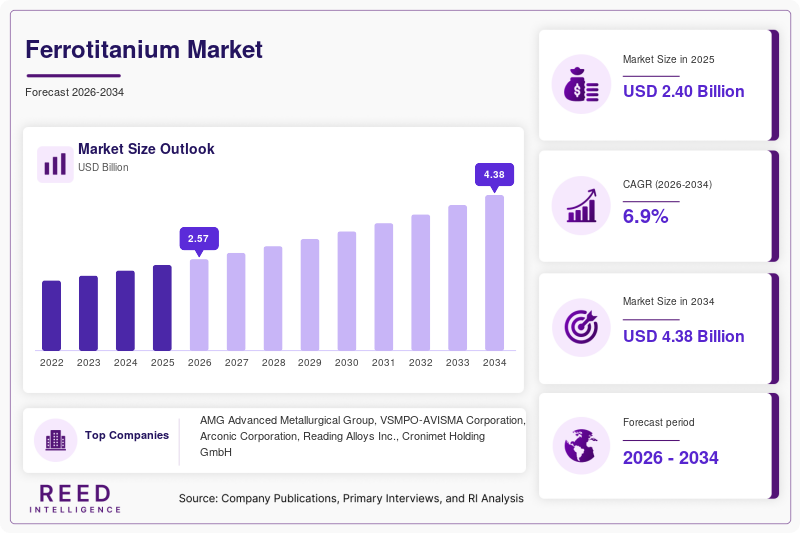
The global Ferrotitanium Market size was valued at approximately USD 2.4 billion in 2026 and is projected to reach around USD 4.1 billion by 2034, expanding at a CAGR of 6.9% during the forecast period (2026–2034). The market growth is primarily supported by increasing demand for high-performance alloys in aerospace, automotive, and defense industries, where ferrotitanium plays a critical role as a deoxidizer and alloying agent.
A key global factor driving the Ferrotitanium Market is the rising focus on lightweight and corrosion-resistant materials. As industries shift toward fuel efficiency and durability, ferrotitanium is widely used in stainless steel and specialty alloys to enhance strength and reduce weight, thereby supporting sustainability goals.
Key Highlights:
- Asia Pacific dominated the market with a 42% share in 2025 and is expected to grow at a CAGR of 7.5% through 2034.
- The steelmaking application segment led with a 55% share, while additive manufacturing is projected to grow fastest at a CAGR of 8.4%.
- Among product types, low-grade ferrotitanium held the largest share, while high-purity variants are expected to grow at a CAGR of 7.8%.
- China remained the dominant country, with market values of USD 620 million in 2024 and USD 660 million in 2025.
Market Trends
Rising Adoption of Recycled Titanium Feedstock
The Ferrotitanium Market is witnessing a notable shift toward the use of recycled titanium scrap as a primary raw material. This trend is driven by both economic and environmental considerations. Manufacturers are increasingly leveraging scrap from aerospace and industrial sources to produce ferrotitanium, reducing production costs and minimizing waste. This approach supports sustainability goals and helps companies comply with stricter environmental regulations. Additionally, advancements in recycling technologies are improving yield efficiency and product quality, making recycled ferrotitanium more competitive with primary sources.
Integration of Ferrotitanium in Advanced Manufacturing Technologies
Another important trend shaping the Ferrotitanium Market is its growing role in advanced manufacturing processes such as additive manufacturing and powder metallurgy. Ferrotitanium is increasingly being used in metal powders for 3D printing applications due to its ability to enhance material strength and corrosion resistance. As industries like aerospace and medical devices adopt precision manufacturing techniques, the demand for high-purity ferrotitanium is rising. This trend is also supported by ongoing research into new alloy compositions that improve performance characteristics. The shift toward digital manufacturing and customization is expected to further accelerate the use of ferrotitanium in next-generation production systems.
Market Drivers
Growing Demand for High-Strength Alloys in Aerospace and Automotive
The increasing demand for high-strength, lightweight materials in aerospace and automotive industries is a major driver for the Ferrotitanium Market. Ferrotitanium is widely used to improve the mechanical properties of steel and alloys, including strength, durability, and corrosion resistance. As manufacturers focus on reducing vehicle weight to improve fuel efficiency and meet emission standards, the use of ferrotitanium-based alloys is expanding. In aerospace applications, the material supports the production of components that can withstand extreme conditions, further boosting its demand.
Expansion of Stainless Steel Production
The steady growth of the stainless steel industry significantly contributes to the expansion of the Ferrotitanium Market. Ferrotitanium acts as an effective deoxidizer and stabilizer during steel production, enhancing product quality. With increasing infrastructure development, urbanization, and industrialization across emerging economies, the demand for stainless steel continues to rise. This directly impacts the consumption of ferrotitanium. Additionally, advancements in steel manufacturing technologies are improving efficiency and encouraging higher adoption of alloying agents like ferrotitanium.
Market Restraint
Volatility in Raw Material Prices
One of the primary challenges in the Ferrotitanium Market is the volatility in raw material prices, particularly titanium scrap and ferroalloys. Fluctuations in supply and demand, geopolitical uncertainties, and trade regulations can significantly impact the availability and cost of raw materials. Since ferrotitanium production relies heavily on scrap recycling, any disruption in the supply chain can lead to price instability. This affects profit margins for manufacturers and creates uncertainty for end-users. Additionally, variations in raw material quality can influence the consistency of the final product, posing operational challenges. Companies are increasingly focusing on securing long-term supply agreements and diversifying sourcing strategies to mitigate this risk.
Market Opportunities
Increasing Use in Additive Manufacturing
The rapid growth of additive manufacturing presents a significant opportunity for the Ferrotitanium Market. As industries adopt 3D printing for complex and customized components, the demand for high-performance metal powders is increasing. Ferrotitanium offers desirable properties such as strength, lightweight characteristics, and corrosion resistance, making it suitable for additive manufacturing applications. This trend is particularly prominent in aerospace, healthcare, and industrial tooling sectors.
Emerging Demand from Renewable Energy Sector
The renewable energy sector is creating new growth avenues for the Ferrotitanium Market. Ferrotitanium is increasingly used in the production of components for wind turbines, solar installations, and energy storage systems due to its durability and resistance to harsh environmental conditions. As global investments in renewable energy projects continue to rise, the demand for high-performance materials is expected to grow. This provides manufacturers with opportunities to expand their product offerings and tap into new end-use industries.
Segmental Analysis
By Type
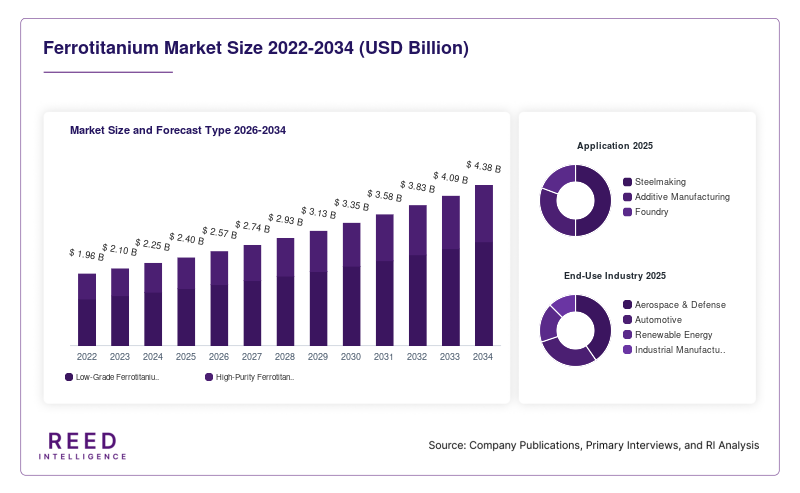
Low-grade ferrotitanium dominated the Ferrotitanium Market in 2025, accounting for approximately 58% of the total share. This dominance is attributed to its widespread use in steelmaking applications, where cost-effectiveness and adequate performance characteristics are prioritized. Low-grade variants are commonly used as deoxidizers and stabilizers in large-scale steel production processes.
High-purity ferrotitanium is expected to be the fastest-growing subsegment, with a projected CAGR of 7.8% during the forecast period. This growth will be driven by increasing demand from advanced applications such as aerospace components and additive manufacturing. High-purity variants offer enhanced performance, making them suitable for precision applications.
By Application
Steelmaking was the dominant application segment, holding around 55% of the Ferrotitanium Market share in 2025. The extensive use of ferrotitanium in stainless steel production and alloy enhancement supports this dominance. The material’s ability to improve mechanical properties and remove impurities makes it essential in steel manufacturing.
Additive manufacturing is anticipated to be the fastest-growing application segment, with a CAGR of 8.4% over the forecast period. The increasing adoption of 3D printing technologies in aerospace and healthcare industries will drive demand for ferrotitanium-based powders.
By End-Use Industry
The aerospace and defense sector dominated the Ferrotitanium Market in 2025, accounting for approximately 34% of the share. The sector relies heavily on high-performance alloys for manufacturing critical components, which drives the demand for ferrotitanium.
The renewable energy sector is projected to be the fastest-growing end-use industry, with a CAGR of 7.6%. The growing focus on sustainable energy solutions and the need for durable materials in energy infrastructure will support this growth.
By Form
Lump form dominated the Ferrotitanium Market in 2025 with a share of around 61%. This form is widely used in traditional steelmaking processes due to ease of handling and compatibility with existing systems.
Powder form is expected to witness the fastest growth, with a CAGR of 8.1%. The increasing use of metal powders in additive manufacturing and advanced metallurgy will drive this segment.
Regional Analysis
North America
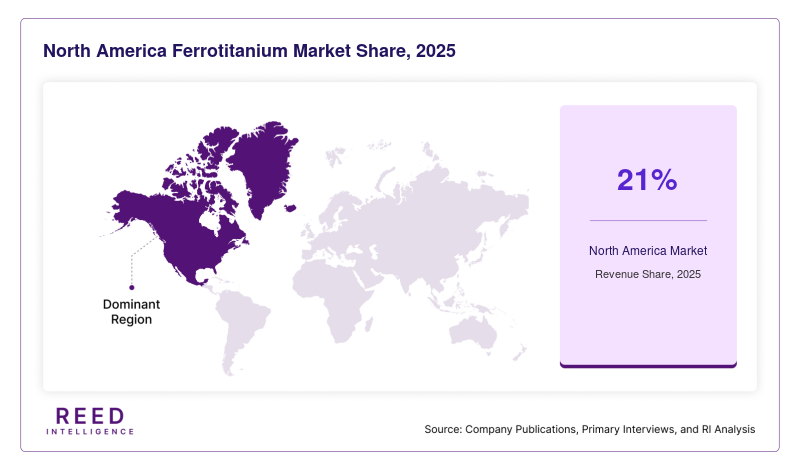
North America accounted for approximately 21% of the Ferrotitanium Market share in 2025 and is expected to grow at a CAGR of 6.5% during the forecast period. The region’s growth is driven by strong demand from aerospace and defense industries, supported by advanced manufacturing capabilities and technological innovation.
The United States dominated the regional market due to its well-established aerospace sector. The country’s focus on high-performance materials and advanced alloy development has increased the demand for ferrotitanium in critical applications.
Europe
Europe held around 24% of the Ferrotitanium Market share in 2025 and is projected to grow at a CAGR of 6.3% through 2034. The region benefits from a strong automotive industry and stringent environmental regulations promoting the use of lightweight materials.
Germany emerged as the leading country, driven by its robust automotive manufacturing base. The country’s emphasis on engineering excellence and sustainable production practices supports the adoption of ferrotitanium in alloy production.
Asia Pacific
Asia Pacific dominated the Ferrotitanium Market with a 42% share in 2025 and is anticipated to grow at the fastest CAGR of 7.5% during the forecast period. Rapid industrialization, infrastructure development, and increasing steel production contribute to the region’s dominance.
China led the regional market due to its large-scale steel manufacturing industry. The country’s continuous investments in infrastructure and industrial projects drive the demand for ferrotitanium.
Middle East & Africa
The Middle East & Africa region accounted for approximately 7% of the Ferrotitanium Market share in 2025 and is expected to grow at a CAGR of 6.8% over the forecast period. Growth in this region is supported by expanding construction and energy sectors.
Saudi Arabia dominated the market, driven by ongoing infrastructure development and diversification initiatives. The country’s focus on industrial growth has increased the demand for alloying materials like ferrotitanium.
Latin America
Latin America held nearly 6% of the Ferrotitanium Market share in 2025 and is projected to grow at a CAGR of 6.2% during the forecast period. The region’s growth is supported by increasing industrial activities and infrastructure investments.
Brazil led the regional market due to its strong mining and metallurgical industries. The country’s resource availability and industrial expansion contribute to the demand for ferrotitanium.
Competitive Landscape
The Ferrotitanium Market is moderately fragmented, with several global and regional players competing based on product quality, pricing, and technological capabilities. Leading companies focus on expanding production capacity, improving recycling processes, and developing high-purity products.
Global Titanium Inc. is recognized as a market leader, driven by its strong product portfolio and focus on sustainable production methods. The company recently announced the expansion of its recycling facilities to enhance production efficiency and meet growing demand.
Other key players are investing in research and development to improve alloy performance and cater to emerging applications. Strategic collaborations and acquisitions are also common strategies adopted by companies to strengthen their market position.
Key Players List
- Global Titanium Inc.
- AMG Advanced Metallurgical Group
- VSMPO-AVISMA Corporation
- Arconic Corporation
- Reading Alloys Inc.
- Cronimet Holding GmbH
- Metalysis Ltd.
- Toho Titanium Co., Ltd.
- ATI Inc.
- OSAKA Titanium Technologies Co., Ltd.
- ZTMC Group
- Titan Metal Fabricators
- Miller and Company LLC
- Nippon Steel Corporation
- Shanghai Titanos Industry Co., Ltd.
Recent Developments
- In 2025, Global Titanium Inc. expanded its recycling capacity to support sustainable production.
- In 2024, AMG Advanced Metallurgical Group invested in advanced alloy processing technologies.
- In 2025, VSMPO-AVISMA Corporation enhanced its aerospace-grade ferrotitanium production.
- In 2024, Metalysis Ltd. introduced innovative powder production techniques for additive manufacturing.
- In 2025, ATI Inc. strengthened its supply chain through strategic partnerships.
Ferrotitanium Market Segments
Type
- Low-Grade Ferrotitanium
- High-Purity Ferrotitanium
Application
- Steelmaking
- Additive Manufacturing
- Foundry
End-Use Industry
- Aerospace & Defense
- Automotive
- Renewable Energy
- Industrial Manufacturing
Form
- Lump
- Powder
By Region
- North America
- Europe
- APAC
- Middle East and Africa
- LATAM