Ferrovanadium Alloy Market Size, Share & Demand Report By Product Type (Standard-Grade Ferrovanadium, Low-Carbon Ferrovanadium, Specialty Ferrovanadium Alloys), By Application (Steel Manufacturing, Aerospace Components, Industrial Machinery, Automotive Components), By End Use (Construction and Infrastructure, Automotive, Aerospace and Defense, Renewable Energy Equipment), By Region & Segment Forecasts, 2026–2034
USD 3950
Market Overview
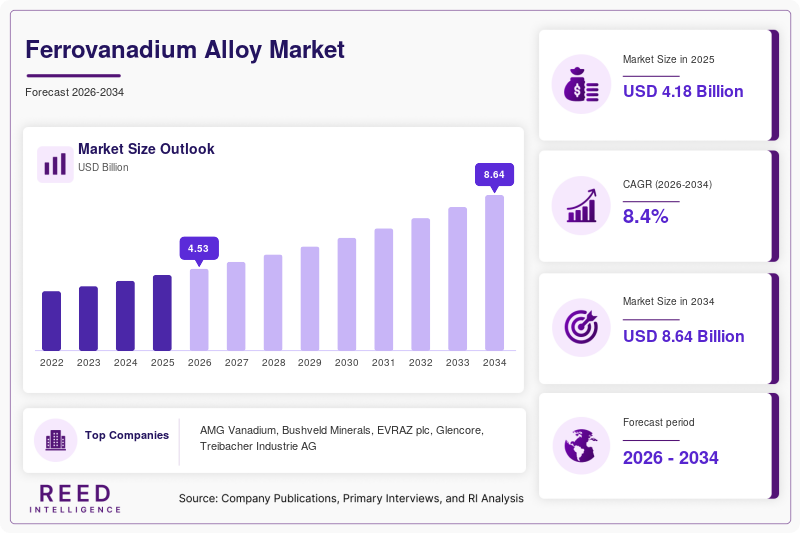
The global Ferrovanadium Alloy Market size was valued at USD 4.18 billion in 2026 and is projected to reach USD 7.96 billion by 2034, expanding at a CAGR of 8.4% during the forecast period. The market continues to witness stable demand due to the increasing use of ferrovanadium alloys in high-strength low-alloy steel production across construction, automotive, aerospace, and energy industries. Ferrovanadium is widely used to improve tensile strength, corrosion resistance, and durability in structural steel products. Rapid industrialization and infrastructure modernization in developing economies have accelerated the adoption of advanced alloying materials in steel manufacturing.
The expansion of renewable energy infrastructure and large-scale transportation projects has also supported market growth. Wind turbines, pipelines, railway tracks, and heavy engineering equipment increasingly require stronger and lighter steel grades, which has increased the consumption of ferrovanadium alloys. Steel manufacturers are focusing on improving material performance while reducing production costs, creating long-term opportunities for alloy suppliers. In addition, the shift toward electric vehicles and lightweight automotive components has increased the requirement for advanced steel formulations containing vanadium-based alloys.
Key Highlights
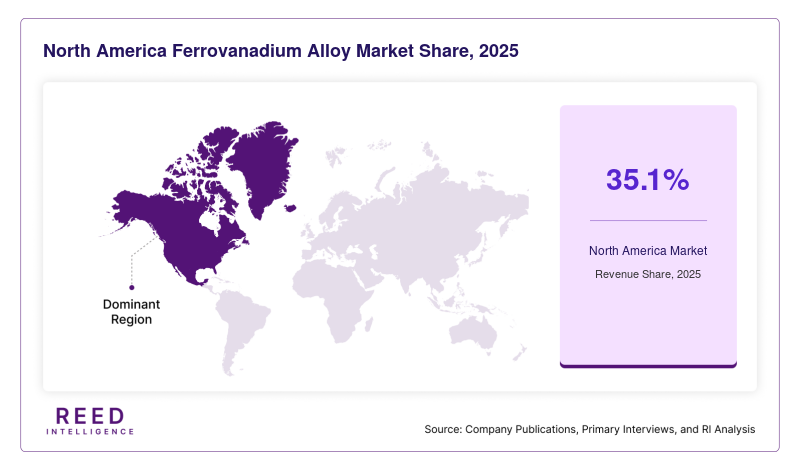
- North America dominated the market with a 35.1% share in 2025.
- Asia Pacific is expected to grow at the fastest CAGR of 10.8% during 2026–2034.
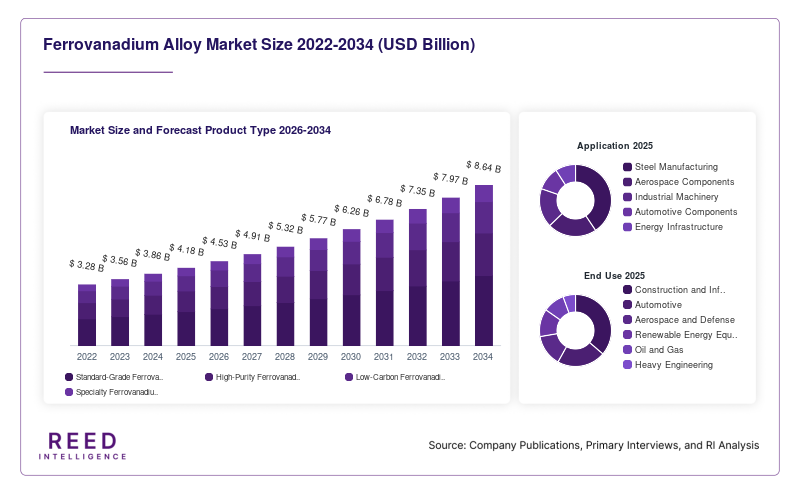
- By product type, standard-grade ferrovanadium accounted for the largest share of 42.8%.
- while high-purity ferrovanadium is projected to grow at a CAGR of 11.6%.
- By application, steel manufacturing led with a 58.4% share.
- whereas aerospace components are expected to expand at a CAGR of 12.1%.
- By end use, construction and infrastructure accounted for the highest share of 39.6%.
- while renewable energy equipment is projected to grow at a CAGR of 11.9%.
- The United States remained the dominant country, with market values of USD 690 million in 2024 and USD 748 million in 2025.
Market Trends
Rising Adoption of High-Strength Low-Alloy Steel in Infrastructure Projects
The increasing use of high-strength low-alloy steel in transportation and infrastructure projects is emerging as a major trend in the Ferrovanadium Alloy Market. Governments across developed and emerging economies are investing heavily in bridges, highways, rail systems, ports, and smart city projects that require durable steel materials with improved fatigue resistance. Ferrovanadium alloys are increasingly used to produce structural steel with higher load-bearing capacity while reducing material weight. This trend is particularly visible in urban rail networks, industrial warehouses, and energy transmission infrastructure. Construction firms are also adopting advanced steel grades to improve project lifespan and reduce maintenance expenses. The growing preference for sustainable construction materials has further encouraged steel producers to incorporate ferrovanadium into steel formulations for enhanced performance and efficiency.
Expansion of Vanadium Applications in Renewable Energy and Aerospace Industries
The growing integration of vanadium-based materials in renewable energy and aerospace manufacturing is another important trend shaping market growth. Renewable energy projects require advanced steel components for wind turbine towers, solar infrastructure, and power transmission systems. Ferrovanadium alloys improve structural reliability and corrosion resistance in harsh operating conditions, making them suitable for renewable energy equipment. In the aerospace industry, manufacturers are increasingly adopting lightweight and high-strength metal components to improve fuel efficiency and operational performance. Ferrovanadium is gaining attention for its role in producing specialized alloys used in aircraft structures and defense systems. Manufacturers are also investing in research programs focused on advanced metallurgical technologies that improve alloy purity and mechanical properties, supporting long-term product innovation.
Market Drivers
Growing Demand for Durable Steel in Industrial Manufacturing
The rising requirement for durable and high-performance steel products across industrial manufacturing sectors is a major driver for the Ferrovanadium Alloy Market. Industries such as automotive, machinery, shipbuilding, and heavy engineering are increasingly using ferrovanadium-enhanced steel to improve wear resistance and structural stability. Manufacturers prefer ferrovanadium because it enhances steel hardness without significantly increasing material weight. The automotive sector, particularly electric vehicle manufacturing, is accelerating the use of advanced lightweight steel grades to improve vehicle efficiency and safety standards. Industrial machinery manufacturers are also adopting vanadium-alloyed steel for cutting tools, gears, and drilling equipment that operate under high stress conditions. Increasing investments in industrial automation and manufacturing modernization are expected to support long-term market expansion.
Expansion of Energy Infrastructure and Pipeline Projects
The rapid expansion of global energy infrastructure is significantly contributing to the growth of the Ferrovanadium Alloy Market. Oil and gas pipelines, renewable energy systems, and thermal power plants require strong and corrosion-resistant steel materials capable of operating in demanding environments. Ferrovanadium alloys help improve the strength and durability of steel pipes and structural components used in energy transportation and distribution systems. Several countries are investing in cross-border pipeline projects and renewable energy facilities to strengthen energy security and reduce carbon emissions. The increasing deployment of offshore wind projects and high-capacity transmission networks is also creating demand for advanced alloy materials. As energy infrastructure projects become larger and more technically complex, steel manufacturers are expected to increase their reliance on ferrovanadium alloys.
Market Restraint
Volatility in Vanadium Raw Material Prices and Supply Chain Constraints
Price volatility associated with vanadium raw materials remains a significant restraint for the Ferrovanadium Alloy Market. The supply of vanadium is concentrated in a limited number of mining regions, making the market vulnerable to geopolitical disruptions, export restrictions, and fluctuations in mining output. Changes in raw material pricing directly affect production costs for ferrovanadium manufacturers and steel producers. Smaller alloy manufacturers often struggle to maintain stable profit margins during periods of sudden price increases. Supply chain disruptions related to transportation costs, energy price fluctuations, and environmental regulations can further limit market growth.
The market is also affected by strict environmental policies surrounding mining and metallurgical operations. Compliance with emission standards and waste management regulations increases operational costs for producers. In some regions, delays in mining approvals and resource licensing have limited the expansion of vanadium extraction projects. For example, temporary production interruptions in major vanadium-producing countries have historically resulted in sudden price spikes, affecting procurement strategies among steel manufacturers. These challenges may limit short-term production capacity expansion and create uncertainty for downstream industries that depend on consistent alloy supply.
Market Opportunities
Increasing Investment in Green Steel Production Technologies
The transition toward sustainable steel manufacturing presents a major opportunity for the Ferrovanadium Alloy Market. Steel producers are increasingly adopting green steel technologies that reduce carbon emissions and improve energy efficiency. Ferrovanadium alloys support the production of stronger steel grades that require lower material input while maintaining structural performance. This enables manufacturers to reduce energy consumption and raw material usage during production. Governments and industrial organizations are promoting low-emission steel manufacturing through policy incentives and infrastructure investment programs. As environmental regulations become stricter, demand for advanced alloying materials that contribute to sustainable manufacturing processes is expected to rise.
In addition, several steel companies are investing in electric arc furnace technology and recycled steel production, where ferrovanadium plays an important role in maintaining alloy quality and mechanical properties. The growing focus on environmentally responsible construction and industrial production is expected to encourage the adoption of high-performance vanadium-containing steel products across multiple sectors.
Development of Advanced Aerospace and Defense Applications
The increasing use of specialized alloys in aerospace and defense applications is creating new growth opportunities for market participants. Aerospace manufacturers require lightweight materials with exceptional strength, thermal stability, and fatigue resistance for aircraft structures and engine systems. Ferrovanadium alloys contribute to the development of advanced steel and titanium-based materials used in aviation and defense equipment. Rising defense spending in several countries is supporting the procurement of military aircraft, naval systems, and armored vehicles that utilize high-performance alloy materials.
The commercial aviation sector is also recovering steadily, resulting in higher production volumes for aircraft components and structural systems. Research institutions and metallurgical companies are developing innovative alloy compositions with enhanced durability and heat resistance for aerospace applications. As manufacturers focus on improving fuel efficiency and operational safety, demand for ferrovanadium-based materials is expected to increase steadily. These developments are likely to create long-term revenue opportunities for alloy suppliers and metal processing companies.
Segmental Analysis
By Product Type
Standard-grade ferrovanadium accounted for the largest share of the global Ferrovanadium Alloy Market in 2024, representing 42.8% of total revenue. This segment continues to dominate because of its extensive use in conventional steel manufacturing applications. Standard-grade ferrovanadium is widely utilized in construction steel, industrial machinery, automotive components, and pipeline production due to its balanced mechanical properties and cost efficiency. Steel manufacturers prefer this alloy grade because it improves tensile strength, impact resistance, and wear performance while maintaining relatively low production costs. The growing demand for reinforced structural steel in commercial buildings, bridges, and transportation systems has strengthened the position of standard-grade ferrovanadium in the global market. Additionally, increasing industrial production across developing economies continues to support large-scale consumption of this segment.
High-purity ferrovanadium is projected to register the fastest CAGR of 11.6% during the forecast period. This segment is gaining traction due to rising demand from aerospace, defense, and advanced engineering industries that require specialized alloy compositions with superior performance characteristics. High-purity ferrovanadium is increasingly used in high-temperature applications, lightweight structural systems, and precision manufacturing processes. Manufacturers are investing in advanced refining technologies to improve alloy purity and meet strict industrial specifications. The growing adoption of electric vehicles, aircraft modernization programs, and renewable energy equipment manufacturing is expected to drive demand for high-purity ferrovanadium products. Furthermore, increasing research and development activities focused on advanced metallurgy are likely to create new commercial opportunities for premium-grade alloy manufacturers.
By Application
Steel manufacturing emerged as the dominant application segment in the Ferrovanadium Alloy Market, accounting for 58.4% of total market share in 2024. Ferrovanadium plays a critical role in producing high-strength low-alloy steel used in infrastructure, transportation, and industrial machinery applications. The alloy improves steel hardness, corrosion resistance, and fatigue performance, making it suitable for demanding industrial environments. Rising investments in urban infrastructure, commercial construction, and heavy engineering projects have significantly increased the consumption of vanadium-alloyed steel products. Steel producers continue to incorporate ferrovanadium into production processes to improve product quality and meet evolving industrial standards. The expansion of railway networks, energy transmission systems, and pipeline infrastructure has further strengthened the dominance of this segment.
Aerospace components are expected to witness the fastest CAGR of 12.1% during 2026–2034. Aerospace manufacturers are increasingly using advanced alloy materials to improve fuel efficiency, operational reliability, and structural performance in aircraft systems. Ferrovanadium-enhanced materials offer excellent strength-to-weight ratios and thermal resistance, making them suitable for aerospace engineering applications. The growth of commercial aviation and defense modernization programs is creating strong demand for specialized metal alloys. Manufacturers are also focusing on lightweight aircraft designs that require advanced materials capable of maintaining durability under extreme conditions. As global air travel demand recovers and military procurement programs expand, the aerospace application segment is expected to create substantial revenue opportunities for ferrovanadium alloy suppliers.
By End Use
Construction and infrastructure represented the leading end-use segment in the Ferrovanadium Alloy Market, accounting for 39.6% of revenue share in 2024. Rapid urbanization and industrial expansion are increasing the demand for high-performance steel in commercial buildings, bridges, highways, and transportation systems. Ferrovanadium alloys help improve the structural strength and durability of steel products used in large-scale infrastructure projects. Governments across multiple regions are investing in public transportation networks, industrial corridors, and smart city initiatives that require advanced construction materials. The increasing use of earthquake-resistant and corrosion-resistant steel in modern infrastructure development has also supported segment growth. In addition, rising investments in industrial parks and logistics facilities are contributing to long-term demand for ferrovanadium-enhanced steel products.
Renewable energy equipment is projected to grow at the fastest CAGR of 11.9% during the forecast period. Wind turbine towers, solar infrastructure systems, and energy transmission networks require durable steel materials capable of operating under challenging environmental conditions. Ferrovanadium alloys improve the mechanical strength and fatigue resistance of steel components used in renewable energy installations. Governments and private investors are significantly increasing funding for clean energy projects to reduce carbon emissions and strengthen energy security. The rapid deployment of offshore wind farms and utility-scale solar facilities is expected to accelerate demand for advanced alloy materials. Manufacturers are also focusing on developing lightweight and corrosion-resistant steel solutions to improve the operational lifespan of renewable energy equipment.
Regional Analysis
North America
North America accounted for 35.1% of the global Ferrovanadium Alloy Market share in 2025 and is expected to maintain steady growth during the forecast period, registering a CAGR of 7.6% through 2034. The region benefits from strong steel manufacturing capabilities, advanced industrial infrastructure, and rising investments in energy transportation projects. Demand for high-strength steel in commercial construction, defense manufacturing, and automotive production continues to support ferrovanadium consumption. Increasing replacement of aging infrastructure across the United States and Canada is encouraging steel producers to adopt alloy-enhanced materials with improved durability and corrosion resistance.
The United States remains the dominant country in the North American market due to its large industrial manufacturing base and significant infrastructure spending. The country continues to invest in transportation modernization, renewable energy systems, and defense programs that require high-performance steel products. Domestic steel manufacturers are expanding production of advanced steel grades to meet changing industrial standards. In addition, the presence of established aerospace and oil and gas industries contributes to consistent demand for ferrovanadium alloys across multiple applications.
Europe
Europe represented 24.4% of the global Ferrovanadium Alloy Market in 2025 and is projected to grow at a CAGR of 7.9% during the forecast period. The region is characterized by strong environmental regulations and increasing adoption of sustainable steel manufacturing practices. European steel producers are investing in low-emission production technologies and energy-efficient metallurgical processes. Demand for ferrovanadium alloys is rising across automotive engineering, industrial machinery, and railway infrastructure sectors. The transition toward lightweight transportation systems and renewable energy projects is further supporting market expansion.
Germany dominates the European market due to its advanced automotive manufacturing sector and extensive engineering capabilities. The country continues to invest in industrial automation, electric vehicle production, and green infrastructure development. German steel manufacturers are increasingly incorporating ferrovanadium into specialized steel grades to improve performance and operational efficiency. In addition, the country’s focus on export-oriented industrial production supports long-term demand for advanced alloy materials used in heavy machinery and transportation equipment.
Asia Pacific
Asia Pacific held 28.7% of the global Ferrovanadium Alloy Market share in 2025 and is expected to record the fastest CAGR of 10.8% during 2026–2034. Rapid industrialization, urban expansion, and infrastructure development are driving steel consumption across the region. Governments in China, India, South Korea, and Southeast Asian countries are investing heavily in transportation systems, smart cities, and renewable energy projects. The growing construction sector and increasing production of industrial machinery are supporting strong demand for ferrovanadium-enhanced steel products.
China remains the dominant country in the Asia Pacific market due to its large steel production capacity and extensive industrial base. The country continues to lead global infrastructure investment, including rail networks, industrial zones, and renewable energy installations. Chinese manufacturers are also expanding production of advanced steel products for automotive and heavy engineering applications. Rising demand for high-strength steel in export-oriented manufacturing industries is encouraging local alloy producers to increase ferrovanadium production capacity and improve refining technologies.
Middle East & Africa
The Middle East & Africa region accounted for 6.5% of the global Ferrovanadium Alloy Market in 2025 and is forecast to grow at a CAGR of 8.2% through 2034. Large-scale infrastructure and energy projects across Gulf countries are driving demand for durable steel materials. Governments are investing in industrial diversification programs, transportation corridors, and urban development initiatives that require advanced construction materials. The oil and gas sector also contributes significantly to regional demand due to the need for high-strength steel pipes and drilling equipment.
Saudi Arabia is the leading country within the regional market because of its ongoing industrial expansion and infrastructure modernization programs. Investments in smart city development, renewable energy projects, and petrochemical facilities are increasing steel consumption across the country. The government’s economic diversification strategy is encouraging domestic manufacturing growth and attracting foreign investment in industrial processing sectors. As construction activity continues to expand, demand for ferrovanadium-enhanced structural steel is expected to rise steadily.
Latin America
Latin America captured 5.3% of the global Ferrovanadium Alloy Market share in 2025 and is anticipated to grow at a CAGR of 7.4% during the forecast period. The region is witnessing gradual growth in infrastructure development, mining activities, and industrial manufacturing. Countries across Latin America are investing in transportation networks, energy infrastructure, and commercial construction projects that require durable steel products. The expansion of renewable energy generation and mining equipment manufacturing is also contributing to increased alloy demand.
Brazil dominates the Latin American market due to its strong mining industry and growing steel production sector. The country possesses significant mineral resources and continues to invest in industrial processing capabilities. Infrastructure modernization projects, including ports, railways, and energy facilities, are supporting demand for high-strength steel materials. In addition, Brazil’s expanding agricultural machinery and automotive manufacturing industries are increasing the use of ferrovanadium alloys in equipment production and structural applications.
Competitive Landscape
The Ferrovanadium Alloy Market is moderately consolidated, with global and regional manufacturers competing on the basis of production capacity, alloy quality, pricing strategies, and supply chain integration. Leading companies are investing in mining partnerships, refining technologies, and recycling capabilities to secure long-term vanadium supply. Strategic collaborations between steel producers and alloy manufacturers are becoming increasingly common as industries seek stable procurement channels and advanced material solutions.
AMG Vanadium remains one of the leading companies in the market due to its strong recycling capabilities, integrated supply chain operations, and advanced alloy production technologies. The company recently expanded its vanadium recovery operations to strengthen supply security and improve production efficiency. Other major participants are also focusing on capacity expansion projects and technological upgrades to meet growing industrial demand.
Companies such as Bushveld Minerals, Treibacher Industrie AG, EVRAZ plc, and Glencore continue to strengthen their market position through long-term supply agreements and investments in advanced metallurgical processing. Several firms are also increasing research efforts related to low-emission alloy production and sustainable mining practices. Competitive intensity is expected to rise as demand for high-performance steel and specialized alloys continues to increase across construction, aerospace, and renewable energy sectors.
Key Players
- AMG Vanadium
- Bushveld Minerals
- EVRAZ plc
- Glencore
- Treibacher Industrie AG
- Largo Inc.
- HBIS Group
- Nippon Steel Corporation
- Gulf Chemical and Metallurgical Corporation
- Pangang Group
- JFE Steel Corporation
- Hickman Williams & Company
- Core Metals Group
- Bear Metallurgical Company
Recent Developments
- AMG Vanadium announced an expansion of its vanadium recycling facility in 2025 to increase ferrovanadium production capacity for steel manufacturing applications.
- Bushveld Minerals entered a long-term supply agreement with an Asian steel producer in 2024 to strengthen vanadium alloy distribution across the Asia Pacific region.
- EVRAZ plc invested in advanced metallurgical processing technologies in 2025 to improve alloy purity and reduce energy consumption during production.
- Largo Inc. initiated a new vanadium extraction optimization program aimed at improving operational efficiency and raw material recovery rates.
Ferrovanadium Alloy Market Segments
Product Type
- Standard-Grade Ferrovanadium
- High-Purity Ferrovanadium
- Low-Carbon Ferrovanadium
- Specialty Ferrovanadium Alloys
Application
- Steel Manufacturing
- Aerospace Components
- Industrial Machinery
- Automotive Components
- Energy Infrastructure
End Use
- Construction and Infrastructure
- Automotive
- Aerospace and Defense
- Renewable Energy Equipment
- Oil and Gas
- Heavy Engineering
By Region
- North America
- Europe
- APAC
- Middle East and Africa
- LATAM