Fiber Bragg Grating Amplifier Market Size, Share & Demand Report By Type (Uniform Fiber Bragg Grating Amplifiers, Chirped Fiber Bragg Grating Amplifiers), By Application (Telecommunications, Sensing and Monitoring, Aerospace and Defense, Healthcare), By End-Use (Telecommunications Industry, Energy and Utilities, Healthcare Sector, Industrial Manufacturing), By Region & Segment Forecasts, 2025–2034
USD 3950
Market Overview
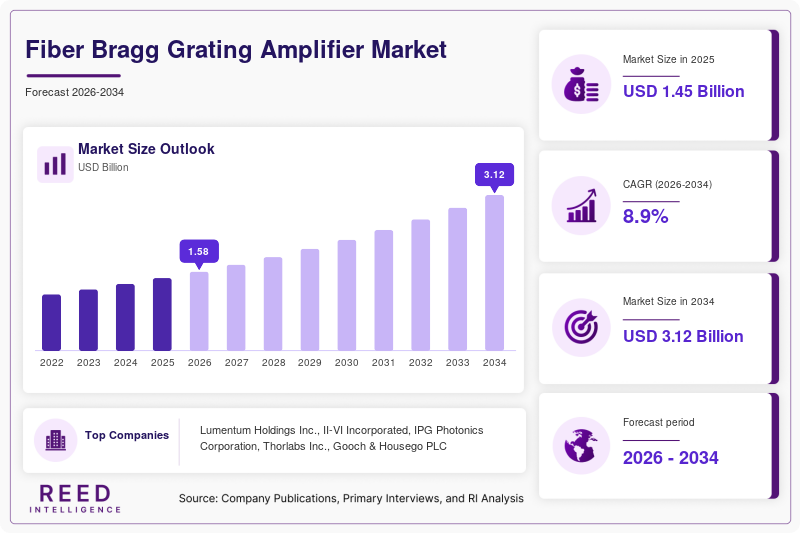
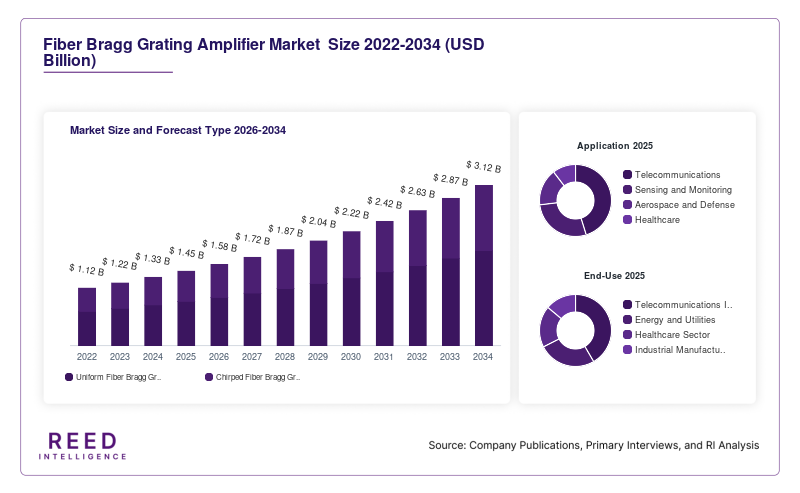
The Fiber Bragg Grating Amplifier Market size was estimated at USD 1.45 billion in 2025 and is projected to reach approximately USD 1.58 billion in 2026. Over the forecast period from 2025 to 2034, the market is expected to grow at a compound annual growth rate (CAGR) of 8.9%, reaching a valuation of nearly USD 3.12 billion by 2034.
Fiber Bragg grating (FBG) amplifiers are widely used in optical networks for signal enhancement, wavelength stabilization, and noise reduction. These components are gaining traction in telecommunications, aerospace, oil & gas, and healthcare sectors due to their ability to operate in harsh environments and deliver precise optical filtering. The growing deployment of fiber-optic infrastructure globally is a key contributor to market growth.
Key Highlights
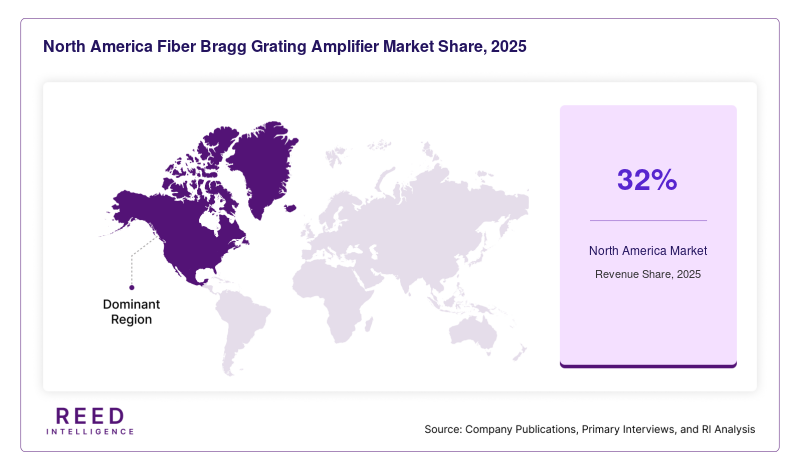
- North America dominated the market in 2025, accounting for approximately 32% share driven by advanced telecom infrastructure and strong R&D investments.
- Asia Pacific is the fastest-growing region, projected to expand at a CAGR of 10.2% from 2025 to 2034 due to rapid 5G deployment and smart city initiatives.
- By type, uniform fiber Bragg grating amplifiers held the largest share of around 54% in 2024, owing to their stability and cost-effectiveness.
- By application, telecommunications led the market with nearly 48% share, supported by rising demand for high-speed data transmission.
- By end-use, the telecommunications industry dominated with about 45% share, driven by continuous expansion of fiber-optic networks.
- The sensing and monitoring segment is expected to be the fastest-growing application, registering a CAGR of 9.8% during the forecast period.
Market Trends
Integration of Fiber Bragg Grating Amplifiers in Smart Infrastructure
The adoption of smart infrastructure systems is significantly influencing the Fiber Bragg Grating Amplifier Market. Governments and private organizations are increasingly investing in intelligent transportation systems, smart buildings, and energy-efficient infrastructure. FBG amplifiers play a crucial role in these applications by enabling accurate sensing and real-time monitoring. Their ability to measure strain, temperature, and pressure with high precision makes them suitable for structural health monitoring in bridges, tunnels, and high-rise buildings. The trend toward digital transformation and automation is further enhancing the demand for advanced sensing technologies, thereby driving the adoption of FBG amplifiers in smart infrastructure projects.
Growing Demand for High-Capacity Optical Communication Networks
The rapid growth of data consumption and cloud-based services is pushing the need for high-capacity optical communication networks. Fiber Bragg grating amplifiers are increasingly being used to enhance signal quality and extend transmission distances in fiber-optic networks. With the rollout of 5G and the anticipated development of 6G technologies, telecom operators are investing heavily in network upgrades. This trend is leading to the integration of FBG amplifiers in wavelength division multiplexing (WDM) systems to improve bandwidth efficiency and reduce signal distortion. As data traffic continues to rise, the importance of reliable and efficient optical amplification solutions is expected to grow steadily.
Market Drivers
Expansion of Fiber Optic Communication Infrastructure
The global expansion of fiber optic communication infrastructure is a primary driver for the Fiber Bragg Grating Amplifier Market. Governments and telecom providers are investing heavily in high-speed internet connectivity to support digital economies. Fiber Bragg grating amplifiers are essential in maintaining signal integrity over long distances, especially in dense optical networks. The increasing demand for seamless connectivity, driven by remote work, online education, and streaming services, is accelerating the deployment of fiber networks. This trend is particularly prominent in developing regions where broadband penetration is still growing, creating a substantial demand for advanced optical components.
Rising Adoption in Industrial and Energy Sectors
The industrial and energy sectors are increasingly adopting FBG amplifiers for monitoring and safety applications. In oil and gas pipelines, power grids, and manufacturing plants, these amplifiers are used in distributed sensing systems to detect anomalies and prevent failures. Their resistance to electromagnetic interference and ability to operate in extreme conditions make them suitable for harsh industrial environments. As industries focus on improving operational efficiency and minimizing downtime, the demand for reliable sensing solutions is rising. This shift toward predictive maintenance and real-time monitoring is significantly contributing to market growth.
Market Restraint
High Initial Cost and Complex Installation
One of the primary restraints in the Fiber Bragg Grating Amplifier Market is the high initial cost associated with deployment and integration. The manufacturing process of fiber Bragg gratings involves precision engineering and specialized equipment, which increases production costs. Additionally, the installation of FBG-based systems requires skilled professionals and advanced infrastructure, making it less accessible for small and medium enterprises.
The complexity of integrating these amplifiers into existing systems can also pose challenges, particularly in legacy networks. For example, industries transitioning from traditional electrical sensors to optical sensing systems may face compatibility issues and require significant capital investment. This can slow down adoption rates, especially in cost-sensitive markets. Despite long-term benefits such as reduced maintenance and improved performance, the upfront investment remains a barrier to widespread adoption.
Market Opportunities
Growth in Renewable Energy Applications
The increasing focus on renewable energy sources presents a significant opportunity for the Fiber Bragg Grating Amplifier Market. Wind farms, solar power plants, and hydroelectric facilities require continuous monitoring of structural integrity and environmental conditions. FBG amplifiers enable precise sensing in these applications, ensuring efficient operation and early detection of faults. As governments worldwide implement policies to promote clean energy, the deployment of advanced monitoring systems is expected to rise. This creates a favorable environment for the adoption of FBG amplifiers in renewable energy projects.
Advancements in Medical and Healthcare Technologies
The healthcare sector is emerging as a promising area for the application of fiber Bragg grating amplifiers. These devices are increasingly used in medical diagnostics, minimally invasive surgeries, and wearable health monitoring systems. Their small size, flexibility, and biocompatibility make them ideal for integration into medical devices. With the growing demand for personalized healthcare and remote patient monitoring, the need for accurate and reliable sensing technologies is increasing. This trend is expected to open new avenues for market growth, particularly in advanced medical research and device development.
Segmental Analysis
By Type
The uniform fiber Bragg grating amplifiers segment dominated the market in 2024, accounting for approximately 54% of the total share. These amplifiers are widely used due to their stable performance and ability to provide consistent wavelength filtering. They are commonly deployed in telecommunications networks where signal integrity is critical. Their relatively simple design and cost-effectiveness make them suitable for large-scale deployment. The growing demand for high-speed data transmission and reliable optical networks is driving the adoption of uniform FBG amplifiers across various industries.
The chirped fiber Bragg grating amplifiers segment is expected to be the fastest-growing, with a projected CAGR of 10.5% during the forecast period. These amplifiers offer enhanced dispersion compensation, making them ideal for long-distance optical communication systems. The increasing need for high-capacity data transmission and reduced signal distortion is driving their adoption. Additionally, advancements in fabrication techniques are improving their performance and reducing costs, further supporting market growth.
By Application
Telecommunications was the dominant application segment in 2024, holding a market share of around 48%. The widespread deployment of fiber-optic networks and increasing data traffic are key factors driving this segment. FBG amplifiers are essential in maintaining signal quality and extending transmission distances in optical networks. The ongoing rollout of 5G infrastructure and increasing demand for high-speed internet services are further boosting the adoption of these amplifiers in the telecommunications sector.
The sensing and monitoring segment is expected to grow at the fastest rate, with a CAGR of 9.8%. This growth is driven by the increasing adoption of FBG-based sensors in industries such as oil and gas, civil engineering, and healthcare. These sensors provide accurate real-time data, enabling efficient monitoring and maintenance. The rising focus on safety and operational efficiency is contributing to the growth of this segment.
By End-Use
The telecommunications industry was the leading end-use segment in 2024, accounting for approximately 45% of the market share. The increasing demand for high-speed data transmission and reliable communication networks is driving the adoption of FBG amplifiers in this sector. Telecom operators are investing in advanced optical technologies to enhance network performance and support growing data traffic.
The healthcare sector is expected to be the fastest-growing end-use segment, with a CAGR of 10.1%. The adoption of FBG amplifiers in medical devices and diagnostic systems is increasing due to their precision and reliability. The growing demand for advanced healthcare solutions and personalized medicine is driving the integration of optical sensing technologies in medical applications.
Regional Analysis
North America
North America held a significant share of the Fiber Bragg Grating Amplifier Market in 2025, accounting for approximately 32% of global revenue. The region is expected to grow at a CAGR of 7.8% during the forecast period. The presence of advanced telecommunications infrastructure and strong investments in research and development contribute to market growth. The adoption of optical sensing technologies in aerospace and defense sectors further strengthens the regional market outlook.
The United States dominates the North American market due to its robust technological ecosystem and early adoption of advanced photonics solutions. A unique growth factor in the region is the increasing deployment of FBG amplifiers in smart grid systems, enabling efficient energy distribution and real-time monitoring. This trend is expected to support sustained demand for these technologies.
Europe
Europe accounted for around 26% of the global market share in 2025 and is projected to grow at a CAGR of 8.1%. The region benefits from strong regulatory support for infrastructure modernization and energy efficiency initiatives. Countries across Europe are investing in optical communication networks and smart infrastructure, driving demand for FBG amplifiers.
Germany leads the European market due to its advanced industrial base and focus on automation. A key growth factor in the region is the integration of FBG-based sensing systems in industrial manufacturing processes. This supports predictive maintenance and improves operational efficiency, contributing to market expansion.
Asia Pacific
Asia Pacific is the fastest-growing region in the Fiber Bragg Grating Amplifier Market, with a CAGR of 10.2%. The region held a market share of approximately 28% in 2025. Rapid urbanization, increasing internet penetration, and large-scale infrastructure projects are driving demand for optical technologies.
China dominates the Asia Pacific market due to its extensive telecommunications network and manufacturing capabilities. A unique growth factor is the government’s focus on expanding 5G infrastructure and smart city initiatives. This is creating substantial opportunities for FBG amplifier deployment in communication and sensing applications.
Middle East & Africa
The Middle East & Africa region accounted for around 8% of the market share in 2025 and is expected to grow at a CAGR of 7.5%. The region is gradually adopting advanced technologies in telecommunications and energy sectors. Investments in oil and gas infrastructure are supporting the demand for reliable sensing solutions.
Saudi Arabia is a key contributor to market growth in this region. A unique growth factor is the increasing use of FBG amplifiers in pipeline monitoring systems, ensuring safety and efficiency in energy transportation. This trend is expected to drive market development over the forecast period.
Latin America
Latin America held approximately 6% of the global market share in 2025 and is projected to grow at a CAGR of 7.2%. The region is experiencing steady growth due to improvements in telecommunications infrastructure and industrial development. Governments are focusing on expanding broadband connectivity to support economic growth.
Brazil leads the Latin American market due to its large population and growing demand for high-speed internet services. A key growth factor is the adoption of optical sensing technologies in mining and industrial applications. This is contributing to the gradual expansion of the Fiber Bragg Grating Amplifier Market in the region.
Competitive Landscape
The Fiber Bragg Grating Amplifier Market is moderately competitive, with several established players focusing on innovation and strategic partnerships. Leading companies are investing in research and development to enhance product performance and expand their application areas. The market is characterized by the presence of both global and regional players, offering a wide range of solutions.
A key market leader is Lumentum Holdings Inc., known for its advanced photonics technologies and strong presence in the telecommunications sector. The company recently introduced a new line of high-efficiency FBG amplifiers designed for next-generation optical networks. Other companies are focusing on expanding their product portfolios and entering emerging markets to strengthen their competitive position.
Key Players
- Lumentum Holdings Inc.
- II-VI Incorporated
- IPG Photonics Corporation
- Thorlabs Inc.
- AOS GmbH
- Proximion AB
- Technica Optical Components LLC
- OFS Fitel LLC
- Gooch & Housego PLC
- TeraXion Inc.
- Fibercore Ltd.
- HBM FiberSensing
- Smart Fibres Ltd.
- Alnair Labs Corporation
- FBGS Technologies GmbH
Recent Developments
- In 2024, a major photonics company launched a new series of FBG amplifiers designed for high-speed optical communication systems, improving signal stability by 20%.
- In 2023, a leading manufacturer partnered with a telecom provider to deploy FBG-based amplification systems in 5G infrastructure projects.
- In 2024, a research institute developed an advanced chirped FBG amplifier with enhanced dispersion compensation capabilities, supporting long-distance data transmission.
Fiber Bragg Grating Amplifier Market Segments
Type
- Uniform Fiber Bragg Grating Amplifiers
- Chirped Fiber Bragg Grating Amplifiers
Application
- Telecommunications
- Sensing and Monitoring
- Aerospace and Defense
- Healthcare
End-Use
- Telecommunications Industry
- Energy and Utilities
- Healthcare Sector
- Industrial Manufacturing
By Region
- North America
- Europe
- APAC
- Middle East and Africa
- LATAM