Fiber Bragg Grating Sensor Market Size, Share, Demand Report By Type (Intrinsic Fiber Bragg Grating Sensors), By Application (Structural Health Monitoring, Oil & Gas Monitoring Systems, Aerospace & Defense Applications, Power & Utilities Monitoring, Medical), By End-Use Industry (Aerospace & Defense, Energy & Power, Oil & Gas), By Material (Silica Optical Fiber, Polymer Optical Fiber) By Region & Segment Forecasts, 2026–2034
USD 3950
Market Overview
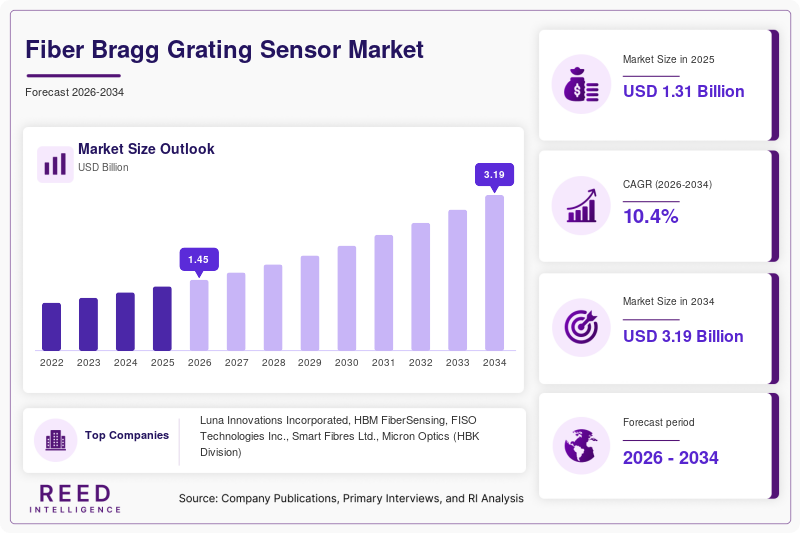
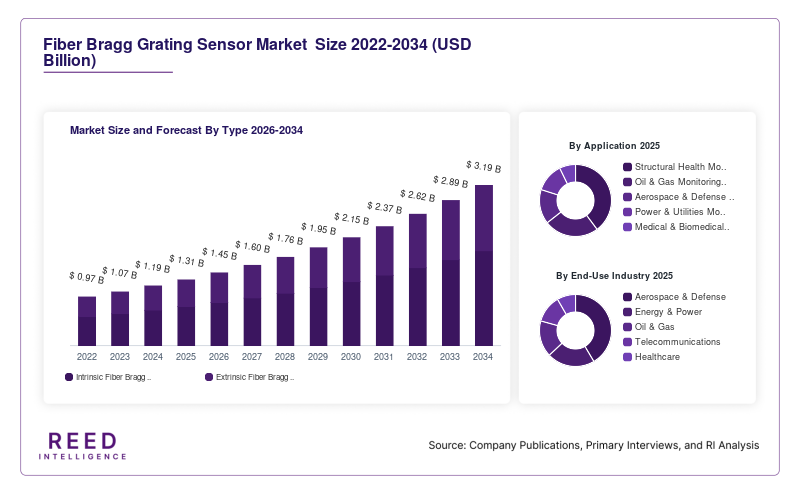
The Fiber Bragg Grating Sensor Market size is estimated at USD 1.45 billion, and it is projected to reach USD 3.20 billion by 2034, registering a CAGR of 10.4% during 2026–2034. A key global factor supporting Fiber Bragg Grating Sensor Market growth is the accelerating adoption of smart infrastructure and condition monitoring systems, particularly in critical assets such as bridges, tunnels, wind turbines, and offshore oil platforms.
The increasing need for real-time, distributed sensing solutions that offer immunity to electromagnetic interference has further strengthened market penetration across industrial sectors.
Key Highlights
- Dominant Region (2025): North America held ~32% share of the Fiber Bragg Grating Sensor Market
- Fastest-Growing Region CAGR (2026–2034): Asia Pacific at ~12.1%
- Leading Subsegment (Type): Multiplexed FBG sensors held ~41% share in 2025
- Fastest-Growing Subsegment: Distributed sensing systems at ~11.8% CAGR (2026–2034)
- Dominant Country (2024–2025): United States, valued at USD 420 million (2024) and USD 470 million (2025)
Market Trends
Expansion of Smart Infrastructure Monitoring Systems
The Fiber Bragg Grating Sensor Market is increasingly influenced by large-scale infrastructure monitoring programs. Governments and private operators are integrating FBG-based sensing networks into bridges, dams, railways, and tunnels to ensure real-time structural integrity analysis. These sensors provide long-distance multiplexing capability, which reduces maintenance cost and enhances safety monitoring efficiency. This trend is significantly boosting demand in civil engineering applications within the Fiber Bragg Grating Sensor Market.
Growing Integration in Renewable Energy Systems
The integration of Fiber Bragg Grating Sensor Market solutions in renewable energy infrastructure, particularly wind turbines and solar farms, is gaining traction. FBG sensors are being deployed for temperature, strain, and vibration monitoring in harsh environments. Their resistance to electromagnetic interference makes them highly suitable for offshore wind installations, contributing to improved asset lifecycle management and operational efficiency.
Market Drivers
Rising Demand for High-Precision Sensing in Aerospace & Defense
The Fiber Bragg Grating Sensor Market is driven by increasing use in aerospace and defense applications where precise strain and temperature monitoring is critical. Aircraft structural testing, spacecraft telemetry, and missile guidance systems increasingly rely on FBG sensors due to their lightweight nature and immunity to electromagnetic interference. This demand continues to strengthen market expansion.
Increasing Adoption in Oil & Gas Monitoring Applications
The oil & gas industry is a major contributor to the Fiber Bragg Grating Sensor Market growth. These sensors are extensively used in downhole monitoring, pipeline integrity management, and offshore platform safety systems. Their ability to withstand high pressure, temperature, and corrosive environments makes them essential for real-time operational monitoring and predictive maintenance strategies.
Market Restraint
High Installation and Interrogation System Costs
A key restraint affecting the Fiber Bragg Grating Sensor Market is the relatively high initial investment associated with installation and interrogation systems. While FBG sensors themselves are cost-efficient over time, the requirement for specialized optical interrogators and skilled installation processes increases upfront costs, limiting adoption among small and medium enterprises.
Market Opportunities
Expansion in Smart City Infrastructure Projects
The Fiber Bragg Grating Sensor Market is expected to benefit significantly from global smart city initiatives. Applications in traffic monitoring, structural health assessment, and utility management systems are creating new demand avenues for fiber-based sensing solutions.
Increasing Adoption in Medical and Biomedical Engineering
Emerging applications in minimally invasive medical procedures, biomedical imaging, and patient monitoring systems are opening new opportunities in the Fiber Bragg Grating Sensor Market. Their small size, biocompatibility, and high sensitivity make them suitable for advanced diagnostic applications.
Segmental Analysis
By Type
The Fiber Bragg Grating Sensor Market is segmented into single-point sensors, multiplexed sensors, and distributed sensing systems. In 2025, multiplexed FBG sensors held ~41% share, driven by their ability to monitor multiple parameters along a single fiber line efficiently.
The fastest-growing subsegment is distributed sensing systems, projected to expand at a CAGR of 11.8% (2026–2034) due to increasing demand for long-range structural monitoring in oil pipelines and infrastructure projects.
By Application
Key applications include structural health monitoring, aerospace & defense, energy & power, oil & gas, medical, and telecommunications. In 2025, structural health monitoring dominated with ~38% share, supported by global infrastructure safety regulations.
The fastest-growing application is oil & gas monitoring, expected to grow at a CAGR of 11.2% (2026–2034) due to rising adoption of predictive maintenance systems and harsh environment sensing requirements.
By End-Use Industry
End-use industries include civil engineering, energy, aerospace, automotive, healthcare, and industrial manufacturing. The energy sector accounted for ~33% share in 2025, driven by wind and power grid monitoring applications.
The fastest-growing end-use segment is aerospace & defense, projected at a CAGR of 10.9% (2026–2034) due to increasing integration in flight safety systems and spacecraft monitoring technologies.
Regional Analysis
North America
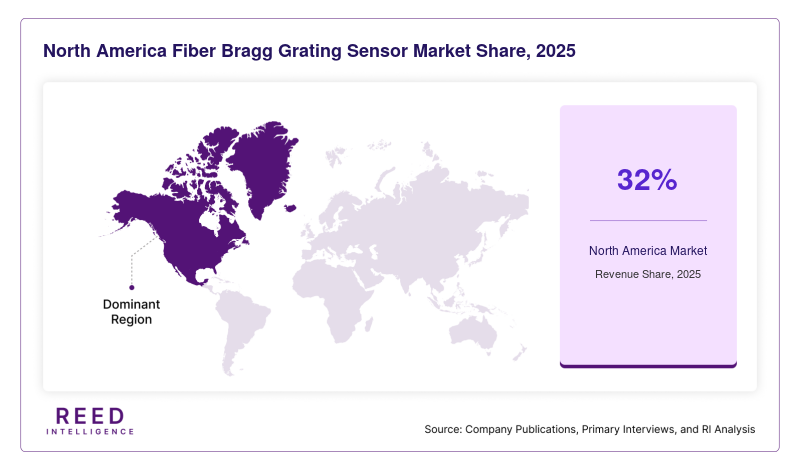
North America accounted for 32% share of the Fiber Bragg Grating Sensor Market in 2025 and is projected to grow at a CAGR of 9.8% (2026–2034). Growth is driven by strong adoption in aerospace, defense, and oil & gas industries. The United States leads the region due to advanced research infrastructure and early adoption of optical sensing technologies.
Europe
Europe held 27% share in 2025 and is expected to expand at a CAGR of 9.5% (2026–2034). The region benefits from widespread deployment in renewable energy projects and civil engineering applications. Germany leads the market due to strong industrial automation and automotive testing applications.
Asia Pacific
Asia Pacific captured 28% share in 2025 and is projected to register the fastest CAGR of 12.1% (2026–2034). Rapid infrastructure development, urbanization, and expansion of energy networks are key growth drivers. China dominates the region due to large-scale deployment in smart infrastructure and manufacturing sectors.
Middle East & Africa
Middle East & Africa held 7% share in 2025 and is expected to grow at a CAGR of 10.2% (2026–2034). The region is driven by oil & gas pipeline monitoring and mega infrastructure projects in Gulf countries. Saudi Arabia is the leading country due to ongoing smart city developments and energy diversification initiatives.
Latin America
Latin America accounted for 6% share in 2025 and is projected to grow at a CAGR of 9.6% (2026–2034). Growth is supported by mining applications, energy infrastructure upgrades, and increasing adoption in civil monitoring systems. Brazil remains the dominant country due to industrial modernization initiatives.
Competitive Landscape
The Fiber Bragg Grating Sensor Market is moderately consolidated with key players focusing on innovation, optical sensing integration, and strategic collaborations. Major companies include FBGS Technologies GmbH, Luna Innovations Incorporated, HBM FiberSensing, Opsens Solutions, and Yokogawa Electric Corporation. These players are actively investing in advanced interrogator systems and expanding application-specific sensor portfolios.
Luna Innovations Incorporated remains a leading company due to its strong presence in aerospace and industrial monitoring applications. The company has recently expanded its Fiber Bragg Grating Sensor Market portfolio with enhanced distributed sensing platforms designed for large-scale infrastructure projects.
FBGS Technologies GmbH and HBM FiberSensing are strengthening their positions through European infrastructure projects and renewable energy collaborations. Yokogawa Electric Corporation continues to focus on industrial automation integration, while Opsens Solutions is expanding in medical sensing applications. Competitive strategies are centered on product innovation, long-distance sensing capability, and cost optimization of interrogation systems.
Key Players List
- FBGS Technologies GmbH
- Luna Innovations Incorporated
- HBM FiberSensing
- Yokogawa Electric Corporation
- Opsens Solutions
- Smart Fibres Limited
- ITF Technologies Inc.
- Micron Optics Inc.
- Qualitrol Company LLC
- NKT Photonics A/S
- AFL Global
- Proximion AB
- Redondo Optics Inc.
- FOS&S
- Sensuron LLC
Recent Developments
- In 2025, Luna Innovations expanded its distributed sensing portfolio for large-scale infrastructure monitoring projects in North America.
- FBGS Technologies GmbH introduced next-generation multiplexed sensing systems designed for wind turbine structural diagnostics.
- Yokogawa Electric Corporation enhanced its industrial automation integration capabilities with advanced Fiber Bragg Grating Sensor Market solutions.
- HBM FiberSensing launched upgraded interrogator systems focused on high-temperature industrial environments.
Fiber Bragg Grating Sensor Market Segments
By Type
- Intrinsic Fiber Bragg Grating Sensors
- Extrinsic Fiber Bragg Grating Sensors
By Application
- Structural Health Monitoring
- Oil & Gas Monitoring Systems
- Aerospace & Defense Applications
- Power & Utilities Monitoring
- Medical & Biomedical Applications
By End-Use Industry
- Aerospace & Defense
- Energy & Power
- Oil & Gas
- Telecommunications
- Healthcare
By Material
- Silica Optical Fiber
- Polymer Optical Fiber
By Region
- North America
- Europe
- APAC
- Middle East and Africa
- LATAM