Fibrinogen Testing Market Size, Share & Demand Report By Product Type (Reagents & Consumables, Instruments, Point-of-Care Testing Systems), By Application (Cardiovascular Disease Testing, Trauma & Emergency Testing, Liver Disease Testing, Surgical Monitoring, Obstetric Complications), By End Use (Hospitals, Diagnostic Laboratories, Research Institutes, Ambulatory Surgical Centers), By Region & Segment Forecasts, 2026–2034
USD 3950
Market Overview
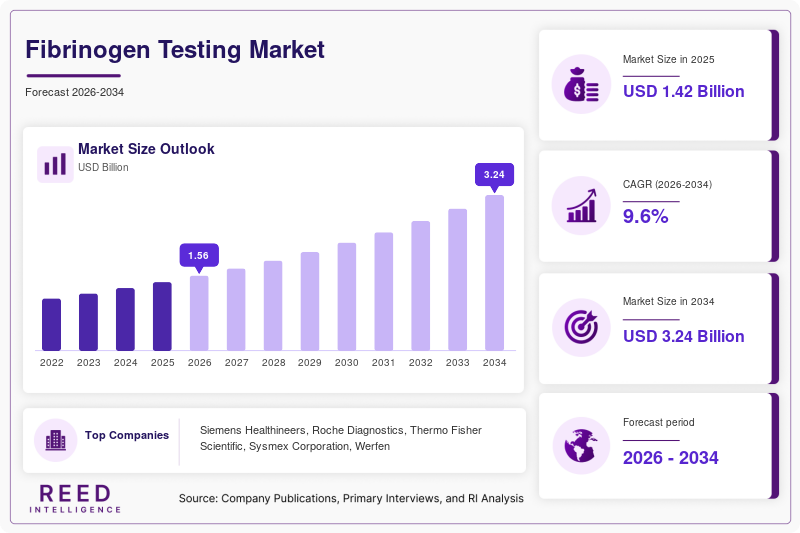
The global Fibrinogen Testing Market size was valued at USD 1.42 billion in 2026 and is projected to reach USD 2.96 billion by 2034, expanding at a CAGR of 9.6% during the forecast period from 2026 to 2034. Fibrinogen testing plays a central role in coagulation diagnostics, trauma care, cardiovascular risk evaluation, liver disease management, and perioperative bleeding assessment. Rising awareness of blood clotting disorders, growing incidence of hemophilia, thrombosis, disseminated intravascular coagulation, and increasing surgical procedures are supporting market expansion. Hospitals, diagnostic laboratories, and point-of-care settings are increasingly adopting fibrinogen assays to improve early diagnosis and treatment precision. One major global factor supporting growth is the growing burden of chronic and acute conditions requiring coagulation monitoring, particularly trauma injuries, cardiovascular disorders, and obstetric complications. Healthcare systems are emphasizing faster hemostasis evaluation, which has accelerated demand for Clauss fibrinogen assays, immunological assays, and automated coagulation analyzers. Technological advances such as high-throughput analyzers, digital lab integration, and decentralized diagnostic platforms are also broadening access to testing. Emerging economies are investing in laboratory modernization, while developed markets continue to focus on clinical accuracy and personalized medicine. The industry is also benefiting from stronger reimbursement pathways in developed countries and expanding private diagnostic infrastructure in developing regions.
Key Highlights
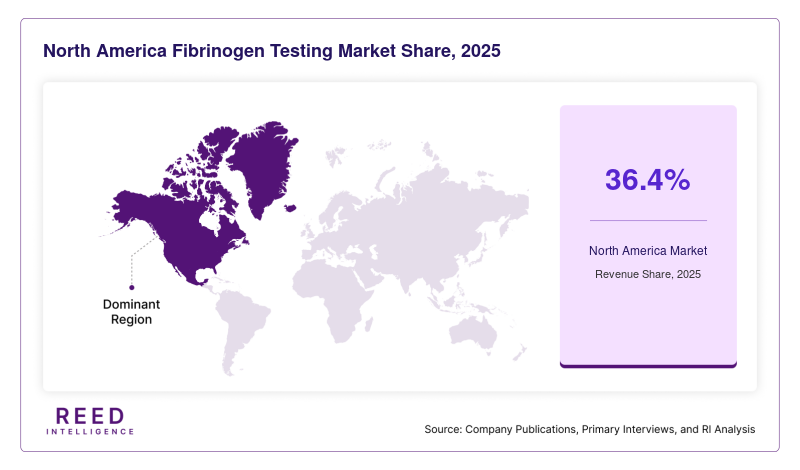
- North America dominated the market with a 36.4% share in 2025.
- Asia Pacific is expected to grow at the fastest CAGR of 11.8% during 2026–2034.
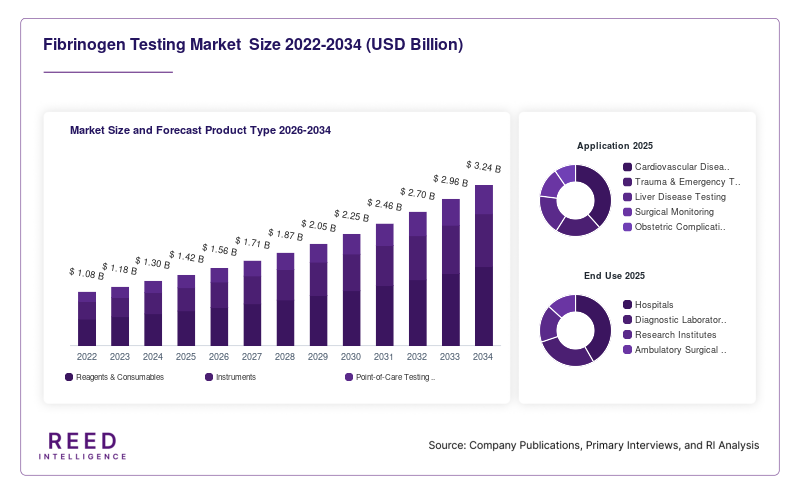
- By product type, reagents and consumables accounted for the largest share of 44.1%, while point-of-care testing systems are projected to grow at a CAGR of 12.6%.
- By application, cardiovascular disease testing led with a 39.3% share, whereas trauma and emergency testing is expected to expand at a CAGR of 12.1%.
- The United States remained the dominant country, with market values of USD 472 million in 2024 and USD 518 million in 2025.
Market Trends
Rising integration of point-of-care coagulation diagnostics
A notable trend shaping the Fibrinogen Testing Market is the growing integration of point-of-care coagulation diagnostics across emergency rooms, ambulatory surgical centers, and trauma care units. Traditional laboratory-based fibrinogen testing remains important, but healthcare providers increasingly prioritize rapid bedside results to guide urgent interventions. Point-of-care fibrinogen systems reduce turnaround time, support critical transfusion decisions, and improve outcomes in trauma and postpartum hemorrhage cases. This trend is particularly relevant in hospitals managing time-sensitive bleeding risks. Manufacturers are responding by developing portable analyzers with automated calibration and simplified workflows. The expansion of decentralized healthcare and outpatient surgery models is further accelerating adoption, making point-of-care solutions a major growth avenue.
Expansion of automated and digital laboratory ecosystems
Automation and digitalization are significantly influencing market trends by improving operational efficiency and testing precision. Diagnostic laboratories are adopting integrated coagulation platforms that combine fibrinogen assays with broader hemostasis panels. Automated systems reduce manual error, enhance throughput, and align with large-volume testing demands. Digital connectivity allows seamless data transfer to electronic health records, improving clinician decision-making and patient monitoring. Artificial intelligence-assisted interpretation tools are also emerging to identify abnormal coagulation patterns faster. This trend is especially strong in developed healthcare markets where laboratories seek cost optimization and quality assurance. As laboratories modernize, demand for software-compatible analyzers and advanced assay reagents is expected to rise steadily.
Market Drivers
Increasing prevalence of bleeding and thrombotic disorders
The rising global prevalence of bleeding disorders, thrombosis, cardiovascular diseases, and liver dysfunction is a key driver of the Fibrinogen Testing Market. Fibrinogen is a critical biomarker in coagulation pathways, and abnormalities are increasingly associated with stroke, venous thromboembolism, sepsis, and major surgeries. Aging populations and lifestyle-related chronic diseases are contributing to larger patient pools requiring coagulation assessment. Hospitals and specialty clinics are emphasizing preventive diagnostics and personalized treatment planning, increasing routine fibrinogen testing volumes. In trauma medicine, fibrinogen deficiency screening has become essential for early intervention. This growing clinical relevance across multiple specialties is strengthening consistent demand for testing technologies worldwide.
Growth in surgical procedures and trauma management
The increase in global surgical volume, including cardiac surgery, orthopedic interventions, transplant procedures, and cesarean deliveries, is driving greater use of fibrinogen testing. Surgical bleeding management requires accurate coagulation assessment to minimize complications and improve outcomes. Trauma care settings are particularly dependent on rapid fibrinogen analysis to guide transfusion protocols. Expanding healthcare infrastructure in emerging economies has increased access to surgeries, creating new testing demand. Additionally, governments and private providers are investing in emergency response systems and advanced trauma centers. As perioperative blood management becomes a standard care priority, fibrinogen testing adoption is expected to expand further.
Market Restraint
High equipment costs and inconsistent access in low-resource settings
Despite favorable market growth, the high cost of automated coagulation analyzers and specialized fibrinogen testing reagents remains a significant restraint. Advanced analyzers require substantial capital investment, maintenance, calibration, and trained personnel, which can limit adoption in small laboratories and underfunded healthcare facilities. In low- and middle-income countries, inconsistent reimbursement systems and infrastructure gaps restrict widespread implementation. Smaller diagnostic centers may rely on basic coagulation tests instead of dedicated fibrinogen assays due to affordability concerns. This creates disparities in testing quality and market penetration. Moreover, supply chain disruptions for reagents can affect operational continuity, particularly in remote regions. These barriers may slow adoption despite increasing clinical need, especially where healthcare modernization remains uneven.
Market Opportunities
Expansion of emerging healthcare infrastructure
Emerging economies present substantial opportunities for the Fibrinogen Testing Market due to ongoing healthcare infrastructure development. Countries across Asia Pacific, Latin America, and parts of Africa are investing in hospital expansion, diagnostic laboratory networks, and medical technology upgrades. Government-backed healthcare access initiatives are improving laboratory testing penetration. Rising awareness of maternal health, trauma care, and cardiovascular disease prevention is also supporting demand. As private diagnostic chains expand into secondary cities, fibrinogen testing providers can access previously underserved populations. Affordable analyzer models and localized reagent manufacturing can further enhance penetration, making emerging markets a critical long-term opportunity.
Innovation in multiplex coagulation platforms
The development of multiplex coagulation testing platforms offers a major opportunity for manufacturers seeking competitive differentiation. Healthcare providers increasingly prefer systems that evaluate multiple coagulation markers simultaneously, including fibrinogen, D-dimer, PT, and aPTT. Integrated solutions improve workflow efficiency and provide broader diagnostic value. This creates opportunities for companies offering scalable systems tailored to both hospitals and reference laboratories. Advanced software integration, predictive analytics, and cloud-connected diagnostics can also strengthen product appeal. As precision medicine expands, multiplex platforms may become standard in coagulation diagnostics, opening new revenue streams across acute and chronic care settings.
Segmental Analysis
By Product Type
Reagents and consumables dominated the product type segment, accounting for 44.1% of market share in 2024. This leadership stems from recurring demand for assay kits, calibrators, controls, and testing chemicals across hospitals and laboratories. Since reagents are essential for every test cycle, they create a continuous revenue stream. Their widespread use in Clauss assays and immunological methods further supports dominance. Increasing patient volumes and broader screening programs are sustaining demand.
Point-of-care testing systems are projected to grow at the fastest CAGR of 12.6% during the forecast period. This growth is driven by demand for rapid bedside diagnostics, emergency medicine expansion, and portable analyzer innovation. Trauma care, ambulatory surgery, and maternal health settings increasingly require immediate coagulation insights. Portable systems improve response speed and operational flexibility, making them attractive across decentralized care models.
By Application
Cardiovascular disease testing held the dominant application share at 39.3% in 2024 due to increasing use of fibrinogen as a biomarker in thrombosis, stroke, and coronary disease risk management. Healthcare providers routinely include fibrinogen analysis in coagulation profiles for at-risk populations. The growing prevalence of metabolic syndrome and aging demographics has reinforced this segment’s importance globally.
Trauma and emergency testing is expected to record the fastest CAGR of 12.1% through 2034. This growth reflects rising demand for immediate bleeding risk assessment in trauma units, military medicine, and emergency surgeries. Rapid transfusion protocols increasingly depend on fibrinogen values for decision-making. Expanding trauma infrastructure globally supports this segment’s acceleration.
By End Use
Hospitals represented the leading end-use segment with a 48.8% share in 2024. Large inpatient volumes, surgical activity, trauma care, and integrated laboratories make hospitals the primary users of fibrinogen testing systems. Hospitals also benefit from better infrastructure and reimbursement support, enabling broad assay deployment.
Diagnostic laboratories are expected to witness the fastest CAGR of 11.4% over the forecast period. Growth is supported by outsourcing trends, rising preventive testing demand, and technological modernization. Independent laboratories increasingly offer comprehensive coagulation panels, making fibrinogen testing more accessible beyond hospital settings. Automation investments further strengthen scalability.
Regional Analysis
North America
North America held the largest share of the Fibrinogen Testing Market in 2025, accounting for 36.4% of global revenue, and is projected to grow at a CAGR of 8.7% through 2034. The region benefits from advanced healthcare systems, strong reimbursement frameworks, and high awareness of coagulation disorders. The United States and Canada continue to invest in hospital automation, trauma care, and precision diagnostics, supporting widespread fibrinogen assay adoption across clinical environments.
The United States remains the dominant country in North America due to its large surgical volume and advanced emergency medicine ecosystem. One unique growth factor is the country’s strong adoption of point-of-care coagulation systems in trauma centers and military medicine. High cardiovascular disease prevalence and strong laboratory modernization initiatives also support sustained market expansion.
Europe
Europe represented 28.1% of the global Fibrinogen Testing Market in 2025 and is expected to register a CAGR of 8.9% during the forecast period. The region benefits from universal healthcare coverage, strong regulatory quality standards, and increasing focus on blood disorder management. Countries are investing in hematology diagnostics and perioperative blood management strategies, creating stable demand for fibrinogen testing technologies.
Germany is the leading country in Europe due to its strong diagnostic infrastructure and advanced hospital network. A unique growth factor is the region’s emphasis on aging population care, where chronic cardiovascular and liver diseases are increasing coagulation monitoring needs. Research collaborations between clinical laboratories and biotech companies further strengthen innovation.
Asia Pacific
Asia Pacific accounted for 22.7% of the market in 2025 and is forecast to expand at the fastest CAGR of 11.8% through 2034. Rapid healthcare modernization, rising surgical procedures, and increasing chronic disease prevalence are driving regional demand. Public and private investments in diagnostic infrastructure are expanding access across urban and semi-urban populations.
China dominates the Asia Pacific market due to large-scale hospital development and diagnostic capacity expansion. A unique growth factor is the country’s substantial investment in domestic medical device manufacturing, which is improving affordability and market reach. Rising maternal care initiatives and trauma care improvements are also accelerating growth.
Middle East & Africa
The Middle East & Africa region captured 7.1% of the global market in 2025 and is projected to grow at a CAGR of 9.3% through 2034. Healthcare diversification, hospital investments, and increasing awareness of coagulation disorders are supporting gradual market development. Gulf countries are leading adoption, while African markets remain at earlier growth stages.
Saudi Arabia is the dominant country due to healthcare infrastructure upgrades and strong investment in tertiary hospitals. A unique growth factor is the region’s growing focus on advanced surgical services and specialized hematology centers. Government health transformation programs are improving diagnostic accessibility.
Latin America
Latin America held 5.7% of the global Fibrinogen Testing Market in 2025 and is anticipated to grow at a CAGR of 9.1% through 2034. Improving healthcare coverage, private diagnostic chain expansion, and growing trauma incidence are supporting market progression. Regional healthcare reforms are also contributing to wider diagnostic adoption.
Brazil leads the Latin American market due to its large hospital network and increasing cardiovascular disease burden. A unique growth factor is expanding private healthcare investment in diagnostic technologies. Enhanced laboratory access and broader awareness of preventive testing are improving long-term market potential.
Competitive Landscape
The Fibrinogen Testing Market is moderately consolidated, with major players focusing on assay innovation, automation, and regional expansion. Siemens Healthineers leads the market through broad coagulation analyzer portfolios and strong hospital partnerships. Thermo Fisher Scientific, Roche Diagnostics, Sysmex Corporation, and Werfen are also prominent participants. These companies emphasize product integration, software capabilities, and global distribution networks. Recent market developments include expanded point-of-care systems, AI-supported coagulation analytics, and strategic collaborations with hospital groups. Competitive differentiation increasingly depends on speed, assay precision, and affordability. Regional manufacturers are also entering emerging markets with lower-cost alternatives, intensifying competition.
Key Players
- Siemens Healthineers
- Roche Diagnostics
- Thermo Fisher Scientific
- Sysmex Corporation
- Werfen
- Danaher Corporation
- Abbott Laboratories
- HORIBA Ltd.
- Trinity Biotech
- Instrumentation Laboratory
- Diagnostica Stago
- Helena Laboratories
- BioMedica Diagnostics
- SEKISUI Diagnostics
- Nihon Kohden Corporation
Recent Developments
- Siemens Healthineers introduced an upgraded coagulation analyzer platform with expanded fibrinogen assay throughput in 2025.
- Roche Diagnostics expanded its digital laboratory connectivity solutions for coagulation testing integration in 2024.
- Sysmex Corporation launched a compact point-of-care coagulation system targeting emergency care environments in 2025.
Fibrinogen Testing Market Segments
Product Type
- Reagents & Consumables
- Instruments
- Point-of-Care Testing Systems
Application
- Cardiovascular Disease Testing
- Trauma & Emergency Testing
- Liver Disease Testing
- Surgical Monitoring
- Obstetric Complications
End Use
- Hospitals
- Diagnostic Laboratories
- Research Institutes
- Ambulatory Surgical Centers
By Region
- North America
- Europe
- APAC
- Middle East and Africa
- LATAM