Fibrodysplasia Ossificans Progressiva Treatment Market Size, Share & Demand Report By Drug Type (RAR Agonists, Gene Therapy, Monoclonal Antibodies, Others), By Route of Administration (Oral, Injectable, Others), By Treatment Type (Symptomatic Treatment, Disease-Modifying Therapy), By End-Use (Hospitals, Specialty Clinics, Research Institutes), By Region & Segment Forecasts, 2025–2034
USD 3950
Market Overview
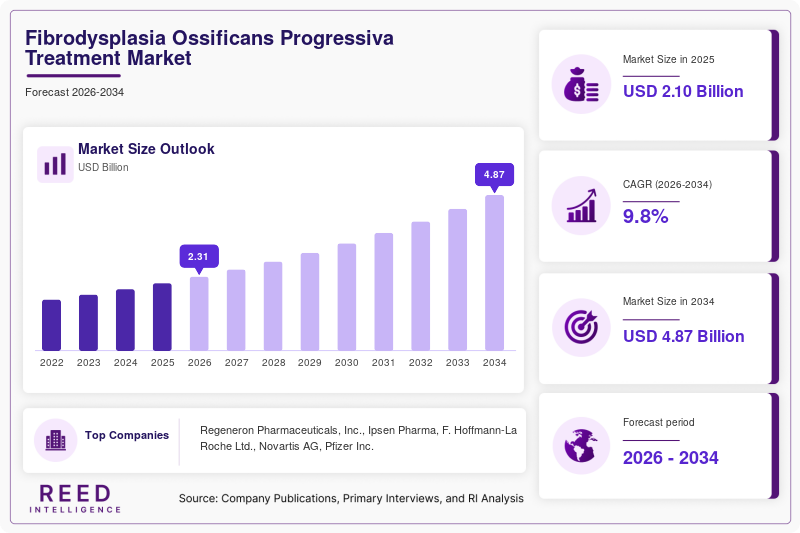
The Fibrodysplasia Ossificans Progressiva Treatment Market size was valued at USD 2.1 billion in 2025 and is projected to reach USD 4.9 billion by 2034, expanding at a CAGR of 9.8% during 2025–2034. The market is driven by increasing advancements in rare disease therapeutics and the growing pipeline of targeted therapies focused on genetic disorders. Fibrodysplasia ossificans progressiva (FOP), a rare and debilitating genetic condition characterized by progressive bone formation in soft tissues, has gained heightened research attention, leading to improved diagnosis rates and therapeutic innovation.
A key global factor supporting the growth of the Fibrodysplasia Ossificans Progressiva Treatment Market is the rising investment in orphan drug development programs. Governments and regulatory bodies are increasingly providing incentives such as fast-track approvals, tax credits, and exclusivity benefits, encouraging pharmaceutical companies to invest in rare disease treatment pipelines. Additionally, improved patient registries and genetic screening technologies are enhancing early diagnosis, thereby supporting treatment adoption.
Key Highlights
- North America dominated with a 42% market share in 2025, while Asia Pacific is expected to register the fastest growth at a CAGR of 11.4%.
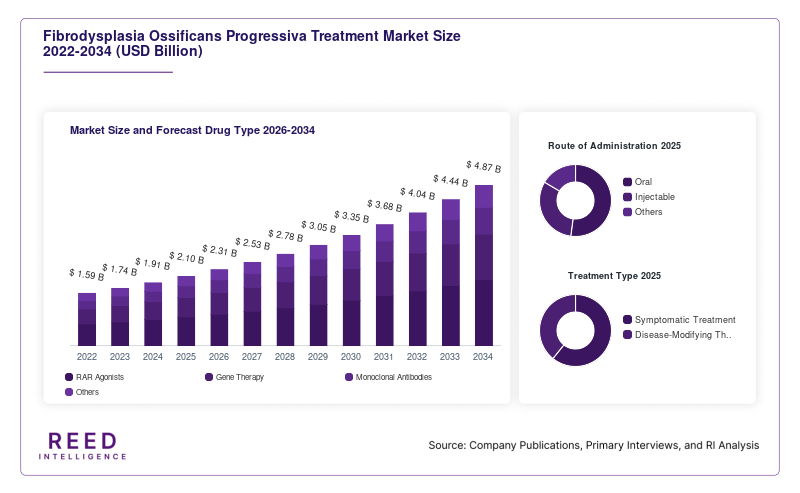
- By drug type, retinoic acid receptor (RAR) agonists led with a 38% share, while gene therapy is projected to grow fastest at a CAGR of 12.2%.
- By route of administration, oral therapies dominated with a 46% share, whereas injectable therapies will grow fastest at a CAGR of 10.6%.
- The United States remained the dominant country, with a market value of USD 820 million in 2025, expected to reach USD 880 million in 2026.
Market Trends
Expansion of Gene-Targeted Therapies
A prominent trend in the Fibrodysplasia Ossificans Progressiva Treatment Market is the growing focus on gene-targeted therapies. Researchers are increasingly targeting the ACVR1 gene mutation responsible for FOP. This shift from symptomatic treatment to disease-modifying approaches is reshaping the treatment landscape. The integration of CRISPR-based technologies and RNA interference platforms is enabling the development of precision therapies with long-term benefits. As clinical trials advance, gene-based approaches are expected to transform treatment standards and improve patient outcomes.
Increasing Collaboration Between Biotech Firms and Research Institutions
Strategic collaborations between biotechnology companies and academic institutions are accelerating innovation in the Fibrodysplasia Ossificans Progressiva Treatment Market. These partnerships facilitate access to patient data, enhance clinical trial efficiency, and enable knowledge sharing. Collaborative models are particularly effective in rare disease markets due to limited patient populations. This trend is leading to faster drug development cycles and increasing the number of investigational therapies entering the pipeline.
Market Drivers
Rising Awareness and Early Diagnosis of Rare Genetic Disorders
Improved awareness among healthcare professionals and patients has significantly contributed to the growth of the Fibrodysplasia Ossificans Progressiva Treatment Market. Educational campaigns and patient advocacy groups are playing a critical role in promoting early diagnosis. Early detection allows for timely intervention, reducing disease progression and increasing demand for therapeutic options.
Favorable Regulatory Support for Orphan Drugs
Regulatory frameworks supporting orphan drug development are driving innovation in the Fibrodysplasia Ossificans Progressiva Treatment Market. Incentives such as extended market exclusivity, reduced clinical trial costs, and priority review processes are encouraging pharmaceutical companies to invest in rare disease treatments. These supportive policies are fostering a competitive pipeline and enabling faster commercialization of novel therapies.
Market Restraint
High Cost of Treatment and Limited Patient Population
A major restraint impacting the Fibrodysplasia Ossificans Progressiva Treatment Market is the high cost associated with treatment development and therapy access. Due to the rarity of FOP, the patient population remains extremely limited, which increases per-patient treatment costs. Pharmaceutical companies often face challenges in achieving economies of scale, resulting in high pricing of therapies.
Additionally, reimbursement limitations in several regions restrict patient access to advanced treatments. Healthcare systems in developing economies often lack the financial infrastructure to support high-cost orphan drugs. This cost barrier not only affects treatment adoption but also limits market expansion in price-sensitive regions. As a result, despite significant innovation, affordability remains a key challenge in the Fibrodysplasia Ossificans Progressiva Treatment Market.
Market Opportunities
Advancements in Personalized Medicine
The rise of personalized medicine presents a strong opportunity in the Fibrodysplasia Ossificans Progressiva Treatment Market. Tailored therapies based on genetic profiling are enabling more effective treatment strategies. Personalized approaches improve efficacy while reducing adverse effects, making them highly attractive in rare disease management. As genomic technologies become more accessible, personalized treatment solutions are expected to gain traction.
Expansion in Emerging Markets
Emerging economies offer untapped growth potential for the Fibrodysplasia Ossificans Progressiva Treatment Market. Improvements in healthcare infrastructure, increased government spending, and growing awareness of rare diseases are creating favorable conditions for market expansion. Pharmaceutical companies are increasingly targeting these regions through partnerships and distribution agreements, which is expected to enhance market penetration.
Segmental Analysis
By Drug Type
RAR agonists dominated the Fibrodysplasia Ossificans Progressiva Treatment Market with a 38% share in 2025, driven by their ability to inhibit abnormal bone formation. These therapies have demonstrated effectiveness in slowing disease progression, making them the preferred treatment option.
Gene therapy is expected to be the fastest-growing subsegment, with a projected CAGR of 12.2%. Its growth will be driven by advancements in genetic engineering technologies and increasing clinical trial activity targeting the underlying cause of FOP.
By Route of Administration
Oral therapies accounted for the largest share of 46% in 2025 due to ease of administration and higher patient compliance. These therapies are widely used for long-term disease management.
Injectable therapies will grow at the fastest CAGR of 10.6%, supported by their higher efficacy and targeted delivery mechanisms. The development of biologics and advanced formulations is driving this segment.
By Treatment Type
Symptomatic treatment dominated with a 52% share in 2025, as most available therapies focus on pain management and inflammation control.
Disease-modifying therapies are expected to grow at a CAGR of 11.8%, driven by ongoing research aimed at altering disease progression. These therapies represent a shift toward more effective long-term solutions.
By End-Use
Hospitals held the largest share of 49% in 2025, as they provide specialized care and access to advanced treatment options.
Specialty clinics are projected to grow at a CAGR of 10.9%, driven by increasing demand for focused and personalized treatment approaches. These clinics offer expertise in managing rare diseases, supporting their growth.
Regional Analysis
North America
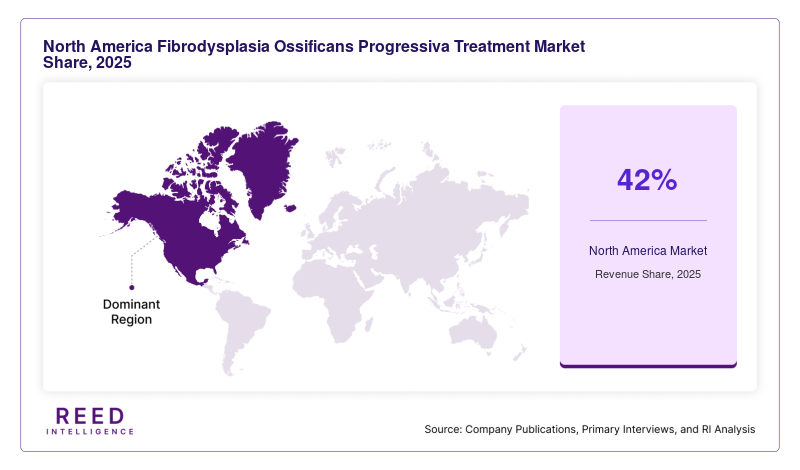
North America accounted for 42% of the Fibrodysplasia Ossificans Progressiva Treatment Market share in 2025 and will continue to expand at a CAGR of 9.1% through 2034. The region’s strong market position was supported by advanced healthcare infrastructure and significant investment in rare disease research.
The United States dominated the regional market due to robust clinical research activity and a well-established orphan drug approval framework. The presence of specialized treatment centers and access to innovative therapies contributed to market growth.
Europe
Europe held 28% of the market share in 2025 and is expected to grow at a CAGR of 8.7% during the forecast period. The region benefited from increasing research funding and supportive regulatory policies for rare diseases.
Germany emerged as the dominant country due to its strong pharmaceutical industry and emphasis on rare disease registries. The availability of reimbursement frameworks also supported treatment adoption.
Asia Pacific
Asia Pacific captured 16% of the Fibrodysplasia Ossificans Progressiva Treatment Market share in 2025 and is projected to grow at the fastest CAGR of 11.4%. The region is experiencing rapid healthcare development and increasing awareness of genetic disorders.
China led the regional market due to its expanding biotechnology sector and growing investment in genomic research. Government initiatives to improve rare disease diagnosis are contributing to market expansion.
Middle East & Africa
The Middle East & Africa accounted for 7% of the market share in 2025 and will grow at a CAGR of 8.2%. The region is gradually improving its healthcare infrastructure and access to specialized treatments.
Saudi Arabia dominated the regional market due to increasing government investment in healthcare modernization. Efforts to enhance rare disease awareness are supporting treatment adoption.
Latin America
Latin America held 7% of the Fibrodysplasia Ossificans Progressiva Treatment Market share in 2025 and is expected to grow at a CAGR of 8.5%. The region is witnessing gradual improvements in healthcare accessibility and diagnostic capabilities.
Brazil emerged as the leading country due to its expanding healthcare system and growing focus on rare disease management. Government support for research initiatives is contributing to market growth.
Competitive Landscape
The Fibrodysplasia Ossificans Progressiva Treatment Market is moderately consolidated, with key players focusing on research and pipeline development. Companies are actively investing in clinical trials and strategic collaborations to strengthen their market position.
The market leader is Regeneron Pharmaceuticals, Inc., which has been actively advancing its pipeline for rare disease treatments. The company recently announced progress in clinical trials for a novel therapy targeting genetic pathways associated with FOP.
Other major players are focusing on expanding their portfolios through partnerships and acquisitions. Continuous innovation and regulatory approvals are shaping the competitive dynamics of the Fibrodysplasia Ossificans Progressiva Treatment Market.
Key Players List
- Regeneron Pharmaceuticals, Inc.
- Ipsen Pharma
- F. Hoffmann-La Roche Ltd.
- Novartis AG
- Pfizer Inc.
- Sanofi S.A.
- Blueprint Medicines Corporation
- Clementia Pharmaceuticals Inc.
- AstraZeneca plc
- GlaxoSmithKline plc
- Amgen Inc.
- Bayer AG
- Takeda Pharmaceutical Company Limited
- Eli Lilly and Company
- BioMarin Pharmaceutical Inc.
Recent Developments
- In 2024, Regeneron Pharmaceuticals advanced a late-stage clinical trial targeting genetic pathways associated with FOP.
- Ipsen Pharma expanded its rare disease portfolio through a strategic collaboration focused on innovative therapies.
- Novartis AG increased investment in gene therapy research for rare genetic disorders.
- Pfizer Inc. initiated a new clinical trial exploring targeted biologics for FOP treatment.
- Roche strengthened its pipeline with new investigational therapies aimed at rare musculoskeletal conditions.
Fibrodysplasia Ossificans Progressiva Treatment Market Segments
Drug Type
- RAR Agonists
- Gene Therapy
- Monoclonal Antibodies
- Others
Route of Administration
- Oral
- Injectable
- Others
Treatment Type
- Symptomatic Treatment
- Disease-Modifying Therapy
End-Use
- Hospitals
- Specialty Clinics
- Research Institutes
By Region
- North America
- Europe
- APAC
- Middle East and Africa
- LATAM