Field Emission Display Market Size, Share & Demand Report By Type (Carbon Nanotube FED, Surface-Conduction Electron-Emitter Display, Others), By Application (Industrial Displays, Automotive Displays, Consumer Electronics, Medical Devices), By End-Use (Defense & Aerospace, Healthcare, Automotive, Industrial), By Region & Segment Forecasts, 2026–2034
USD 3950
Market Overview
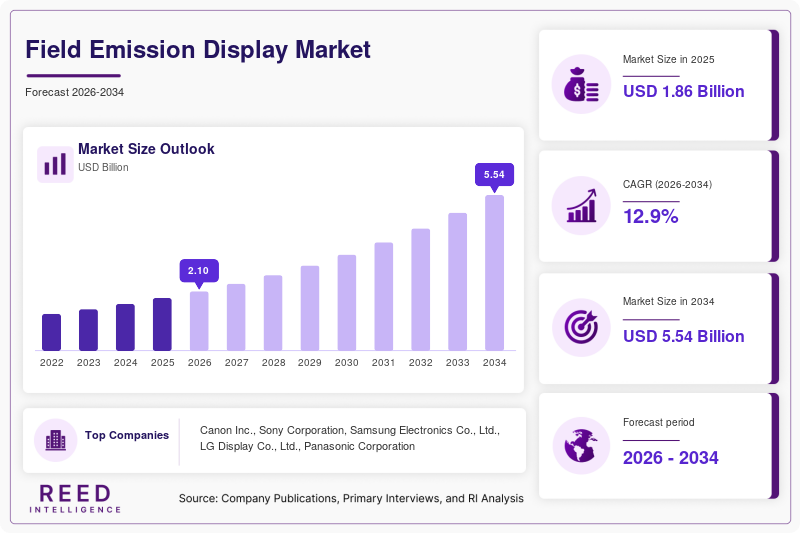
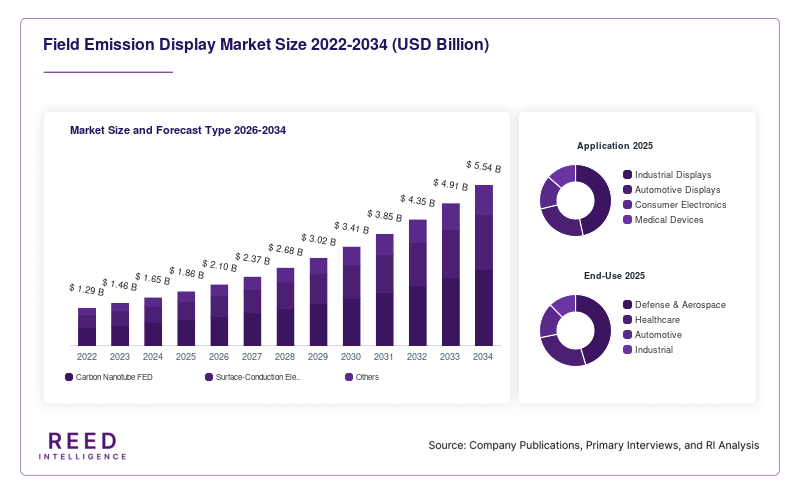
The Field Emission Display Market is estimated to reach a value of USD 2.1 billion in 2026 and is projected to grow to approximately USD 5.6 billion by 2034, expanding at a CAGR of 12.9% during 2026–2034. Field emission displays (FEDs) represent a class of flat-panel display technology that utilizes electron emission from cold cathodes to illuminate phosphor-coated screens, delivering high contrast ratios, low power consumption, and fast response times. The market is gaining renewed attention due to increasing demand for energy-efficient display technologies across industrial, automotive, and specialized defense applications.
One key global factor supporting market growth is the rising adoption of advanced display systems in mission-critical environments. Industries such as aerospace, defense, and medical imaging require displays that function reliably under extreme conditions. FED technology, with its resilience, low latency, and ability to operate in wide temperature ranges, has emerged as a viable alternative to conventional LCD and OLED panels in these niche applications.
Key Highlights
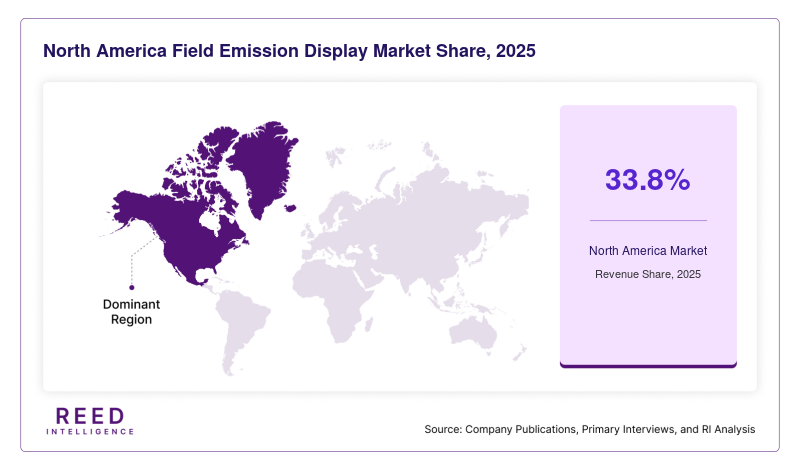
- North America dominated the market with a 33.8% share in 2025.
- Asia Pacific is expected to grow at the fastest CAGR of 13.7% during 2026–2034.
- By type, carbon nanotube FEDs accounted for the largest share of 42.6%.
- while surface-conduction electron-emitter displays are projected to grow at a CAGR of 14.2%.
- By application, industrial displays led with a 39.4% share, whereas automotive displays are expected to expand at a CAGR of 13.5%.
- The United States remained the dominant country, with market values of USD 480 million in 2024 and USD 525 million in 2025.
Market Trends
Increasing Integration of Nanotechnology in FED Manufacturing
A notable trend in the Field Emission Display Market is the integration of nanotechnology, particularly carbon nanotubes and graphene-based emitters. These materials enable improved electron emission efficiency, reduced power consumption, and enhanced display brightness. Manufacturers are investing in advanced fabrication techniques to ensure uniform emitter distribution, which is critical for display quality. This trend is also contributing to thinner and more flexible display designs, enabling applications in portable and wearable electronics. As research progresses, the scalability of nanomaterial-based FEDs is improving, making them more commercially viable across broader applications.
Growing Demand for High-Performance Displays in Defense and Aerospace
Another significant trend is the increasing demand for high-performance displays in defense and aerospace sectors. FEDs are gaining traction due to their ability to operate in harsh environments, including extreme temperatures and high radiation zones. These displays offer superior readability under direct sunlight and maintain performance stability during high-speed operations. Governments and defense agencies are prioritizing advanced display systems for cockpit instrumentation, surveillance equipment, and mission-critical control panels. This trend is expected to drive consistent demand, particularly in developed economies with strong defense budgets.
Market Drivers
Rising Demand for Energy-Efficient Display Technologies
Energy efficiency is a primary driver of the Field Emission Display Market. FEDs consume significantly less power compared to traditional display technologies due to their cold cathode emission mechanism. With increasing global focus on energy conservation and sustainability, industries are actively seeking solutions that reduce power consumption without compromising performance. FEDs are particularly attractive for applications requiring continuous operation, such as industrial monitoring systems and medical devices. As energy regulations become more stringent, the demand for low-power display technologies is expected to increase, supporting market expansion.
Advancements in Material Science and Manufacturing Processes
Continuous advancements in material science are enabling improved performance and cost-efficiency in FED production. Innovations in emitter materials, including nanostructured carbon and metal oxides, are enhancing durability and emission stability. Additionally, improvements in manufacturing processes, such as vacuum sealing and substrate fabrication, are reducing production defects and increasing yield rates. These advancements are making FED technology more competitive with established display technologies. As production costs decline and performance improves, adoption is expected to expand across new application areas.
Market Restraint
High Production Costs and Limited Commercial Adoption
One of the primary restraints affecting the Field Emission Display Market is the relatively high production cost associated with manufacturing FED panels. The fabrication process involves complex vacuum environments, precise emitter alignment, and advanced materials, which increase overall production expenses. These factors limit large-scale commercialization and restrict adoption primarily to niche markets where performance outweighs cost considerations.
Additionally, the dominance of established display technologies such as LCD and OLED poses a challenge. These alternatives benefit from mature supply chains, economies of scale, and widespread consumer acceptance. As a result, FED manufacturers face difficulties in penetrating mainstream markets such as consumer electronics. For example, smartphone and television manufacturers continue to favor OLED displays due to their flexibility and cost efficiency. This competitive pressure slows the pace of FED adoption and limits investment in large-scale production facilities, thereby constraining market growth.
Market Opportunities
Expansion in Automotive Display Systems
The automotive sector presents a significant opportunity for the Field Emission Display Market. With the increasing adoption of advanced driver assistance systems (ADAS) and digital dashboards, there is a growing need for high-performance displays. FEDs offer advantages such as fast response times, high contrast ratios, and visibility under varying lighting conditions, making them suitable for automotive applications. As electric and autonomous vehicles gain traction, manufacturers are exploring advanced display technologies to enhance user experience and safety. This trend is expected to create substantial growth opportunities for FED providers.
Adoption in Medical Imaging and Diagnostic Equipment
Another promising opportunity lies in the medical sector, particularly in imaging and diagnostic equipment. FEDs provide high-resolution imaging with minimal latency, which is critical for accurate diagnostics. Their ability to operate continuously without significant degradation makes them suitable for hospital environments. Additionally, FEDs emit less heat compared to traditional displays, reducing the need for extensive cooling systems. As healthcare infrastructure expands globally and demand for advanced diagnostic tools increases, the adoption of FED technology in medical applications is expected to grow significantly.
Segmental Analysis
By Type
Carbon nanotube-based FEDs held the dominant share of 42.6% in 2024, owing to their superior electron emission efficiency and durability. These displays offer enhanced brightness, low power consumption, and longer lifespan compared to other types. The widespread availability of carbon nanotube materials and ongoing advancements in nanotechnology are supporting their dominance. Industries such as defense and healthcare prefer this type due to its reliability and performance in critical applications.
Surface-conduction electron-emitter displays are the fastest-growing subsegment, expected to expand at a CAGR of 14.2% during the forecast period. This growth is driven by their ability to deliver uniform emission and improved display quality. Advancements in manufacturing techniques are reducing production costs, making them more accessible. Increasing demand for high-resolution displays in industrial and automotive applications is further driving growth in this segment.
By Application
Industrial displays accounted for the largest share of 39.4% in 2024, driven by their extensive use in monitoring and control systems. These displays require high reliability and durability, making FEDs an ideal choice. Industries such as manufacturing, energy, and transportation are adopting FED technology to enhance operational efficiency. The ability of FEDs to operate in harsh environments further supports their dominance in this segment.
Automotive displays are the fastest-growing application segment, with a projected CAGR of 13.5% during 2026–2034. The increasing adoption of digital dashboards and infotainment systems is driving demand for advanced display technologies. FEDs offer advantages such as fast response times and high visibility, making them suitable for automotive applications. The rise of electric and autonomous vehicles is further accelerating growth in this segment.
By End-Use
The defense and aerospace sector held the dominant share of 36.8% in 2024, driven by the need for high-performance displays in mission-critical applications. FEDs are widely used in cockpit displays, surveillance systems, and control panels. Their ability to operate in extreme conditions and provide clear visibility makes them a preferred choice in this sector. Increasing defense budgets and modernization programs are supporting growth in this segment.
The healthcare sector is the fastest-growing end-use segment, expected to grow at a CAGR of 13.9% during the forecast period. The demand for advanced diagnostic equipment and imaging systems is driving adoption of FED technology. These displays provide high resolution and low latency, which are essential for accurate diagnostics. Expanding healthcare infrastructure and increasing investment in medical technology are further contributing to growth in this segment.
Regional Analysis
North America
North America accounted for a dominant share of 33.8% in 2025 and is projected to grow at a CAGR of 11.5% during the forecast period. The region benefits from strong technological infrastructure and high investment in research and development. Demand for advanced display technologies in defense, aerospace, and healthcare sectors continues to drive market growth. The presence of leading technology companies further supports innovation and adoption of FED solutions.
The United States remains the dominant country in the region, supported by its robust defense sector and high spending on advanced technologies. A unique growth factor is the increasing use of FEDs in military applications, including cockpit displays and surveillance systems. Government initiatives to modernize defense equipment are expected to sustain demand for high-performance display technologies.
Europe
Europe held a significant share of the Field Emission Display Market in 2025 and is expected to grow at a CAGR of 10.9% through 2034. The region is characterized by strong industrial and automotive sectors, which are key consumers of advanced display technologies. Increasing focus on energy efficiency and sustainability is also driving adoption of FED solutions across various industries.
Germany is the leading country in the European market, driven by its advanced automotive manufacturing industry. A unique growth factor is the integration of FED technology in automotive dashboards and infotainment systems. European automakers are investing in innovative display solutions to enhance vehicle performance and user experience.
Asia Pacific
Asia Pacific is the fastest-growing region, expected to expand at a CAGR of 13.7% during the forecast period. The region benefits from rapid industrialization, increasing consumer electronics production, and growing demand for advanced display technologies. Countries such as China, Japan, and South Korea are investing heavily in display manufacturing and innovation.
China dominates the regional market due to its large-scale manufacturing capabilities and strong electronics industry. A unique growth factor is the government’s support for advanced manufacturing technologies, including display innovation. Subsidies and investments in research facilities are accelerating the development and adoption of FED technology.
Middle East & Africa
The Middle East & Africa region is witnessing moderate growth, with a projected CAGR of 9.8% during 2026–2034. Increasing investments in infrastructure and technology are driving demand for advanced display systems. The region’s focus on modernization and digital transformation is creating opportunities for FED adoption.
The United Arab Emirates is a key market in the region, supported by its focus on smart city initiatives. A unique growth factor is the use of FEDs in public display systems and control centers. Government-led projects are promoting the adoption of advanced technologies, including high-performance displays.
Latin America
Latin America is expected to grow at a CAGR of 10.2% during the forecast period, driven by increasing industrialization and technological adoption. The region is gradually embracing advanced display technologies in sectors such as healthcare and manufacturing. Economic development and rising investments in infrastructure are supporting market growth.
Brazil is the dominant country in the region, driven by its expanding industrial base. A unique growth factor is the adoption of FEDs in industrial monitoring systems. Companies are investing in advanced technologies to improve operational efficiency and safety, creating demand for reliable display solutions.
Competitive Landscape
The Field Emission Display Market is moderately competitive, with a mix of established technology companies and emerging players focusing on innovation. Leading companies are investing in research and development to enhance display performance and reduce production costs. Strategic partnerships and collaborations are common, enabling companies to expand their technological capabilities and market presence.
Canon Inc. is a leading player in the market, known for its advancements in surface-conduction electron-emitter display technology. The company has recently focused on improving production scalability and exploring new application areas, including automotive and medical displays. Other key players are also investing in nanotechnology and advanced materials to strengthen their competitive position. Continuous innovation and product development are expected to shape the competitive landscape in the coming years.
Key Players List
- Canon Inc.
- Sony Corporation
- Samsung Electronics Co., Ltd.
- LG Display Co., Ltd.
- Panasonic Corporation
- AU Optronics Corp.
- BOE Technology Group Co., Ltd.
- Sharp Corporation
- Innolux Corporation
- TCL Corporation
- Japan Display Inc.
- Visionox Technology Inc.
- E Ink Holdings Inc.
- Universal Display Corporation
- Applied Nanotech Holdings Inc.
Recent Developments
- In 2025, Canon Inc. announced advancements in surface-conduction electron-emitter technology, improving display efficiency and reducing production costs.
- In 2024, Samsung Electronics invested in nanomaterial research to enhance field emission performance in next-generation displays.
- In 2025, LG Display initiated pilot production of advanced FED panels targeting automotive and industrial applications.
Field Emission Display Market Segments
Type
- Carbon Nanotube FED
- Surface-Conduction Electron-Emitter Display
- Others
Application
- Industrial Displays
- Automotive Displays
- Consumer Electronics
- Medical Devices
End-Use
- Defense & Aerospace
- Healthcare
- Automotive
- Industrial
By Region
- North America
- Europe
- APAC
- Middle East and Africa
- LATAM