Filament Tapes Market Size, Share & Demand Report By Type (Mono-directional Filament Tapes, Cross-weave Filament Tapes), By Application (Packaging, Construction, Electrical & Electronics, Others), By End-Use Industry (Logistics & Transportation, Automotive, Building & Construction, Consumer Goods, Others) By Region & Segment Forecasts, 2026–2034
USD 3950
Market Overview
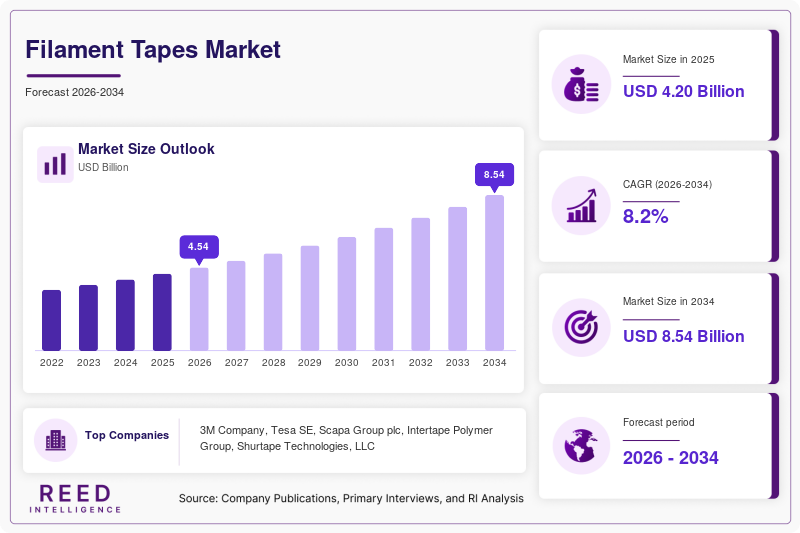
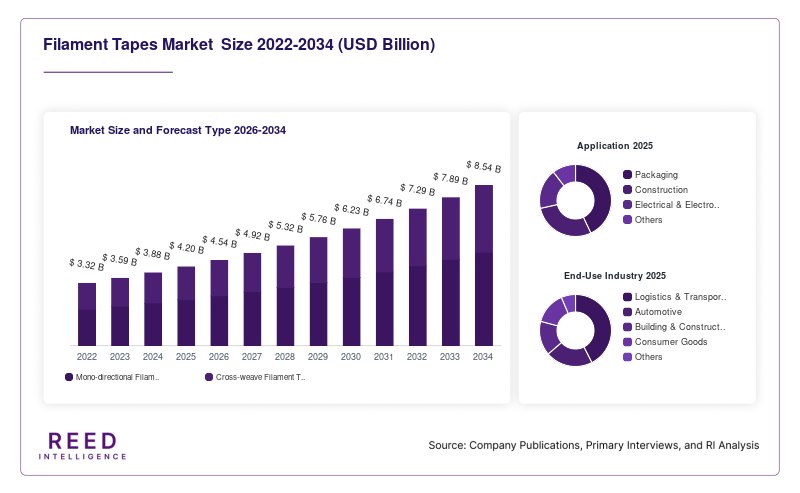
The global Filament Tapes Market size was valued at approximately USD 4.2 billion in 2026 and is projected to reach around USD 7.9 billion by 2034, registering a CAGR of 8.2% during the forecast period (2026–2034). Filament tapes, known for their high tensile strength and durability, are widely used across packaging, logistics, construction, and automotive industries. These tapes are reinforced with fiberglass filaments, making them suitable for bundling, sealing, and heavy-duty packaging applications. The market continues to evolve due to increased demand for efficient packaging solutions and the expansion of global trade.
A major global factor supporting market growth is the steady rise in e-commerce and logistics activities. As supply chains become more complex and globalized, the need for secure packaging solutions has intensified. Filament tapes offer enhanced load stability and resistance to tearing, making them ideal for long-distance transportation and industrial packaging. The growth of warehouse automation and the adoption of advanced packaging technologies further contribute to the increasing demand for these tapes across multiple industries.
Key Highlights
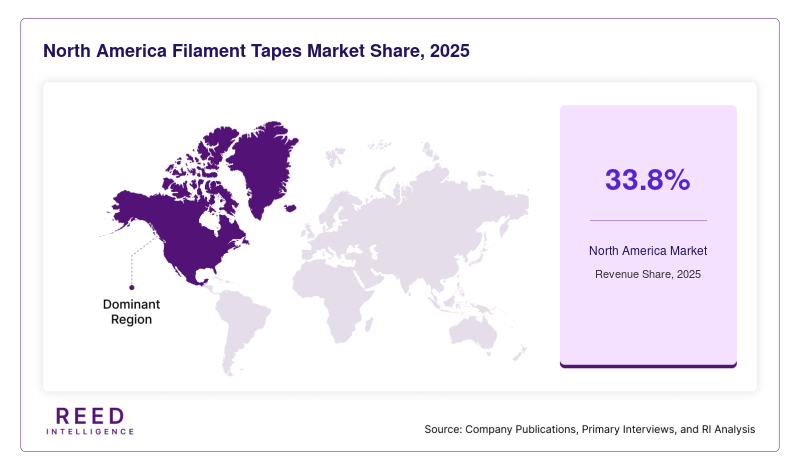
- North America dominated the market with a 33.8% share in 2025.
- Asia Pacific is expected to grow at the fastest CAGR of 9.6% during 2026–2034.
- By type, mono-directional filament tapes accounted for the largest share of 42.7%, while cross-weave filament tapes are projected to grow at a CAGR of 9.9%.
- By application, packaging led with a 46.3% share, whereas construction applications are expected to expand at a CAGR of 8.8%.
- The United States remained the dominant country, with market values of USD 620 million in 2024 and USD 670 million in 2025.
Market Trends
Rising adoption of sustainable and eco-friendly adhesive solutions
The increasing focus on sustainability is shaping the filament tapes market significantly. Manufacturers are investing in the development of eco-friendly adhesive formulations and recyclable backing materials to meet environmental regulations and consumer expectations. Water-based adhesives and biodegradable polymers are gaining attention as companies seek to reduce their environmental footprint. Additionally, the shift toward sustainable packaging in industries such as retail and food distribution is encouraging the adoption of filament tapes that align with green standards. This trend is further supported by regulatory bodies promoting reduced plastic usage and improved waste management practices.
The demand for eco-conscious solutions is also driven by corporate sustainability goals across major industries. Businesses are prioritizing packaging materials that can be easily recycled or reused without compromising performance. As a result, innovation in filament tape production is focused on balancing strength and environmental responsibility. This trend is expected to create new growth avenues for manufacturers that can deliver cost-effective and sustainable products.
Increasing integration with automated packaging systems
Automation in packaging and logistics operations is transforming the usage patterns of filament tapes. Industries are adopting automated sealing and bundling systems to improve efficiency, reduce labor costs, and enhance consistency. Filament tapes are being engineered to meet the requirements of high-speed automated machinery, including improved adhesion, uniform thickness, and consistent unwinding properties. These advancements are essential for maintaining operational efficiency in large-scale distribution centers and manufacturing facilities.
The growth of smart warehouses and Industry 4.0 technologies is further accelerating this trend. Automated systems require materials that can perform reliably under continuous operation, and filament tapes offer the necessary durability and strength. As companies invest in robotics and advanced packaging equipment, the demand for high-performance filament tapes is expected to rise steadily. This trend highlights the importance of product innovation and customization in meeting evolving industrial needs.
Market Drivers
Expansion of global logistics and e-commerce sectors
The rapid growth of e-commerce and global logistics networks is a major driver of the filament tapes market. With increasing online retail activities, the volume of goods being transported has surged, creating a strong demand for secure and durable packaging solutions. Filament tapes provide high tensile strength and resistance to stress, making them ideal for heavy-duty packaging and bundling applications. Their ability to maintain package integrity during long transit periods is particularly valuable in international shipping.
Additionally, logistics companies are focusing on minimizing product damage and reducing return rates. Filament tapes help achieve these objectives by offering reliable sealing and reinforcement capabilities. The expansion of cross-border trade and the rise of third-party logistics providers are further contributing to market growth. As supply chains become more complex, the need for dependable packaging materials like filament tapes continues to increase.
Growth in construction and industrial applications
The construction and industrial sectors are significant contributors to the demand for filament tapes. These tapes are widely used for securing materials, reinforcing structures, and bundling heavy components. Their high strength and durability make them suitable for demanding environments where standard adhesive tapes may fail. The growth of infrastructure projects, particularly in developing economies, is driving the adoption of filament tapes in construction activities.
In industrial settings, filament tapes are used for palletizing, pipe wrapping, and equipment maintenance. The increasing emphasis on operational efficiency and safety is encouraging the use of high-performance materials. Filament tapes offer a cost-effective solution for various industrial applications, reducing the need for additional fastening tools. This driver is expected to remain strong as industrialization continues to expand globally.
Market Restraint
Volatility in raw material prices and supply chain disruptions
Fluctuations in raw material prices pose a significant challenge to the filament tapes market. The production of filament tapes relies on materials such as polypropylene, fiberglass, and adhesives, which are subject to price volatility due to changes in crude oil prices and supply chain dynamics. Sudden increases in raw material costs can impact profit margins for manufacturers and lead to higher product prices for end-users. This situation may reduce demand, especially in price-sensitive markets.
Supply chain disruptions, including transportation delays and shortages of key materials, further complicate the production process. For example, global events affecting trade routes or manufacturing hubs can lead to delays in raw material availability, impacting production schedules. These challenges require manufacturers to adopt strategies such as supplier diversification and inventory management to maintain stability. Despite these efforts, raw material volatility remains a key restraint influencing market growth.
Market Opportunities
Technological advancements in adhesive formulations
Innovations in adhesive technology present significant opportunities for the filament tapes market. Manufacturers are developing advanced formulations that offer improved bonding strength, temperature resistance, and durability. These enhancements enable filament tapes to be used in a wider range of applications, including extreme industrial environments. The integration of pressure-sensitive adhesives with enhanced performance characteristics is particularly promising.
These advancements also support the development of specialized tapes tailored to specific industries. For instance, tapes designed for automotive applications require resistance to heat and chemicals, while those used in electronics need precise adhesion and minimal residue. The ability to customize products based on application requirements creates new revenue streams for manufacturers. This opportunity is expected to drive innovation and competitiveness in the market.
Increasing demand from emerging economies
Emerging economies offer substantial growth potential for the filament tapes market. Rapid industrialization, urbanization, and infrastructure development in regions such as Asia Pacific and Latin America are driving demand for high-performance packaging and construction materials. The expansion of manufacturing activities in these regions is creating a strong need for reliable adhesive solutions.
Additionally, the growth of local industries and increasing foreign investments are contributing to market expansion. Governments in emerging economies are investing in infrastructure projects, which require durable materials for construction and logistics. Filament tapes are well-suited for these applications, making them an attractive option for various industries. This opportunity highlights the importance of geographic expansion and market penetration strategies for manufacturers.
Segmental Analysis
By Type
Mono-directional filament tapes dominated the market in 2024, accounting for a share of approximately 42.7%. These tapes are widely used due to their high tensile strength in a single direction, making them ideal for bundling and reinforcing applications. Industries such as logistics and construction rely heavily on these tapes for securing heavy loads and ensuring package stability. The cost-effectiveness and ease of application further contribute to their widespread adoption.
The demand for mono-directional tapes is also supported by their compatibility with automated packaging systems. Their consistent performance and durability make them suitable for high-volume operations. As industries continue to prioritize efficiency and reliability, the dominance of this subsegment is expected to remain strong.
Cross-weave filament tapes are projected to be the fastest-growing subsegment, with a CAGR of 9.9% during the forecast period. These tapes offer strength in multiple directions, providing enhanced durability and resistance to tearing. This feature makes them suitable for applications requiring multidirectional reinforcement.
The growth of this subsegment is driven by increasing demand from industries such as automotive and heavy manufacturing. These sectors require robust materials capable of withstanding extreme conditions. The versatility and superior performance of cross-weave tapes are expected to drive their adoption in the coming years.
By Application
Packaging applications held the largest share of 46.3% in 2024, driven by the growing demand for secure and efficient packaging solutions. Filament tapes are widely used for sealing boxes, bundling items, and reinforcing packages. Their high strength and durability make them suitable for handling heavy loads and ensuring product safety during transportation.
The expansion of e-commerce and logistics activities has significantly contributed to the growth of this subsegment. Companies are focusing on reducing product damage and improving customer satisfaction, which drives the demand for reliable packaging materials. Filament tapes play a crucial role in achieving these objectives.
Construction applications are expected to grow at the fastest CAGR of 8.8% during the forecast period. The increasing number of infrastructure projects and the need for durable materials are driving the demand for filament tapes in this sector.
These tapes are used for securing materials, reinforcing structures, and bundling components. Their ability to withstand harsh conditions makes them suitable for construction applications. The growth of urbanization and infrastructure development is expected to support this subsegment.
By End-Use Industry
The logistics and transportation sector dominated the market in 2024, accounting for a significant share. The increasing volume of goods being transported globally has created a strong demand for secure packaging solutions. Filament tapes are widely used for palletizing, bundling, and reinforcing packages in this sector.
The growth of e-commerce and global trade has further strengthened the demand for filament tapes in logistics. Companies are focusing on improving supply chain efficiency and reducing losses, which drives the adoption of high-performance materials. This subsegment is expected to maintain its dominance.
The automotive industry is projected to be the fastest-growing subsegment, with a CAGR of 8.5%. The increasing use of filament tapes in automotive manufacturing and maintenance is driving this growth.
These tapes are used for securing components, bundling wires, and reinforcing parts. Their resistance to heat and chemicals makes them suitable for automotive applications. The growth of the automotive industry, particularly in emerging economies, is expected to drive this subsegment.
Regional Analysis
North America
North America held a significant share of 33.8% in 2025 and is expected to grow at a CAGR of 7.6% during the forecast period. The region benefits from a well-established industrial base and advanced logistics infrastructure. The presence of major packaging and manufacturing companies supports the demand for filament tapes. Additionally, the adoption of automated packaging systems is high in this region, driving the need for high-performance adhesive solutions.
The United States remains the dominant country in North America, driven by strong e-commerce growth and advanced supply chain networks. A key growth factor is the increasing adoption of automation in warehouses and distribution centers. This trend is encouraging the use of filament tapes that can perform efficiently in high-speed packaging operations.
Europe
Europe accounted for approximately 27.4% of the market share in 2025 and is projected to grow at a CAGR of 7.9%. The region’s focus on sustainability and regulatory compliance is influencing the demand for eco-friendly filament tapes. Industries are adopting recyclable materials and low-impact adhesives to meet environmental standards.
Germany is the leading country in this region, supported by its strong manufacturing and automotive sectors. A unique growth factor is the emphasis on sustainable packaging solutions. Companies are investing in environmentally friendly materials, creating opportunities for filament tape manufacturers to innovate and expand their product offerings.
Asia Pacific
Asia Pacific is expected to witness the fastest growth, with a CAGR of 9.6% during the forecast period. The region’s market share stood at around 24.6% in 2025. Rapid industrialization, urbanization, and the expansion of e-commerce are key drivers of market growth in this region.
China dominates the Asia Pacific market due to its large manufacturing base and growing logistics sector. A major growth factor is the increasing investment in infrastructure and industrial development. This trend is driving the demand for durable and cost-effective packaging solutions, including filament tapes.
Middle East & Africa
The Middle East & Africa region held a market share of approximately 7.2% in 2025 and is projected to grow at a CAGR of 6.8%. The region is witnessing gradual growth due to increasing industrial activities and infrastructure development.
The United Arab Emirates is a key contributor to the market, supported by its strategic position as a logistics hub. A unique growth factor is the expansion of trade and distribution networks. This development is increasing the demand for reliable packaging materials, including filament tapes.
Latin America
Latin America accounted for about 7.0% of the market share in 2025 and is expected to grow at a CAGR of 7.2%. The region is experiencing steady growth due to the expansion of manufacturing and logistics sectors.
Brazil is the dominant country in this region, driven by its growing industrial base. A key growth factor is the increasing adoption of advanced packaging solutions in the retail and food industries. This trend is supporting the demand for filament tapes in various applications.
Competitive Landscape
The filament tapes market is moderately competitive, with several key players focusing on product innovation and strategic partnerships. Leading companies are investing in research and development to enhance product performance and expand their application scope. The market is characterized by the presence of both global and regional players, creating a dynamic competitive environment.
3M Company is considered a leading player in the market, known for its advanced adhesive technologies and diverse product portfolio. The company recently introduced a new range of high-strength filament tapes designed for automated packaging systems, reflecting its focus on innovation. Other major players are also expanding their production capacities and strengthening their distribution networks to gain a competitive edge.
Key Players
- 3M Company
- Tesa SE
- Scapa Group plc
- Intertape Polymer Group
- Shurtape Technologies, LLC
- Berry Global Inc.
- Avery Dennison Corporation
- Saint-Gobain Performance Plastics
- Nitto Denko Corporation
- PPM Industries S.p.A.
- Parafix Tapes & Conversions Ltd.
- Adhesive Applications, Inc.
- DeWAL Industries
- CCT Tapes
- Sekisui Chemical Co., Ltd.
Recent Developments
- Several manufacturers have introduced eco-friendly filament tapes with recyclable materials to meet sustainability goals.
- A leading company expanded its production facility in Asia Pacific to cater to rising regional demand.
- New product launches focusing on high-performance adhesive formulations have enhanced durability and application versatility.
Filament Tapes Market Segments
Type
- Mono-directional Filament Tapes
- Cross-weave Filament Tapes
Application
- Packaging
- Construction
- Electrical & Electronics
- Others
End-Use Industry
- Logistics & Transportation
- Automotive
- Building & Construction
- Consumer Goods
- Others
By Region
- North America
- Europe
- APAC
- Middle East and Africa
- LATAM