File Integrity Monitoring Market Size, Share & Demand Report By Deployment Mode (On-Premises, Cloud-Based, Hybrid), By Component (Software, Services), By Organization Size (Large Enterprises, Small & Medium Enterprises), By End-Use Industry (BFSI, Healthcare, Government & Defense, IT & Telecom, Retail & E-commerce, Manufacturing, Energy & Utilities, Others), By Region & Segment Forecasts, 2026–2034
USD 3950
Market Overview
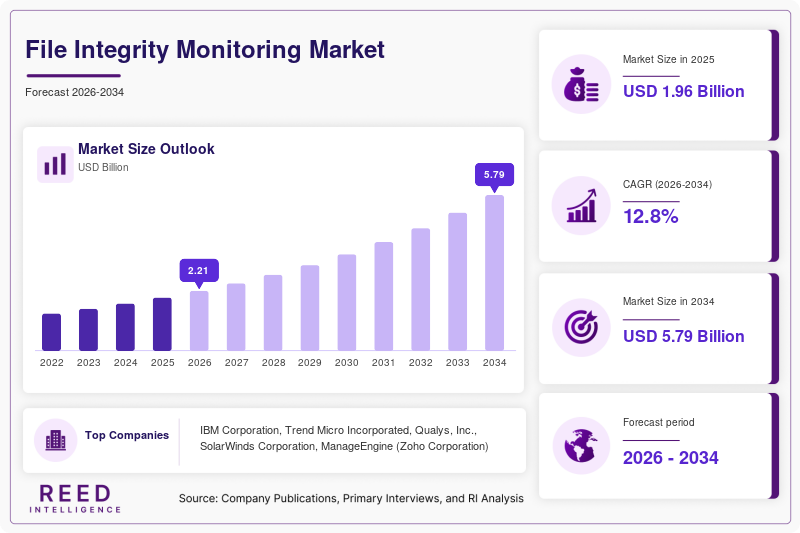
The File Integrity Monitoring Market size was valued at USD 1.96 billion in 2026 and is projected to reach USD 5.14 billion by 2034, expanding at a CAGR of 12.8% during the forecast period (2026–2034). The global File Integrity Monitoring Market is witnessing substantial growth as organizations increasingly prioritize cybersecurity resilience, regulatory compliance, and real-time threat detection across digital infrastructures. File integrity monitoring (FIM) solutions have become a critical component of enterprise security frameworks by continuously monitoring files, configurations, operating systems, databases, and critical digital assets for unauthorized changes.
A major global factor supporting market expansion is the rapid increase in sophisticated cyberattacks targeting enterprise networks, cloud environments, and critical infrastructure systems. Organizations across sectors are investing heavily in proactive security technologies capable of detecting unauthorized modifications before they lead to operational disruptions, data breaches, or compliance violations. As cybercriminal tactics become increasingly advanced, enterprises are deploying continuous monitoring platforms to strengthen visibility and accelerate incident response capabilities.
Key Highlights
- North America dominated the File Integrity Monitoring Market with 38.4% market share in 2025, while Asia Pacific is projected to register the fastest CAGR of 14.5% during 2026–2034.
- By Deployment Mode, Cloud-Based Solutions accounted for 57.2% market share in 2025, while Hybrid Deployment is expected to grow at a CAGR of 15.1%.
- By Component, Software Solutions represented 69.8% share in 2025, whereas Managed Services are anticipated to expand at 14.7% CAGR.
- By Enterprise Size, Large Enterprises held 63.5% market share in 2025, while Small and Medium Enterprises (SMEs) will witness a CAGR of 15.4%.
- By Industry Vertical, BFSI accounted for 24.9% share in 2025, while Healthcare is expected to grow at 15.2% CAGR.
- The United States remained the dominant country, with market values reaching USD 565 million in 2024 and USD 642 million in 2025.
Market Trends
Integration of Artificial Intelligence and Behavioral Analytics
One of the most influential trends shaping the File Integrity Monitoring Market is the integration of artificial intelligence and behavioral analytics into monitoring platforms. Traditional rule-based systems are increasingly being supplemented by machine learning algorithms capable of identifying abnormal file modifications and suspicious behavior patterns. These intelligent systems reduce false positives, improve threat prioritization, and provide security teams with actionable insights. Organizations are adopting AI-powered monitoring solutions to manage growing data volumes while improving threat detection accuracy.
Expansion of Cloud-Native Monitoring Solutions
Another significant trend is the emergence of cloud-native file integrity monitoring platforms. Enterprises migrating workloads to public, private, and hybrid cloud infrastructures require security solutions capable of monitoring distributed environments. Cloud-native platforms offer scalability, centralized visibility, automated deployment, and simplified management. As cloud adoption accelerates across industries, vendors are developing solutions optimized for containerized environments, cloud workloads, and multi-cloud architectures.
Market Drivers
Growing Frequency of Cybersecurity Breaches
The rising number of ransomware attacks, insider threats, malware campaigns, and advanced persistent threats continues to drive demand for file integrity monitoring technologies. Unauthorized modifications to critical files often represent early indicators of security incidents. Organizations increasingly rely on continuous monitoring systems to identify suspicious activity before attackers can compromise sensitive assets. Enhanced visibility into file changes improves overall cybersecurity posture and accelerates threat response efforts.
Increasing Regulatory Compliance Requirements
Organizations face growing pressure to comply with cybersecurity and data protection regulations. Standards such as PCI DSS, HIPAA, SOX, GDPR, NIST frameworks, and various national cybersecurity mandates emphasize continuous monitoring of critical systems. File integrity monitoring solutions assist organizations in maintaining compliance by providing audit trails, automated reporting capabilities, and real-time alerts. Regulatory obligations continue to support sustained investment in monitoring technologies.
Market Restraint
Complexity of Security Infrastructure Integration
A significant challenge affecting market adoption is the complexity associated with integrating file integrity monitoring solutions into existing security ecosystems. Large organizations often operate diverse IT environments consisting of legacy systems, cloud platforms, databases, and third-party applications. Integrating monitoring tools across these environments can require specialized expertise, additional configuration efforts, and ongoing maintenance resources.
Market Opportunities
Expansion of Managed Security Services
Growing demand for outsourced cybersecurity operations presents substantial opportunities for managed service providers. Many organizations lack dedicated cybersecurity personnel capable of continuously monitoring file integrity events. Managed service offerings provide cost-effective access to advanced monitoring technologies and expert security resources. Increasing adoption of managed security services will create new revenue opportunities across the market.
Adoption Across Critical Infrastructure Sectors
Critical infrastructure industries such as energy, utilities, transportation, manufacturing, and telecommunications are increasingly investing in cybersecurity modernization initiatives. Protecting operational technology environments and industrial control systems requires enhanced visibility into configuration and file changes. The expansion of cybersecurity programs across critical infrastructure sectors creates significant growth opportunities for file integrity monitoring vendors.
Segmental Analysis
By Component
The market is segmented into Software Solutions and Services.
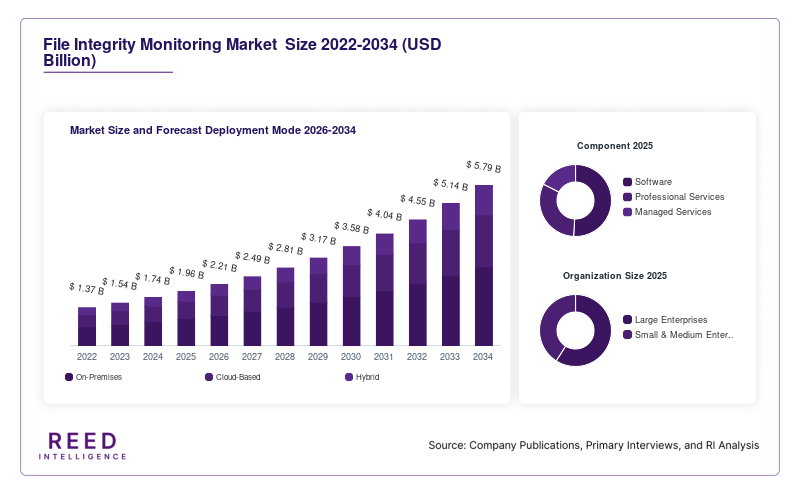
Software Solutions dominated the market with 69.8% share in 2025. Organizations widely adopted software-based monitoring platforms to achieve continuous visibility across enterprise systems, applications, and databases. These solutions provided centralized management capabilities and automated threat detection functionalities.
Managed Services are projected to register the fastest CAGR of 14.7% through 2034. Growing cybersecurity talent shortages and increasing demand for outsourced security operations will encourage enterprises to adopt managed monitoring services. These offerings provide continuous expertise without requiring extensive in-house resources.
By Deployment Mode
The market includes Cloud-Based, On-Premises, and Hybrid Deployment models.
Cloud-Based Solutions accounted for 57.2% market share in 2025. Their scalability, rapid deployment capabilities, centralized visibility, and operational flexibility contributed to widespread adoption among organizations of various sizes.
Hybrid Deployment is anticipated to expand at a 15.1% CAGR during the forecast period. Enterprises managing both on-premises infrastructure and cloud environments will increasingly favor hybrid architectures that provide unified monitoring capabilities across diverse IT ecosystems.
By Enterprise Size
The market is segmented into Large Enterprises and Small & Medium Enterprises (SMEs).
Large Enterprises held 63.5% market share in 2025 due to complex security requirements, extensive IT infrastructures, and greater cybersecurity budgets. Continuous monitoring remained essential for protecting large-scale digital environments.
SMEs are expected to grow at a CAGR of 15.4% through 2034. The increasing availability of affordable cloud-based monitoring platforms and managed services will enable smaller organizations to strengthen cybersecurity capabilities without substantial infrastructure investments.
By Industry Vertical
The market comprises BFSI, Healthcare, Government & Defense, IT & Telecommunications, Retail & E-commerce, Manufacturing, and Others.
BFSI represented 24.9% market share in 2025. Financial institutions require continuous monitoring of sensitive systems and transaction environments to maintain operational integrity and regulatory compliance.
Healthcare is projected to witness the fastest CAGR of 15.2% through 2034. Growing digitization of patient records, connected medical systems, and healthcare applications will increase demand for monitoring technologies capable of protecting sensitive healthcare information and maintaining system integrity.
Regional Analysis
North America
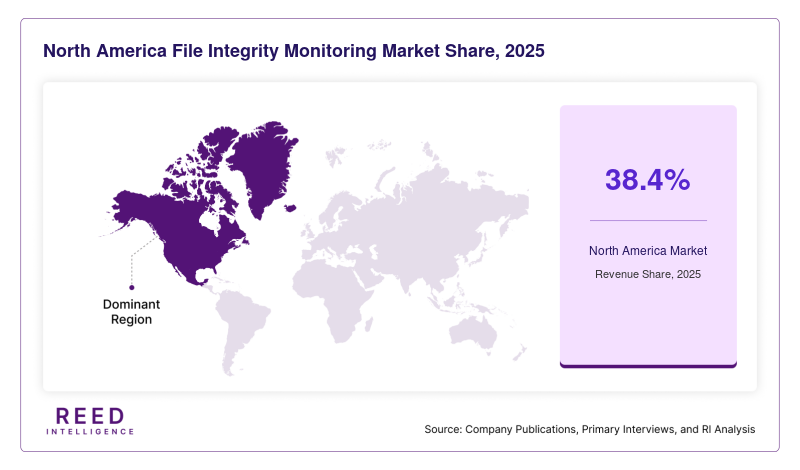
North America accounted for 38.4% of the File Integrity Monitoring Market share in 2025. The region benefited from advanced cybersecurity maturity, strong regulatory enforcement, high technology adoption rates, and substantial enterprise cybersecurity spending. Organizations across multiple sectors prioritized continuous monitoring capabilities to strengthen digital resilience.
The United States dominated the regional market due to extensive adoption of cybersecurity solutions across financial services, healthcare, government, and technology industries. Growing investments in zero-trust architectures and threat detection platforms supported sustained demand. The regional market is expected to grow at a CAGR of 11.9% through 2034.
Europe
Europe represented 27.1% market share in 2025. The region experienced steady growth as organizations strengthened cybersecurity programs to address evolving threat landscapes and regulatory requirements. Demand for compliance-oriented monitoring solutions remained particularly strong.
Germany emerged as the dominant country due to extensive digital transformation initiatives and strong focus on industrial cybersecurity. Enterprises increasingly adopted monitoring platforms to protect critical business systems and maintain compliance with regional regulations. Europe is projected to expand at a CAGR of 12.2% during the forecast period.
Asia Pacific
Asia Pacific captured 22.8% market share in 2025 and is anticipated to record the highest growth rate of 14.5% CAGR during 2026–2034. Rapid digitalization, expanding cloud adoption, and increasing cybersecurity awareness continue to support market growth throughout the region.
China led the regional market due to substantial investments in cybersecurity infrastructure and digital economy development. Large enterprises and government agencies increasingly implemented monitoring technologies to protect expanding digital ecosystems. Rising cybersecurity spending will continue supporting regional market expansion.
Middle East & Africa
The Middle East & Africa accounted for 6.5% market share in 2025. Cybersecurity modernization initiatives, government-led digital transformation programs, and increasing adoption of cloud technologies contributed to market development.
Saudi Arabia remained the dominant country due to large-scale cybersecurity investments associated with economic diversification and smart infrastructure projects. Enhanced focus on protecting critical digital assets accelerated deployment of advanced monitoring platforms. The regional market is forecast to grow at a CAGR of 13.1% through 2034.
Latin America
Latin America held 5.2% market share in 2025. Growing awareness of cyber risks, expanding financial technology ecosystems, and increasing regulatory requirements supported market adoption. Organizations across multiple industries continued investing in security modernization initiatives.
Brazil dominated the regional market due to increasing digital transformation activities and expanding cybersecurity investments. Enterprises sought stronger monitoring capabilities to protect business-critical data and applications. The regional market is expected to register a CAGR of 12.4% during the forecast period.
Competitive Landscape
The File Integrity Monitoring Market remains highly competitive, characterized by continuous innovation, strategic partnerships, cloud platform enhancements, and integration with broader cybersecurity ecosystems. Vendors focus on improving automation, analytics capabilities, compliance management features, and cloud security functionality.
Qualys Inc. maintained a leading market position through its integrated vulnerability management and file integrity monitoring capabilities. The company recently enhanced its cloud-based monitoring platform with advanced automation and risk prioritization features designed to improve threat detection efficiency.
Tripwire, Inc. continued strengthening its enterprise security portfolio through expanded compliance monitoring capabilities and automated configuration management functionality.
ManageEngine focused on enhancing centralized visibility and security operations integration across enterprise environments.
SolarWinds Corporation expanded monitoring capabilities through improved threat intelligence integration and automated alerting systems.
Rapid7, Inc. continued investing in cloud-native security monitoring technologies designed to support evolving enterprise cybersecurity requirements.
Key Players List
- Qualys Inc.
- Tripwire, Inc.
- SolarWinds Corporation
- ManageEngine (Zoho Corporation)
- Rapid7, Inc.
- Broadcom Inc.
- IBM Corporation
- Microsoft Corporation
- CrowdStrike Holdings, Inc.
- Trend Micro Incorporated
- LogRhythm, Inc.
- AT&T Cybersecurity
- Cimcor, Inc.
- Netwrix Corporation
- Paessler AG
Recent Developments
- Qualys expanded automated compliance monitoring and threat detection capabilities within its cloud security platform.
- Tripwire introduced enhanced configuration integrity monitoring features designed for hybrid enterprise environments.
- Rapid7 strengthened integration between file monitoring tools and security operations workflows.
- ManageEngine launched new analytics features to improve investigation and incident response efficiency.
- SolarWinds upgraded monitoring automation functionalities for large-scale enterprise deployments.
- Netwrix expanded auditing and change monitoring capabilities for cloud and on-premises environments.
- Cimcor enhanced real-time alerting technologies to support critical infrastructure cybersecurity programs.
File Integrity Monitoring Market Segments
Deployment Mode
- On-Premises
- Cloud-Based
- Hybrid
Component
- Software
- Professional Services
- Managed Services
Organization Size
- Large Enterprises
- Small & Medium Enterprises (SMEs)
End-Use Industry
- BFSI
- Healthcare
- Government & Defense
- IT & Telecom
- Retail & E-commerce
- Manufacturing
- Energy & Utilities
- Others
Region
- North America
- Europe
- Asia Pacific
- Middle East & Africa
- Latin America
By Region
- North America
- Europe
- APAC
- Middle East and Africa
- LATAM