Film And Video Production Market Size, Share & Trends Analysis Report By Type (Film Production, Video Production, Animation & VFX, Others), By Application (Theatrical, Television & Streaming, Advertising & Commercial, Others) and By Region (North America, Europe, Asia Pacific, Latin America, Middle East & Africa) Forecasts, 2026–2034
USD 3950
Film And Video Production Market Size
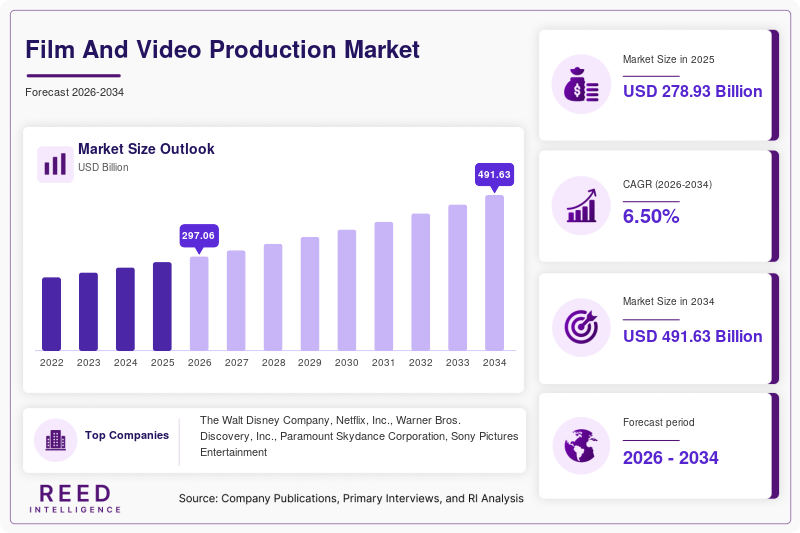
The global film and video production market size was valued at USD 278.93 billion in 2025 and is projected to grow from USD 296.95 billion in 2026 to USD 491.63 billion by 2034, registering a CAGR of 6.50% during the forecast period from 2026 to 2034.
The film and video production market is moving from a predominantly studio-centered production structure toward a distributed global production ecosystem in which studios, streaming platforms, independent producers, broadcasters, advertisers and specialized production-service companies participate in overlapping workflows. Content is increasingly developed for multiple release windows, requiring producers to consider theatrical presentation, streaming delivery, international localization, advertising-supported distribution and downstream licensing during project development.
Streaming remains an important structural force because platforms require a continuing pipeline of original and licensed programming to maintain engagement. Netflix's 2026 global slate, for example, included films, series and nonfiction projects across multiple production markets, demonstrating how international commissioning has become integrated into platform content strategies.
Film And Video Production Market Drivers
Expansion of Streaming-Led Content Commissioning
Streaming platforms have changed production demand by requiring continuous flows of original and acquired programming rather than concentrating expenditure around a limited theatrical release calendar. The model creates recurring requirements for writers, directors, performers, production crews, post-production facilities, localization, VFX and delivery services. Netflix's 2026 programming strategy illustrates this model through simultaneous development of local and international productions.
The mechanism extends beyond the platforms themselves. When commissioning becomes geographically distributed, local production companies can access international projects while studios and service providers develop capabilities closer to talent pools and cost-efficient production centers. This is supporting greater utilization of production facilities and post-production capacity in markets such as India, Spain and other international hubs.
Recovery of Theatrical and Franchise Production
Theatrical production remains commercially important for high-budget franchises because a successful cinema release can establish value across subsequent streaming, licensing, merchandising and international distribution windows. Disney's 2026 theatrical slate demonstrates the continued concentration of studio investment around established intellectual property and large-scale cinematic experiences.
This structure supports demand for high-end cinematography, physical production, animation, sound design, visual effects and post-production. It also encourages studios to prioritize projects capable of supporting differentiated theatrical experiences, while smaller productions increasingly rely on streaming, specialty distribution or hybrid release strategies.
Expansion of Global Production Infrastructure
Production infrastructure is becoming more international as companies seek access to skilled crews, tax incentives, visual-effects capabilities and specialized technology. Netflix's Eyeline Studios in Hyderabad represents a direct investment in production innovation infrastructure, while its Fort Monmouth project in New Jersey involves a planned USD 1 billion development with 12 soundstages totaling nearly 500,000 square feet.
Film And Video Production Market Restraints
High Production Costs and Project Financing Risk
film and video production requires substantial upfront expenditure before commercial returns become visible. Cast, crew, locations, equipment, insurance, sets, post-production and visual effects can create large fixed or semi-fixed commitments. Cost inflation and schedule disruption can therefore materially alter project economics.
The financing challenge is particularly relevant to mid-budget productions that lack established franchises or guaranteed distribution. Studios can prioritize projects with recognizable intellectual property because those projects provide more predictable audience positioning, while independent producers may face tighter financing and distribution conditions. This can reduce diversity in production pipelines even when overall content demand remains substantial.
Fragmented Monetization and Distribution Economics
The proliferation of theatrical, subscription streaming, advertising-supported streaming, television, transactional video and international licensing has expanded distribution options but also increased complexity. Producers must negotiate different rights, windows, territories and revenue structures, while platforms seek greater control over content economics.
The changing economics of major media companies illustrate this tension. Warner Bros. Discovery reported a 26% year-over-year decline in second-quarter 2026 content revenue, primarily associated with lower theatrical revenue in its Studios segment, even as its streaming business continued to grow. The contrast demonstrates that stronger streaming consumption does not automatically translate into uniform improvement across every production-revenue channel.
Film And Video Production Market Opportunities
Production Technology, VFX and Virtual Production
The increasing technical complexity of film and video creates opportunities for VFX, virtual production, real-time rendering, digital environments and advanced post-production workflows. These capabilities can reduce location requirements, support complex visual storytelling and allow production teams to integrate digital environments earlier in the workflow.
Investment in dedicated production-technology infrastructure strengthens this opportunity. Netflix's Hyderabad Eyeline Studios specifically incorporates visual effects, virtual production and next-generation production technology, demonstrating how production infrastructure is expanding beyond conventional soundstages.
Local-Language Production With Global Distribution
Local-language production increasingly serves both domestic audiences and international streaming catalogs. A production originally developed for a regional market can now reach audiences across multiple countries without requiring the same traditional distribution infrastructure.
Netflix's Indian production activity illustrates this mechanism. In August 2026, the company reported that its Operation Safed Sagar production generated more than USD 24 million in economic contribution, involved more than 200 directly hired cast and crew members, over 4,000 daily hires and 15 India-based VFX studios.
Film And Video Production Market Segmental Analysis
By Type
Film Production Is the Largest Segment
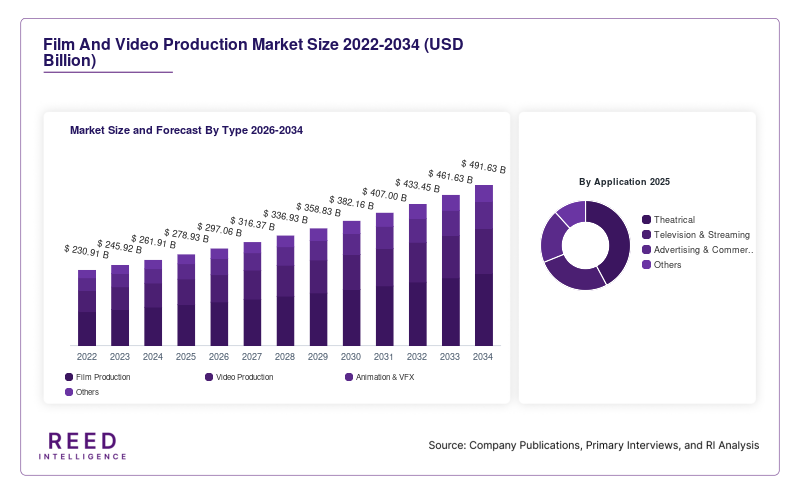
Film Production accounts for approximately 52.0% of the global film and video production market, making it the dominant type segment. Its position is supported by the continuing commercial value of theatrical releases, established studio franchises, international distribution and downstream licensing. Large film projects also generate extensive demand across cinematography, set construction, equipment rental, post-production, VFX and sound services.
The segment nevertheless operates under high financial exposure because individual projects can require substantial capital before release. Studios therefore increasingly use recognizable intellectual property, established franchises and diversified distribution windows to manage project-level uncertainty. Disney's 2026 production slate illustrates the continued importance of franchise and established-property production across theatrical and streaming channels.
Animation & VFX Is Expanding Faster Because Production Complexity Is Increasing
Animation & VFX is projected to record the fastest growth among the major type categories, with a 9.2% CAGR during 2026–2034. Demand is supported by superhero, fantasy, science-fiction, animated and digitally enhanced productions, as well as the growing use of virtual environments.
The segment benefits from the geographic expansion of technical production capacity. Netflix's Hyderabad Eyeline Studios specifically targets animation, visual effects and production innovation, while the company's Indian productions increasingly involve local VFX companies and technical artists.
Video Production represents approximately 28.0% of the market and is projected to grow at a 6.4% CAGR, supported by streaming series, corporate video, digital content and commercial production. Others accounts for approximately 7.0%, with a 4.9% CAGR, reflecting specialized and smaller-scale production categories.
Film And Video Production Market By Application
Television & Streaming Is the Largest Application
Television & Streaming accounts for approximately 44.0% of the market, making it the largest application segment. Continuous programming requirements, international commissioning and expanding streaming catalogs create recurring production demand rather than relying solely on individual theatrical release cycles.
The segment is also the fastest-growing application, with a projected 8.7% CAGR. Streaming platforms increasingly combine original productions with licensed content and local-language programming. Netflix's January 2026 global slate announcement, which included productions across Spain and international markets, demonstrates the breadth of this commissioning model.
Theatrical production represents approximately 31.0% of demand and is projected to grow at a 5.2% CAGR. Advertising & Commercial production accounts for approximately 17.0%, with a 6.0% CAGR, supported by digital advertising and branded video. Other applications account for approximately 8.0%, growing at a 4.5% CAGR.
Film And Video Production Market Regional Analysis
North America Film And Video Production Market
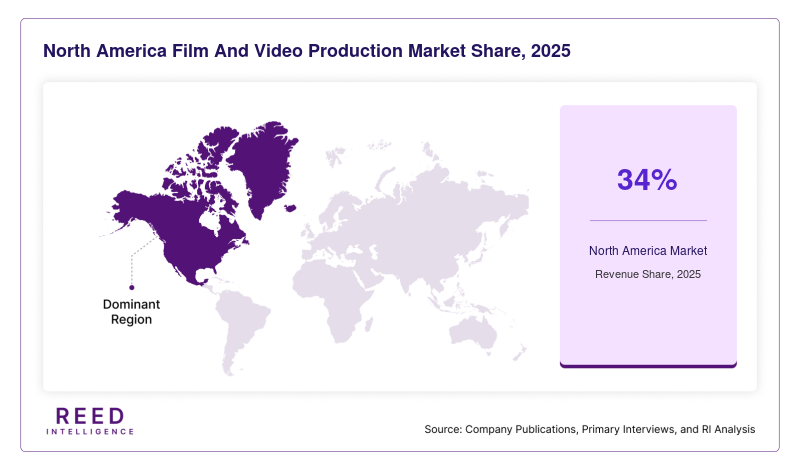
North America is the dominant region, accounting for approximately 34.0% market share. The region benefits from the concentration of major studios, streaming companies, production-service providers, technical infrastructure and established theatrical distribution networks. The United States remains the principal production center, while Canada provides an important production-services ecosystem supported by skilled crews, studio infrastructure and production incentives.
The region's production structure is increasingly influenced by the relationship between theatrical studios and streaming platforms. Disney's continued investment across Disney, Pixar, Marvel, Lucasfilm, Searchlight and 20th Century Studios demonstrates the breadth of production infrastructure available within the region.
Netflix is also expanding physical production infrastructure in the United States, with its Fort Monmouth project representing a planned large-scale studio development.The principal constraints include high labor and production costs, competition for experienced crews and increasing pressure to demonstrate returns from expensive content portfolios.
Europe Film And Video Production Market
Europe is projected to register an 8.1% CAGR during 2026–2034. The region combines established film industries in the United Kingdom, France, Germany, Italy and Spain with an expanding network of production-service markets.
The United Kingdom remains particularly important for high-value international productions. During the first half of 2026, 73 films began shooting in the UK, while inward-investment productions accounted for £905 million, or 88% of total feature-film production expenditure during the period.
Spain and other European markets are also benefiting from international streaming production. Netflix's 2026 Spanish slate included multiple projects in production or post-production, supporting demand for local crews, facilities and post-production services.
Asia Pacific Film And Video Production Market
Asia Pacific is projected to be the fastest-growing regional market, recording a 10.4% CAGR through 2034. Growth is supported by large domestic audiences, expanding streaming penetration, competitive production costs, local-language content and increasingly sophisticated VFX and post-production capabilities.
India is becoming particularly important within the regional production ecosystem. Netflix's March 2026 opening of Eyeline Studios in Hyderabad strengthened the city's role in global animation, VFX and production-technology workflows.
Japan, South Korea, Australia and China contribute through established film and television industries, while Southeast Asian markets are becoming increasingly relevant for regional production and location-based filming. The principal limitation is fragmentation between languages, regulatory frameworks and distribution systems, although streaming platforms can reduce some of these barriers through centralized global distribution.
Middle East and Africa Film And Video Production Market
The Middle East and Africa region is projected to grow at a 9.9% CAGR during 2026–2034. Investment in creative industries, new production facilities, location incentives and international co-productions is expanding the region's role in global production.
The strongest opportunities are concentrated in countries developing dedicated film infrastructure and seeking to attract international productions. Production activity creates demand not only for studios but also for equipment rental, hospitality, transportation, construction, post-production and local creative talent.
The region remains constrained by uneven production infrastructure, limited availability of highly specialized technical personnel in some countries and differences in intellectual-property and investment frameworks. Greater integration with international streaming and studio production networks can reduce these constraints over time.
Latin America Film And Video Production Market
Latin America is projected to expand at a 9.3% CAGR. Mexico, Brazil, Argentina, Colombia and Chile provide established production ecosystems supported by large domestic audiences and increasing demand for Spanish- and Portuguese-language content.
Streaming platforms are particularly important because they can distribute regional productions beyond domestic markets. This creates a commercial mechanism in which local producers can develop stories for domestic audiences while accessing international viewers through platform distribution.
The region's key constraints include currency volatility, financing limitations, infrastructure differences and uneven access to high-end production technology. Continued development of local VFX, post-production and studio capabilities can improve the region's ability to retain more production expenditure domestically.
Competitive Landscape
The film and video production market is characterized by a combination of vertically integrated entertainment groups, streaming platforms, independent production companies and specialized technical-service providers. Competitive differentiation increasingly depends on intellectual-property ownership, production capacity, global distribution, technology infrastructure and the ability to finance projects across multiple release windows.
The Walt Disney Company maintains a broad production portfolio spanning Disney, Pixar, Marvel, Lucasfilm, 20th Century Studios and Searchlight Pictures. Its strategy combines theatrical releases with streaming distribution and extensive downstream monetization. Disney's 2026 theatrical performance and pipeline demonstrate how established intellectual property remains central to large-scale production economics.
Netflix competes through a global commissioning model, localized content production, technology infrastructure and direct access to a large international audience. Its investments in Hyderabad and New Jersey show that production infrastructure is becoming a strategic asset rather than merely an outsourced requirement.
Key Market Players
- The Walt Disney Company
- Netflix, Inc.
- Warner Bros. Discovery, Inc.
- Paramount Skydance Corporation
- Sony Pictures Entertainment
- NBCUniversal
- Amazon MGM Studios
- Lionsgate Studios Corp.
- Sony Pictures Television
- Apple Studios
- A24
- Legendary Entertainment
Recent Market Developments
Netflix Opens Eyeline Studios in Hyderabad March 2026
In March 2026, Netflix opened Eyeline Studios in Hyderabad as a global production and innovation facility focused on animation, visual effects, virtual production and next-generation production technologies. The development strengthens India's integration into Netflix's global production pipeline and expands the company's dedicated technical-production infrastructure.
Disney Expands 2026 Theatrical Production Slate September 2026
In September 2026, Disney reported that Walt Disney Studios had surpassed USD 4 billion in global box-office receipts for the year and highlighted its upcoming slate across Disney Animation, Pixar, Marvel, Searchlight and 20th Century Studios. The development reinforces the continued role of large-scale theatrical production within a broader film-and-streaming portfolio
Film And Video Production Market Segments
By Type
- Film Production
- Video Production
- Animation & VFX
- Others
By Application
- Theatrical
- Television & Streaming
- Advertising & Commercial
- Others
By Region
- North America
- Europe
- APAC
- Middle East and Africa
- LATAM