Filtered Water Faucets & Faucet Systems Market Size, Share & Demand Report By Product Type (Integrated Filtered Faucets, Standalone Filter Faucet Systems, Smart Digital Faucet Systems, Touchless Filtered Faucets), By Filtration Technology (Activated Carbon Filtration, Reverse Osmosis Filtration, Ultraviolet Purification, Ceramic Filtration, Multi-Stage Filtration Systems), By End Use (Residential, Commercial, Industrial), By Distribution Channel (Online Retail, Specialty Stores, Supermarkets and
USD 3950
Market Overview
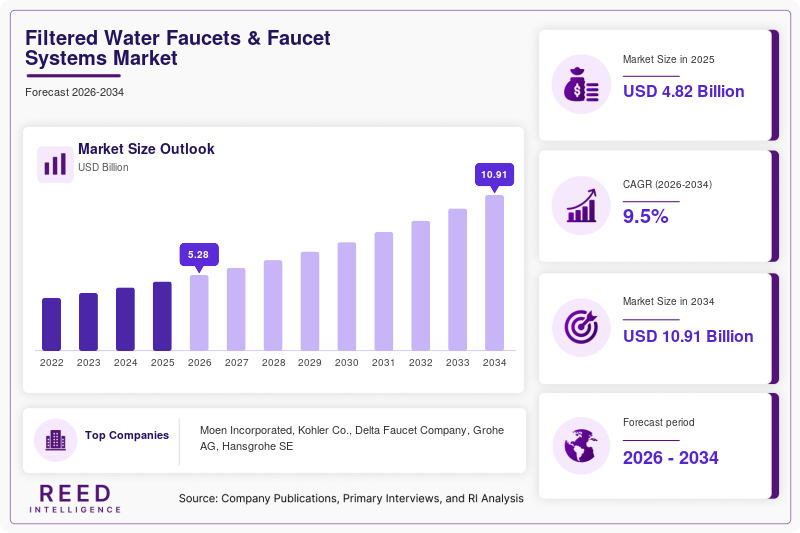
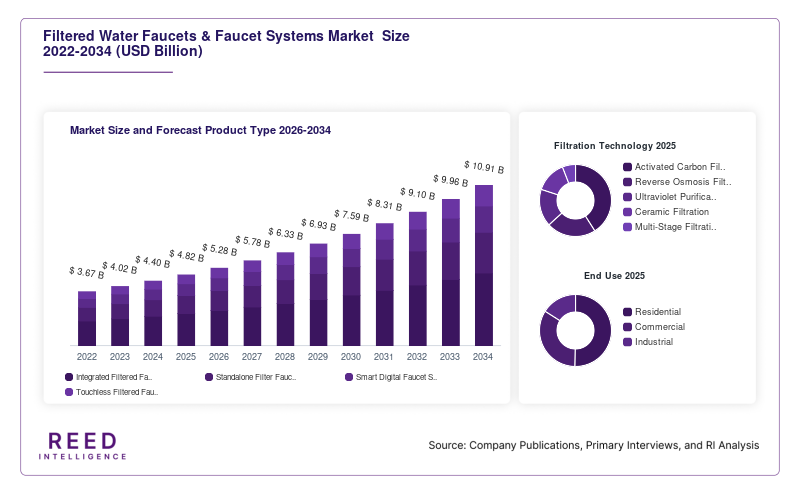
The global Filtered Water Faucets & Faucet Systems Market size was valued at USD 4.82 billion in 2026 and is projected to reach USD 9.94 billion by 2034, expanding at a CAGR of 9.5% during the forecast period from 2026 to 2034. The market is experiencing consistent growth due to rising concerns related to drinking water quality, increasing urbanization, and growing adoption of smart kitchen infrastructure across residential and commercial sectors. Consumers are increasingly investing in advanced faucet filtration systems that improve water purity while reducing dependency on bottled water. Manufacturers are also integrating touchless operation, digital monitoring, and multi-stage filtration technologies into premium faucet systems to improve convenience and water efficiency.
A major global factor supporting market growth is the increasing awareness regarding water contamination caused by industrial discharge, aging pipelines, and microbial pollutants. Governments and environmental organizations across several countries are promoting safe drinking water initiatives, which has increased household spending on point-of-use water purification systems. The growing popularity of eco-conscious lifestyles and sustainability goals has further encouraged the installation of filtered faucet systems in homes, offices, hotels, healthcare facilities, and educational institutions. Demand is also increasing due to rising renovation activities in urban housing projects and the expansion of smart home ecosystems.
Key Highlights
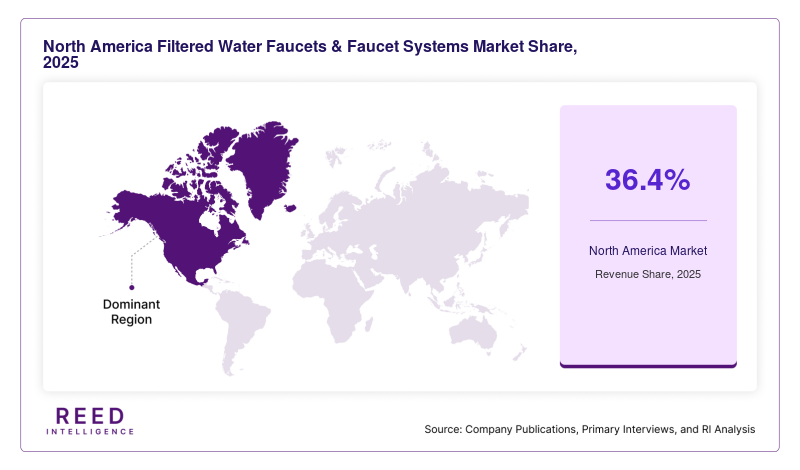
- North America dominated the market with a 36.4% share in 2025, while Asia Pacific is expected to grow at the fastest CAGR of 11.8% during 2026–2034.
- By product type, integrated filtered faucets accounted for the largest share of 42.7%, while smart digital faucet systems are projected to grow at a CAGR of 12.9%.
- By filtration technology, activated carbon filtration led with a 39.6% share, whereas reverse osmosis-based systems are expected to expand at a CAGR of 13.1%.
- By end use, residential applications held a 58.3% share, while commercial installations are projected to grow at a CAGR of 10.7%.
- The United States remained the dominant country, with market values of USD 1.21 billion in 2024 and USD 1.34 billion in 2025.
Market Trends
Rising Integration of Smart and Touchless Water Filtration Faucets
The growing integration of smart technologies into kitchen and bathroom infrastructure is shaping the Filtered Water Faucets & Faucet Systems Market. Consumers are increasingly adopting touchless faucets equipped with motion sensors, temperature indicators, filter replacement alerts, and digital monitoring systems. These advanced systems improve hygiene standards and reduce unnecessary water consumption in residential and commercial settings. Smart faucet systems are gaining traction in developed economies due to the rapid expansion of smart homes and connected appliances. Manufacturers are focusing on app-enabled monitoring functions that allow users to track water quality, filter life, and daily water usage through mobile applications. Hotels, hospitals, and corporate offices are also installing sensor-based filtered faucets to maintain sanitation standards and improve operational efficiency. The trend is expected to accelerate further as consumers prioritize convenience, sustainability, and automation in modern interior infrastructure.
Growing Preference for Sustainable and Bottle-Free Drinking Solutions
Consumers are increasingly shifting toward environmentally sustainable drinking water solutions, which is contributing to the expansion of filtered faucet systems worldwide. Rising concerns regarding plastic waste generated by bottled water consumption have encouraged households and businesses to adopt permanent water filtration installations. Filtered faucets reduce reliance on single-use plastic bottles while providing continuous access to purified water directly from taps. Governments in several countries are also supporting eco-friendly water management initiatives and promoting sustainable household appliances. Manufacturers are introducing recyclable filters and energy-efficient purification systems to align with environmental regulations and consumer preferences. The hospitality sector, educational institutions, and commercial facilities are integrating filtered water stations to reduce operating costs and meet sustainability targets. This trend is expected to strengthen as awareness regarding environmental conservation and circular economy practices continues to increase across urban populations.
Market Drivers
Increasing Concerns Regarding Drinking Water Contamination
The rising incidence of water contamination across urban and semi-urban regions is a major factor driving the growth of the Filtered Water Faucets & Faucet Systems Market. Industrial waste discharge, chemical pollutants, aging municipal pipelines, and microbial contamination have increased consumer concerns regarding the safety of tap water. As a result, households are investing in point-of-use filtration systems that offer immediate access to cleaner drinking water. Several governments and health agencies are conducting awareness campaigns related to waterborne diseases and the long-term health risks associated with contaminated water. Consumers are increasingly seeking advanced filtration technologies capable of removing heavy metals, chlorine, bacteria, and microplastics. The demand is particularly strong in densely populated cities where municipal infrastructure struggles to meet water quality standards. This growing focus on health and preventive household solutions is expected to support market expansion throughout the forecast period.
Expansion of Residential Renovation and Smart Kitchen Projects
The rapid increase in residential renovation projects and smart kitchen installations is contributing significantly to market growth. Urban homeowners are prioritizing premium kitchen upgrades that combine functionality, design, and sustainability. Filtered faucet systems are increasingly being integrated into modular kitchens and luxury housing projects due to their convenience and aesthetic compatibility. Real estate developers are also incorporating built-in filtration faucets into newly constructed apartments and smart homes to improve property value and attract environmentally conscious buyers. In addition, rising disposable income levels in developing economies are encouraging consumers to spend more on advanced kitchen appliances and water-saving technologies. The growing influence of interior design trends and online home improvement platforms has accelerated awareness regarding modern filtration faucet systems. These factors are creating long-term opportunities for manufacturers offering compact, multifunctional, and visually appealing faucet solutions.
Market Restraint
High Installation and Maintenance Costs Limiting Adoption in Price-Sensitive Markets
The relatively high cost associated with advanced filtered faucet systems remains a major restraint for the market, particularly in developing and price-sensitive economies. Premium faucet systems equipped with reverse osmosis technology, smart sensors, and multi-stage filtration units often require significant upfront investment. In addition to installation expenses, consumers must also bear recurring maintenance costs related to filter replacement, servicing, and plumbing modifications. Small households and low-income consumers may prefer traditional water purifiers or bottled water instead of investing in integrated filtration faucets. Commercial establishments operating under strict budget constraints may also delay adoption due to ongoing operational costs. In rural regions, limited awareness regarding long-term health benefits further reduces willingness to purchase advanced filtration systems. The market also faces challenges from counterfeit low-cost products that affect consumer trust and reduce the sales potential of established brands. These cost-related concerns may slow penetration rates in emerging economies despite rising demand for clean drinking water solutions.
Market Opportunities
Rising Demand for Compact Filtration Systems in Urban Apartments
The increasing population density in urban areas is creating strong opportunities for compact and space-efficient filtered faucet systems. Modern apartments and small residential units often have limited kitchen space, encouraging consumers to adopt integrated faucet filtration systems instead of bulky standalone purifiers. Manufacturers are introducing slim and multifunctional faucet designs that combine purification, temperature control, and water-saving features within compact structures. The demand for easy-to-install under-sink filtration systems is also increasing among tenants and urban homeowners seeking convenience and minimal maintenance requirements. Growing urbanization in Asia Pacific, Latin America, and the Middle East is expected to strengthen the need for compact purification infrastructure. Developers of modular housing projects and smart apartments are increasingly partnering with faucet manufacturers to integrate filtration systems during initial construction phases. This shift toward compact living environments is likely to generate substantial growth opportunities across residential applications.
Expansion of Commercial and Hospitality Infrastructure
The expansion of commercial infrastructure and hospitality facilities is expected to create favorable growth opportunities for the Filtered Water Faucets & Faucet Systems Market. Hotels, restaurants, airports, hospitals, and office complexes are increasingly adopting advanced filtered faucet systems to improve hygiene standards and provide safe drinking water to customers and employees. Commercial users are prioritizing touchless and high-capacity filtration solutions that support sustainability goals and reduce bottled water consumption. The hospitality industry is particularly focused on improving guest experience through premium kitchen and bathroom installations. In healthcare facilities, filtered faucet systems help maintain sanitation standards and reduce contamination risks. Rapid investments in tourism infrastructure across emerging economies are supporting demand for advanced water filtration technologies. Manufacturers are also developing commercial-grade faucet systems with enhanced durability, automated maintenance alerts, and high-volume filtration capabilities to meet the operational requirements of large facilities.
Segmental Analysis
By Product Type
Integrated filtered faucets dominated the Filtered Water Faucets & Faucet Systems Market and accounted for 42.7% of the global share in 2024. These systems are widely preferred because they combine filtration functionality directly into standard kitchen or bathroom faucets, eliminating the need for separate purification units. Consumers increasingly favor integrated designs due to their space-saving structure, aesthetic compatibility, and ease of operation. Residential users are particularly adopting these products in modular kitchens and compact apartments where efficient use of space is important. Manufacturers are also focusing on premium stainless steel finishes, flexible spray modes, and ergonomic designs to improve customer appeal. The growing popularity of smart kitchens and modern interior layouts has strengthened demand for integrated filtration faucets across developed and emerging economies. In addition, increasing awareness regarding safe drinking water and convenience continues to support strong adoption rates.
Smart digital faucet systems are projected to register the fastest CAGR of 12.9% during the forecast period. These advanced systems include digital displays, touchless activation, app connectivity, and automatic filter monitoring functions that improve user convenience and operational efficiency. Commercial establishments such as hotels, hospitals, and office buildings are increasingly adopting smart faucet systems to maintain hygiene standards and optimize water usage. Consumers are also showing strong interest in connected appliances that integrate with broader smart home ecosystems. Manufacturers are introducing voice-controlled faucet systems and sensor-based purification technologies to attract technology-oriented buyers. The growing penetration of the Internet of Things and increasing investments in home automation infrastructure are expected to accelerate adoption. Rising consumer preference for premium and technologically advanced household appliances will further support long-term segment growth.
By Filtration Technology
Activated carbon filtration systems accounted for the largest market share of 39.6% in 2024 due to their cost-effectiveness and ability to improve water taste and odor. These systems are widely used in residential faucet installations because they efficiently remove chlorine, volatile organic compounds, and certain contaminants without requiring high maintenance costs. Consumers prefer activated carbon filters because they are relatively affordable and compatible with various faucet designs. Manufacturers are increasingly introducing multi-layer carbon filtration cartridges with enhanced absorption capacity to improve purification performance. Demand is also supported by rising awareness regarding chemical contaminants in municipal water supplies. In commercial settings, activated carbon systems are frequently installed in restaurants and hospitality facilities to improve beverage and food preparation quality. Their ease of replacement and widespread retail availability continue to strengthen their market position.
Reverse osmosis-based systems are anticipated to grow at the fastest CAGR of 13.1% during the forecast period. These systems are gaining popularity because they provide advanced purification by removing dissolved solids, heavy metals, bacteria, and other microscopic contaminants. Rising consumer concerns regarding industrial pollution and waterborne diseases are encouraging households to invest in high-efficiency filtration technologies. Reverse osmosis faucet systems are increasingly being integrated into premium residential kitchens and healthcare facilities where water purity standards are particularly important. Manufacturers are developing compact under-sink reverse osmosis systems with faster filtration speed and lower water wastage to improve product adoption. In addition, growing demand for ultra-pure drinking water in urban regions with poor municipal water quality is expected to support rapid segment expansion over the coming years.
By End Use
Residential applications held the dominant share of 58.3% in 2024 due to increasing household awareness regarding clean drinking water and growing investment in kitchen improvement projects. Consumers are increasingly replacing conventional faucets with filtered systems that provide convenient access to purified water while reducing bottled water expenses. Rising urbanization and the expansion of apartment housing have contributed significantly to the demand for compact and integrated faucet filtration products. Manufacturers are offering a wide range of aesthetically appealing faucet systems designed specifically for residential kitchens and bathrooms. E-commerce channels and home improvement retailers have also improved product accessibility and consumer awareness. The growing popularity of sustainable living practices and concerns regarding waterborne contaminants continue to encourage households to adopt advanced filtration technologies across developed and developing economies.
Commercial applications are projected to expand at the fastest CAGR of 10.7% during the forecast period due to increasing installations across hotels, restaurants, offices, airports, and healthcare facilities. Businesses are investing in filtered faucet systems to improve hygiene standards, enhance customer experience, and reduce operational costs associated with bottled water procurement. The hospitality sector is witnessing particularly strong demand for premium touchless faucet systems equipped with advanced filtration technologies. Healthcare institutions are also adopting filtered faucets to maintain sanitation standards and minimize contamination risks. Manufacturers are introducing heavy-duty commercial faucet systems capable of handling high-volume water usage and continuous operation. Rising corporate sustainability initiatives and stricter public health regulations are expected to further strengthen adoption across commercial environments throughout the forecast timeline.
Regional Analysis
North America
North America accounted for 36.4% of the global Filtered Water Faucets & Faucet Systems Market share in 2025 and is expected to maintain a stable growth trajectory during the forecast period. The regional market is projected to expand at a CAGR of 8.7% from 2026 to 2034 due to strong consumer awareness regarding water quality and increasing adoption of smart home technologies. The presence of advanced residential infrastructure and high spending on kitchen remodeling projects are supporting demand for premium faucet systems. Consumers in the region are also increasingly choosing eco-friendly filtration solutions that reduce dependence on bottled water.
The United States remained the dominant country within the regional market due to high household penetration of water filtration appliances and strong distribution networks. Rising concerns regarding lead contamination and aging water infrastructure have encouraged consumers to install point-of-use filtration faucets in residential and commercial buildings. The country is also witnessing increased demand for touchless faucet systems across healthcare facilities, restaurants, and educational institutions. Major manufacturers continue to introduce digitally connected faucet systems with enhanced filtration efficiency and app-based monitoring features.
Europe
Europe represented 27.1% of the global market share in 2025 and is anticipated to register a CAGR of 8.9% during the forecast period. Demand across the region is supported by stringent environmental regulations, rising sustainability awareness, and increasing preference for energy-efficient household products. Consumers in countries such as Germany, France, and the United Kingdom are adopting advanced filtered faucet systems to improve water quality while reducing plastic bottle usage. The market is also benefiting from rising investments in smart residential infrastructure and premium kitchen renovation projects.
Germany emerged as the dominant country in Europe due to strong consumer preference for technologically advanced and environmentally responsible household appliances. The country has witnessed significant adoption of integrated filtration systems in urban residential complexes and commercial facilities. Manufacturers are increasingly introducing recyclable filter cartridges and water-efficient faucet technologies to comply with regional sustainability standards. The growing popularity of modern kitchen aesthetics and high-quality plumbing fixtures is further strengthening product demand across the German market.
Asia Pacific
Asia Pacific held 22.5% of the global Filtered Water Faucets & Faucet Systems Market share in 2025 and is projected to grow at the fastest CAGR of 11.8% during the forecast period. Rapid urbanization, rising disposable income levels, and increasing concerns regarding water contamination are driving regional demand. Countries across the region are experiencing rapid growth in residential construction and infrastructure modernization, which is creating favorable conditions for faucet system installations. Consumers are also becoming more aware of waterborne diseases and the health benefits associated with advanced purification technologies.
China dominated the regional market due to its large urban population and expanding middle-class consumer base. The country has experienced increasing demand for smart kitchen appliances and integrated water filtration solutions in both residential and commercial applications. Government initiatives focused on improving drinking water quality and urban sanitation standards have further accelerated product adoption. Domestic manufacturers are investing heavily in advanced filtration technologies and cost-effective smart faucet systems to strengthen their competitive presence in the regional market.
Middle East & Africa
The Middle East & Africa accounted for 7.1% of the global market share in 2025 and is expected to grow at a CAGR of 9.3% from 2026 to 2034. Demand in the region is supported by increasing investments in hospitality infrastructure, urban housing projects, and commercial development. Water scarcity concerns and desalination dependency have encouraged consumers and businesses to adopt filtration technologies that improve drinking water quality. Governments across Gulf countries are also supporting smart infrastructure initiatives that include water-efficient appliances and advanced plumbing systems.
Saudi Arabia emerged as the dominant country in the regional market due to rapid urban expansion and rising investment in premium residential and hospitality projects. Hotels, healthcare facilities, and luxury apartments are increasingly installing advanced filtered faucet systems to meet hygiene standards and improve customer experience. The country is also witnessing growing demand for water-saving fixtures as part of sustainability initiatives aligned with long-term economic diversification strategies. These factors are expected to support continued market growth throughout the forecast period.
Latin America
Latin America captured 6.9% of the global Filtered Water Faucets & Faucet Systems Market share in 2025 and is forecast to expand at a CAGR of 9.1% during the study period. The regional market is benefiting from increasing urban population growth, rising awareness regarding safe drinking water, and expanding middle-income consumer groups. Residential consumers are increasingly adopting faucet filtration systems as concerns regarding municipal water quality continue to rise. Commercial establishments are also investing in filtration infrastructure to improve hygiene and operational sustainability.
Brazil remained the dominant country within the Latin American market due to growing demand for affordable water purification technologies in urban centers. Rapid expansion of residential construction activities and renovation projects is supporting product adoption across households and apartment complexes. Consumers are increasingly preferring compact filtration faucets that reduce maintenance costs and improve water accessibility. Local distributors and international brands are strengthening retail availability through e-commerce platforms and home improvement chains, further contributing to regional market expansion.
Competitive Landscape
The Filtered Water Faucets & Faucet Systems Market is moderately competitive, with international manufacturers focusing on product innovation, smart technology integration, and strategic distribution expansion to strengthen their market positions. Companies are investing heavily in research and development activities to improve filtration efficiency, water conservation capabilities, and user convenience. The market is also witnessing increasing partnerships between faucet manufacturers and smart home technology providers to introduce connected filtration systems with app-based monitoring and automation functions.
Moen Incorporated remains one of the leading companies in the market due to its extensive product portfolio, strong retail presence, and continuous innovation in smart faucet systems. The company recently introduced an advanced touchless filtered faucet series integrated with digital water usage tracking and voice-control compatibility. Other major players are also focusing on expanding manufacturing capabilities and strengthening online distribution channels to reach a wider customer base. Competition is further intensifying as regional manufacturers introduce affordable filtration faucet systems designed specifically for emerging economies.
Key Players
- Moen Incorporated
- Kohler Co.
- Delta Faucet Company
- Grohe AG
- Hansgrohe SE
- Franke Holding AG
- A. O. Smith Corporation
- Culligan International Company
- Brita GmbH
- Elkay Manufacturing Company
- Panasonic Corporation
- 3M Company
- TOTO Ltd.
- Puronics Inc.
- Waterdrop Inc.
Recent Developments
- In February 2026, Moen Incorporated launched a new AI-enabled smart filtered faucet system featuring real-time water quality monitoring and predictive filter replacement notifications.
- In September 2025, Kohler Co. expanded its manufacturing operations in Southeast Asia to support rising demand for integrated kitchen filtration faucets across emerging markets.
- In June 2025, Delta Faucet Company introduced a touchless commercial faucet range with multi-stage filtration technology designed for hospitality and healthcare applications.
- In January 2026, A. O. Smith Corporation partnered with a smart home technology provider to integrate app-controlled filtration management into premium residential faucet systems.
- In November 2025, Grohe AG launched a sustainable faucet filtration series manufactured using recycled materials and water-saving flow control technology.
Filtered Water Faucets & Faucet Systems Market Segments
Product Type
- Integrated Filtered Faucets
- Standalone Filter Faucet Systems
- Smart Digital Faucet Systems
- Touchless Filtered Faucets
Filtration Technology
- Activated Carbon Filtration
- Reverse Osmosis Filtration
- Ultraviolet Purification
- Ceramic Filtration
- Multi-Stage Filtration Systems
End Use
- Residential
- Commercial
- Industrial
By Region
- North America
- Europe
- APAC
- Middle East and Africa
- LATAM