Financial Accounting Advisory Services Market Size, Share & Trends Analysis Report By Service Type (Financial Reporting & Technical Accounting, Transaction Accounting & M&A Advisory, Finance Transformation & Managed Accounting, Regulatory & Compliance Advisory, Other Services), By Enterprise Size (Large Enterprises, Small & Medium Enterprises), By Industry Vertical (BFSI, Technology & Telecommunications, Healthcare & Life Sciences, Manufacturing, Energy & Utilities, Consumer & Retail, Others) an
USD 3950
Financial Accounting Advisory Services Market Size
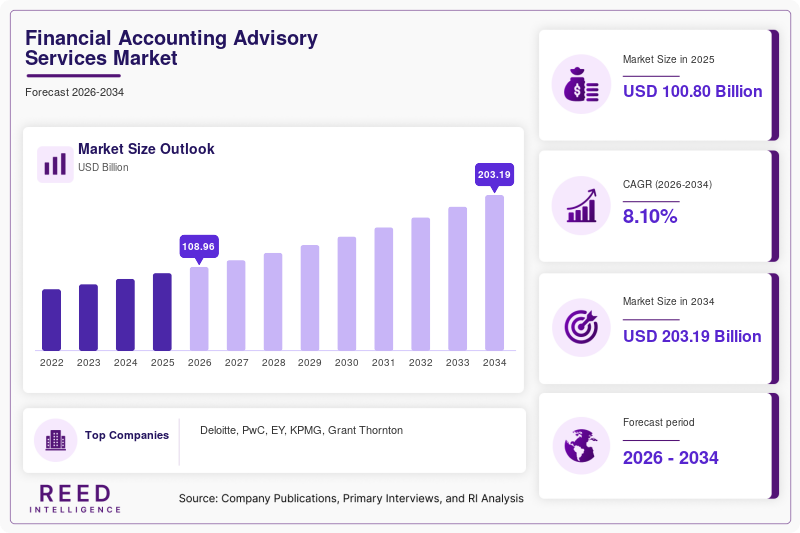
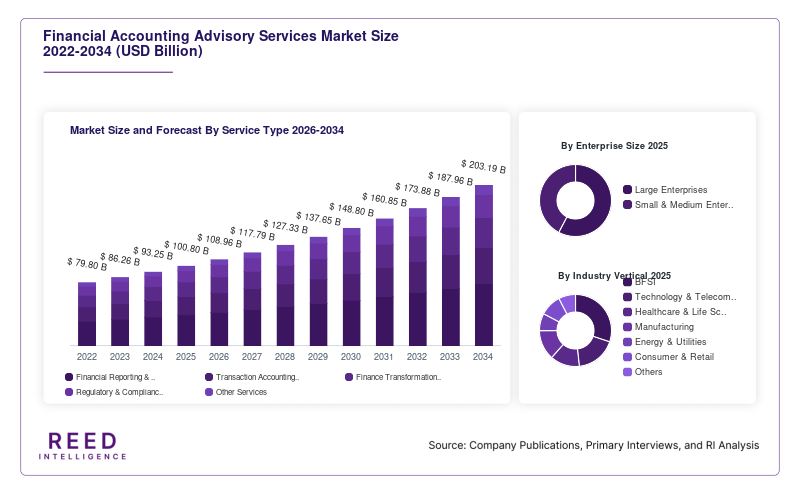
The global financial accounting advisory services market is valued at USD 100.80 Billion in 2025 and USD 108.96 Billion in 2026. The market is projected to reach USD 203.19 Billion by 2034, registering a 8.10% CAGR during the forecast period.
The financial accounting advisory services market is expanding as companies face increasingly complex reporting requirements, sophisticated transactions, technology-driven finance transformation and shortages of experienced accounting talent. Financial accounting advisory services typically support organizations with technical accounting, financial reporting, transaction accounting, IPO and capital-markets readiness, accounting-policy development, finance transformation, reporting processes, controls and specialized managed services.
Major professional-services firms now position accounting advisory as a broader finance-function offering rather than a narrow technical-accounting service. EY's Financial Accounting Advisory Services practice covers transaction accounting, IPOs and capital markets, treasury and finance specialisms, financial applications and analytics, enhanced corporate reporting and managed financial-accounting services.
Financial Accounting Advisory Services Market Drivers
Accounting complexity is increasing the demand for specialized advisory expertise
Organizations are dealing with more complicated transactions, multinational structures, changing accounting requirements and increasingly detailed disclosure obligations. KPMG notes that businesses face greater complexity from transactions and ongoing changes in accounting standards and regulatory frameworks, while Deloitte highlights the need for support with accounting standards implementation, policy design, technical accounting issues and financial-reporting processes.
This complexity creates recurring demand for external specialists because internal finance teams may not maintain deep expertise across every accounting framework, transaction structure or industry-specific issue.
The result is a shift from occasional consulting toward targeted advisory support for areas such as revenue recognition, business combinations, impairment, lease accounting, financial instruments, consolidation, foreign-GAAP conversions and emerging disclosure requirements.
M&A, IPOs and corporate restructuring are increasing transaction-accounting demand
Transaction activity creates an immediate requirement for accounting analysis and reporting readiness. Businesses involved in acquisitions, divestitures, IPOs, cross-border transactions and restructurings often need assistance with purchase accounting, opening balance sheets, carve-out financial statements, pro forma information, accounting policies and post-deal integration.
KPMG's accounting advisory practice specifically includes transaction-related accounting, disclosure, valuation, integration and separation support. Deloitte similarly combines deal advisory with transaction execution, accounting, reporting and integration.
PwC's CMAAS practice also identifies IPOs, M&A, divestitures and accounting-change events as core situations where specialist support is required.
The commercial impact is that every major capital event can produce multiple advisory opportunities across the transaction lifecycle, strengthening the recurring demand base for accounting specialists.
Finance transformation and AI are expanding the scope of accounting advisory
Finance organizations are moving beyond basic compliance toward real-time reporting, continuous close, predictive analytics and automated workflows. EY identifies AI, new skills and strategic agility as major themes in finance transformation and describes continuous close as a pathway to faster reporting and more informed decision-making.
PwC similarly identifies agentic AI as a potential driver of changes in forecasting, reporting, procurement, payments, treasury, tax and accounting-close activities.This creates demand for advisers capable of combining accounting knowledge with data, ERP, controls and automation expertise.
Financial Accounting Advisory Services Market Restraints
Shortages of experienced accounting and finance professionals can constrain delivery capacity
Financial accounting advisory requires professionals with specialized knowledge of accounting standards, transaction structures, financial reporting, controls and industry-specific issues. At the same time, finance functions are facing talent shortages and increasing pressure to deliver more strategic output.
EY's 2026 finance-transformation research identifies talent shortages alongside AI adoption and rising complexity as major issues facing chief accounting officers and controllers.
The constraint is particularly significant for fast-growing advisory practices because demand can increase more quickly than firms can recruit, train and retain professionals with specialized accounting knowledge.
Data quality, systems fragmentation and AI governance complicate finance transformation
Automation can increase efficiency, but transformation projects depend on reliable underlying data, integrated systems and effective controls. Grant Thornton notes that AI adoption in accounting and financial reporting changes risk from manual execution toward model design, data integrity, interpretability and system oversight.
BDO likewise notes that organizations are increasingly applying AI to journal entries, estimates, financial close and regulatory reporting while developing governance frameworks and controls to address AI-specific risks.
This means advisory firms increasingly need to address accounting, technology, data and control risks simultaneously, which can raise project complexity and implementation costs.
Financial Accounting Advisory Services Market Opportunities
Agentic AI can create a new generation of accounting-advisory services
AI is moving from isolated automation tools toward broader finance workflows. PwC and OpenAI announced an expanded collaboration in May 2026 to develop an AI-native finance function covering planning, forecasting, reporting, procurement, payments, treasury, tax and the accounting close.
KPMG has also developed an AI Accounting Analysis Platform for Disaggregation of Income Statement Expenses, using AI and accounting expertise to help companies analyze reporting requirements and plan implementation activities.
The opportunity extends to continuous close, automated reconciliations, technical-accounting research, disclosure preparation, transaction accounting, controls testing and financial-reporting analytics. Advisory firms that combine AI with human review can potentially expand recurring service models while preserving specialist judgment.
Managed accounting and finance-as-a-service models can increase recurring revenue
Companies increasingly seek external support not only for isolated technical questions but also for ongoing finance processes. EY's managed financial accounting and expanded corporate reporting offering combines specialist talent, technology and global delivery capabilities to support finance functions on an ongoing basis.
KPMG's 2026 professional-services analysis also identifies continued interest in outsourced accounting, bookkeeping, reporting and CFO-advisory services, particularly as businesses seek efficiency and address accounting-talent shortages.
This creates an opportunity for accounting advisory providers to build recurring managed-service relationships covering close support, reporting, accounting policy maintenance, controls, consolidation and regulatory reporting.
Service Type Analysis
Financial Reporting & Technical Accounting holds the dominant service share
financial reporting & Technical Accounting represents the largest service category because organizations require continuous support with accounting policies, complex reporting judgments, new standards, disclosure requirements, GAAP conversions and financial-statement preparation.
The Financial Reporting & Technical Accounting segment accounts for 31% of the global market in 2026, making it the dominant service category.
Deloitte, EY, KPMG and Grant Thornton all position technical accounting, financial reporting and standards implementation as core components of their advisory offerings.
Transaction Accounting & M&A Advisory remains a major source of project demand
Transaction accounting & M&A advisory covers purchase accounting, carve-outs, acquisition accounting, IPO readiness, transaction reporting, separation accounting and post-deal financial integration.
The segment is supported by continued M&A activity and increasing transaction complexity. Deloitte's transaction-advisory model explicitly combines accounting and reporting with acquisition and divestiture execution, while KPMG provides accounting, valuation, integration and separation expertise around transactions.
Regional Analysis
North America Financial Accounting Advisory Services
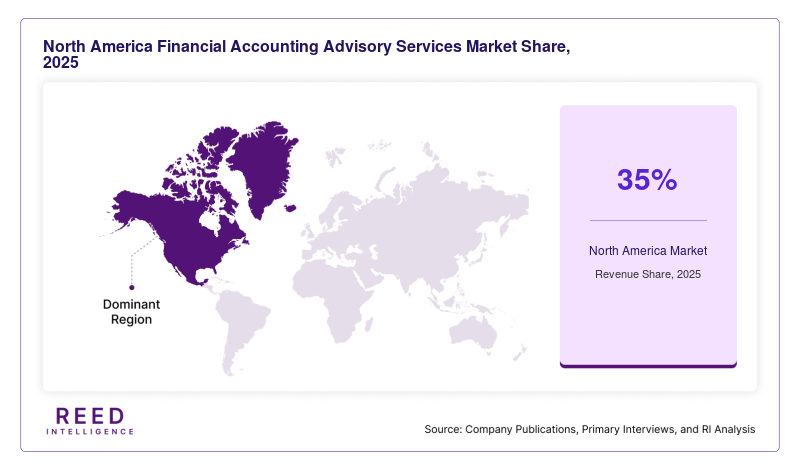
North America represents the dominant regional market due to its large population of publicly listed companies, sophisticated capital markets, extensive M&A activity and high concentration of global professional-services firms.
The North America region accounts for 35% of the global market in 2026, making it the dominant regional market.
The region also has a mature ecosystem for technical accounting, IPO advisory, transaction accounting, finance transformation and outsourced accounting. Deloitte, PwC, EY, KPMG, Grant Thornton and BDO all maintain extensive accounting and financial-reporting advisory capabilities across the region.
Europe Financial Accounting Advisory Services
Europe has a substantial market for accounting advisory because multinational companies operate under IFRS and multiple national reporting requirements, while cross-border M&A and regulatory changes create ongoing demand for technical expertise.
The regional market is supported by IFRS conversions, cross-border transactions, IPOs, finance transformation and reporting-governance projects. KPMG's European Accounting Advisory practice, for example, includes IFRS transitions, IPO support, M&A, cross-border transactions and financial-reporting process improvements.
APAC Financial Accounting Advisory Services
APAC is becoming the fastest-growing regional market as multinational investment, IPO activity, technology adoption and finance transformation expand across China, India, Southeast Asia, Japan, South Korea and Australia.
The APAC region is projected to register a 9.20% CAGR, making it the fastest-growing regional market.
The expansion of digital finance, cross-border investment and growing technology-sector activity supports increasing demand for accounting standards, transaction accounting, reporting transformation and managed finance services.
Middle East and Africa Financial Accounting Advisory Services
The Middle East and Africa market is supported by economic diversification, infrastructure investment, cross-border transactions, capital-market development and increasing adoption of international reporting practices.
Demand is particularly relevant in markets undertaking large-scale investment programs, corporate restructurings, privatizations and finance transformations.
Regional advisory teams increasingly combine technical accounting with transaction, valuation, regulatory and finance-transformation capabilities.
LATAM Financial Accounting Advisory Services
LATAM is developing as companies increasingly adopt international reporting standards, undertake cross-border transactions and modernize finance functions.
The region presents opportunities in IFRS advisory, transaction accounting, reporting transformation, financial controls and finance outsourcing, particularly among multinational companies and rapidly growing enterprises.
Competitive Landscape
The Financial Accounting Advisory Services Market is highly competitive and concentrated around global professional-services networks, major accounting firms, specialist advisory companies and expanding technology-enabled finance providers.
Deloitte provides accounting advisory across technical accounting, standards implementation, reporting, restatement remediation, GAAP conversions and capital-markets transactions. Its broader transaction platform connects accounting and reporting with acquisitions, divestitures and integration.
EY operates one of the broadest FAAS platforms, covering transaction accounting, IPOs, capital markets, finance optimization, corporate reporting, analytics and managed financial accounting services. Its recent finance-transformation work emphasizes continuous close, AI and modern finance operating models.
Key Market Players
- Deloitte
- PwC
- EY
- KPMG
- Grant Thornton
- BDO
- RSM
- Forvis Mazars
- Crowe
- Alvarez & Marsal
- FTI Consulting
- Protiviti
- Baker Tilly
- HLB International
- CLA
Recent Developments
August 2026 – Deloitte expanded its AI Controls and Assurance capabilities. Deloitte announced an expanded suite of AI Controls and Assurance services designed to help organizations govern AI across the enterprise, including advisory and assurance support throughout the AI lifecycle. The offering specifically addresses AI governance, controls, risk management and processes where AI affects financial reporting and operational integrity.
August 2026 – PwC highlighted the development of an agentic finance operating model. PwC's August 2026 finance outlook described a model in which autonomous AI increasingly supports core finance cycles while finance professionals retain oversight, interpretation, judgment and strategic decision-making. Source: PwC, August 27, 2026.
Financial Accounting Advisory Services Market Segments
By Service Type
- Financial Reporting & Technical Accounting
- Transaction Accounting & M&A Advisory
- Finance Transformation & Managed Accounting
- Regulatory & Compliance Advisory
- Other Services
By Enterprise Size
- Large Enterprises
- Small & Medium Enterprises
By Industry Vertical
- BFSI
- Technology & Telecommunications
- Healthcare & Life Sciences
- Manufacturing
- Energy & Utilities
- Consumer & Retail
- Others
By Region
- North America
- Europe
- APAC
- Middle East and Africa
- LATAM