Financial Data Services Market Size, Share, Demand Report By Data Type (Market Data Services, Alternative Data Services, Reference Data Services), By Application (Investment Management, Risk Analytics, Trading & Execution Systems), By End Use (Banking Institutions, Asset Management Firms, Fintech Companies, Insurance Providers, Corporate Enterprises), By Regional Outlook & Segment Forecasts, 2026–2034
USD 3950
Market Overview
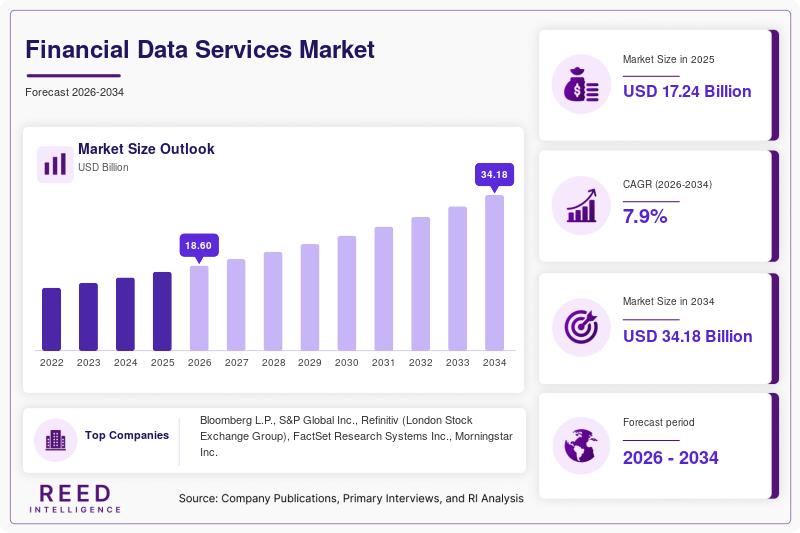
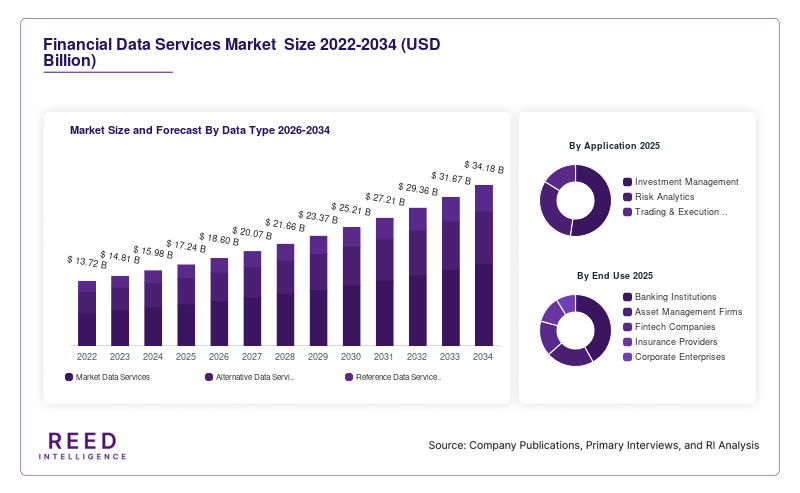
The Financial Data Services Market size is witnessing steady expansion driven by the increasing reliance of financial institutions, fintech companies, and enterprise users on real-time, accurate, and structured financial intelligence. In 2026, the global market size is estimated at USD 18.6 billion, and it is projected to reach approximately USD 34.2 billion by 2034, registering a CAGR of 7.9% during the forecast period. The growth trajectory reflects rising demand for data-driven decision-making across banking, investment management, insurance, and capital markets, where timely insights into market movements and risk exposure have become essential for operational efficiency and regulatory compliance.
One of the primary global factors supporting market growth is the accelerated digital transformation of financial ecosystems. The shift toward cloud-based analytics platforms, API-driven data distribution, and AI-enabled financial modeling has significantly improved the accessibility and usability of financial data services. Institutions are increasingly integrating advanced data aggregation tools to manage structured and unstructured datasets, enhancing forecasting accuracy and investment strategies. Additionally, regulatory frameworks emphasizing transparency and risk monitoring have further strengthened the adoption of standardized financial data solutions across developed and emerging economies.
Key Highlights
- North America dominated the market with a 34.2% share in 2025, while Asia Pacific is expected to grow at the fastest CAGR of 11.2% during 2026–2034.
- By data type, market data services accounted for the largest share of 39.6%, while alternative data services are projected to grow at a CAGR of 13.1%.
- By application, investment management led with a 42.3% share, whereas risk analytics is expected to expand at a CAGR of 12.5%.
- The United States remained the dominant country, with market values of USD 5.8 billion in 2024 and USD 6.4 billion in 2025.
Market Trends
Expansion of Real-Time Financial Data Ecosystems
The Financial Data Services Market is experiencing a strong shift toward real-time data ecosystems, where financial institutions rely on continuous data feeds to support trading decisions, portfolio management, and risk assessment. This trend is driven by the increasing volatility of global financial markets and the need for immediate insights into price movements, macroeconomic indicators, and geopolitical developments. Real-time APIs and streaming data platforms are replacing traditional end-of-day reporting systems, enabling firms to respond more efficiently to market changes. Cloud-native architectures and low-latency infrastructure are further enhancing the scalability and speed of financial data delivery across global markets.
Another important dimension of this trend is the integration of real-time analytics with artificial intelligence and machine learning models. Financial institutions are deploying predictive algorithms that process live data streams to identify anomalies, forecast market movements, and optimize trading strategies. This has led to increased adoption of high-frequency trading platforms and algorithmic investment systems. The demand for real-time data is also expanding beyond capital markets into areas such as insurance underwriting and credit scoring, where instant data validation improves decision accuracy and reduces operational risks.
Growth of Alternative Data Integration in Financial Analytics
The increasing use of alternative data sources such as social media sentiment, satellite imagery, web traffic analytics, and consumer behavior datasets is reshaping the Financial Data Services Market. Organizations are leveraging these unconventional datasets to gain deeper insights into market trends and consumer activity that traditional financial indicators may not capture. This trend is particularly strong among hedge funds, asset managers, and fintech startups seeking competitive advantages through differentiated data inputs. The growing availability of structured APIs and data marketplaces has made alternative data more accessible and scalable.
Additionally, advancements in natural language processing and big data analytics are enabling firms to extract meaningful insights from unstructured datasets. Financial institutions are combining traditional financial metrics with alternative indicators to improve predictive accuracy and enhance portfolio diversification strategies. This integration is also supporting more sophisticated risk modeling frameworks, where behavioral and macro-level signals are incorporated into financial decision-making processes. As regulatory acceptance of alternative data increases, its role in shaping financial intelligence ecosystems is expected to expand further.
Market Drivers
Increasing Demand for Data-Driven Investment Strategies
The Financial Data Services Market is significantly driven by the rising adoption of data-driven investment strategies across institutional and retail investors. Market participants are increasingly relying on advanced analytics platforms to process large volumes of financial information and generate actionable insights. This shift is particularly evident in asset management firms and hedge funds that require accurate, timely, and granular data to optimize portfolio performance. The integration of financial data services with predictive analytics and machine learning tools enables better asset allocation, risk assessment, and return optimization across diverse market conditions.
Furthermore, the expansion of digital trading platforms and robo-advisory services has amplified the need for structured financial datasets. Investors now expect real-time access to market indicators, historical performance metrics, and macroeconomic data to support automated decision-making systems. This demand is also supported by increasing financial literacy and accessibility of investment tools, which is encouraging broader participation in capital markets. As a result, financial data services are becoming a core component of modern investment infrastructure.
Expansion of Regulatory Compliance and Risk Management Requirements
Another major driver of the Financial Data Services Market is the growing emphasis on regulatory compliance and risk management across global financial systems. Regulatory authorities are enforcing stricter reporting standards, requiring financial institutions to maintain transparent and accurate data records. This has led to increased adoption of financial data services that enable real-time compliance monitoring, audit trails, and standardized reporting frameworks. Institutions are leveraging these services to ensure adherence to regulations such as Basel III, MiFID II, and other regional financial governance policies.
In addition, the rising complexity of financial instruments and cross-border transactions has intensified the need for advanced risk analytics. Financial data services provide institutions with tools to assess credit risk, market risk, and operational risk more effectively. By integrating centralized data platforms, organizations can improve risk visibility and reduce exposure to financial volatility. This has become especially important for global banks and insurance companies operating in highly regulated environments, where compliance failures can result in significant financial penalties and reputational damage.
Market Restraint
Data Privacy Concerns and Integration Complexity
One of the major restraints impacting the Financial Data Services Market is the growing concern surrounding data privacy and the complexity of integrating diverse financial datasets. As financial institutions increasingly rely on third-party data providers and cloud-based platforms, ensuring data security and compliance with privacy regulations has become more challenging. Regulations such as GDPR and other regional data protection laws impose strict guidelines on how financial data can be collected, stored, and processed. This creates operational challenges for organizations attempting to integrate multiple data sources into unified analytics platforms.
Moreover, the integration of legacy financial systems with modern data infrastructure remains a significant barrier. Many traditional financial institutions still operate on outdated systems that are not fully compatible with advanced data analytics tools. This results in high implementation costs, longer deployment cycles, and increased technical complexity. The lack of standardized data formats across providers further complicates interoperability, limiting the seamless exchange of financial information across platforms and regions. These challenges collectively slow down the adoption rate of advanced financial data services.
Market Opportunities
Expansion of Cloud-Based Financial Data Platforms
The transition toward cloud-based infrastructure presents a significant opportunity for the Financial Data Services Market. Cloud platforms enable financial institutions to scale their data operations efficiently while reducing infrastructure costs. These platforms offer enhanced flexibility, allowing organizations to access real-time financial data from multiple sources without the limitations of on-premise systems. The adoption of hybrid and multi-cloud strategies is further supporting the development of resilient and scalable financial data ecosystems across global markets.
Additionally, cloud-based financial data services are enabling improved collaboration between financial institutions, fintech companies, and data providers. This interconnected ecosystem facilitates seamless data sharing and integration, improving decision-making speed and accuracy. The ability to deploy advanced analytics tools on cloud platforms is also driving innovation in areas such as predictive modeling, automated trading systems, and risk intelligence solutions. As cloud adoption continues to expand, financial data services are expected to become more accessible to small and mid-sized enterprises as well.
Increasing Adoption of AI-Powered Financial Analytics
The integration of artificial intelligence into financial data services is creating substantial growth opportunities. AI-powered analytics tools are enabling financial institutions to process large volumes of structured and unstructured data more efficiently, uncovering hidden patterns and generating predictive insights. These capabilities are particularly valuable in areas such as fraud detection, credit scoring, and algorithmic trading, where accuracy and speed are critical.
Furthermore, machine learning models are continuously improving through exposure to new datasets, enhancing the overall quality of financial forecasting. Financial institutions are increasingly investing in AI-driven platforms to automate data analysis processes and reduce human intervention in routine tasks. This is leading to improved operational efficiency and reduced decision-making latency. As AI technologies continue to mature, their integration into financial data services is expected to redefine industry standards for analytics and intelligence generation.
Segmental Analysis
By Data Type
Market data services held the dominant position with approximately 39.6% share in 2024 within the Financial Data Services Market. These services form the backbone of financial analytics infrastructure, providing structured datasets such as real-time price feeds, historical market performance, trading volumes, and benchmark indices. Their widespread use across investment banks, asset management firms, and trading platforms reinforces their strong market presence. Market data services are essential for decision-making in high-frequency trading and long-term portfolio management, making them a core component of financial ecosystems globally. Increasing reliance on automated trading systems and algorithm-based strategies continues to strengthen demand for these structured datasets across institutional investors.
Alternative data services are projected to grow at a CAGR of 13.1%, emerging as one of the fastest-expanding subsegments in the market. This growth is driven by increasing demand for unconventional datasets such as social media sentiment, satellite imagery, mobile location data, and web traffic analytics. These data sources provide deeper insights into consumer behavior, economic activity, and market trends that traditional financial indicators may not fully capture. Hedge funds, fintech companies, and quantitative investment firms are increasingly adopting alternative data to enhance predictive accuracy and generate alpha. The integration of AI and machine learning tools has further improved the usability of alternative datasets, enabling more sophisticated investment strategies and risk modeling frameworks.
By Application
Investment management accounted for the largest share of approximately 42.3% in 2024, driven by the extensive use of financial data services for portfolio construction, asset allocation, and performance tracking. Institutional investors rely heavily on structured and real-time financial datasets to evaluate market conditions, optimize returns, and manage diversified portfolios. The increasing complexity of global financial markets has further reinforced the importance of data-driven investment decision-making. Financial advisors, asset managers, and hedge funds are integrating advanced analytics platforms to enhance forecasting accuracy and improve investment outcomes. This segment continues to remain the primary revenue contributor within the financial data services ecosystem.
Risk analytics is expected to grow at a CAGR of 12.5%, driven by increasing regulatory requirements and rising financial market volatility. Financial institutions are adopting advanced risk assessment tools to evaluate credit risk, market risk, and operational risk more effectively. The growing complexity of financial instruments and global exposure has made risk management a critical priority for banks and insurance companies. Financial data services enable organizations to perform scenario analysis, stress testing, and predictive risk modeling, improving resilience against financial disruptions. Increasing regulatory scrutiny has also accelerated the adoption of integrated risk analytics platforms across global financial institutions.
By End Use
Banking institutions held the largest share of approximately 37.8% in 2024, supported by their extensive reliance on financial data services for compliance reporting, transaction monitoring, and credit evaluation. Banks utilize structured and real-time data platforms to ensure regulatory compliance and improve operational efficiency. The increasing adoption of digital banking services and automation in financial operations has further strengthened the demand for integrated data solutions. Banking institutions also use financial data services to enhance fraud detection systems and improve customer risk profiling capabilities.
Fintech companies are projected to grow at a CAGR of 14.2%, emerging as the fastest-growing end-use segment. This growth is driven by rapid innovation in digital financial services, mobile banking platforms, and algorithm-driven investment tools. Fintech firms heavily rely on real-time financial data to power robo-advisory systems, peer-to-peer lending platforms, and automated trading solutions. The increasing availability of cloud-based APIs and alternative data sources has significantly reduced barriers to entry, enabling fintech companies to scale rapidly and compete with traditional financial institutions in delivering advanced financial analytics solutions.
Regional Analysis
North America
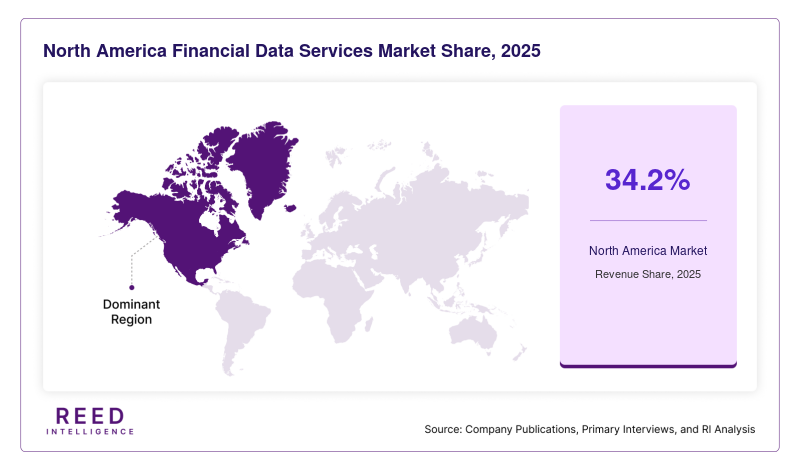
North America accounted for approximately 34.2% share of the Financial Data Services Market in 2025 and is projected to expand at a CAGR of 7.2% during the forecast period. The region maintains a dominant position due to the strong presence of global financial institutions, advanced capital markets infrastructure, and early adoption of cloud-based financial analytics solutions. The United States continues to drive the majority of demand, supported by high trading volumes, widespread use of algorithmic trading platforms, and increasing reliance on real-time data intelligence systems. Canada also contributes steadily, particularly through modernization initiatives in banking and investment services.
The United States remains the leading country in the region, supported by its deep financial ecosystem centered in New York and other major financial hubs. A key growth factor is the rapid expansion of AI-enabled financial data platforms used for high-frequency trading, risk modeling, and portfolio optimization. Additionally, increasing regulatory requirements related to transparency and reporting standards are driving demand for integrated financial data services that support compliance automation and audit-ready reporting systems across large financial enterprises.
Europe
Europe held around 26.5% share in 2025 and is expected to grow at a CAGR of 7.6% over the forecast period. The region benefits from a well-established banking sector, strong regulatory frameworks, and increasing digitization of financial services. Countries such as the United Kingdom, Germany, France, and Switzerland play a key role in driving demand for financial data services, particularly in investment banking, wealth management, and insurance analytics. The region is also witnessing increased adoption of ESG-focused financial data platforms.
The United Kingdom dominates the European market due to its position as a global financial hub and fintech innovation center. A major growth factor is the increasing integration of real-time analytics into trading and risk management systems, driven by regulatory requirements and market volatility. Germany is also expanding steadily, supported by demand from industrial investment analysis and corporate finance sectors, where financial data services are being used to improve forecasting accuracy and capital allocation efficiency.
Asia Pacific
Asia Pacific accounted for 21.8% share in 2025 and is projected to register the fastest CAGR of 11.2% during the forecast period. The region’s growth is fueled by rapid digital transformation, expansion of fintech ecosystems, and rising participation in capital markets across emerging economies. Countries such as China, India, Japan, South Korea, and Singapore are key contributors. Increasing adoption of mobile banking, digital investment platforms, and AI-based financial tools is significantly boosting demand for financial data services.
China leads the regional market due to large-scale financial modernization programs and strong investment in AI-powered financial technologies. A key growth factor is the expansion of digital asset trading platforms and real-time financial analytics systems used across banking and investment sectors. India is also emerging as a high-growth market, supported by rapid fintech adoption, growing retail investor participation, and increasing demand for cloud-based financial data platforms that support scalable analytics and decision-making.
Middle East & Africa
The Middle East & Africa region held approximately 8.1% share in 2025 and is expected to grow at a CAGR of 8.3% during the forecast period. Growth is supported by ongoing economic diversification efforts, rising foreign investment, and increasing development of financial infrastructure. Countries such as the United Arab Emirates, Saudi Arabia, and South Africa are leading adoption of financial data services. The region is increasingly focusing on building advanced financial ecosystems aligned with global standards.
The United Arab Emirates dominates the regional market due to its strong position as a financial and fintech hub. A key growth factor is government-led digital transformation initiatives, including smart financial services frameworks and AI-driven regulatory systems. Saudi Arabia is also experiencing growth driven by Vision 2030 initiatives, which are accelerating investment in digital banking platforms and financial analytics solutions to support non-oil economic expansion.
Latin America
Latin America accounted for 9.4% share in 2025 and is projected to grow at a CAGR of 7.9% during the forecast period. The region is witnessing gradual modernization of banking systems and increasing fintech penetration across Brazil, Mexico, Chile, and Argentina. Rising demand for digital financial services and improved access to capital markets is driving adoption of financial data services. However, varying regulatory environments and infrastructure gaps continue to influence market growth dynamics.
Brazil leads the regional market due to its large banking sector and rapidly expanding fintech ecosystem. A key growth factor is increasing demand for real-time financial analytics to support credit risk assessment and investment decision-making. Mexico is also emerging as a strong contributor, supported by digital banking expansion and cross-border financial activities linked to North American trade integration.
Competitive Landscape
The Financial Data Services Market is characterized by strong competition among established data providers and emerging fintech analytics firms. Key players focus on expanding data coverage, improving real-time capabilities, and integrating AI-driven analytics solutions. Companies such as Bloomberg, Refinitiv, S&P Global, FactSet, and Morningstar maintain significant market presence through comprehensive financial data platforms and global distribution networks. Recent developments include increased investment in cloud-native data infrastructure and partnerships with fintech firms to enhance data accessibility and analytical capabilities. Product innovation and API-based service expansion remain central strategies for maintaining competitiveness in this evolving market.
Key Players
- Bloomberg L.P.
- S&P Global Inc.
- Refinitiv (London Stock Exchange Group)
- FactSet Research Systems Inc.
- Morningstar Inc.
- ICE Data Services
- Moody’s Analytics
- MSCI Inc.
- Dow Jones (News Corp)
- Standard & Poor’s Financial Services
- SIX Financial Information
- TradingView Inc.
- RavenPack
- Intrinio
- AlphaSense Inc.
Recent Developments
- In 2025, Bloomberg L.P. expanded its AI-driven financial data analytics suite, enhancing real-time market intelligence capabilities for institutional investors and improving predictive modeling accuracy across global trading systems.
- In 2025, S&P Global Inc. strengthened its cloud-based data delivery infrastructure by integrating advanced API solutions, enabling faster and more scalable access to credit ratings, ESG metrics, and structured financial datasets for enterprise clients.
- In 2024, Refinitiv (London Stock Exchange Group) enhanced its alternative data offerings by incorporating expanded sentiment analysis tools and unstructured data feeds, supporting improved investment decision-making for hedge funds and asset managers.
- In 2024, FactSet Research Systems Inc. introduced next-generation portfolio analytics tools focused on risk visualization and scenario modeling, helping financial institutions optimize asset allocation and improve compliance reporting efficiency.
Financial Data Services Market Segments
By Data Type
- Market Data Services
- Alternative Data Services
- Reference Data Services
By Application
- Investment Management
- Risk Analytics
- Trading & Execution Systems
By End Use
- Banking Institutions
- Asset Management Firms
- Fintech Companies
- Insurance Providers
- Corporate Enterprises
By Region
- North America
- Europe
- APAC
- Middle East and Africa
- LATAM