Financial Leasing Market Size, Share & Demand Report By Asset Type (Equipment Leasing, Vehicle Leasing, Aircraft Leasing, Real Estate Leasing, Renewable Energy Asset Leasing, Technology Asset Leasing), By End-User (Large Enterprises, Small and Medium Enterprises), By Industry Vertical (Manufacturing, Transportation and Logistics, Healthcare, Construction, Information Technology, Energy & Utilities, Renewable Energy, Agriculture, Others), By Region & Segment Forecasts, 2026–2034
USD 3950
Market Overview
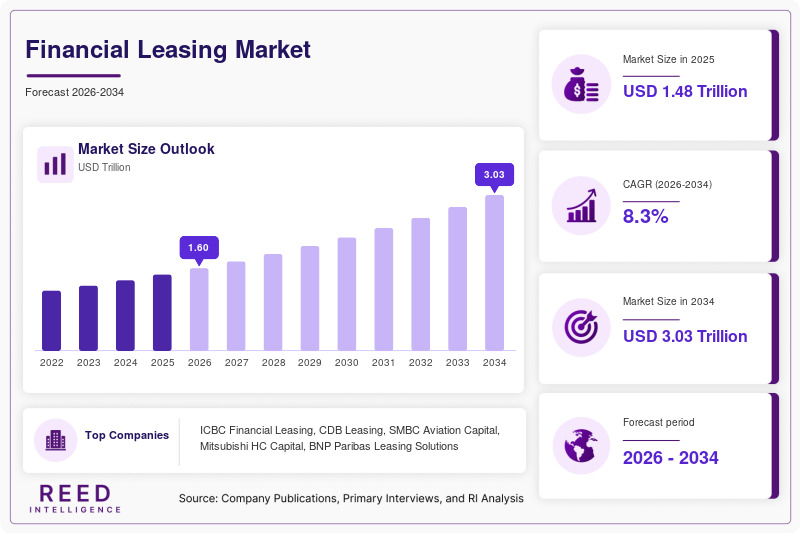
The global Financial Leasing Market size was valued at USD 1.48 trillion in 2026 and is projected to reach USD 2.79 trillion by 2034, expanding at a CAGR of 8.3% during the forecast period from 2026 to 2034. Financial leasing has become an important financing mechanism for businesses seeking access to equipment, machinery, vehicles, aircraft, technology infrastructure, and industrial assets without committing significant upfront capital. The growing preference for asset-light business models across manufacturing, transportation, healthcare, construction, and logistics sectors continues to support demand for leasing solutions worldwide.
A major factor supporting market expansion is the increasing global emphasis on capital efficiency and operational flexibility. Organizations are increasingly choosing leasing arrangements to preserve cash flow, improve liquidity management, and gain access to advanced technologies. Financial leasing also enables businesses to replace aging equipment more efficiently while reducing the risks associated with asset ownership. Furthermore, the digital transformation of leasing platforms, enhanced credit assessment technologies, and increasing participation of financial institutions have improved market accessibility for both large enterprises and small and medium-sized businesses.
Key Highlights
- North America dominated the market with a 34.8% share in 2025, while Asia Pacific is expected to grow at the fastest CAGR of 10.6% during 2026–2034.
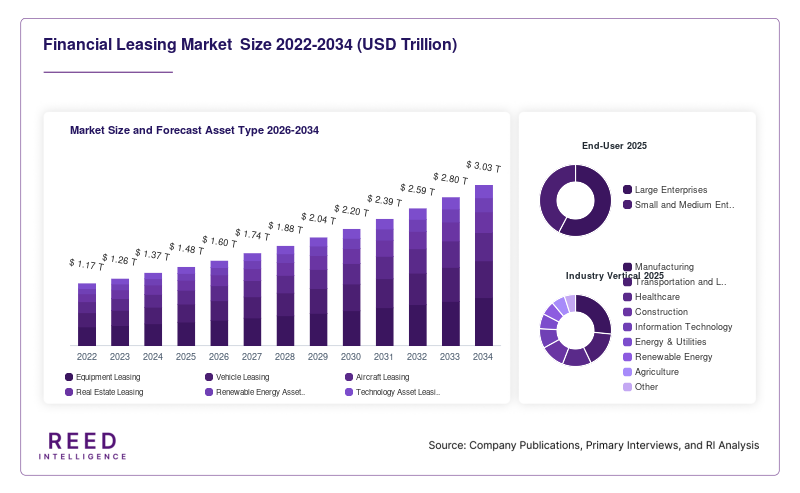
- By asset type, equipment leasing accounted for the largest share of 39.4%, while renewable energy asset leasing is projected to grow at a CAGR of 11.9%.
- By end-user, large enterprises led with a 58.2% share, whereas small and medium enterprises are expected to expand at a CAGR of 10.8%.
- By industry vertical, transportation and logistics held a 26.7% share, while renewable energy is forecast to grow at a CAGR of 12.3%.
- The United States remained the dominant country, with market values of USD 391 billion in 2024 and USD 425 billion in 2025.
Market Trends
Digitalization of Leasing Operations
The financial leasing industry is witnessing rapid digital transformation as providers adopt cloud-based platforms, artificial intelligence, and automated contract management systems. Digital leasing platforms are simplifying customer onboarding, credit evaluation, documentation, and payment processing. These technologies are reducing operational costs while improving customer experience and transaction speed. Businesses increasingly prefer digital channels that offer real-time asset tracking, online approvals, and transparent lease management capabilities. The integration of advanced analytics is also enabling leasing companies to assess risk more effectively and customize financing solutions. As competition intensifies across global markets, digital innovation is becoming a critical differentiator for leasing providers seeking to improve efficiency and strengthen customer retention.
Rising Demand for Sustainable Asset Financing
Sustainability objectives are increasingly influencing financial leasing decisions across industries. Organizations are leasing energy-efficient machinery, electric vehicles, renewable energy systems, and environmentally friendly equipment to meet environmental targets while controlling capital expenditures. Governments in several regions are promoting green investments through incentives and supportive financing frameworks, encouraging greater adoption of sustainable leasing arrangements. Leasing companies are responding by expanding portfolios focused on clean energy and low-carbon assets. The growing importance of environmental, social, and governance initiatives is expected to accelerate demand for sustainable leasing products, particularly among corporations pursuing long-term sustainability commitments and regulatory compliance objectives.
Market Drivers
Expanding Infrastructure and Industrial Development Activities
Large-scale investments in infrastructure projects, industrial facilities, transportation networks, and public utilities are significantly driving demand for financial leasing solutions. Construction companies, manufacturers, and logistics operators often require expensive equipment and machinery that can place pressure on capital budgets. Leasing provides a practical alternative by allowing businesses to acquire necessary assets while maintaining financial flexibility. Emerging economies are experiencing substantial industrial growth, creating additional demand for leased equipment and vehicles. As governments continue to invest in modernization and economic development initiatives, leasing providers are expected to benefit from increasing demand across multiple sectors requiring access to capital-intensive assets.
Growing Preference for Asset-Light Business Strategies
Organizations across industries are increasingly adopting asset-light operating models to improve financial efficiency and reduce ownership-related risks. Financial leasing enables businesses to utilize critical assets without committing substantial capital or assuming full ownership responsibilities. This approach supports better cash flow management and allows companies to allocate resources toward innovation, expansion, and strategic investments. Rapid technological advancements also encourage leasing because businesses can upgrade equipment more frequently without facing asset obsolescence concerns. The flexibility offered by leasing arrangements aligns with modern corporate financial strategies, making leasing an attractive option for enterprises seeking operational agility and competitive advantage.
Market Restraint
Economic Uncertainty and Credit Risk Exposure
Economic volatility remains a significant challenge for the financial leasing market. Fluctuating interest rates, inflationary pressures, and uncertain business conditions can affect leasing demand and increase credit risks for providers. During periods of economic slowdown, businesses may delay equipment acquisitions, reduce expansion plans, or encounter financial difficulties that impact lease repayment performance. Leasing companies must carefully manage credit exposure while maintaining portfolio quality. In addition, changing regulatory requirements and stricter lending standards may increase compliance costs and limit financing availability for certain customer segments. For example, industries heavily dependent on global trade may experience reduced investment activity during economic disruptions, affecting leasing volumes. These factors can create challenges for market participants seeking sustainable growth while balancing profitability and risk management objectives.
Market Opportunities
Increasing Adoption Among Small and Medium Enterprises
Small and medium enterprises represent a substantial growth opportunity for financial leasing providers. Many SMEs face challenges in accessing traditional financing due to limited collateral, shorter operating histories, or constrained credit profiles. Leasing solutions offer a flexible financing alternative that enables these businesses to acquire essential equipment, vehicles, and technology assets. As digital lending platforms improve accessibility and streamline approval processes, more SMEs are expected to utilize leasing products. Growing entrepreneurial activity, particularly in developing economies, further supports demand. Providers that develop tailored leasing solutions for SMEs can expand customer bases and capture significant market growth opportunities throughout the forecast period.
Expansion of Renewable Energy Asset Leasing
The transition toward renewable energy is creating attractive opportunities within the financial leasing market. Businesses and utility operators increasingly require financing for solar panels, wind turbines, energy storage systems, and related infrastructure. Leasing arrangements help reduce upfront investment requirements while facilitating adoption of clean energy technologies. Government incentives, sustainability commitments, and rising energy demand are supporting investments in renewable energy projects worldwide. Leasing companies that specialize in renewable energy assets can benefit from long-term growth prospects and diversified revenue streams. As environmental goals become more prominent across industries, demand for renewable energy leasing solutions is expected to accelerate significantly.
Segmental Analysis
By Asset Type
Equipment leasing represented the dominant asset type segment, accounting for approximately 39.4% of market revenue in 2024. The segment benefits from extensive demand across manufacturing, construction, healthcare, logistics, and industrial sectors. Equipment leasing enables organizations to obtain machinery and operational assets without significant capital commitments. Businesses also gain flexibility in upgrading equipment as technologies evolve. The widespread need for production machinery, medical devices, construction equipment, and industrial systems continues to support segment leadership. Furthermore, leasing providers have developed specialized financing solutions that address diverse customer requirements, strengthening adoption among both large enterprises and smaller organizations.
Renewable energy asset leasing is expected to emerge as the fastest-growing subsegment, expanding at a CAGR of 11.9% through 2034. Growing investments in solar power systems, wind energy installations, battery storage technologies, and related infrastructure are driving demand. Organizations increasingly seek financing mechanisms that support sustainability objectives while minimizing capital expenditures. Government incentives, environmental regulations, and corporate sustainability commitments are accelerating adoption. Leasing companies that develop expertise in renewable energy financing are well positioned to capitalize on growing investments in clean energy infrastructure worldwide.
By End-User
Large enterprises held the leading position within the end-user segment, accounting for approximately 58.2% of market revenue in 2024. These organizations frequently utilize leasing arrangements to finance large-scale equipment acquisitions, transportation fleets, industrial machinery, and technology infrastructure. Leasing helps preserve liquidity while supporting expansion initiatives and operational efficiency objectives. Large enterprises also benefit from customized leasing structures that align with complex financial strategies. The substantial scale of asset requirements across manufacturing, transportation, healthcare, and telecommunications sectors contributes significantly to segment dominance.
Small and medium enterprises are projected to record the fastest CAGR of 10.8% during the forecast period. Increasing awareness of leasing benefits, improved digital access to financing, and growing entrepreneurial activity are supporting adoption among SMEs. Leasing enables smaller businesses to access essential assets without large upfront investments, improving competitiveness and productivity. Digital leasing platforms are further simplifying application and approval processes, making financing more accessible. As SMEs continue to expand their contribution to economic growth worldwide, leasing demand from this segment is expected to rise considerably.
By Industry Vertical
Transportation and logistics accounted for the largest share of approximately 26.7% in 2024. The sector relies heavily on leased vehicles, aircraft, shipping equipment, and logistics infrastructure to support operations. Leasing provides operational flexibility while reducing ownership risks and capital requirements. Fleet modernization initiatives, rising freight volumes, and increasing e-commerce activities continue to support demand. Logistics providers frequently utilize leasing arrangements to maintain efficient operations and adapt to changing market requirements. The sector's ongoing need for asset-intensive infrastructure contributes to its leading position within the market.
Renewable energy is expected to be the fastest-growing industry vertical, advancing at a CAGR of 12.3% through 2034. Growing investments in clean energy generation and energy transition projects are driving demand for specialized leasing solutions. Solar farms, wind energy installations, and energy storage systems often require substantial financing, making leasing an attractive option. Regulatory support, sustainability goals, and increasing energy demand further strengthen growth prospects. Leasing providers are expanding offerings to support renewable energy projects, creating new revenue opportunities while facilitating broader adoption of sustainable energy technologies.
Regional Analysis
North America
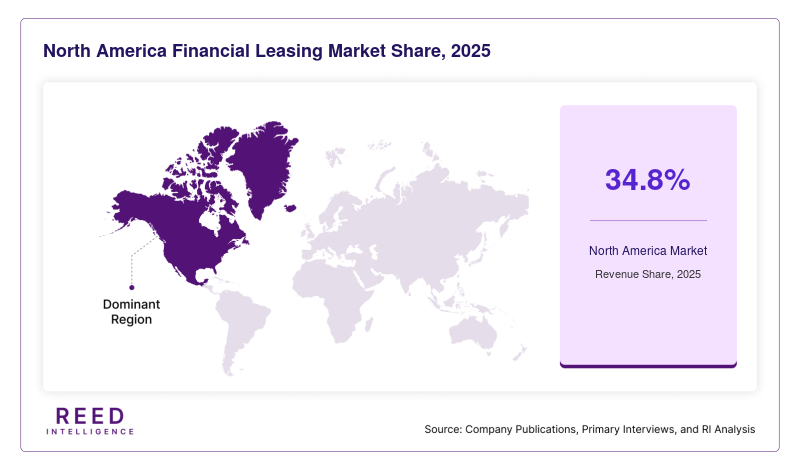
North America accounted for approximately 34.8% of the global financial leasing market in 2025 and continues to maintain a strong position due to its mature financial services sector and extensive adoption of leasing solutions across industries. The region is expected to register a CAGR of 7.4% through 2034. Strong demand from transportation, aviation, healthcare, and industrial manufacturing sectors contributes to sustained market expansion. Advanced financing infrastructure and established regulatory frameworks further support leasing activities throughout the region.
The United States remains the dominant country within North America. A key growth factor is the widespread adoption of technology-driven leasing platforms that improve transaction efficiency and customer accessibility. Businesses increasingly utilize leasing to finance advanced manufacturing equipment, commercial fleets, and digital infrastructure. Continued investments in industrial modernization and fleet replacement programs are expected to reinforce market growth across the country.
Europe
Europe represented approximately 27.3% of global market revenue in 2025 and is projected to grow at a CAGR of 7.8% during the forecast period. The region benefits from strong demand for equipment financing, transportation assets, and industrial machinery. Leasing plays an important role in supporting business investments while preserving liquidity. Growing emphasis on sustainable finance and green investments is also encouraging adoption of specialized leasing products across multiple industries.
Germany leads the European market due to its strong industrial base and advanced manufacturing sector. A unique growth factor is the increasing implementation of Industry 4.0 technologies, which drives demand for leased automation equipment and smart manufacturing systems. Businesses seeking operational efficiency and technological competitiveness are increasingly relying on leasing arrangements to fund modernization initiatives.
Asia Pacific
Asia Pacific held nearly 24.5% of the global financial leasing market in 2025 and is forecast to achieve the fastest CAGR of 10.6% through 2034. Rapid industrialization, urbanization, and infrastructure development are generating substantial demand for leased assets. Expanding manufacturing activities and increasing investments in transportation infrastructure are contributing to strong market growth. The region's expanding SME sector further strengthens leasing demand across various industries.
China dominates the Asia Pacific market and continues to experience significant leasing activity. A major growth factor is the government's ongoing support for industrial expansion and infrastructure development projects. Rising investments in renewable energy, advanced manufacturing, and transportation systems are creating favorable conditions for leasing providers. The country's large business ecosystem also supports broad adoption of leasing solutions.
Middle East & Africa
The Middle East & Africa region accounted for approximately 7.1% of global market share in 2025 and is anticipated to expand at a CAGR of 8.5% during the forecast period. Increasing investments in construction, energy, transportation, and industrial projects are supporting demand for financial leasing services. Leasing is becoming an attractive financing option for organizations seeking flexibility while managing large-scale capital expenditures.
The United Arab Emirates remains the dominant market within the region. A unique growth factor is the diversification of the economy beyond hydrocarbons, leading to greater investments in logistics, aviation, tourism, and infrastructure. Leasing providers are benefiting from increased demand for commercial equipment and transportation assets that support economic diversification strategies.
Latin America
Latin America captured approximately 6.3% of the global financial leasing market in 2025 and is expected to record a CAGR of 8.1% through 2034. The market is supported by growing investments in transportation, agriculture, mining, and industrial sectors. Businesses are increasingly adopting leasing arrangements to access equipment while managing capital constraints. Improvements in financial inclusion and leasing awareness are also contributing to market expansion.
Brazil represents the largest country market in Latin America. A key growth factor is the modernization of agricultural operations, which requires significant investments in machinery and equipment. Leasing solutions enable agricultural enterprises to access advanced technologies without substantial upfront expenditures. Continued development across agribusiness and industrial sectors is expected to support future market growth.
Competitive Landscape
The financial leasing market is characterized by the presence of global financial institutions, specialized leasing firms, and diversified asset financing providers. Market participants focus on digital transformation, portfolio diversification, strategic partnerships, and geographic expansion to strengthen their competitive positions. The increasing integration of technology into leasing operations is enabling providers to improve customer experiences and enhance risk management capabilities.
Among major participants, ICBC Financial Leasing maintains a strong market position due to its extensive asset portfolio, broad geographic presence, and strong relationships across industrial sectors. The company continues to expand leasing solutions for infrastructure, transportation, and energy projects. A recent development involved the expansion of its sustainable asset financing portfolio to support renewable energy investments.
Key Players
- ICBC Financial Leasing
- CDB Leasing
- SMBC Aviation Capital
- Mitsubishi HC Capital
- BNP Paribas Leasing Solutions
- DLL Group
- Wells Fargo Equipment Finance
- Bank of America Leasing
- JP Morgan Leasing Services
- Societe Generale Equipment Finance
- China Minsheng Financial Leasing
- Bohai Leasing
- GE Capital Leasing
- Hitachi Capital Corporation
- De Lage Landen International
Recent Developments
- In 2025, a leading global leasing provider expanded its digital leasing platform capabilities to streamline credit assessments, automate contract processing, and improve customer onboarding efficiency across multiple industry sectors.
- In 2025, several financial institutions introduced specialized leasing programs for renewable energy assets, supporting increased adoption of solar power systems, wind energy equipment, and battery storage infrastructure.
- In 2024, a major financial leasing company launched flexible equipment financing solutions tailored for small and medium enterprises, enabling broader access to industrial machinery and technology assets.
- In 2024, leasing providers increased investments in artificial intelligence and data analytics tools to strengthen risk evaluation processes, enhance portfolio management, and improve lease performance monitoring.
- In 2025, strategic partnerships between leasing companies and equipment manufacturers accelerated the deployment of asset-financing solutions for construction, transportation, and advanced manufacturing projects worldwide.
Financial Leasing Market Segments
Asset Type
- Equipment Leasing
- Vehicle Leasing
- Aircraft Leasing
- Real Estate Leasing
- Renewable Energy Asset Leasing
- Technology Asset Leasing
End-User
- Large Enterprises
- Small and Medium Enterprises
Industry Vertical
- Manufacturing
- Transportation and Logistics
- Healthcare
- Construction
- Information Technology
- Energy & Utilities
- Renewable Energy
- Agriculture
- Other
By Region
- North America
- Europe
- APAC
- Middle East and Africa
- LATAM