Fine Bubble Diffuser Market Size, Share, Demand Report By Material Type (EPDM Membrane Diffusers, Silicone Membrane Diffusers, Ceramic Diffusers, Polyurethane Diffusers), By Application (Municipal Wastewater Treatment, Industrial Wastewater Treatment), By End-Use Industry (Municipal Utilities, Chemical Industry, Food & Beverage Industry) By Region & Segment Forecasts, 2026–2034
USD 3950
Market Overview
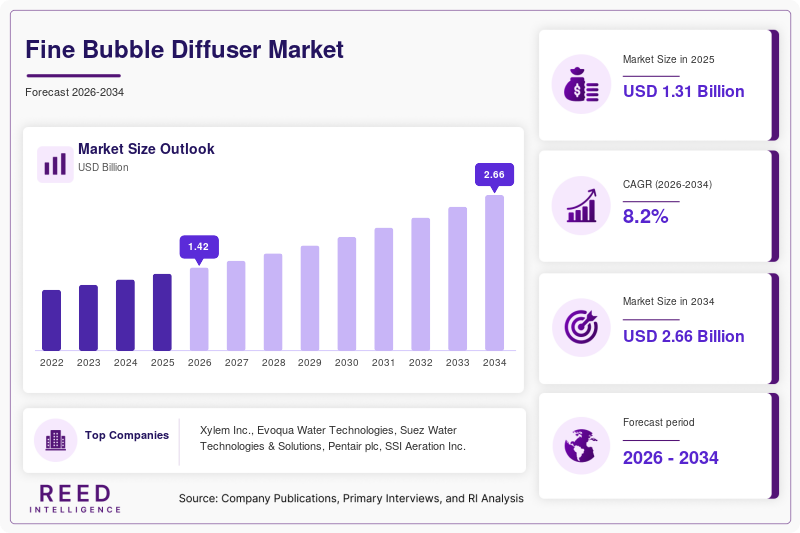
The Fine Bubble Diffuser Market size is estimated at approximately USD 1.42 billion, and it is projected to reach around USD 2.68 billion by 2034, registering a CAGR of 8.2% during the forecast period 2026–2034. Growth is primarily supported by increasing investments in water infrastructure modernization and stricter environmental regulations aimed at reducing biological oxygen demand in wastewater discharge. The adoption of energy-efficient aeration technologies has further strengthened demand, as fine bubble diffusers significantly improve oxygen transfer efficiency compared to conventional systems.
One global factor supporting market growth is the increasing focus on sustainable water management practices. Governments and private utilities are prioritizing technologies that reduce energy consumption in wastewater treatment plants, where aeration typically accounts for a major share of operational costs. Fine bubble diffusers help reduce energy usage while maintaining higher treatment efficiency, making them a preferred solution in both new installations and retrofit projects.
Key Highlights
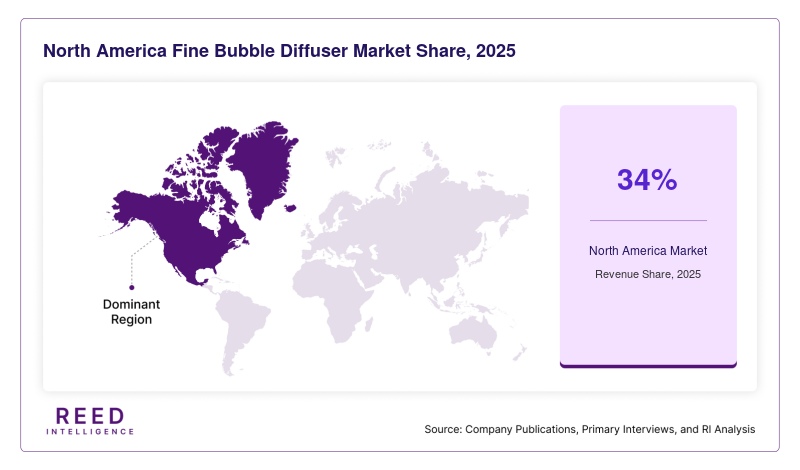
- North America dominated the market with a 34.2% share in 2025.
- Asia Pacific is expected to grow at the fastest CAGR of 11.2% during 2026–2034.
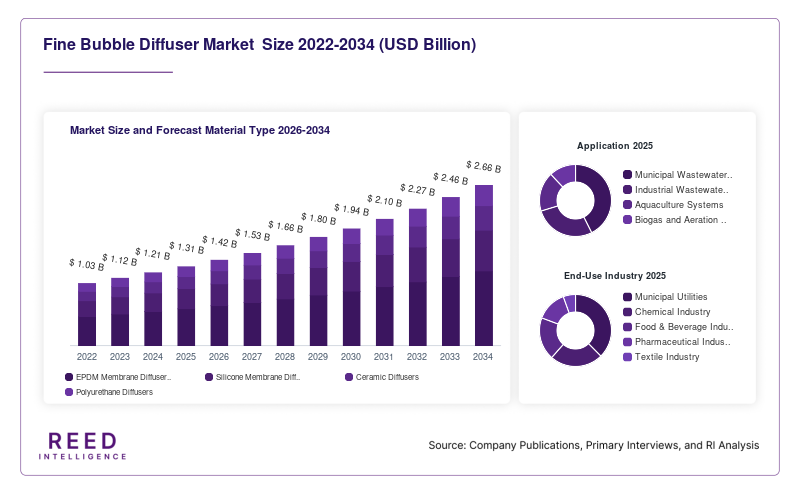
- By material type, EPDM membrane diffusers accounted for the largest share of 40.1%.
- By application, municipal wastewater treatment led with a 46.3% share, whereas industrial wastewater treatment is expected to expand at a CAGR of 9.8%.
- The United States remained the dominant country, with market values of USD 520 million in 2024 and USD 565 million in 2025.
Market Trends
Increasing Integration of Energy-Efficient Aeration Systems
A major trend in the Fine Bubble Diffuser Market is the growing integration of energy-efficient aeration systems in wastewater treatment facilities. Operators are increasingly replacing coarse bubble and mechanical aeration systems with fine bubble diffusers due to their higher oxygen transfer efficiency and reduced power consumption. These systems enhance biological treatment performance while significantly lowering operational costs. Municipal utilities in developed regions are upgrading existing infrastructure to comply with energy optimization mandates, while emerging economies are incorporating these systems into new treatment plants. The trend is further strengthened by rising electricity costs and sustainability goals, encouraging widespread adoption across both public and private sectors.
Expansion of Smart Monitoring and Automated Diffusion Systems
Another notable trend is the incorporation of smart monitoring and automated control technologies in fine bubble diffuser systems. Advanced sensors and IoT-enabled platforms are being integrated to optimize airflow distribution and detect diffuser fouling or performance degradation in real time. This improves operational efficiency and reduces maintenance downtime in wastewater treatment plants. Operators are leveraging data-driven insights to adjust aeration rates based on biological load requirements, enhancing treatment precision. The trend is particularly strong in industrial applications where process stability is critical. Increasing digital transformation in water management infrastructure is expected to further accelerate adoption of intelligent diffuser systems.
Market Drivers
Rising Investments in Wastewater Treatment Infrastructure
A key driver of the Fine Bubble Diffuser Market is the increasing global investment in wastewater treatment infrastructure. Rapid urbanization and industrialization are generating higher volumes of wastewater, requiring advanced treatment technologies to meet environmental standards. Governments are allocating significant budgets for upgrading sewage treatment plants, particularly in developing economies. Fine bubble diffusers are widely adopted due to their ability to improve oxygen transfer efficiency and reduce energy consumption. Large-scale infrastructure development projects, including smart cities and industrial parks, are further contributing to market growth. This sustained investment cycle continues to create strong demand across municipal and industrial segments.
Stringent Environmental Regulations and Water Quality Standards
Another major driver is the enforcement of stringent environmental regulations and water quality standards across multiple regions. Regulatory bodies are imposing strict discharge limits on pollutants such as biochemical oxygen demand and nitrogen compounds. As a result, wastewater treatment plants are required to adopt highly efficient aeration systems to ensure compliance. Fine bubble diffusers enable improved biological treatment performance, making them a preferred choice for regulatory compliance. In addition, increasing public awareness regarding water conservation and pollution control is encouraging utilities and industries to adopt advanced treatment technologies, further supporting market expansion.
Market Restraint
High Maintenance Requirements and Operational Challenges
A significant restraint in the Fine Bubble Diffuser Market is the high maintenance requirement associated with diffuser systems. Over time, diffusers are prone to fouling, clogging, and membrane degradation due to continuous exposure to wastewater contaminants. This results in reduced oxygen transfer efficiency and increased operational downtime. Regular cleaning, replacement, and system monitoring are necessary to maintain optimal performance, which increases lifecycle costs for end users. Smaller municipalities and industrial operators with limited budgets often face challenges in maintaining these systems effectively. Additionally, improper installation or poor operational practices can further reduce system efficiency, limiting widespread adoption in cost-sensitive markets.
Market Opportunities
Expansion of Industrial Wastewater Treatment Applications
One major opportunity in the Fine Bubble Diffuser Market lies in the expanding industrial wastewater treatment sector. Industries such as chemicals, food and beverage, pharmaceuticals, and textiles are generating complex wastewater streams requiring advanced treatment solutions. Fine bubble diffusers offer improved oxygen transfer and enhanced biological degradation efficiency, making them suitable for industrial applications. Growing environmental compliance requirements in emerging economies are encouraging industries to invest in modern treatment infrastructure. The increasing focus on zero liquid discharge systems further supports demand, as fine bubble diffusers play a critical role in optimizing aeration processes within these systems.
Technological Advancements in Diffuser Materials and Design
Another key opportunity is the ongoing advancement in diffuser materials and design technologies. Manufacturers are developing durable membranes with improved resistance to fouling and chemical degradation, extending product lifespan and reducing maintenance costs. Innovations in diffuser geometry are enhancing oxygen distribution efficiency, making systems more effective in large-scale treatment plants. Additionally, the development of hybrid diffuser systems that combine fine bubble and coarse bubble technologies is gaining traction. These advancements are expected to open new application areas and improve adoption rates across both developed and developing markets.
Segmental Analysis
Material Type Segment
EPDM membrane diffusers dominated the Fine Bubble Diffuser Market with approximately 40.1% share in 2024 due to their durability and cost-effectiveness. These diffusers are widely used in municipal wastewater treatment plants because they offer stable oxygen transfer efficiency and long operational life under varying water conditions. Their resistance to chemical degradation and mechanical stress makes them suitable for large-scale installations where continuous operation is required.
Ceramic diffusers are emerging as the fastest-growing subsegment, projected to expand at a CAGR of 10.6% during 2026–2034. Their growth is driven by superior durability, high resistance to fouling, and enhanced oxygen transfer efficiency. Industrial applications, particularly in chemical and pharmaceutical sectors, are increasingly adopting ceramic-based systems due to their long lifecycle and reduced maintenance requirements.
Application Segment
Municipal wastewater treatment led the market with a 46.3% share in 2024, driven by large-scale infrastructure development and government-funded sanitation projects. Fine bubble diffusers are extensively used in sewage treatment plants to improve biological oxygen demand removal efficiency. Their ability to reduce energy consumption makes them a preferred choice for municipal utilities aiming to optimize operational costs.
Industrial wastewater treatment is the fastest-growing application segment, expected to register a CAGR of 9.8%. Growth is driven by strict discharge regulations and increasing industrial production. Industries are adopting advanced aeration systems to meet compliance requirements and improve treatment efficiency, particularly in sectors generating high-strength wastewater.
End-Use Segment
Municipal utilities dominated the end-use segment with a 52.4% share in 2024, supported by widespread sewage treatment infrastructure across urban areas. These systems rely heavily on fine bubble diffusers for continuous aeration processes in activated sludge systems.
Industrial end-use is expected to grow at a CAGR of 9.5%, driven by rising investments in in-house wastewater treatment facilities. Increasing regulatory pressure and sustainability initiatives are encouraging industries to adopt efficient diffusion technologies.
Regional Analysis
North America
North America accounted for approximately 34%–35% of the global Fine Bubble Diffuser Market share in 2025, maintaining its position as the leading regional market. The region is projected to expand at a CAGR of around 7.5%–7.8% during 2026–2034. This dominance is supported by strong regulatory frameworks and consistent investments in wastewater infrastructure modernization. Government-backed funding programs and policy initiatives for water treatment upgrades have significantly accelerated the adoption of energy-efficient aeration systems. Additionally, the region benefits from a mature industrial base and early adoption of advanced treatment technologies.
The United States remains the dominant country in North America, contributing the largest share of regional revenue. A key growth factor is the extensive retrofit and replacement of aging wastewater treatment systems. Federal and state-level funding programs, including infrastructure investments and grants, have encouraged municipalities to upgrade aeration systems with fine bubble diffusers. This transition is driven by the need to reduce operational costs and improve oxygen transfer efficiency in treatment plants.
Europe
Europe held an estimated 26%–28% share of the Fine Bubble Diffuser Market in 2025 and is expected to grow at a CAGR of approximately 7.8%–8.0% through 2034. The region’s growth is driven by strict environmental directives and water quality standards enforced by regulatory bodies. Countries across the region are investing in sustainable water management systems, including advanced aeration technologies. Increasing focus on reducing carbon emissions and energy consumption in wastewater treatment plants is further supporting market expansion.
Germany is the leading country in Europe due to its strong industrial base and advanced environmental engineering sector. A unique growth factor is the widespread adoption of circular water management practices, including water reuse and recycling systems. Industrial facilities in Germany are increasingly integrating fine bubble diffusers to enhance treatment efficiency and meet regulatory compliance requirements.
Asia Pacific
Asia Pacific accounted for approximately 22%–24% of the global market share in 2025 and is projected to grow at the fastest CAGR of 10.5%–11.2% during the forecast period. Rapid urbanization, industrial expansion, and increasing population are key drivers of demand for wastewater treatment solutions in the region. Governments in countries such as China and India are heavily investing in sewage infrastructure development and pollution control measures. The region also benefits from rising awareness about water conservation and environmental sustainability.
China dominates the Asia Pacific market, supported by large-scale government initiatives aimed at reducing water pollution and improving wastewater treatment capacity. A key growth factor is the implementation of stringent discharge regulations across industrial sectors, which is driving the adoption of advanced aeration technologies. Additionally, the expansion of smart cities and industrial zones is creating sustained demand for fine bubble diffuser systems.
Middle East & Africa
The Middle East & Africa region accounted for around 6%–7% of the Fine Bubble Diffuser Market share in 2025 and is expected to grow at a CAGR of approximately 8.2%–8.5% through 2034. Growth in this region is primarily driven by increasing water scarcity and the need for efficient water reuse systems. Governments are investing in wastewater treatment and desalination projects to address water shortages and support urban development.
Saudi Arabia leads the regional market, driven by large-scale infrastructure projects and investments in water treatment technologies. A unique growth factor is the integration of wastewater treatment with desalination facilities, where fine bubble diffusers play a crucial role in improving aeration efficiency. The region is also witnessing increasing adoption of sustainable water management practices in both municipal and industrial sectors.
Latin America
Latin America held approximately 6%–7% share of the Fine Bubble Diffuser Market in 2025 and is projected to grow at a CAGR of 7.5%–7.9% during the forecast period. The region’s growth is supported by improving sanitation infrastructure and rising government initiatives to expand wastewater treatment capacity. Countries are focusing on enhancing urban water management systems to meet growing population demands and environmental standards.
Brazil is the dominant country in Latin America due to its large population and increasing investments in municipal wastewater treatment projects. A key growth factor is the expansion of public-private partnerships aimed at improving water infrastructure. These initiatives are enabling the adoption of advanced aeration technologies, including fine bubble diffusers, to enhance treatment efficiency and reduce environmental impact.
Competitive Landscape
The Fine Bubble Diffuser Market is moderately consolidated with the presence of several global and regional players focusing on innovation, durability, and energy efficiency. Key companies include Xylem Inc., Suez Water Technologies, Aquatec Maxcon, Evoqua Water Technologies, and SSI Aeration Inc. Xylem Inc. holds a leading position due to its extensive product portfolio and strong global distribution network. Recent development includes expansion of its energy-efficient diffuser line targeting large municipal projects in Asia and North America, enhancing its competitive position in the market.
Key Players List
- Xylem Inc.
- Evoqua Water Technologies
- Suez Water Technologies & Solutions
- Aquatec Maxcon
- SSI Aeration Inc.
- GE Water & Process Technologies
- EnviroTech Systems
- KLa Systems
- Aquatec Maxcon
- Aeration Industries International
- Pentair plc
- Aquatec Maxcon Asia
- Lenntech B.V.
- EDI Environmental Dynamics Inc.
- Blue Diamond Pumps
Recent Developments
- In 2025, Xylem Inc. expanded its fine bubble diffuser manufacturing capacity in Southeast Asia to meet rising demand from municipal wastewater projects.
- Evoqua Water Technologies introduced a next-generation ceramic diffuser system designed to improve oxygen transfer efficiency by optimizing bubble distribution patterns in 2025.
- SSI Aeration Inc. launched an IoT-enabled monitoring platform in 2026 that allows real-time tracking of diffuser performance and predictive maintenance scheduling across treatment facilities.
Fine Bubble Diffuser Market Segments
Material Type
- EPDM Membrane Diffusers
- Silicone Membrane Diffusers
- Ceramic Diffusers
- Polyurethane Diffusers
Application
- Municipal Wastewater Treatment
- Industrial Wastewater Treatment
- Aquaculture Systems
- Biogas and Aeration Processes
End-Use Industry
- Municipal Utilities
- Chemical Industry
- Food & Beverage Industry
- Pharmaceutical Industry
- Textile Industry
By Region
- North America
- Europe
- APAC
- Middle East and Africa
- LATAM