Fingerprint Vehicle Access Market Size, Share Demand Report By Type (Capacitive Fingerprint Sensors, Optical Fingerprint Sensors, Ultrasonic Fingerprint Sensors), By Application (Vehicle Entry Systems, Ignition Systems, Infotainment Authentication), By End-Use (Passenger Vehicles, Commercial Vehicles), By Region & Segment Forecasts, 2025–2034
USD 3950
Market Overview
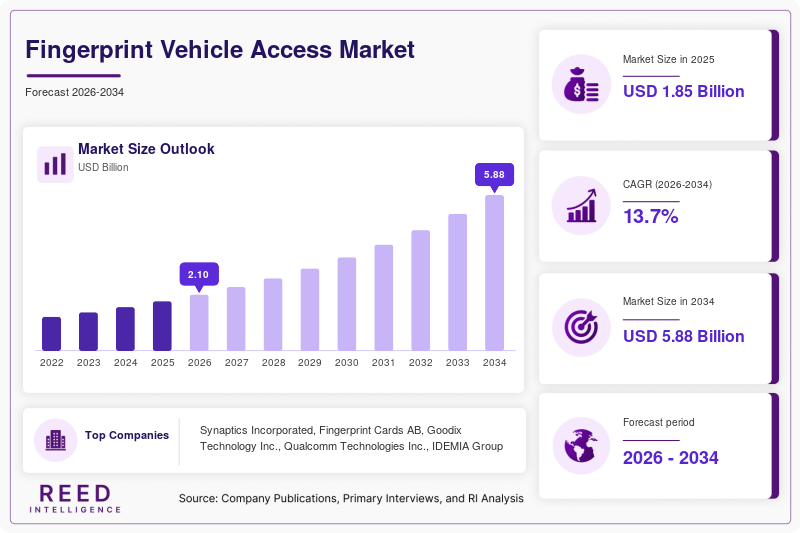
The Fingerprint Vehicle Access Market size was estimated at USD 1.85 billion in 2025 and is projected to reach USD 2.12 billion in 2026, expanding further to approximately USD 5.94 billion by 2034, registering a compound annual growth rate (CAGR) of 13.7% from 2025 to 2034. Increasing concerns around vehicle theft, coupled with advancements in biometric sensor technologies, are shaping the growth trajectory of this market.
Fingerprint-based vehicle access systems provide a secure and personalized alternative to traditional key-based entry. These systems enable users to unlock and start vehicles using biometric identification, reducing risks associated with lost or stolen keys. The rising adoption of connected and smart vehicles has further accelerated the integration of fingerprint authentication systems across mid-range and premium automotive segments.
Key Highlights
- North America held 32.0% of the Fingerprint Vehicle Access Market share in 2025, while Asia Pacific will register the fastest CAGR of 15.6% through 2034.
- Capacitive fingerprint sensors accounted for 48.0% share in 2025, while optical fingerprint sensors will grow at a CAGR of 15.1%.
- Vehicle entry systems represented 55.0% share in 2025, whereas ignition systems will grow at a CAGR of 14.8%.
- The United States remained the dominant country, with the market valued at USD 0.59 billion in 2025 and projected to reach USD 0.67 billion in 2026.
Market Trends
Integration of Biometric Systems with Connected Vehicle Ecosystems
A significant trend in the Fingerprint Vehicle Access Market is the integration of biometric authentication with connected vehicle platforms. Automakers are embedding fingerprint sensors into infotainment systems, door handles, and ignition modules to create a unified digital ecosystem. These systems are increasingly linked with cloud-based platforms, enabling remote user verification and data synchronization. This integration allows drivers to access their personalized settings across multiple vehicles, enhancing convenience and usability. Moreover, as vehicles become part of the broader Internet of Things (IoT) landscape, fingerprint authentication is being combined with smartphone apps and digital keys. This trend is expected to strengthen the adoption of biometric solutions, particularly in premium and electric vehicles.
Rising Adoption in Mid-Range Vehicle Segments
Initially limited to luxury vehicles, fingerprint access systems are now being adopted in mid-range vehicle segments due to declining sensor costs and improved scalability. Automotive OEMs are focusing on cost optimization and modular system designs to expand biometric features across a wider range of models. This shift is supported by increasing consumer awareness and demand for advanced security features, even in affordable vehicles. Additionally, advancements in semiconductor technology have enabled the production of compact and energy-efficient fingerprint sensors suitable for automotive environments. As competition intensifies, manufacturers are using biometric access as a differentiating feature, which is expected to accelerate market penetration across emerging economies.
Market Drivers
Increasing Demand for Enhanced Vehicle Security
The growing incidence of vehicle theft and unauthorized access has led to a heightened focus on advanced security solutions. Fingerprint vehicle access systems offer a reliable and tamper-resistant alternative to traditional key-based systems. Unlike conventional keys or key fobs, biometric identifiers cannot be easily duplicated or stolen, providing an added layer of protection. Automotive manufacturers are leveraging this technology to meet regulatory requirements and consumer expectations for safety. Additionally, insurance companies are encouraging the adoption of advanced security features by offering incentives, further boosting demand. As urbanization continues and vehicle ownership increases, the need for secure access systems is expected to drive sustained market growth.
Growth of Electric and Autonomous Vehicles
The rapid expansion of electric vehicles (EVs) and advancements in autonomous driving technologies are significantly contributing to the growth of the Fingerprint Vehicle Access Market. These vehicles rely heavily on digital interfaces and advanced electronics, making them ideal platforms for biometric integration. Fingerprint authentication enhances user experience by enabling seamless entry and personalized settings without physical keys. Moreover, autonomous vehicles require secure identification systems to ensure authorized usage, making biometric solutions essential. Governments and automakers are investing in EV infrastructure and innovation, which is expected to further accelerate the adoption of fingerprint access systems in the coming years.
Market Restraint
High Initial Costs and Integration Complexity
Despite its advantages, the adoption of fingerprint vehicle access systems is hindered by high initial costs and integration challenges. The implementation of biometric systems requires specialized hardware, software, and secure data management infrastructure, which can increase overall vehicle production costs. This is particularly challenging for entry-level and budget vehicle segments, where cost sensitivity is high. Additionally, integrating fingerprint sensors into vehicle architecture requires careful design to ensure durability, accuracy, and resistance to environmental factors such as dust, moisture, and temperature variations. For example, in regions with extreme weather conditions, maintaining consistent sensor performance can be difficult. These factors may slow down adoption rates, especially among smaller manufacturers with limited resources.
Market Opportunities
Expansion in Emerging Markets
Emerging economies present a significant growth opportunity for the Fingerprint Vehicle Access Market. Rapid urbanization, increasing disposable incomes, and rising vehicle ownership are driving demand for advanced automotive technologies in regions such as Asia Pacific and Latin America. Governments in these regions are also promoting the adoption of smart and connected vehicles, creating a favorable environment for biometric solutions. Additionally, local manufacturers are partnering with technology providers to develop cost-effective fingerprint systems tailored to regional needs. As consumer awareness increases, the demand for secure and convenient access solutions is expected to grow, providing substantial opportunities for market expansion.
Integration with Multi-Modal Biometric Systems
The development of multi-modal biometric systems, combining fingerprint recognition with facial or voice authentication, is creating new opportunities in the market. These systems offer enhanced security and flexibility, allowing users to choose their preferred authentication method. Automotive companies are investing in research and development to integrate multiple biometric technologies into a single platform. This approach not only improves accuracy but also addresses limitations associated with individual systems. For instance, fingerprint recognition can be complemented by facial recognition in scenarios where fingerprints are not easily captured. The adoption of multi-modal systems is expected to gain traction, particularly in high-end and autonomous vehicles.
Segmental Analysis
By Type
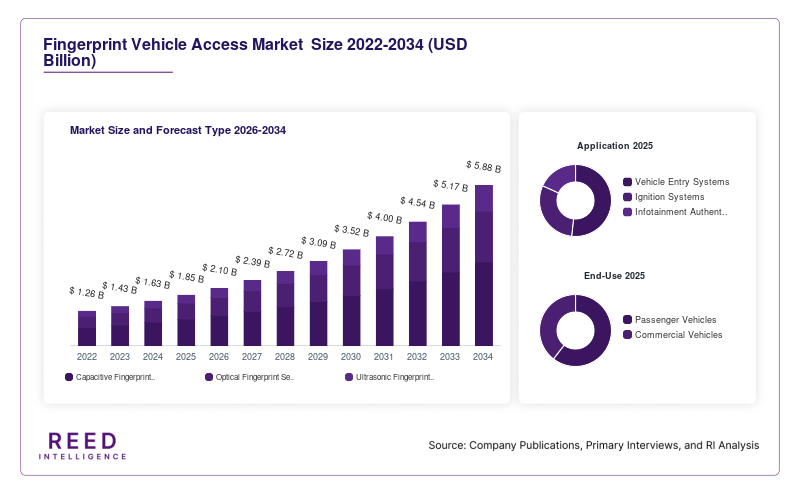
The capacitive fingerprint sensors segment dominated the market in 2024, accounting for approximately 48% of the total market share. These sensors are widely used due to their high accuracy, durability, and cost-effectiveness. Capacitive sensors detect fingerprint patterns through electrical signals, making them suitable for automotive applications. Their compact size and low power consumption further enhance their adoption. Automotive manufacturers prefer these sensors for integration into door handles and ignition systems, ensuring reliable performance under various conditions.
Optical fingerprint sensors are expected to be the fastest-growing segment, with a projected CAGR of 15.1% during the forecast period. These sensors use light-based imaging to capture fingerprint patterns, offering high-resolution data and improved accuracy. The growth of this segment is driven by advancements in imaging technology and increasing demand for enhanced security features. Additionally, optical sensors are being integrated into touchscreens and infotainment systems, providing a seamless user experience.
By Application
The vehicle entry system segment held the largest market share in 2024, accounting for around 55% of the total market. Fingerprint-based entry systems are widely adopted due to their convenience and security benefits. These systems eliminate the need for physical keys and enable quick access to vehicles. The increasing demand for contactless solutions and the integration of smart technologies are driving the growth of this segment.
The ignition system segment is expected to witness the highest growth, with a CAGR of 14.8% during the forecast period. Fingerprint-based ignition systems provide an additional layer of security by ensuring that only authorized users can start the vehicle. The growth of this segment is supported by the rising adoption of electric and autonomous vehicles, where secure user authentication is essential.
By End-Use
The passenger vehicles segment dominated the market in 2024, accounting for approximately 68% of the total market share. The increasing demand for advanced features in passenger cars, especially in the premium segment, is driving the adoption of fingerprint access systems. Consumers are seeking enhanced security and personalized experiences, which is encouraging automakers to integrate biometric technologies.
The commercial vehicles segment is expected to grow at the fastest rate, with a CAGR of 14.2%. The adoption of fingerprint access systems in commercial vehicles is driven by the need for fleet management and security. These systems enable companies to monitor and control vehicle access, reducing the risk of unauthorized usage. Additionally, the integration of biometric systems with telematics is enhancing operational efficiency.
Regional Analysis
North America
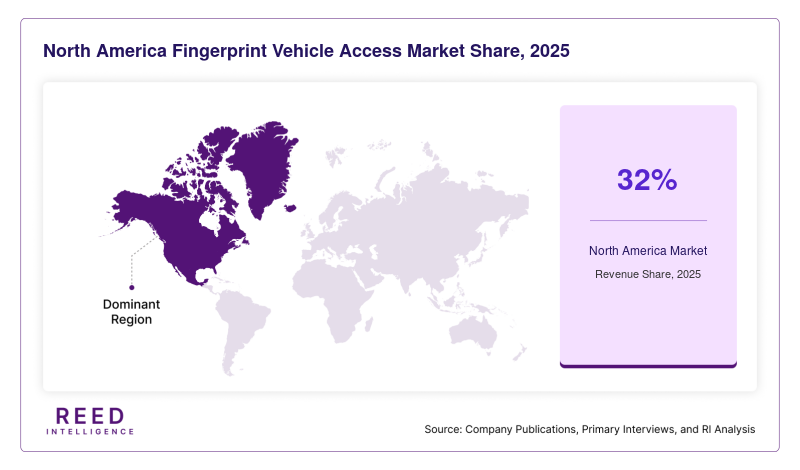
North America accounted for a significant share of the Fingerprint Vehicle Access Market in 2025, contributing approximately 32% of the global market. The region is projected to grow at a CAGR of 12.8% during the forecast period. The presence of advanced automotive infrastructure, high consumer awareness, and strong demand for connected vehicles are key factors driving market growth. Additionally, the adoption of electric vehicles and smart mobility solutions is further supporting the integration of biometric systems.
The United States dominates the regional market due to its strong automotive industry and technological innovation. A unique growth factor in this region is the increasing collaboration between automotive manufacturers and technology firms to develop integrated biometric solutions. These partnerships are enabling faster deployment of advanced access systems and enhancing overall vehicle security.
Europe
Europe held around 27% of the global market share in 2025 and is expected to grow at a CAGR of 13.2% through 2034. The region’s focus on vehicle safety regulations and technological advancements is driving the adoption of fingerprint access systems. Additionally, the presence of leading automotive manufacturers and increasing investments in research and development are contributing to market expansion.
Germany leads the European market, supported by its strong automotive manufacturing base. A unique growth factor is the emphasis on premium vehicle features and innovation. European consumers prioritize safety and advanced technology, which is encouraging automakers to integrate biometric systems into their vehicles.
Asia Pacific
Asia Pacific emerged as a rapidly growing region, accounting for 24% of the market share in 2025 and expected to register the highest CAGR of 15.6%. The region’s growth is driven by rising vehicle production, increasing disposable incomes, and growing demand for advanced automotive technologies. Governments are also promoting smart mobility solutions, further boosting market growth.
China dominates the Asia Pacific market due to its large automotive industry and rapid adoption of new technologies. A unique growth factor is the strong presence of domestic manufacturers investing in cost-effective biometric solutions. This is enabling wider adoption across different vehicle segments.
Middle East & Africa
The Middle East & Africa region accounted for approximately 9% of the global market in 2025 and is projected to grow at a CAGR of 11.9%. The market is driven by increasing demand for luxury vehicles and growing awareness of advanced security systems. Additionally, the adoption of smart city initiatives is supporting the integration of biometric technologies.
The United Arab Emirates leads the regional market, driven by high demand for premium vehicles. A unique growth factor is the increasing adoption of smart mobility solutions and government initiatives promoting technological innovation in transportation.
Latin America
Latin America held around 8% of the market share in 2025 and is expected to grow at a CAGR of 12.3%. The region is experiencing steady growth due to rising vehicle ownership and increasing awareness of advanced security features. Economic development and urbanization are also contributing to market expansion.
Brazil dominates the Latin American market due to its large automotive sector. A unique growth factor is the growing demand for affordable yet secure vehicle access solutions. Manufacturers are focusing on developing cost-effective biometric systems to cater to this demand.
Competitive Landscape
The Fingerprint Vehicle Access Market is moderately competitive, with several global and regional players focusing on innovation and strategic partnerships. Companies are investing in research and development to improve sensor accuracy, durability, and integration capabilities. The market is characterized by collaborations between automotive manufacturers and technology providers to develop advanced biometric solutions.
One of the leading companies in the market is Synaptics Incorporated, known for its advanced fingerprint sensor technologies. The company has recently introduced automotive-grade biometric solutions designed for enhanced durability and performance. Other key players are focusing on expanding their product portfolios and entering emerging markets to strengthen their market presence.
Key Players
- Synaptics Incorporated
- Fingerprint Cards AB
- Goodix Technology Inc.
- Qualcomm Technologies Inc.
- IDEMIA Group
- Bosch Mobility Solutions
- Continental AG
- Denso Corporation
- Valeo SA
- HID Global Corporation
- Thales Group
- Apple Inc.
- Samsung Electronics Co., Ltd.
- Fujitsu Limited
- NEC Corporation
Recent Developments
- In 2024, a major automotive supplier launched an integrated fingerprint access system designed specifically for electric vehicles, enhancing security and user experience.
- In 2023, a leading semiconductor company introduced a new generation of automotive-grade fingerprint sensors with improved resistance to environmental factors.
- In 2025, an automotive OEM partnered with a biometric technology provider to develop multi-modal authentication systems combining fingerprint and facial recognition.
Fingerprint Vehicle Access Market Segments
Type
- Capacitive Fingerprint Sensors
- Optical Fingerprint Sensors
- Ultrasonic Fingerprint Sensors
Application
- Vehicle Entry Systems
- Ignition Systems
- Infotainment Authentication
End-Use
- Passenger Vehicles
- Commercial Vehicles
By Region
- North America
- Europe
- APAC
- Middle East and Africa
- LATAM