Finished Heated Tobacco Market Size, Share & Trends Analysis Report By Product Type (Heated Tobacco Sticks, Heated Tobacco Devices), By Distribution Channel (Offline, Online) and By Region (North America, Europe, Asia Pacific, Latin America, Middle East & Africa) Forecasts, 2026–2034
USD 3950
Finished Heated Tobacco Market Size
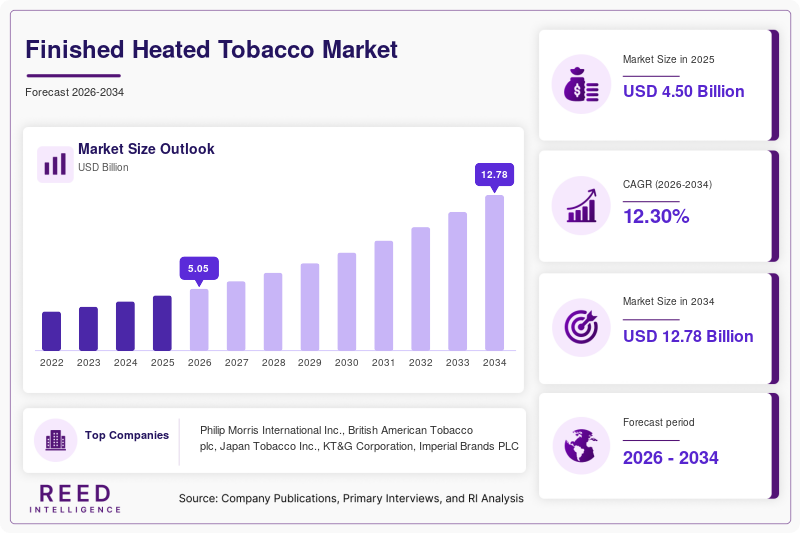
The global finished heated tobacco market was valued at USD 4.50 billion in 2025 and is projected to grow from USD 5.05 billion in 2026 to USD 12.78 billion by 2034, registering a CAGR of 12.30% during the forecast period from 2026 to 2034.
Finished heated tobacco products consist primarily of commercially manufactured tobacco sticks, tobacco units, capsules, and dedicated electronic heating devices designed to heat processed tobacco rather than combust it. The category differs from electronic cigarettes because the consumable contains tobacco rather than an e-liquid. WHO identifies heated tobacco products as tobacco products that generate aerosols containing nicotine and toxic chemicals when tobacco is heated.
The market's commercial development is being shaped by established tobacco companies that have built integrated ecosystems encompassing hardware, consumables, retail channels, digital engagement, and product-support services. IQOS, glo, and Ploom represent major branded platforms, while additional products from KT&G and other manufacturers broaden the competitive field.
Finished Heated Tobacco Market Drivers
Expansion of Smoke-Free Product Portfolios
Large tobacco manufacturers are allocating increasing commercial and R&D resources to smoke-free categories. PMI reported that its smoke-free business accounted for 42% of total net revenues in H1 2026, with IQOS maintaining strong underlying momentum. PMI has also invested more than USD 14 billion in smoke-free innovations since beginning its transformation toward alternative tobacco and nicotine products.
This strategy creates an integrated commercial mechanism in which hardware sales, recurring consumable purchases, retail relationships, and brand ecosystems reinforce one another. For finished heated tobacco, recurring consumable demand is particularly important because device adoption establishes an installed base that can generate repeated tobacco-stick purchases.
Increasing Consumer Adoption in Established Heated-Tobacco Markets
Japan provides one of the clearest examples of category penetration. Heated tobacco sales increased from 41.3 billion sticks in 2020 to 73.4 billion in 2025, while cigarette volumes declined from 98.8 billion to 78.2 billion over the same period. The data indicate a substantial shift in tobacco-product purchasing patterns rather than merely an increase in total tobacco-unit consumption.
Manufacturers are responding by broadening consumable variants and device formats. PMI, for example, expanded the SENTIA portfolio in Japan to 19 variants with the July 2026 launch of SENTIA Cobalt Blue.
Product Innovation and Platform Development
Competition increasingly occurs at the platform level rather than through individual tobacco-stick brands. Heating technology, battery architecture, temperature control, consumable design, charging, device ergonomics, and product personalization are becoming interconnected elements of finished-product differentiation.
BAT's glo portfolio illustrates this transition. The company launched glo Hilo and Hilo Plus in 2025 using dual-heating technology and subsequently streamlined its commercial footprint around glo Hilo in priority markets during 2026.
Finished Heated Tobacco Market Restraints
Regulatory and Public-Health Restrictions
Regulatory treatment remains fragmented across countries, affecting market access, product claims, taxation, flavors, advertising, packaging, retail distribution, and importation. WHO states that HTPs contain tobacco and toxic emissions and should be regulated as tobacco products. Its 2025 position paper also calls for controlled regulation of heated tobacco products and other nicotine products.
India illustrates the impact of restrictive policy. The country continues to prohibit the production, import, sale, and advertising of heated tobacco products under its 2019 prohibition framework, limiting the addressable commercial market despite India's large tobacco-consuming population.
Health-Evidence Uncertainty and Consumer Perception
The category continues to face scientific and consumer-perception constraints. WHO states that there is currently no conclusive evidence establishing that HTPs are less harmful than conventional cigarettes, while noting that some toxicants occur at lower levels and others can occur at similar or higher concentrations.
This creates a regulatory and communications challenge for manufacturers because reduced-exposure authorizations are product-specific. FDA's April 2026 renewal of selected IQOS products permits specified exposure-modification claims but explicitly does not mean that the products are safe or FDA-endorsed.
Finished Heated Tobacco Market Opportunities
Premiumization and Advanced Heating Technologies
Premium devices provide manufacturers with an avenue to differentiate beyond tobacco flavor and nicotine delivery. Newer generations emphasize faster heating, temperature control, induction or multi-heating technologies, battery improvements, and reduced cleaning requirements.
BAT's glo Hilo platform uses infrared and resistive heating, while PMI's ILUMA platform uses induction heating with dedicated SMARTCORE tobacco sticks. These developments create opportunities for manufacturers to segment consumers according to device performance, design, convenience, and consumable compatibility rather than relying solely on tobacco characteristics.
Expansion of Consumable Portfolios
Consumables represent a recurring component of the finished heated tobacco ecosystem. Manufacturers can expand consumer choice through additional tobacco blends, flavor profiles, nicotine characteristics, price tiers, and device-specific formats.
PMI's expansion of SENTIA in Japan and the introduction of additional IQOS-compatible products during 2026 demonstrate how consumable innovation can be used to deepen an existing device ecosystem.
Finished Heated Tobacco Market Segmental Analysis
By Product Type
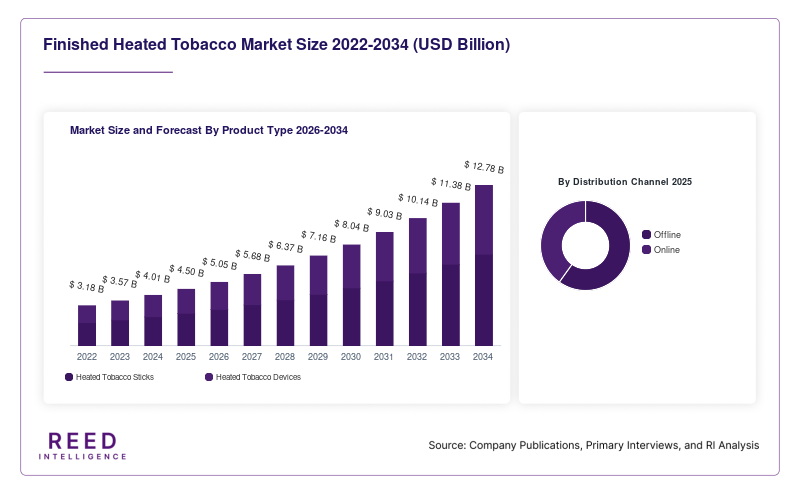
Heated Tobacco Sticks represented the dominant product category, accounting for approximately 69% share of the finished heated tobacco market. Their recurring-purchase structure, compatibility with established heating platforms, and broad flavor and tobacco-format portfolios make consumables a central component of the category's commercial model. Japan's 2025 heated-tobacco sales of 73.4 billion sticks illustrate the scale that consumable ecosystems can achieve in mature markets.
Heated Tobacco Devices represented approximately 31% share and are projected to record the faster growth trajectory, at approximately 14.1% CAGR through 2034. Device innovation is shifting toward induction heating, faster startup, improved battery systems, compact form factors, and simplified maintenance. PMI's IQOS ILUMA and BAT's glo Hilo demonstrate the movement toward differentiated heating platforms.
By Distribution Channel
Offline distribution accounted for approximately 82% share, supported by tobacco retailers, convenience stores, specialty stores, company-operated outlets, and other regulated physical points of sale. The category's regulatory requirements and the importance of device demonstrations and consumable availability reinforce the role of physical channels.
Online distribution accounted for approximately 18% share but is projected to register the faster growth rate at approximately 15.0% CAGR. Digital channels provide manufacturers with greater control over product information, device support, subscription-related services, and direct consumer engagement where regulations permit online sales.
Finished Heated Tobacco Market Regional Analysis
North America Finished Heated Tobacco Market
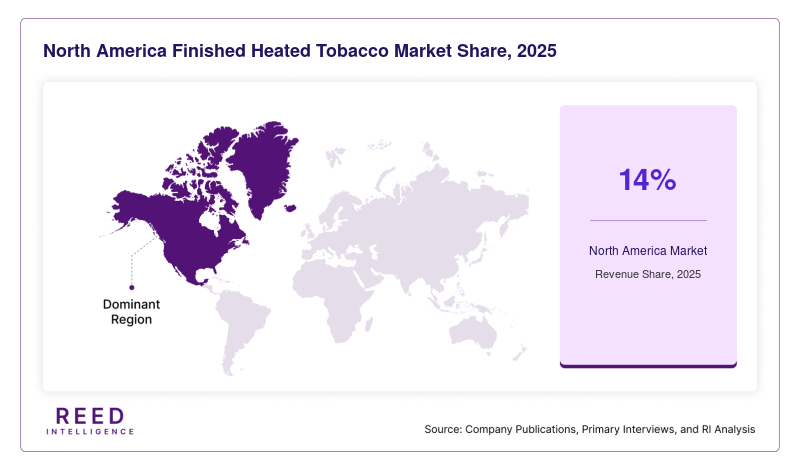
North America accounted for approximately 14% share of the global finished heated tobacco market. Regulatory authorization remains an important determinant of commercial access, particularly in the United States. FDA renewed modified-risk orders for five specific IQOS products in April 2026, providing continued authorization for specified exposure-modification communications.
The region is projected to expand at approximately 11.2% CAGR through 2034 as manufacturers develop regulated routes for smoke-free products and strengthen product portfolios.
Europe Finished Heated Tobacco Market
Europe represented approximately 24% share and is projected to expand at approximately 10.6% CAGR. The region contains several mature tobacco markets with established heated-product adoption, but national regulatory differences create uneven commercialization conditions.
Product taxation, advertising controls, packaging rules, and restrictions on flavors and nicotine-related communications remain important determinants of finished-product positioning.
Asia Pacific Finished Heated Tobacco Market
Asia Pacific was the dominant regional market, accounting for approximately 47% share, supported by established adoption in Japan and the presence of major manufacturers across Japan, South Korea, and other Asian markets. Japan's heated tobacco sales reached 73.4 billion sticks in fiscal 2025, demonstrating the depth of the category in a mature Asian market.
Asia Pacific is also the fastest-growing region, with an estimated 14.3% CAGR through 2034. Product launches, extensive retail networks, local manufacturing capabilities, and established consumer familiarity with heated tobacco platforms support regional expansion.
Latin America Finished Heated Tobacco Market
Latin America represented approximately 7% share and is projected to register a 10.2% CAGR. Market development remains highly dependent on national regulatory frameworks because countries differ substantially in their treatment of heated tobacco, electronic nicotine products, tobacco taxation, and advertising.
Where permitted, manufacturers can leverage established cigarette distribution infrastructure to introduce finished heated tobacco products, while restrictions can substantially constrain market access.
Middle East & Africa Finished Heated Tobacco Market
Middle East & Africa accounted for approximately 8% share and is projected to grow at approximately 11.0% CAGR. Adoption is concentrated in markets where modern nicotine products have established regulatory pathways and premium tobacco consumers have access to branded heating systems.
Regulatory uncertainty, import requirements, taxation, disposable-income differences, and uneven retail infrastructure remain important factors affecting the pace and geographic breadth of adoption.
Competitive Landscape
The finished heated tobacco market is concentrated around large multinational tobacco companies with proprietary device ecosystems and recurring consumable portfolios. Philip Morris International maintains a major position through IQOS, including IQOS ILUMA and compatible tobacco sticks. PMI reported more than 35 million adult users of its leading heated tobacco product as of July 2026 and stated that smoke-free products represented 42% of global net revenues in the first half of 2026.
British American Tobacco competes through glo, which is sold in approximately 30 markets. Its latest commercial strategy centers on glo Hilo in priority markets and a platform reset around Hyper Pro Plus. BAT stated in its 2026 first-half trading update that it was streamlining its commercial footprint to increase scale in priority heated-product markets.
Key Market Players
- Philip Morris International Inc.
- British American Tobacco plc
- Japan Tobacco Inc.
- KT&G Corporation
- Imperial Brands PLC
- Altria Group, Inc.
- Reynolds American Inc.
- China National Tobacco Corporation
- Shenzhen First Union Technology Co., Ltd.
- HNB Technology S.A.
Finished Heated Tobacco Market Recent Developments
-
September 2026 - Philip Morris International Philip Morris Japan opened the first global IQOS flagship store in Tokyo's Ginza district on September 4, 2026, creating a dedicated consumer-experience location for IQOS and heated tobacco products.
-
July 2026 - British American Tobacco BAT reported that it had streamlined its heated-products commercial footprint around glo Hilo in priority markets and initiated a Hyper Pro Plus platform reset, while citing competitive intensity and inventory effects in Japan.
Finished Heated Tobacco Market Segments
By Product Type
- Heated Tobacco Sticks
- Heated Tobacco Devices
By Distribution Channel
- Offline
- Online
By Region
- North America
- Europe
- APAC
- Middle East and Africa
- LATAM