Fipronil Pyrazole Market Size, Share & Demand Report By Formulation Type (Liquid Formulations, Granules, Gel-Based Formulations), By Application (Agricultural Pest Control, Veterinary Applications, Termite Control, Seed Treatment), By End Use (Residential Pest Management, Industrial Facilities, Veterinary Clinics, Government Pest Control Programs), By Region & Segment Forecasts, 2026–2034
USD 3950
Market Overview
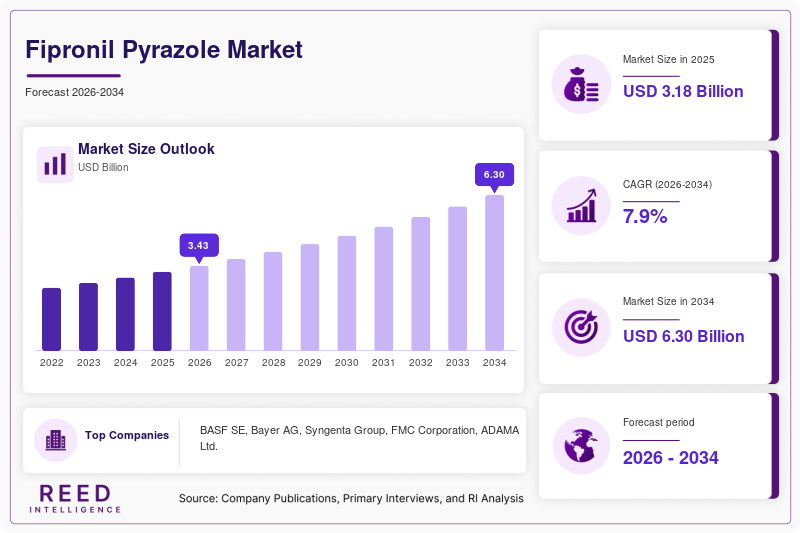
The global Fipronil Pyrazole Market size was valued at USD 3.18 billion in 2026 and is projected to reach USD 5.86 billion by 2034, expanding at a CAGR of 7.9% during the forecast period. The market continues to gain traction due to the increasing demand for broad-spectrum insecticides across agricultural and veterinary applications. Fipronil pyrazole compounds are widely used to control termites, beetles, ants, locusts, fleas, and crop-damaging insects because of their strong residual activity and effectiveness at low concentrations. Growing pressure on food production systems, changing climatic conditions, and increasing infestation rates across cereal, vegetable, and fruit crops are supporting long-term product adoption.
The expansion of commercial farming activities in emerging economies has become a major factor driving market growth. Large-scale agricultural producers are increasingly adopting advanced crop protection chemicals to improve productivity and minimize economic losses caused by pest attacks. In addition, rising demand for seed treatment products and integrated pest management solutions has strengthened the position of fipronil pyrazole formulations within the agrochemical industry. The veterinary sector is also contributing to market expansion through the growing use of flea and tick treatment products for companion animals and livestock.
Key Highlights
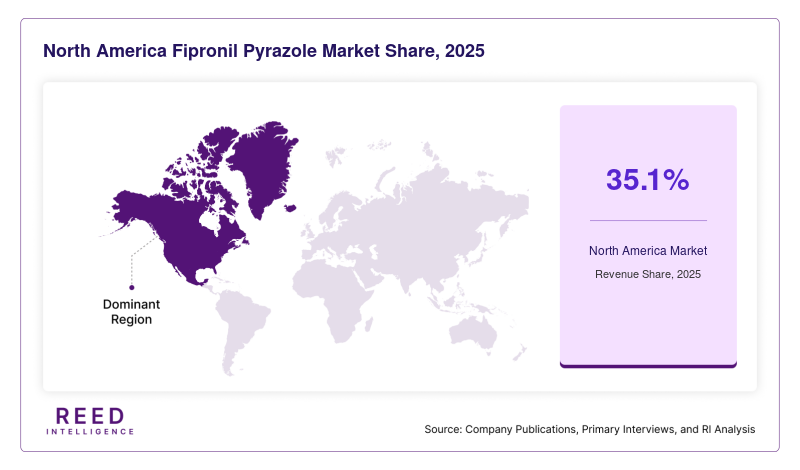
- North America dominated the market with a 35.1% share in 2025.
- Asia Pacific is expected to grow at the fastest CAGR of 9.8% during 2026–2034.
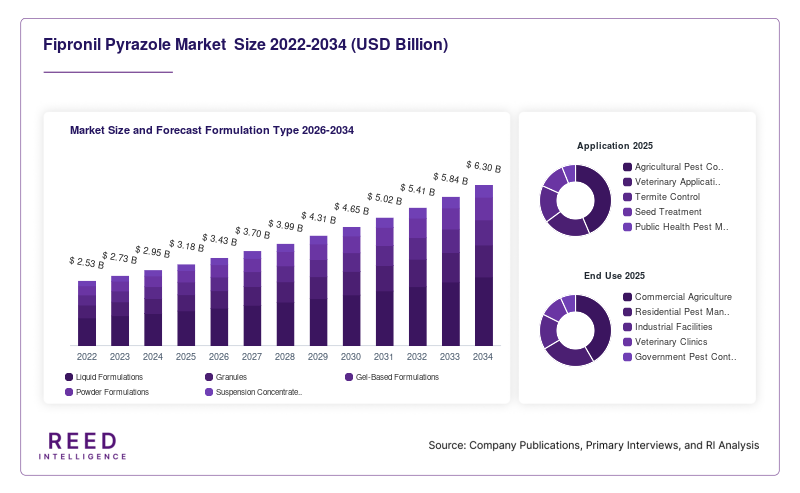
- By formulation type, liquid formulations accounted for the largest share of 42.6%.
- while gel-based formulations are projected to grow at a CAGR of 10.1%.
- By application, agricultural pest control led with a 48.4% share.
- whereas veterinary applications are expected to expand at a CAGR of 9.5%.
- By end use, commercial agriculture accounted for the highest share of 51.8%.
- while residential pest management is projected to grow at a CAGR of 8.9%.
- The United States remained the dominant country, with market values of USD 610 million in 2024 and USD 665 million in 2025.
Market Trends
Expansion of Seed Treatment Applications
The increasing adoption of seed treatment technologies is emerging as a major trend in the Fipronil Pyrazole Market. Agricultural producers are shifting toward preventive pest management practices that protect crops during early growth stages and improve germination efficiency. Fipronil pyrazole compounds are increasingly integrated into seed treatment solutions for corn, rice, soybean, and wheat cultivation due to their ability to protect roots and seedlings from soil-borne insects. This trend is particularly strong in regions with high pest pressure and intensive farming activities. Seed treatment methods also help reduce the volume of pesticide applications during the crop cycle, improving operational efficiency and reducing labor costs. Manufacturers are responding by introducing multi-action formulations that combine insecticidal and fungicidal properties. The growing emphasis on crop productivity and sustainable farming practices is expected to further increase demand for advanced seed treatment products during the forecast period.
Rising Adoption in Companion Animal Healthcare
The growing focus on companion animal healthcare is creating strong momentum for fipronil pyrazole products in veterinary applications. Pet owners are increasingly investing in flea, tick, and mite control products to improve animal hygiene and prevent disease transmission. Veterinary clinics and pet care companies are expanding their portfolios with topical sprays, spot-on treatments, and medicated shampoos containing fipronil pyrazole compounds because of their long-lasting efficacy. Urbanization and rising disposable income levels are contributing to increased pet ownership rates across developing and developed economies. In addition, online distribution channels and organized pet retail networks are making veterinary treatment products more accessible to consumers. Product manufacturers are also investing in improved formulations with reduced odor, better skin compatibility, and longer residual protection. The growing humanization of pets and increasing awareness regarding parasite-related diseases are expected to support sustained market demand over the next decade.
Market Drivers
Growing Demand for High-Yield Agricultural Production
The rising global requirement for food security is a significant driver for the Fipronil Pyrazole Market. Rapid population growth and shrinking arable land availability are encouraging farmers to maximize crop output through efficient pest management practices. Pest infestations continue to cause considerable yield losses in grains, vegetables, fruits, and oilseed crops, increasing the need for highly effective insecticides. Fipronil pyrazole products offer broad-spectrum protection and longer residual control compared to conventional alternatives, making them suitable for intensive farming systems. Large-scale farming enterprises are increasingly investing in advanced agrochemical solutions to reduce crop damage and maintain product quality standards. Government support programs focused on agricultural modernization are also accelerating adoption in emerging economies. The expansion of precision farming technologies and increased awareness regarding economic crop losses caused by insect attacks are expected to maintain strong market demand throughout the forecast period.
Increasing Infestation Rates Linked to Climate Variability
Changing climatic conditions are contributing to the spread of insect populations and increasing pest resistance across several agricultural regions. Higher temperatures, irregular rainfall patterns, and changing humidity levels are creating favorable conditions for insect breeding and migration, resulting in frequent outbreaks across crop-producing nations. This has intensified the demand for reliable pest control chemicals with long-duration effectiveness. Fipronil pyrazole formulations are gaining preference because they can target multiple insect species while maintaining stable performance under varied environmental conditions. Agricultural producers are increasingly adopting preventive insecticide programs to minimize the financial impact of infestation-related crop losses. The rising occurrence of termite infestations in residential and commercial infrastructure is also contributing to product demand beyond agriculture. As climate variability continues to influence pest distribution patterns, the need for efficient crop and structural protection solutions is expected to strengthen market growth.
Market Restraint
Regulatory Restrictions and Environmental Concerns
Stringent environmental regulations related to pesticide usage remain a major restraint for the Fipronil Pyrazole Market. Regulatory authorities in several countries have imposed restrictions on the application of fipronil-based products due to concerns regarding ecological toxicity, pollinator decline, and contamination of aquatic ecosystems. Increasing scrutiny over chemical residues in food products has also led to tighter compliance requirements for agrochemical manufacturers and agricultural producers. These regulations often increase operational costs associated with testing, product registration, labeling, and environmental monitoring. In some regions, limitations on crop-specific usage and dosage levels have affected product penetration and reduced sales opportunities for manufacturers. Environmental advocacy groups are also encouraging the adoption of biological pest control methods and organic farming practices, creating additional competitive pressure on chemical insecticides. For example, certain European agricultural markets have reduced the use of broad-spectrum insecticides in sensitive farming zones to protect biodiversity and groundwater quality. Such regulatory developments may slow product approvals and limit expansion opportunities in environmentally sensitive regions.
Market Opportunities
Expansion of Integrated Pest Management Programs
The increasing implementation of integrated pest management programs is creating new growth opportunities for the Fipronil Pyrazole Market. Agricultural producers are seeking balanced pest control strategies that combine chemical, biological, and mechanical methods to improve sustainability while maintaining crop productivity. Fipronil pyrazole products are being incorporated into integrated pest management systems because they can be used in targeted and low-dose applications with effective pest control outcomes. This compatibility supports their use in modern farming programs focused on reducing unnecessary pesticide exposure. Governments and agricultural organizations are promoting training initiatives that encourage efficient pesticide application and resistance management. The growing adoption of drone spraying technologies and precision agriculture tools is also supporting more controlled use of insecticides. As farmers continue to transition toward data-driven crop protection practices, demand for efficient and adaptable insecticide solutions is expected to increase steadily across both developed and emerging agricultural markets.
Rising Demand Across Emerging Agricultural Economies
Emerging economies in Asia, Latin America, and Africa are presenting strong opportunities for market participants due to rapid agricultural commercialization and increasing crop protection awareness. Many developing countries are expanding irrigation infrastructure, mechanized farming operations, and export-oriented crop production, creating higher demand for advanced agrochemical products. Small and medium-scale farmers are increasingly adopting modern insecticide formulations to improve crop quality and reduce post-harvest losses. Distribution partnerships between agrochemical manufacturers and local retailers are improving product accessibility in rural farming communities. In addition, government initiatives supporting agricultural productivity and food security are encouraging the use of modern pest control solutions. The expansion of horticulture cultivation, rice farming, and cash crop production in emerging economies is expected to create long-term demand for fipronil pyrazole formulations. Companies investing in localized production facilities and region-specific formulations are likely to gain competitive advantages in these high-growth markets.
Segmental Analysis
By Formulation Type
Liquid formulations accounted for the largest share of the Fipronil Pyrazole Market in 2024, representing 42.6% of global revenue. These formulations are widely preferred because they provide easy application, strong dispersion capability, and compatibility with large-scale agricultural spraying systems. Commercial farmers favor liquid insecticides for crop protection programs involving cereals, vegetables, fruits, and oilseed crops due to their rapid action and consistent coverage performance. The segment also benefits from extensive use in termite control and veterinary treatment products where uniform distribution is essential for effective pest management. Manufacturers continue to invest in concentrated suspension technologies and improved stability features to increase shelf life and operational efficiency. Rising adoption of precision spraying equipment and mechanized farming practices is further supporting the dominance of liquid formulations across developed and emerging agricultural markets.
Gel-based formulations are projected to register the fastest CAGR of 10.1% during the forecast period due to increasing demand for targeted pest management solutions in residential, commercial, and veterinary applications. Gel products are gaining traction because they minimize product wastage while improving application precision in localized infestation areas. Pest management service providers increasingly use gel formulations for ant and cockroach control in urban infrastructure, food processing facilities, and hospitality environments. The veterinary sector is also contributing to growth through the introduction of easy-to-apply topical products for companion animals. Manufacturers are focusing on low-odor and residue-resistant gel technologies to improve consumer acceptance and safety standards. The growing preference for controlled application methods and the rising expansion of organized pest control services are expected to accelerate segment growth over the coming years.
By Application
Agricultural pest control represented the dominant application segment in 2024, accounting for 48.4% of the global market share. The segment continues to benefit from rising demand for effective crop protection solutions capable of managing a wide range of insect species across cereals, vegetables, fruits, and plantation crops. Farmers are increasingly using fipronil pyrazole formulations to reduce yield losses caused by termites, beetles, grasshoppers, and stem borers. Strong residual activity and compatibility with integrated pest management systems have strengthened product adoption within commercial farming operations. In addition, the expansion of seed treatment programs and precision agriculture practices has increased the importance of advanced insecticide products within modern farming systems. Agrochemical distributors are also expanding rural penetration through localized retail networks and farmer awareness programs, further supporting segment growth across emerging agricultural economies.
Veterinary applications are anticipated to witness the fastest CAGR of 9.5% during 2026–2034 due to rising pet ownership and increasing awareness regarding animal hygiene and parasite prevention. Companion animal healthcare spending has increased significantly in urban markets where pet owners are seeking long-lasting flea and tick treatment solutions. Veterinary clinics and pet care brands are introducing improved spot-on treatments, sprays, shampoos, and collar products containing fipronil pyrazole compounds because of their broad-spectrum effectiveness. Livestock producers are also adopting advanced parasite management programs to improve animal health and productivity. The expansion of organized pet retail stores and e-commerce channels is making veterinary treatment products more accessible to consumers. Increasing emphasis on preventive healthcare and rising demand for premium veterinary products are expected to create sustained growth opportunities for this segment.
By End Use
Commercial agriculture accounted for the highest share of the Fipronil Pyrazole Market in 2024, representing 51.8% of total revenue. Large farming enterprises rely heavily on advanced insecticide products to protect crop yields, maintain quality standards, and reduce financial losses caused by infestations. Commercial growers involved in export-oriented agriculture require consistent pest control solutions that support productivity and compliance with international quality requirements. The segment is benefiting from the rapid expansion of mechanized farming systems, irrigation projects, and precision agriculture technologies. Large-scale producers are increasingly adopting integrated crop management strategies that combine advanced insecticides with data-driven monitoring tools to optimize productivity. In addition, agricultural cooperatives and government-backed modernization programs are improving awareness regarding effective pesticide usage and resistance management. These factors continue to strengthen demand from the commercial agriculture sector.
Residential pest management is expected to expand at the fastest CAGR of 8.9% during the forecast period due to increasing urbanization and rising awareness regarding household hygiene standards. Demand for termite control, ant management, and cockroach treatment solutions is increasing across residential complexes, commercial buildings, and public infrastructure. Urban consumers are increasingly seeking long-lasting and low-maintenance pest control products that can be applied safely in indoor environments. Organized pest control service providers are expanding rapidly in metropolitan areas, creating higher consumption of specialized formulations designed for localized applications. Product innovation focused on odor reduction, improved safety, and convenient packaging is also improving consumer acceptance. In emerging economies, rising disposable incomes and growing investments in housing infrastructure are expected to further support segment expansion over the coming years.
Regional Analysis
North America
North America accounted for 35.1% of the global Fipronil Pyrazole Market in 2025 and is expected to maintain a stable growth trajectory with a forecast CAGR of 6.9% during 2026–2034. The region benefits from advanced agricultural infrastructure, strong adoption of precision farming technologies, and widespread use of professional pest management solutions. Demand remains high across commercial farming, residential termite control, and veterinary applications. The presence of established agrochemical manufacturers and strong distribution networks also contributes to regional market stability. Increasing investments in crop productivity improvement programs continue to support product consumption across the United States and Canada.
The United States represents the dominant country in the regional market due to its large-scale agricultural sector and extensive use of advanced insecticide formulations. The country recorded substantial demand from corn, soybean, and wheat cultivation areas where insect infestation management remains a priority. One unique growth factor in the country is the rising adoption of precision application technologies, including GPS-guided spraying systems and drone-assisted pesticide delivery. These technologies improve application efficiency and reduce chemical wastage, encouraging greater acceptance of premium insecticide products among commercial farmers and pest management companies.
Europe
Europe held a significant share of the Fipronil Pyrazole Market in 2025 and is projected to expand at a CAGR of 6.1% during the forecast period. Market growth in the region is influenced by the need for efficient crop protection products despite increasingly strict environmental regulations. Demand remains concentrated in high-value agricultural sectors such as fruits, vegetables, vineyards, and greenhouse farming. Professional pest control services also contribute to regional revenue generation, particularly in urban infrastructure and food storage facilities. Manufacturers are focusing on low-dose and controlled-release formulations to comply with evolving regulatory standards and environmental sustainability requirements.
France emerged as the dominant country within the European market because of its strong agricultural production base and advanced agrochemical distribution systems. The country maintains extensive cultivation of cereals, grapes, and horticultural crops that require effective pest management solutions to maintain export quality standards. A unique growth factor in France is the increasing investment in precision greenhouse farming technologies, which require highly targeted insecticide applications for pest control efficiency. The integration of digital monitoring systems and automated spraying equipment is supporting demand for specialized formulations with controlled environmental impact.
Asia Pacific
Asia Pacific is anticipated to register the fastest CAGR of 9.8% during 2026–2034, supported by rapid agricultural expansion and increasing crop protection awareness. The region accounted for a substantial portion of global consumption in 2025 due to high agricultural dependence and large-scale cultivation of rice, vegetables, and fruits. Rising population levels and growing food demand are pushing governments and farming enterprises to improve agricultural productivity through modern pest management techniques. The market is also benefiting from improving agrochemical distribution channels, rising mechanization rates, and increasing investments in commercial farming operations across developing countries.
China remains the leading country in the regional market because of its extensive agricultural output and large agrochemical manufacturing base. The country continues to witness strong demand for insecticides in rice paddies, vegetable farms, and export-oriented horticulture production. One unique growth factor driving the Chinese market is the expansion of smart agriculture initiatives supported by government modernization programs. Digital farm management platforms, automated spraying technologies, and large-scale precision farming practices are increasing the adoption of advanced insecticide products. Domestic manufacturers are also expanding export capacities to strengthen their position in global agrochemical supply chains.
Middle East & Africa
The Middle East & Africa region is projected to grow at a CAGR of 7.1% during the forecast period, supported by rising investments in agricultural development and pest management infrastructure. The market is gradually expanding as governments focus on improving food security and reducing dependence on imported agricultural products. Demand for fipronil pyrazole formulations is increasing across cereal farming, horticulture, and livestock management activities. The expansion of commercial greenhouse projects and irrigation-based farming systems is also contributing to higher insecticide consumption. International agrochemical companies are strengthening regional distribution partnerships to improve product availability across developing agricultural markets.
Saudi Arabia represents the dominant country in the regional market due to its investments in controlled-environment agriculture and modern farming technologies. The country is actively promoting greenhouse cultivation and water-efficient farming systems to improve domestic food production capacity. A unique growth factor supporting the Saudi Arabian market is the increasing adoption of protected agriculture techniques that require advanced pest management solutions. High-value greenhouse crops such as tomatoes, cucumbers, and peppers are vulnerable to insect infestations, creating strong demand for effective and long-lasting insecticide formulations with controlled application characteristics.
Latin America
Latin America accounted for a notable share of the Fipronil Pyrazole Market in 2025 and is expected to expand at a CAGR of 7.6% during 2026–2034. The region benefits from large-scale agricultural exports, favorable climatic conditions for crop cultivation, and increasing use of modern farming inputs. Demand for fipronil pyrazole products is particularly strong in soybean, sugarcane, corn, and coffee cultivation. Agricultural producers are increasingly adopting advanced crop protection products to minimize economic losses caused by insect outbreaks and improve export-quality standards. Growing awareness regarding integrated pest management practices is also contributing to regional market growth.
Brazil emerged as the leading country in the Latin American market due to its extensive agricultural production and export-oriented farming sector. The country experiences high levels of pest pressure across several crop categories, creating sustained demand for broad-spectrum insecticides. One unique growth factor driving the Brazilian market is the expansion of large-scale soybean farming in newly cultivated agricultural zones. These regions often face severe infestations from soil insects and leaf-feeding pests, encouraging producers to adopt preventive insecticide programs. Increasing investments in agricultural logistics and farm mechanization are further supporting product penetration.
Competitive Landscape
The competitive landscape of the Fipronil Pyrazole Market is characterized by the presence of multinational agrochemical companies, regional manufacturers, and specialized veterinary product providers. Market participants are competing through formulation innovation, pricing strategies, distribution expansion, and investment in environmentally compliant product development. Leading companies are strengthening their research capabilities to develop low-dose formulations with improved residual performance and reduced ecological impact. Strategic collaborations with agricultural distributors and veterinary healthcare providers are also supporting market penetration across emerging economies.
BASF SE remains one of the leading participants in the market due to its broad agrochemical portfolio, extensive global distribution network, and ongoing investments in advanced crop protection technologies. The company recently expanded its insecticide research initiatives focused on precision agriculture applications and sustainable formulation development. Other major players are concentrating on regional manufacturing expansion and digital agriculture partnerships to improve supply chain efficiency and strengthen customer engagement. Increasing competition from generic manufacturers in Asia is encouraging established companies to focus on premium formulations, technical support services, and integrated pest management solutions.
Key Players
- BASF SE
- Bayer AG
- Syngenta Group
- FMC Corporation
- ADAMA Ltd.
- UPL Limited
- Nufarm Limited
- Sumitomo Chemical Co., Ltd.
- Corteva Agriscience
- Jiangsu Yangnong Chemical Group
- Nissan Chemical Corporation
- Bharat Rasayan Limited
- Shandong Weifang Rainbow Chemical Co., Ltd.
- Gharda Chemicals Ltd.
Recent Developments
- BASF SE introduced an upgraded fipronil pyrazole formulation in 2025 designed for precision seed treatment applications with improved residual effectiveness and lower dosage requirements.
- Syngenta Group expanded its agrochemical distribution partnership network across Southeast Asia in 2025 to strengthen product availability in rice and vegetable farming regions.
- FMC Corporation announced the expansion of its veterinary product portfolio in 2024 with new companion animal parasite control solutions targeting flea and tick management.
- UPL Limited established a new formulation manufacturing facility in Latin America in 2025 to improve regional supply chain efficiency and support growing agricultural demand.
Fipronil Pyrazole Market Segments
Formulation Type
- Liquid Formulations
- Granules
- Gel-Based Formulations
- Powder Formulations
- Suspension Concentrates
Application
- Agricultural Pest Control
- Veterinary Applications
- Termite Control
- Seed Treatment
- Public Health Pest Management
End Use
- Commercial Agriculture
- Residential Pest Management
- Industrial Facilities
- Veterinary Clinics
- Government Pest Control Programs
By Region
- North America
- Europe
- APAC
- Middle East and Africa
- LATAM