Fireproofing Hydraulic Fluid Market Size, Share & Trends Analysis Report By Fluid Type, By Application, By End User and By Region, Forecasts 2026–2034
USD 3950
Fireproofing Hydraulic Fluid Market Size
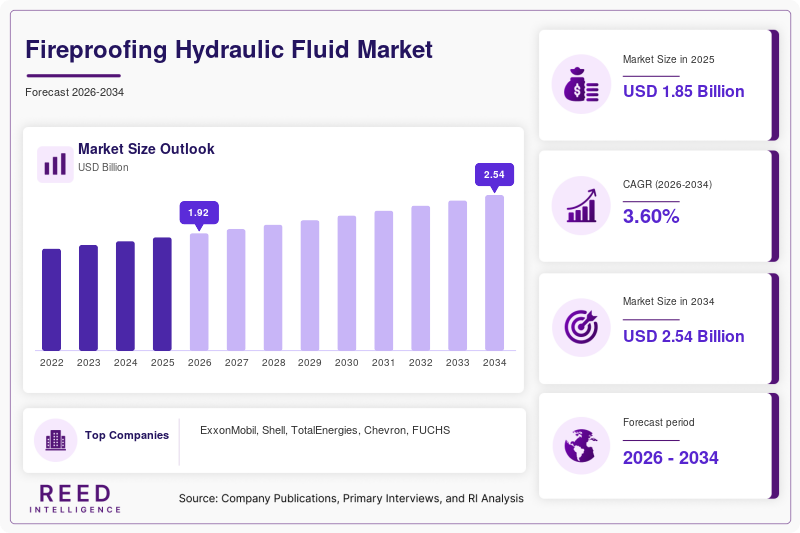
The global fireproofing hydraulic fluid market was valued at USD 1.85 billion in 2025 and is projected to grow from USD 1.92 billion in 2026 to USD 2.56 billion by 2034, registering a CAGR of 3.60% during the forecast period from 2026 to 2034.
Fireproofing hydraulic fluids, more commonly referred to as fire-resistant hydraulic fluids, are used where conventional mineral-oil-based hydraulic fluids could present an elevated fire hazard. Key applications include steel and foundry operations, mining, aerospace, offshore energy, power generation, construction and heavy industrial machinery.
The market is supported by workplace safety requirements, increasing industrial automation and the continued operation of hydraulic equipment in high-temperature environments. Steel mills, foundries and mining operations represent important demand centers because hydraulic systems can operate near molten metal, furnaces, high-temperature machinery and other ignition sources.
Fireproofing Hydraulic Fluid Market Drivers
Increasing Industrial Fire-Safety Requirements
Industrial facilities operating hydraulic machinery near furnaces, molten metals and other heat sources require fluids that reduce the likelihood and severity of hydraulic-fluid fires.
Safety standards and workplace risk-management requirements are therefore supporting adoption across high-risk industries.
Growth of Steel and Metal Processing
Steel and foundry operations are major users of fire-resistant hydraulic fluids.
Hydraulic systems used around casting, rolling and metal-forming equipment can be exposed to high temperatures and ignition sources, increasing demand for specialized fluids. Mordor Intelligence estimates that steel and foundry applications accounted for 26.67% of 2025 market revenue in its market framework.
Expansion of Mining Activities
Mining equipment frequently operates in confined and hazardous environments where hydraulic-fluid ignition can create significant safety risks.
Fire-resistant formulations are therefore used in underground mining equipment and other hydraulic machinery where fire prevention is particularly important.
Growth in Offshore Energy
Offshore oil, gas and wind installations use hydraulic systems for cranes, pitch systems, mooring systems and other equipment.
The combination of high equipment pressures, limited access and environmental sensitivity is supporting demand for fire-resistant and biodegradable hydraulic fluids. Offshore oil, gas and wind applications were identified as one of the faster-growing segments in recent market analysis.
Increasing Industrial Automation
Automation is increasing the number of hydraulic systems operating continuously and at higher performance levels.
As hydraulic machinery becomes more integrated into automated production lines, fluid reliability, thermal stability and fire safety are becoming increasingly important.
Fireproofing Hydraulic Fluid Market Restraints
Higher Cost of Specialty Fluids
Fire-resistant hydraulic fluids can cost more than conventional mineral-oil-based hydraulic fluids.
The higher initial fluid cost can discourage adoption among price-sensitive users where fire risk is considered relatively low.
Compatibility Requirements
Different formulations can have different compatibility characteristics with seals, hoses, coatings and hydraulic components.
Switching from conventional mineral oil can therefore require compatibility assessments and, in some cases, replacement of system components.
Lower Lubricity of Some Water-Based Fluids
Water-containing formulations can provide strong fire resistance but may have lower lubricity than conventional hydraulic oils.
This can affect component wear and equipment performance in systems not specifically designed for water-based fluids.
Maintenance and Fluid Management
Some fire-resistant formulations require careful monitoring of water content, contamination, viscosity and other properties.
Incorrect fluid maintenance can reduce system performance and service life.
Fireproofing Hydraulic Fluid Market Opportunities
Growth of Synthetic Ester Fluids
HFDU synthetic esters are gaining attention because of their biodegradability and suitability for environmentally sensitive applications.
Recent industry analysis projects HFDU synthetic esters to grow at approximately 3.56% CAGR through 2031.
Offshore Wind Development
The expansion of offshore wind installations creates opportunities for fire-resistant hydraulic fluids used in turbine hydraulic systems, cranes and associated equipment.
The offshore oil, gas and wind application category was projected to grow at approximately 4.11% CAGR through 2031 in one recent market analysis.
Electrification and Advanced Machinery
Increasing electrification and automation of heavy equipment are creating additional requirements around fire safety and thermal performance.
This is encouraging equipment manufacturers and operators to evaluate specialized hydraulic fluids for demanding operating environments.
Environmentally Compliant Fluids
Environmental regulations are encouraging mining, marine, construction and offshore operators to consider biodegradable synthetic ester formulations.
This creates opportunities for suppliers offering fluids that combine fire resistance with improved environmental performance.
Real-Time Fluid Monitoring
Digital fluid-monitoring systems can track operating conditions and contamination, helping operators extend service intervals and reduce maintenance costs.
The integration of monitoring technologies with specialty hydraulic fluids represents an emerging opportunity.
Fluid Type Segment Analysis
By Fluid Type
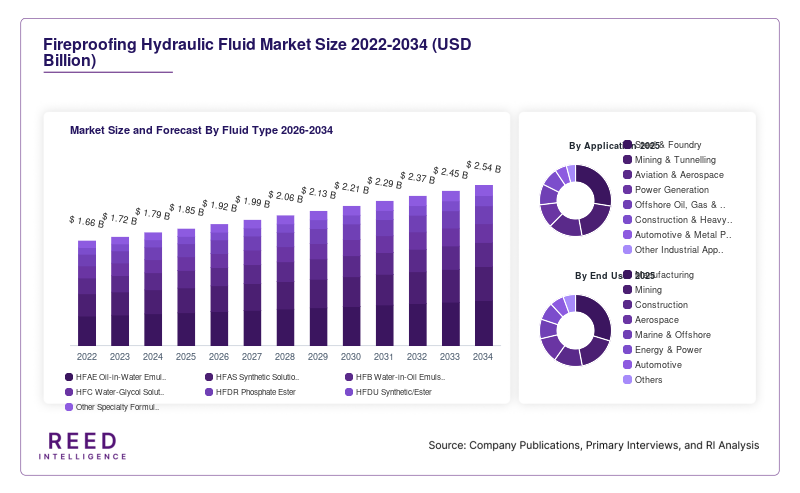
HFC water-glycol fluids accounted for approximately 31.22% of the fire-resistant hydraulic fluid market in 2025, making them the largest fluid-type segment in the cited market framework. Their adoption is supported by cost advantages and established use in steel-mill and industrial hydraulic systems.
HFDU synthetic/ester fluids are among the fastest-growing major categories, with a projected CAGR of approximately 3.56% through 2031. Their growth is associated with biodegradability requirements and increasing adoption in marine, mining, construction and offshore applications.
HFDR phosphate-esters remain important in aerospace applications because of their thermal stability and established qualification requirements, while HFA and HFB formulations serve specialized water-based applications.
Application Segment Analysis
By Application
Steel and foundry applications accounted for approximately 26.67% of market revenue in 2025, making them the largest application segment in the cited market framework. Hydraulic systems used near molten metal, casting equipment and high-temperature production processes require enhanced fire resistance.
Offshore oil, gas and wind applications are among the fastest-growing major application areas, with a projected CAGR of approximately 4.11% through 2031. Expansion of offshore infrastructure and demand for fluids suitable for high-pressure hydraulic systems are supporting growth.
Mining and tunnelling, aviation and aerospace, power generation, construction and heavy equipment, and automotive and metal-press applications account for additional demand.
End-User Segment Analysis
By End User
Manufacturing represents the largest end-user category, supported by widespread use of hydraulic presses, metal-forming machinery, casting equipment and automated production systems.
Aerospace is among the faster-growing specialized end-user segments, supported by aircraft production, maintenance activity and stringent requirements for hydraulic-system safety and fluid performance.
Mining and marine/offshore users also represent important growth opportunities because hydraulic equipment operates in environments where fire incidents can have significant operational and safety consequences.
Fireproofing Hydraulic Fluid Market Regional Analysis
Asia-Pacific Holds the Largest Share
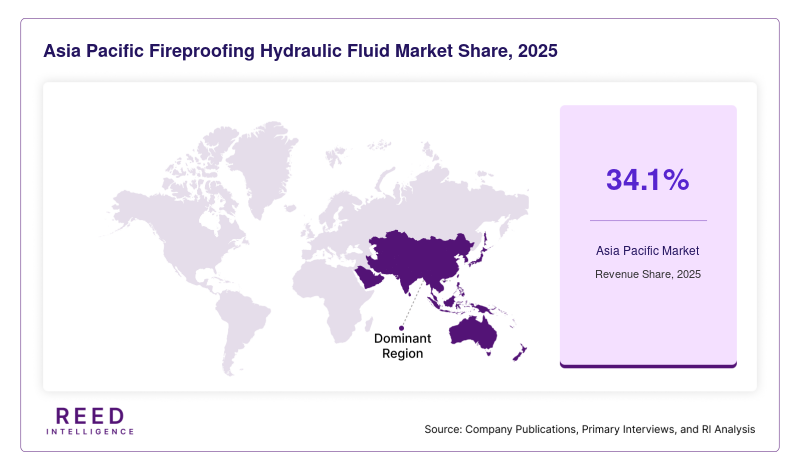
Asia-Pacific accounted for approximately 34.11% of 2025 revenue in the cited market framework, making it the largest regional market. Strong steel production, mining activity, manufacturing capacity and industrial development support demand for fire-resistant hydraulic fluids.
North America Maintains Strong Demand
North America has established demand across steel manufacturing, mining, aerospace, power generation and heavy equipment applications.
Industrial safety requirements and established hydraulic-equipment infrastructure support continued consumption.
Europe Focuses on Performance and Environmental Compliance
Europe represents an important market for fire-resistant hydraulic fluids, particularly in industrial manufacturing, aerospace, offshore wind and environmentally sensitive applications.
Demand for biodegradable synthetic esters is supported by environmental regulations and sustainability requirements.
Middle East & Africa Shows Strong Growth Potential
Middle East & Africa is projected to be one of the fastest-growing regional markets, with an estimated CAGR of approximately 4.67% from 2026 through 2031 in the cited market analysis. Offshore oil and gas activity, mining and emerging wind projects are supporting regional demand.
Latin America Represents an Emerging Market
Mining, metal processing, agriculture-related heavy equipment and industrial development are creating opportunities for fire-resistant hydraulic-fluid suppliers in Latin America.
Fireproofing Hydraulic Fluid Market Competitive Landscape
Competition in the fireproofing hydraulic fluid market is based on fire resistance, lubrication performance, thermal stability, biodegradability, equipment compatibility, certifications, product lifecycle, pricing and technical support.
Major lubricant manufacturers are developing water-glycol, phosphate-ester and synthetic-ester formulations for specialized industrial applications.
Key Market Players
- ExxonMobil
- Shell
- TotalEnergies
- Chevron
- FUCHS
- Quaker Houghton
- Castrol
- Lubrizol
- Petronas
- Idemitsu Kosan
Fireproofing Hydraulic Fluid Market Recent Developments
- Synthetic ester formulations are gaining adoption in applications where biodegradability and fire resistance are both important. Mining, construction, marine and offshore operators are increasingly evaluating these formulations as environmental requirements become more stringent.
- Offshore oil, gas and wind installations are creating new demand for hydraulic fluids capable of operating under high pressures and variable temperatures. The offshore segment is projected to grow faster than several established application categories.
Fireproofing Hydraulic Fluid Market Segments
By Fluid Type
- HFAE Oil-in-Water Emulsion
- HFAS Synthetic Solution
- HFB Water-in-Oil Emulsion
- HFC Water-Glycol Solution
- HFDR Phosphate Ester
- HFDU Synthetic/Ester
- Other Specialty Formulations
By Application
- Steel & Foundry
- Mining & Tunnelling
- Aviation & Aerospace
- Power Generation
- Offshore Oil, Gas & Wind
- Construction & Heavy Equipment
- Automotive & Metal Pressing
- Other Industrial Applications
By End User
- Manufacturing
- Mining
- Construction
- Aerospace
- Marine & Offshore
- Energy & Power
- Automotive
- Others
By Region
- North America
- Europe
- APAC
- Middle East and Africa
- LATAM