Fish Collagen Peptide Market Size, Share & Demand Report By Source (Skin, Scales, Bones), By Form (Powder, Liquid), By Application (Nutraceuticals, Cosmetics, Food & Beverages, Pharmaceuticals), By Distribution Channel (Online Retail, Pharmacies & Drug Stores, Specialty Stores, Supermarkets & Hypermarkets), By Region & Segment Forecasts, 2025–2034
USD 3950
Market Overview
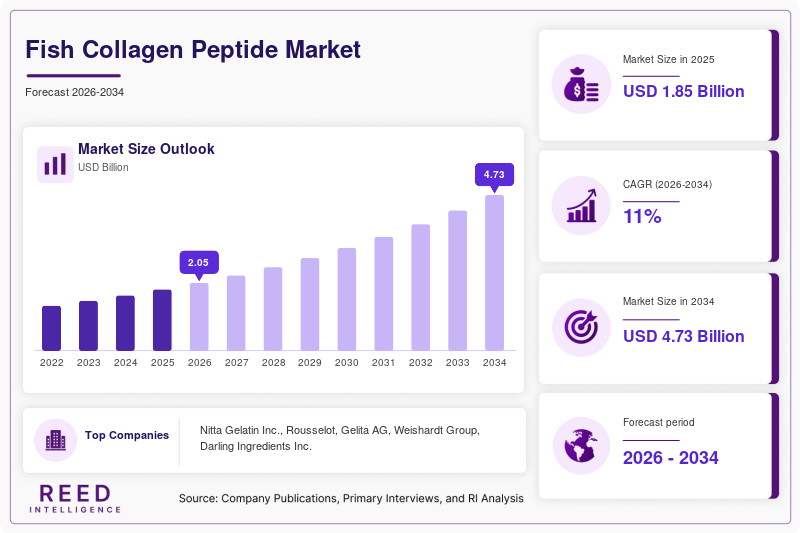
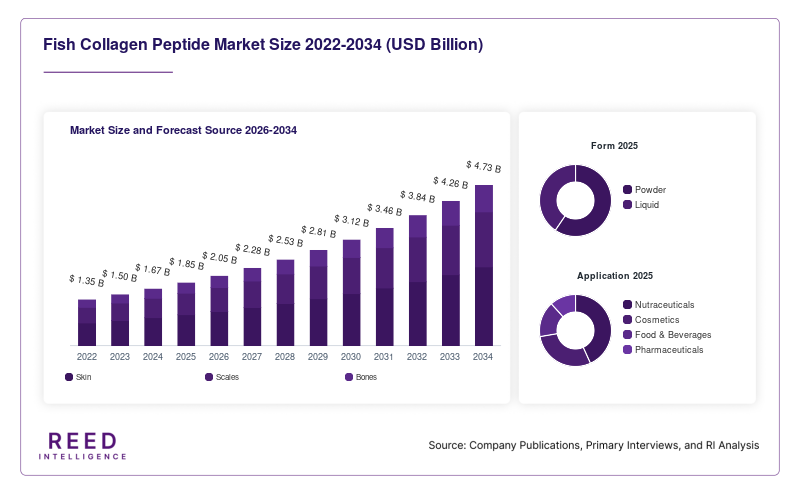
The global Fish Collagen Peptide Market size was valued at approximately USD 1.85 billion in 2025 and is projected to reach USD 4.72 billion by 2034, expanding at a CAGR of 11.0% during the forecast period (2025–2034). The market growth is primarily attributed to increasing demand for bioavailable protein ingredients across nutraceuticals, cosmetics, and functional foods. Fish collagen peptides, derived from marine sources such as skin, scales, and bones, have gained preference due to their high absorption rate, sustainability profile, and compatibility with dietary restrictions.
A major global factor supporting market expansion is the rising shift toward marine-based alternatives over bovine and porcine collagen. Concerns related to animal-borne diseases, religious constraints, and environmental sustainability have accelerated the adoption of fish-derived collagen peptides in both developed and emerging economies.
Key Highlights
- Asia Pacific dominated the market with a 38.5% share in 2025, while North America is expected to register the fastest CAGR of 11.8%.
- By application, nutraceuticals led with a 41.2% share, while cosmetics is projected to grow fastest at a CAGR of 12.3%.
- By source, skin-derived collagen peptides held the largest share at 46.7%, whereas scale-derived peptides are anticipated to expand at a CAGR of 11.9%.
- China remained the dominant country, with market values of USD 520 million in 2025 and USD 575 million in 2026.
Market Trends
Rising Integration in Functional Foods and Beverages
Fish collagen peptides are increasingly incorporated into functional foods and beverages, including protein drinks, fortified snacks, and dietary supplements. Consumers are seeking convenient formats that deliver health benefits such as improved skin elasticity, joint mobility, and bone strength. Manufacturers are responding by launching collagen-infused ready-to-drink beverages and protein powders with enhanced flavor profiles. This trend is strengthening product accessibility and widening consumer adoption across age groups.
Growth of Clean-Label and Sustainable Marine Ingredients
The growing preference for clean-label and sustainable products is influencing the Fish Collagen Peptide Market. Marine-derived collagen is perceived as more environmentally friendly compared to land-based sources due to the utilization of fish processing by-products. Companies are emphasizing traceability, eco-friendly sourcing, and minimal processing to align with consumer expectations. This trend is particularly strong in Europe and North America, where regulatory frameworks and consumer awareness support sustainable ingredient adoption.
Market Drivers
Increasing Demand for Anti-Aging and Beauty-from-Within Products
The rising demand for ingestible beauty solutions is a key driver of the Fish Collagen Peptide Market. Consumers are increasingly opting for supplements that promote skin hydration, elasticity, and wrinkle reduction. Fish collagen peptides, known for their high bioavailability and low molecular weight, are widely used in beauty supplements. The expanding aging population and growing awareness of preventive healthcare are contributing to the increased consumption of such products.
Expanding Applications in Sports Nutrition and Healthcare
Fish collagen peptides are gaining traction in sports nutrition and clinical applications due to their role in muscle recovery, joint health, and bone strength. Athletes and fitness enthusiasts are incorporating collagen-based supplements into their routines. Additionally, healthcare professionals are recommending collagen peptides for post-surgery recovery and osteoporosis management. This broadening application scope is significantly boosting market growth.
Market Restraint
Limited Raw Material Availability and Price Volatility
One of the major challenges in the Fish Collagen Peptide Market is the fluctuating availability of raw materials. Fish collagen is primarily derived from by-products of the seafood processing industry, making supply dependent on fishing volumes and seasonal variations. Environmental regulations, overfishing concerns, and supply chain disruptions can impact raw material availability.
Furthermore, price volatility associated with marine raw materials increases production costs, affecting profit margins for manufacturers. Small- and medium-scale players are particularly vulnerable to these fluctuations, limiting their ability to scale operations. The inconsistency in raw material quality also poses challenges in maintaining product standardization.
These factors collectively hinder market growth, especially in regions where seafood processing infrastructure is less developed.
Market Opportunities
Expansion in Emerging Markets
Emerging economies in Asia, Latin America, and the Middle East present significant growth opportunities for the Fish Collagen Peptide Market. Increasing disposable income, urbanization, and rising health awareness are driving demand for dietary supplements and functional foods. Market players are focusing on expanding distribution networks and launching affordable product variants to cater to these regions.
Innovation in Personalized Nutrition
The growing trend of personalized nutrition offers new opportunities for fish collagen peptide manufacturers. Companies are developing customized formulations based on individual health needs, age groups, and lifestyle preferences. Integration with digital health platforms and diagnostic tools is enabling targeted product development. This innovation is expected to enhance consumer engagement and drive long-term market growth.
Segmental Analysis
By Source
Skin-derived fish collagen peptides dominated the market with a 46.7% share in 2025 due to their high collagen content and ease of extraction. These peptides are widely used in nutraceuticals and cosmetics, offering superior bioavailability and functional properties.
Scale-derived collagen peptides are expected to be the fastest-growing segment, registering a CAGR of 11.9% during the forecast period. Their growth will be driven by increasing utilization of fish waste and advancements in extraction technologies, enabling cost-effective production.
By Form
Powder form held the largest market share of 62.4% in 2025, as it is easy to incorporate into various applications such as beverages, supplements, and food products. The longer shelf life and convenient storage further support its dominance.
Liquid collagen peptides are projected to grow at a CAGR of 12.1%, driven by rising demand for ready-to-consume products. Their convenience and improved absorption rates are attracting consumers seeking quick health benefits.
By Application
Nutraceuticals accounted for the largest share of 41.2% in 2025, driven by increasing consumption of dietary supplements for health and wellness. Fish collagen peptides are widely used in capsules, tablets, and powders for joint and skin health.
Cosmetics is expected to be the fastest-growing segment, with a CAGR of 12.3%. The growing demand for anti-aging and skincare products will drive the adoption of collagen peptides in topical formulations and ingestible beauty products.
By End-Use
Food and beverages dominated the market with a 35.6% share in 2025, supported by the growing trend of functional foods. Collagen peptides are increasingly used in protein bars, drinks, and dairy products.
Pharmaceuticals will grow at a CAGR of 11.7%, driven by increasing use in medical nutrition and therapeutic applications. The focus on preventive healthcare and recovery solutions will boost demand.
By Distribution Channel
Offline channels held a 68.2% share in 2025, as consumers prefer purchasing health supplements from pharmacies and specialty stores. These channels offer product authenticity and professional guidance.
Online channels are expected to grow at a CAGR of 13.0%, driven by the expansion of e-commerce platforms and increasing digital adoption. Convenience, discounts, and wider product availability are key growth factors.
Regional Analysis
North America
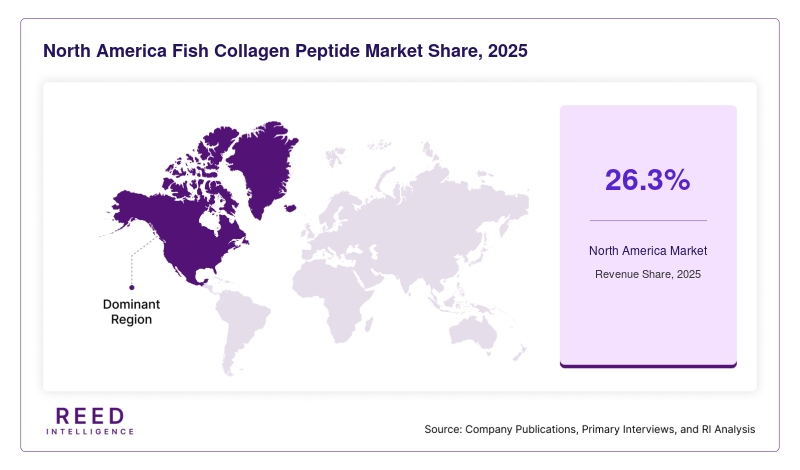
North America accounted for 26.3% of the Fish Collagen Peptide Market share in 2025 and is expected to grow at a CAGR of 11.8% during the forecast period. The region will benefit from strong demand for dietary supplements and functional beverages, supported by well-established retail and e-commerce channels.
The United States dominated the regional market due to high consumer awareness regarding health and wellness products. The increasing adoption of collagen-based supplements among fitness enthusiasts and aging populations is driving growth. Additionally, product innovation and premiumization strategies are supporting market expansion.
Europe
Europe held a 22.1% market share in 2025 and will grow at a CAGR of 10.6% through 2034. The region’s growth will be driven by stringent quality standards and increasing demand for sustainable and clean-label ingredients.
Germany emerged as the dominant country, supported by a strong nutraceutical industry and high consumer preference for natural products. The presence of advanced manufacturing facilities and research initiatives is contributing to the development of high-quality collagen peptides.
Asia Pacific
Asia Pacific led the market with a 38.5% share in 2025 and is projected to grow at a CAGR of 10.9%. The region’s dominance is attributed to abundant raw material availability and a well-established seafood processing industry.
China was the leading country, driven by high production capacity and increasing domestic consumption of collagen supplements. The expanding middle-class population and growing awareness of beauty and health products are fueling demand.
Middle East & Africa
The Middle East & Africa accounted for 7.2% of the market in 2025 and is expected to grow at a CAGR of 9.8%. The market will expand due to increasing demand for halal-certified collagen products and rising health awareness.
Saudi Arabia dominated the region, supported by a growing dietary supplements market and increasing investment in healthcare infrastructure. The demand for marine-based collagen is rising due to religious preferences.
Latin America
Latin America held a 5.9% share in 2025 and is anticipated to grow at a CAGR of 10.2%. The region’s growth will be supported by increasing consumption of functional foods and beverages.
Brazil led the market due to its large consumer base and growing interest in beauty and wellness products. The expansion of retail channels and local manufacturing capabilities is contributing to market growth.
Competitive Landscape
The Fish Collagen Peptide Market is moderately fragmented, with several global and regional players competing based on product quality, innovation, and distribution networks. Leading companies are focusing on expanding their product portfolios and strengthening their presence in emerging markets.
The market leader, Nitta Gelatin Inc., has maintained a strong position through continuous investment in research and development and the launch of high-purity marine collagen products. The company recently introduced a new line of bioactive peptides targeting joint health and skin care applications.
Other key players are adopting strategies such as mergers, partnerships, and capacity expansion to enhance their market share. Increasing focus on sustainable sourcing and clean-label products is shaping competitive dynamics.
Key Players List
- Nitta Gelatin Inc.
- Rousselot
- Gelita AG
- Weishardt Group
- Darling Ingredients Inc.
- Amicogen Inc.
- Vital Proteins LLC
- Titan Biotech Ltd.
- Seagarden AS
- Norland Products Inc.
- Hangzhou Nutrition Biotechnology Co., Ltd.
- BHN Co., Ltd.
- Ewald-Gelatine GmbH
- Connoils LLC
- Hofseth BioCare ASA
Recent Developments
- In 2024, Nitta Gelatin Inc. launched a new marine collagen peptide product line targeting sports nutrition.
- Gelita AG expanded its production capacity for fish collagen peptides in Europe.
- Rousselot introduced a clean-label certified marine collagen ingredient for nutraceutical applications.
- Darling Ingredients Inc. invested in sustainable sourcing technologies for marine raw materials.
- Hofseth BioCare ASA developed a premium collagen peptide product derived from salmon for skincare applications.
Fish Collagen Peptide Market Segments
Source
- Skin
- Scales
- Bones
Form
- Powder
- Liquid
Application
- Nutraceuticals
- Cosmetics
- Food & Beverages
- Pharmaceuticals
Distribution Channel
- Online Retail
- Pharmacies & Drug Stores
- Specialty Stores
- Supermarkets & Hypermarkets
By Region
- North America
- Europe
- APAC
- Middle East and Africa
- LATAM