Fishing Drone Market Size, Share & Demand Report By Product Type (Aerial Fishing Drones, Hybrid Fishing Drones, Underwater Fishing Drones), By Application (Recreational Fishing, Commercial Fishing Support, Aquaculture Monitoring), By End User (Individual Consumers, Commercial Enterprises, Government & Research Organizations), By Region & Segment Forecasts, 2026–2034
USD 3950
Market Overview
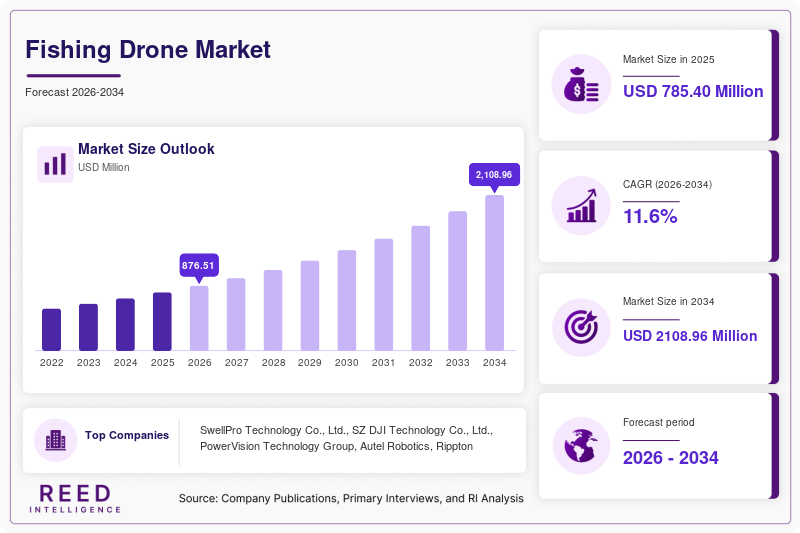
The global Fishing Drone Market size was valued at USD 785.4 million in 2026 and is projected to reach USD 1.89 billion by 2034, expanding at a CAGR of 11.6% during 2026–2034. Fishing drones, designed to support bait deployment, sonar-based fish detection, coastal surveying, line casting, and recreational fishing efficiency, are increasingly transforming both consumer and commercial fishing practices. The market has gained momentum due to the broader adoption of advanced recreational marine technologies, particularly among sport fishing enthusiasts seeking precision tools that improve casting distance, surveillance, and catch optimization. Rising disposable incomes, increasing popularity of offshore recreational fishing, and improvements in drone battery endurance have strengthened product demand across coastal economies. Manufacturers are integrating GPS autopilot, waterproof frames, payload release systems, and AI-powered fish recognition, broadening product utility. The expansion of e-commerce channels and direct-to-consumer sales platforms has also accelerated global accessibility. In addition, governments in several countries are promoting regulated recreational fishing tourism, indirectly supporting drone-assisted fishing equipment sales. Hybrid drones combining underwater and aerial functionality are creating new commercial pathways, especially for marine observation and aquaculture support.
Key Highlights
- North America dominated the market with a 36.8% share in 2025.
- Asia Pacific is expected to grow at the fastest CAGR of 13.1% during 2026–2034.
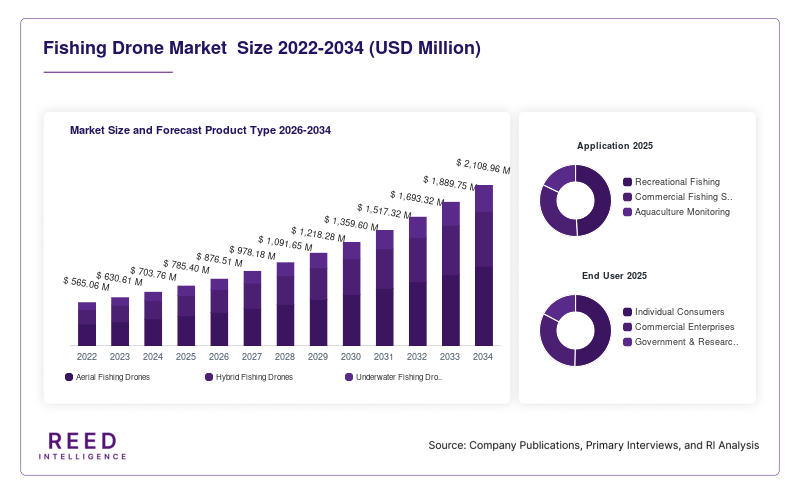
- By product type, aerial fishing drones accounted for the largest share of 61.4%, while hybrid fishing drones are projected to grow at a CAGR of 14.3%.
- By application, recreational fishing led with a 58.7% share, whereas commercial fishing support is expected to expand at a CAGR of 12.8%.
- The United States remained the dominant country, with market values of USD 214 million in 2024 and USD 247 million in 2025.
Market Trends
Integration of AI and Smart Sonar Systems
A significant trend shaping the Fishing Drone Market is the integration of artificial intelligence, machine vision, and sonar analytics into drone platforms. Fishing drones are increasingly equipped with fish recognition software, underwater mapping capabilities, and predictive fish movement analysis. These technologies improve targeting efficiency and reduce time spent identifying productive fishing zones. AI-enabled route optimization and return-to-home functions also enhance user safety and reliability. Premium manufacturers are focusing on companion mobile apps that provide weather integration, route history, and fish density heat maps. This trend is expanding beyond hobbyist applications and into small-scale professional fishing operations, where operational precision matters. As component prices decline, smart fishing drones are becoming more accessible, supporting broader adoption across emerging markets.
Growth of Waterproof and Multi-Environment Drone Platforms
Another major market trend is the development of waterproof, salt-resistant, and amphibious fishing drones capable of operating in coastal, lake, and offshore environments. Traditional recreational drones faced durability limitations in marine conditions, but newer models now include corrosion-resistant materials, floating structures, and emergency buoyancy systems. This evolution is broadening customer trust and product longevity. Manufacturers are also launching drones with interchangeable payload systems for bait dropping, underwater cameras, and rescue support. Such versatility attracts consumers seeking multifunctional marine devices rather than single-purpose tools. Demand is particularly strong in regions with sport fishing tourism, where rugged drones support long-distance casting and marine scouting. These product improvements are increasing replacement cycles and encouraging premium product purchases.
Market Drivers
Expansion of Recreational Fishing Tourism Worldwide
The growth of recreational fishing tourism is a major driver for the Fishing Drone Market. Coastal tourism economies, including the United States, Australia, Thailand, and South Africa, are witnessing increased spending on advanced fishing equipment as travelers seek enhanced outdoor experiences. Fishing drones improve bait placement over long distances and provide visual scouting, making them highly attractive for surf fishing and offshore recreational users. Charter operators are also incorporating drone-assisted fishing packages to differentiate services. This tourism-driven demand is encouraging innovation and localized marketing campaigns. As more consumers view fishing as a technology-enhanced leisure activity, manufacturers benefit from repeat purchases, upgrades, and accessory sales, supporting sustained market expansion.
Advancements in Drone Battery Life and Payload Capacity
Technological improvements in lithium battery efficiency, lightweight composites, and propulsion systems are significantly driving Fishing Drone Market growth. Earlier product limitations related to flight time and carrying capacity restricted adoption. However, modern fishing drones can now carry heavier bait loads over longer distances while maintaining stable flight performance in windy coastal environments. Improved battery systems offering 30–60 minutes of operation are increasing practicality. Enhanced payload capabilities also support commercial applications such as net monitoring and fish scouting. These innovations reduce barriers for first-time buyers and support wider use cases, including aquaculture surveillance. The resulting value proposition is expanding the customer base from hobbyists to semi-professional operators.
Market Restraint
Regulatory Restrictions and Safety Compliance Challenges
One of the primary restraints in the Fishing Drone Market is the complex regulatory environment governing drone use in coastal, marine, and public recreational zones. Different countries enforce varying airspace restrictions, licensing requirements, payload regulations, and privacy laws, creating barriers for consumers and manufacturers. In some regions, fishing drones are restricted near wildlife reserves, beaches, or protected marine areas, limiting operational freedom. Compliance costs can also increase product prices, especially for advanced drones requiring certified geofencing or safety systems. Weather risks, signal interference, and potential accidents involving people or boats further intensify safety concerns. For example, highly regulated European coastal zones may require drone registration and operational limitations that discourage casual users. These restrictions can slow adoption rates and create fragmented global expansion strategies for manufacturers.
Market Opportunities
Expansion into Commercial Aquaculture and Marine Monitoring
The increasing digitization of aquaculture presents a substantial opportunity for the Fishing Drone Market. Commercial fish farms are adopting drones for stock monitoring, feed distribution observation, water surface inspection, and security surveillance. Fishing drones equipped with thermal imaging or underwater sensors can help identify stock movement, environmental issues, and infrastructure damage. This expands market relevance beyond recreational use into operational business efficiency. Coastal aquaculture industries in Asia Pacific and Latin America are particularly promising due to rising seafood demand. Manufacturers that tailor products for industrial aquaculture applications may unlock recurring enterprise sales and software service revenue, creating stronger margins than consumer-only markets.
Emerging Demand in Developing Coastal Economies
Developing economies with expanding middle-class populations and growing marine tourism industries offer major untapped opportunities. Countries such as India, Indonesia, Brazil, and the Philippines are seeing rising consumer interest in recreational fishing technologies. Affordable mid-range fishing drones designed for entry-level buyers can capture these expanding customer segments. Localized e-commerce, digital payments, and social media marketing are accelerating awareness. In addition, fishing competitions and influencer-driven outdoor content are increasing product visibility. Companies that establish regional partnerships and lower-cost product lines may benefit from first-mover advantages in these high-growth but underpenetrated markets.
Segmental Analysis
By Product Type
Aerial fishing drones dominated the market in 2024, accounting for 61.4% of total share. Their leadership is supported by superior casting range, easier deployment, and lower average pricing compared to hybrid alternatives. Recreational users favor aerial systems for surf fishing, bait dropping, and fish scouting due to portability and intuitive controls. Product innovation in camera quality, GPS precision, and waterproofing has reinforced their market position. Established product ecosystems also offer replacement batteries, release systems, and software upgrades, increasing long-term consumer retention.
Hybrid fishing drones are projected to witness the fastest CAGR of 14.3% through 2034. These drones combine aerial and underwater capabilities, allowing fish detection, underwater observation, and enhanced scouting. Growth is driven by consumers seeking multifunctional investments and commercial operators valuing broader marine applications. Their use in aquaculture and environmental observation adds commercial relevance beyond recreation.
By Application
Recreational fishing held the largest 2024 market share at 58.7%, driven by hobbyist demand, sport fishing competitions, and tourism experiences. Fishing drones improve user efficiency, reduce casting limitations, and increase engagement. Consumer-focused marketing and social media content are also boosting demand among younger demographics. Recreational buyers remain the largest contributor to direct-to-consumer sales channels.
Commercial fishing support is forecast to grow at the fastest CAGR of 12.8% through 2034. Growth stems from applications including net surveillance, fish school scouting, and coastal monitoring. Small-scale fisheries and aquaculture businesses increasingly view drones as cost-efficient operational tools. Product adaptation for industrial settings is expected to strengthen this segment.
By End User
Individual consumers represented the dominant end-user segment in 2024, holding 63.9% share due to broad recreational participation and rising affordability. Personal buyers drive volume sales through online marketplaces and outdoor equipment retailers. Demand is strongest among sport fishing communities, beach anglers, and marine hobbyists seeking technology-enhanced experiences.
Commercial enterprises are expected to register the fastest CAGR of 13.4% through 2034. Aquaculture firms, charter operators, and marine survey businesses are adopting fishing drones for productivity gains. Their willingness to invest in premium multifunctional platforms creates high-margin opportunities for manufacturers focused on enterprise solutions.
Regional Analysis
North America
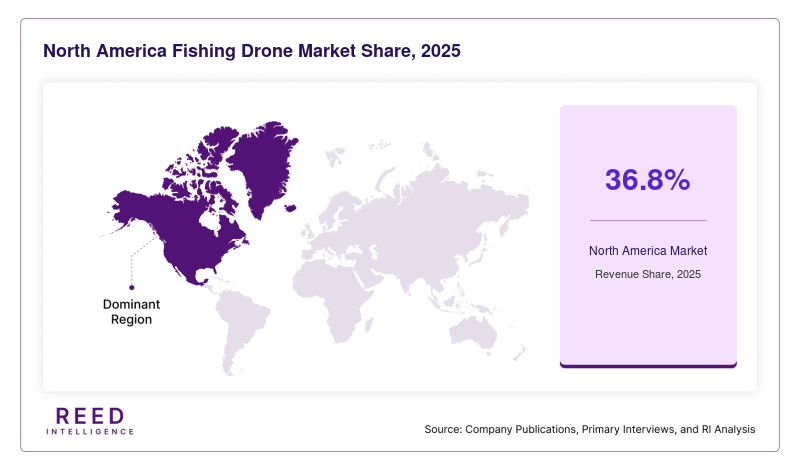
North America accounted for 36.8% of the global Fishing Drone Market share in 2025 and is projected to maintain leadership with a CAGR of 10.9% through 2034. High consumer spending on recreational fishing technologies, widespread coastal sport fishing culture, and strong drone infrastructure support regional dominance. The presence of specialized fishing drone manufacturers and premium accessory ecosystems also contributes to market maturity. Consumer preference for long-range bait deployment drones remains particularly strong in the United States and Canada.
The United States dominates the regional market due to extensive coastal tourism, recreational fishing participation, and rapid technology adoption. A unique growth factor is the popularity of surf fishing communities that increasingly rely on drones for extended casting distances and fish scouting. Integration of drone use into guided fishing experiences is also expanding consumer awareness.
Europe
Europe represented 24.1% of the Fishing Drone Market in 2025 and is forecast to grow at a CAGR of 10.4% during the forecast period. Demand is supported by marine recreation trends, advanced drone regulations encouraging safer innovation, and premium consumer adoption. Countries with strong coastal tourism industries are leading purchases. Product demand is particularly high for compact waterproof drones that comply with tighter regional airspace standards.
The United Kingdom leads Europe due to growing recreational coastal fishing communities and increasing technology-enabled outdoor hobbies. A distinctive growth factor is consumer interest in multifunctional marine gadgets that combine fishing assistance with photography and surveillance, increasing perceived product value.
Asia Pacific
Asia Pacific held 21.7% of the market in 2025 and is expected to record the fastest CAGR of 13.1% through 2034. Rising disposable income, expanding recreational fishing awareness, and growing coastal tourism are driving strong demand. Affordable drone manufacturing ecosystems in China are also reducing product costs, making fishing drones more accessible across multiple income groups.
China dominates the regional market through large-scale drone production capabilities and rising domestic fishing technology demand. A unique growth factor is the country’s strong electronics manufacturing infrastructure, enabling rapid product innovation, lower costs, and broad online distribution channels.
Middle East & Africa
Middle East & Africa captured 9.2% of the Fishing Drone Market in 2025 and is projected to grow at a CAGR of 11.3%. Growth is supported by expanding marine tourism, sport fishing investments, and increasing consumer interest in advanced leisure technologies. Coastal nations are seeing gradual adoption, especially in tourism-linked recreational fishing.
South Africa leads the region due to established sport fishing tourism and strong coastal recreational markets. A unique growth factor is the increasing use of fishing drones in competitive shore angling, where casting distance can significantly influence catch potential.
Latin America
Latin America accounted for 8.2% of global market share in 2025 and is expected to expand at a CAGR of 11.8% during 2026–2034. Regional growth is fueled by coastal recreation, marine biodiversity tourism, and growing awareness of drone-assisted fishing. Increasing access to imported consumer drone technologies also supports adoption.
Brazil dominates the regional market due to its extensive coastline and expanding marine leisure sector. A unique growth factor is the rise of social media-driven outdoor recreation trends, which are increasing visibility for fishing drones among younger consumers.
Competitive Landscape
The Fishing Drone Market is moderately fragmented, with competition centered on product durability, payload efficiency, smart navigation, and software ecosystems. SZ DJI Technology Co., Ltd. remains a leading influence through drone innovation expertise, although specialized fishing-focused brands are gaining traction. SwellPro has emerged as a category leader due to waterproof drone specialization and fishing-specific payload systems. Recent developments include expanded AI sonar integration and improved saltwater durability features. PowerVision, Autel Robotics, Gannet, and Rippton are actively strengthening their portfolios with autonomous navigation, modular accessories, and hybrid product launches. Strategic partnerships with marine retailers and direct e-commerce channels are increasingly shaping competitive advantage.
Key Players
- SwellPro Technology Co., Ltd.
- SZ DJI Technology Co., Ltd.
- PowerVision Technology Group
- Autel Robotics
- Rippton
- Gannet Sports
- Poseidon Drones
- Splash Drone
- Yuneec International
- AEE Technology
- QuadH2O
- Chasing Innovation
- Parrot Drones
- Freefly Systems
- Walkera Technology
Recent Developments
- SwellPro introduced an upgraded waterproof fishing drone with AI-assisted bait targeting in 2025.
- PowerVision expanded hybrid drone capabilities with improved underwater imaging features in 2025.
- Rippton launched a smart autopilot fishing drone series focused on autonomous shoreline deployment in 2026.
Fishing Drone Market Segments
Product Type
- Aerial Fishing Drones
- Hybrid Fishing Drones
- Underwater Fishing Drones
Application
- Recreational Fishing
- Commercial Fishing Support
- Aquaculture Monitoring
End User
- Individual Consumers
- Commercial Enterprises
- Government & Research Organizations
By Region
- North America
- Europe
- APAC
- Middle East and Africa
- LATAM