Flame Detonation Arrestor Market Size, Share & Demand Report By Type (Inline Detonation Arrestors, End-of-Line Detonation Arrestors), By Application (Oil & Gas, Chemical Processing, Pharmaceuticals, Others), By End-Use (Industrial Manufacturing, Energy, Chemicals, Others), By Region & Segment Forecasts, 2026–2034
USD 3950
Market Overview
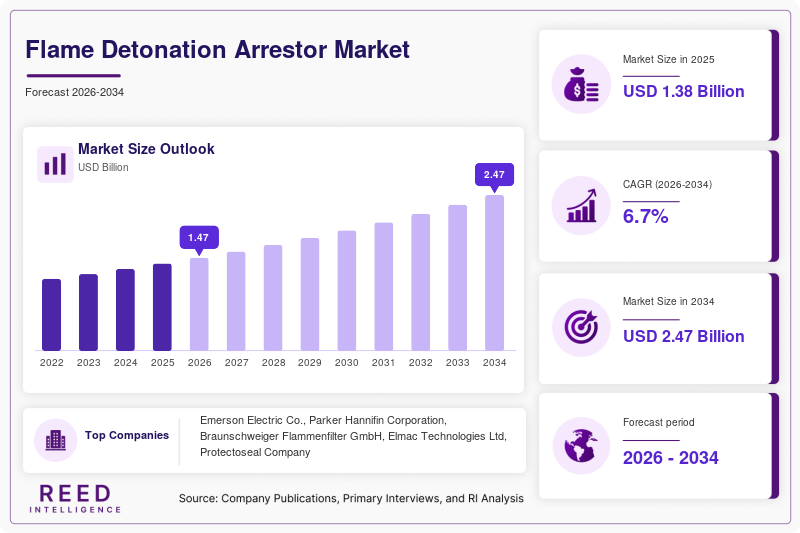
The Flame Detonation Arrestor Market size was valued at USD 1.38 billion in 2026 and is projected to reach approximately USD 2.31 billion by 2034, expanding at a CAGR of 6.7% during the forecast period. The market reflects steady expansion driven by increasing emphasis on industrial safety systems across hazardous environments such as oil & gas, chemicals, and power generation. Flame detonation arrestors play a critical role in preventing flame propagation and explosion transmission, making them essential safety devices in industries handling flammable gases and vapors.
A key global factor supporting market growth is the tightening of industrial safety regulations across developed and emerging economies. Regulatory bodies are enforcing stricter compliance standards for explosion protection systems, compelling manufacturers and facility operators to integrate advanced detonation arrestors into their infrastructure. This has significantly increased product adoption in sectors such as refining, petrochemicals, and pharmaceuticals, where risk mitigation is a priority.
Key Highlights
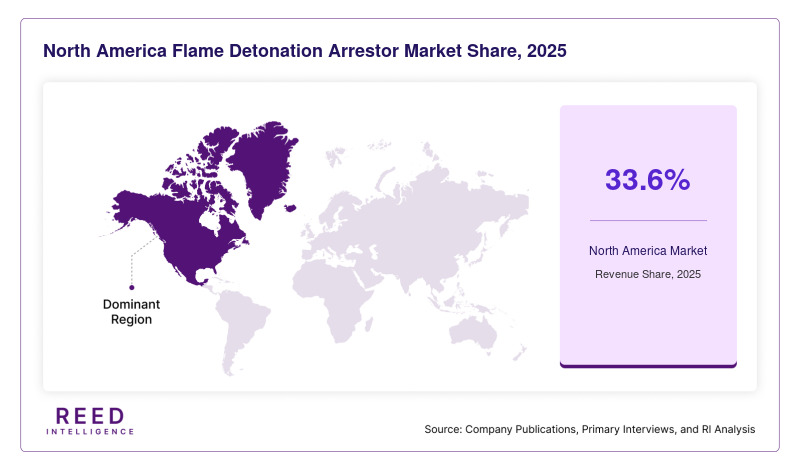
- North America dominated the market with a 33.6% share in 2025.
- Asia Pacific is expected to grow at the fastest CAGR of 8.4% during 2026–2034.
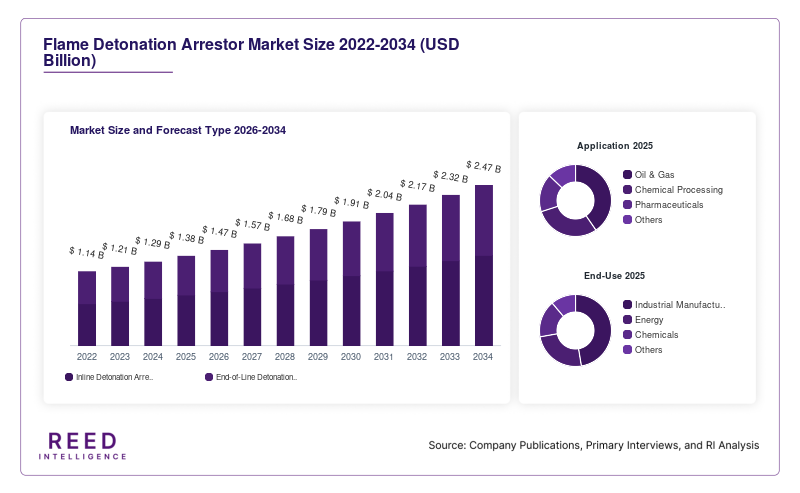
- By type, inline detonation arrestors accounted for the largest share of 42.8%.
- while end-of-line arrestors are projected to grow at a CAGR of 7.9%.
- By application, oil & gas led with a 45.3% share, whereas chemical processing is expected to expand at a CAGR of 7.5%.
- The United States remained the dominant country, with market values of USD 410 million in 2024 and USD 445 million in 2025.
Market Trends
Increasing integration of smart monitoring systems
The adoption of smart monitoring technologies is shaping the Flame Detonation Arrestor Market by enabling real-time performance tracking and predictive maintenance. Manufacturers are incorporating sensors and IoT-enabled systems into arrestors to monitor temperature, pressure, and flow conditions continuously. This allows early detection of operational anomalies and reduces the risk of failure in critical environments. Industries such as oil & gas and chemical processing are increasingly relying on digitalized safety systems to ensure uninterrupted operations. The integration of automation and remote diagnostics also minimizes downtime and enhances operational efficiency, making smart arrestors a preferred choice in modern industrial setups.
Rising demand for corrosion-resistant and high-performance materials
Another notable trend is the growing use of advanced materials to enhance the durability and efficiency of flame detonation arrestors. Industries operating in harsh environments require equipment that can withstand extreme temperatures, corrosive chemicals, and high-pressure conditions. As a result, manufacturers are focusing on developing arrestors using stainless steel alloys, composites, and specialized coatings. These materials improve resistance to wear and extend product lifecycle, reducing maintenance costs. This trend is particularly evident in offshore oil platforms and chemical plants, where equipment reliability is critical for safety and operational continuity.
Market Drivers
Expansion of oil & gas and petrochemical industries
The expansion of oil & gas exploration and refining activities continues to drive demand for flame detonation arrestors. These industries involve handling highly flammable substances, requiring robust safety systems to prevent catastrophic incidents. Increasing investments in upstream and downstream operations, particularly in emerging economies, are boosting the installation of safety equipment. As refineries and storage facilities expand capacity, the need for explosion prevention devices grows proportionally. Furthermore, modernization of existing infrastructure in developed regions is also contributing to sustained demand, as operators upgrade safety systems to meet current standards.
Stringent safety regulations and compliance requirements
Government regulations and international safety standards play a crucial role in driving the adoption of flame detonation arrestors. Regulatory bodies mandate the installation of explosion protection systems in facilities dealing with combustible gases. Compliance with standards such as ATEX and ISO certifications is becoming mandatory for industrial operations. This has compelled companies to invest in certified and high-performance arrestors to avoid legal penalties and operational disruptions. Additionally, insurance requirements often necessitate the use of certified safety equipment, further accelerating market growth. The increasing focus on workplace safety and environmental protection continues to reinforce this driver.
Market Restraint
High installation and maintenance costs
One of the primary challenges in the Flame Detonation Arrestor Market is the high cost associated with installation and maintenance. Advanced arrestors designed for high-risk environments require precision engineering and high-quality materials, which significantly increase their initial cost. Small and medium-sized enterprises often face budget constraints, limiting their ability to adopt these safety systems. Additionally, regular inspection, cleaning, and replacement of components are necessary to ensure optimal performance, adding to operational expenses. In industries with tight profit margins, these costs can act as a barrier to widespread adoption. For example, smaller chemical processing units may delay upgrading safety equipment due to financial limitations, potentially impacting overall market penetration.
Market Opportunities
Growth in emerging industrial economies
Emerging economies present significant growth opportunities for the Flame Detonation Arrestor Market. Rapid industrialization in regions such as Asia Pacific and Latin America is driving demand for safety equipment across manufacturing, energy, and chemical sectors. Governments in these regions are investing heavily in infrastructure development and industrial expansion, creating a favorable environment for market growth. As safety awareness increases and regulatory frameworks evolve, the adoption of detonation arrestors is expected to rise. Companies entering these markets can benefit from untapped potential and growing demand for reliable safety solutions.
Technological advancements and product innovation
Continuous innovation in design and functionality offers substantial opportunities for market players. Manufacturers are developing compact, lightweight, and high-efficiency arrestors to meet evolving industry requirements. Innovations such as modular designs and easy maintenance features are enhancing product usability. Additionally, advancements in computational fluid dynamics are enabling the development of more efficient flame-quenching mechanisms. These innovations not only improve performance but also reduce lifecycle costs, making advanced arrestors more accessible to a wider range of industries. Companies investing in research and development are likely to gain a competitive edge in the market.
Segmental Analysis
By Type
Inline detonation arrestors dominated the market in 2024, accounting for a share of 42.8%. These arrestors are widely used in pipelines where continuous flow of flammable gases occurs. Their ability to prevent flame propagation within piping systems makes them essential in industries such as oil & gas and chemicals. Inline arrestors are preferred due to their high efficiency and compatibility with existing infrastructure. They are designed to handle high-pressure conditions and provide reliable performance, contributing to their dominant position in the market.
End-of-line arrestors are expected to be the fastest-growing subsegment, with a CAGR of 7.9% during the forecast period. These arrestors are used at vent outlets to prevent external ignition sources from entering the system. Their growth is driven by increasing demand in storage tanks and venting systems. The simplicity of installation and lower maintenance requirements make them an attractive option for industries seeking cost-effective safety solutions.
By Application
The oil & gas segment led the market in 2024, with a share of 45.3%. This dominance is attributed to the high risk of explosions in oil extraction, refining, and transportation processes. Flame detonation arrestors are critical in preventing accidents and ensuring safe operations in this sector. The continuous expansion of oil & gas infrastructure globally further supports the growth of this segment.
The chemical processing segment is anticipated to grow at the fastest CAGR of 7.5%. The increasing production of chemicals and the handling of hazardous substances require advanced safety systems. Growth in specialty chemicals and pharmaceuticals is also contributing to the demand for detonation arrestors. Companies are investing in high-performance safety equipment to meet regulatory requirements and ensure operational safety.
By End-Use
The industrial manufacturing segment accounted for the largest share of 38.6% in 2024. This segment includes various industries such as power generation, food processing, and pharmaceuticals, where flammable materials are used. The need for reliable safety systems to prevent accidents is driving the adoption of flame detonation arrestors in this segment.
The energy sector is expected to grow at the fastest CAGR of 7.8%. Increasing investments in renewable energy and power generation projects are creating demand for safety equipment. As energy infrastructure expands, the need for explosion prevention systems becomes more critical. This is driving the growth of detonation arrestors in the energy sector.
Regional Analysis
North America
North America accounted for a significant share of 33.6% in 2025 and is expected to grow at a steady CAGR of 5.9% during the forecast period. The region benefits from a well-established industrial base and strict safety regulations across sectors such as oil & gas and chemicals. High awareness regarding workplace safety and the presence of leading manufacturers further support market growth. Continuous investments in upgrading aging infrastructure also contribute to sustained demand.
The United States dominates the regional market due to its extensive oil refining capacity and advanced industrial ecosystem. A key growth factor is the increasing adoption of automation and digital safety systems in industrial operations. Companies are integrating smart arrestors to enhance operational efficiency and reduce risks, driving demand for advanced solutions.
Europe
Europe held a market share of approximately 27.4% in 2025 and is projected to grow at a CAGR of 6.1% during the forecast period. The region’s growth is supported by stringent environmental and safety regulations enforced by regulatory authorities. Industries are required to comply with strict standards, leading to increased adoption of certified safety equipment.
Germany is the dominant country in the European market, driven by its strong manufacturing and chemical industries. A unique growth factor is the emphasis on sustainable industrial practices, which includes upgrading safety systems to minimize environmental risks. This focus is encouraging the adoption of advanced detonation arrestors.
Asia Pacific
Asia Pacific is the fastest-growing region, with a projected CAGR of 8.4% during the forecast period and a market share of 24.1% in 2025. Rapid industrialization and infrastructure development are key drivers of market growth. Increasing investments in energy and chemical sectors are boosting demand for safety equipment.
China leads the regional market due to its large-scale industrial activities and expanding petrochemical sector. A significant growth factor is government initiatives aimed at improving industrial safety standards. These initiatives are driving the adoption of advanced flame detonation arrestors across various industries.
Middle East & Africa
The Middle East & Africa region accounted for 8.2% of the market share in 2025 and is expected to grow at a CAGR of 6.5%. The region’s growth is primarily driven by its strong presence in the oil & gas sector. Continuous investments in exploration and refining activities are increasing the demand for safety equipment.
Saudi Arabia dominates the regional market due to its extensive oil production capabilities. A unique growth factor is the expansion of petrochemical complexes, which require advanced safety systems to handle flammable materials. This is driving the adoption of detonation arrestors.
Latin America
Latin America held a market share of 6.7% in 2025 and is projected to grow at a CAGR of 6.2%. The region is witnessing gradual industrial development, particularly in energy and chemical sectors. Increasing awareness of industrial safety is supporting market growth.
Brazil is the leading country in the region, driven by its growing oil & gas industry. A key growth factor is the modernization of industrial infrastructure, which includes upgrading safety systems. This is creating opportunities for the adoption of advanced flame detonation arrestors.
Competitive Landscape
The Flame Detonation Arrestor Market is moderately fragmented, with several global and regional players competing based on product quality, innovation, and pricing. Leading companies are focusing on research and development to introduce advanced products with improved efficiency and durability. Strategic partnerships, mergers, and acquisitions are common strategies to expand market presence.
Emerson Electric Co. is a leading player in the market, known for its advanced safety solutions and global presence. The company recently introduced a new range of smart detonation arrestors integrated with monitoring systems, enhancing operational efficiency and safety. Other major players are also investing in technological advancements and expanding their product portfolios to cater to diverse industry needs.
Key Players List
- Emerson Electric Co.
- Parker Hannifin Corporation
- Braunschweiger Flammenfilter GmbH
- Elmac Technologies Ltd
- Protectoseal Company
- L&J Engineering
- Tornado Combustion Technologies
- Westech Industrial Ltd
- BS&B Safety Systems
- Groth Corporation
- Motherwell Tank Protection
- Fike Corporation
- KITO Armaturen GmbH
- Ergil Group
- Assentech Sales Ltd
Recent Developments
- Emerson Electric Co. launched a new smart monitoring-enabled detonation arrestor in 2025 to enhance predictive maintenance capabilities.
- Elmac Technologies expanded its manufacturing facility in Europe to meet growing regional demand.
- Parker Hannifin introduced corrosion-resistant arrestors designed for offshore applications in 2024.
Flame Detonation Arrestor Market Segments
Type
- Inline Detonation Arrestors
- End-of-Line Detonation Arrestors
Application
- Oil & Gas
- Chemical Processing
- Pharmaceuticals
- Others
End-Use
- Industrial Manufacturing
- Energy
- Chemicals
- Others
By Region
- North America
- Europe
- APAC
- Middle East and Africa
- LATAM