Flame-retardant Polyester Staple Fiber Market Size, Share & Demand Report By Product Type (Hollow Fiber, Solid Fiber), By Application (Home Furnishing, Industrial Textiles, Protective Clothing, Automotive Interiors), By End-Use Industry (Construction, Automotive, Textile Manufacturing, Industrial) By Region & Segment Forecasts, 2025–2034
USD 3950
Market Overview
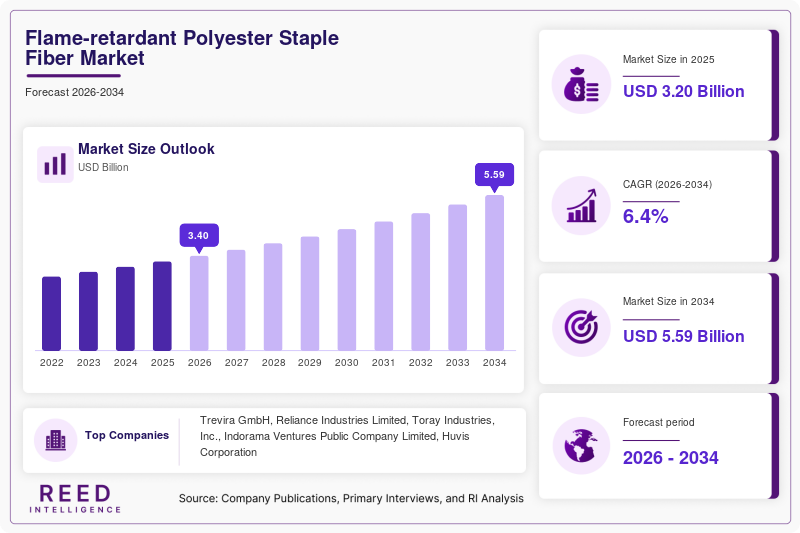
The global Flame-retardant Polyester Staple Fiber Market size was valued at USD 3.2 billion in 2025 and is projected to reach USD 5.6 billion by 2034, expanding at a CAGR of 6.4% during the forecast period (2025–2034). The market growth is supported by increasing safety regulations across construction, automotive, and textile industries, which are encouraging the adoption of flame-retardant materials in both developed and emerging economies.
A key global factor contributing to market expansion is the growing emphasis on fire safety standards in residential and commercial infrastructure. Governments and regulatory bodies are mandating the use of flame-resistant materials in upholstery, insulation, and industrial textiles, thereby boosting the demand for flame-retardant polyester staple fibers. Additionally, advancements in fiber engineering are enabling manufacturers to develop durable, lightweight, and environmentally compliant flame-retardant fibers, which is further strengthening market growth.
Key Highlights:
- Asia Pacific dominated the market with a 42% share in 2025, while the Middle East & Africa is expected to register the fastest CAGR of 7.3% during the forecast period.
- Hollow fiber segment led with a 48% share, while solid fiber is projected to grow at a CAGR of 6.9%.
- Home furnishing application accounted for 36% share, while industrial textiles are expected to grow at 7.1% CAGR.
- China remained the dominant country with market values of USD 1.1 billion in 2025 and USD 1.17 billion in 2026.
Market Trends
Increasing Adoption of Eco-friendly Flame-retardant Fibers
Manufacturers are focusing on developing halogen-free and environmentally friendly flame-retardant polyester staple fibers. This shift is driven by tightening environmental regulations and consumer awareness regarding sustainable materials. The use of phosphorus-based and bio-based flame-retardant additives is gaining traction, as industries seek compliance with global safety and environmental standards. This trend is expected to reshape product development strategies and create differentiation opportunities within the Flame-retardant Polyester Staple Fiber Market.
Integration in Advanced Industrial Applications
The market is witnessing increased adoption in advanced industrial applications such as automotive interiors, aerospace textiles, and electrical insulation. These sectors require high-performance materials that offer both durability and fire resistance. As a result, manufacturers are investing in research and development to enhance fiber strength, thermal stability, and resistance properties. The growing demand for multifunctional materials is encouraging innovation, thereby expanding the application scope of flame-retardant polyester staple fibers across various industries.
Market Drivers
Stringent Fire Safety Regulations Across Industries
Governments worldwide are implementing strict fire safety regulations in construction, transportation, and public infrastructure sectors. These regulations mandate the use of flame-retardant materials in upholstery, insulation, and structural applications. As a result, manufacturers and end-users are increasingly adopting flame-retardant polyester staple fibers to ensure compliance, which is driving market growth.
Rising Demand from Automotive and Transportation Sector
The automotive and transportation industries are increasingly using flame-retardant polyester staple fibers in seat fabrics, carpets, and interior components. These materials enhance passenger safety by reducing fire risks while maintaining comfort and durability. With the growth of electric vehicles and public transportation systems, the demand for advanced fire-resistant materials is expected to rise, further supporting the expansion of the Flame-retardant Polyester Staple Fiber Market.
Market Restraint
High Production Costs and Complex Manufacturing Processes
The production of flame-retardant polyester staple fibers involves advanced chemical treatments and specialized manufacturing processes, which increase overall production costs. The use of flame-retardant additives and compliance with stringent safety standards add to the cost burden for manufacturers.
Additionally, maintaining the balance between flame resistance, fiber strength, and environmental compliance requires continuous investment in research and development. These factors can limit the adoption of flame-retardant fibers, particularly among small and medium-sized enterprises operating in cost-sensitive markets.
The availability of alternative materials, such as inherently flame-resistant fibers and treated natural fibers, also poses competition. These alternatives may offer comparable performance at lower costs, thereby affecting market penetration. As a result, high production costs and technical complexities remain key challenges for the Flame-retardant Polyester Staple Fiber Market.
Market Opportunities
Growth in Infrastructure and Smart Building Projects
The expansion of smart cities and modern infrastructure projects is creating significant opportunities for flame-retardant materials. These projects emphasize safety, sustainability, and energy efficiency, leading to increased use of flame-retardant polyester staple fibers in insulation, upholstery, and construction textiles. The demand for fire-resistant materials in commercial and residential buildings is expected to drive market growth over the forecast period.
Increasing Demand for Protective Clothing
The rising demand for protective clothing in industries such as oil & gas, firefighting, and manufacturing is creating new growth avenues. Flame-retardant polyester staple fibers are widely used in the production of safety garments due to their durability and fire resistance. As occupational safety standards become more stringent, the adoption of protective textiles is expected to increase, offering growth opportunities for market players.
Segmental Analysis
By Type
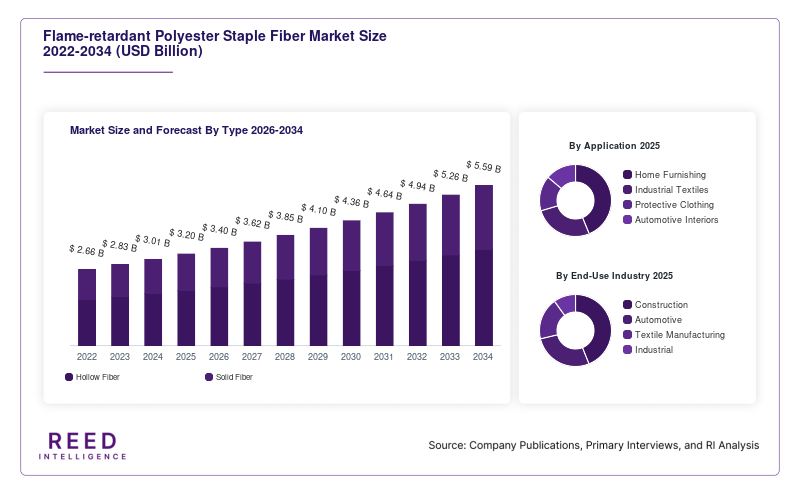
Hollow fiber dominated the Flame-retardant Polyester Staple Fiber Market with a 48% share in 2025. Its lightweight structure, thermal insulation properties, and cost-effectiveness make it suitable for applications in home furnishings and insulation materials.
Solid fiber is expected to be the fastest-growing segment, registering a CAGR of 6.9% during the forecast period. Its superior strength and durability make it ideal for industrial and automotive applications. The increasing demand for high-performance materials will drive its growth.
By Application
Home furnishing accounted for 36% of the market share in 2025, driven by the use of flame-retardant fibers in carpets, upholstery, and mattresses. The growing demand for fire-resistant household products is supporting this segment.
Industrial textiles are projected to grow at a CAGR of 7.1% during the forecast period. The increasing use of flame-retardant materials in insulation, filtration, and protective applications is driving this segment’s growth.
By End-Use Industry
The construction sector dominated the market with a 34% share in 2025, due to the extensive use of flame-retardant fibers in building materials and insulation.
The automotive sector is expected to grow at a CAGR of 6.7%, driven by the rising demand for fire-resistant materials in vehicle interiors and components.
By Distribution Channel
Direct sales held the largest share of 52% in 2025, as manufacturers prefer direct engagement with industrial clients for bulk orders.
Online distribution channels are expected to grow at a CAGR of 7.4%, supported by the increasing digitalization of supply chains and procurement processes.
Regional Analysis
North America
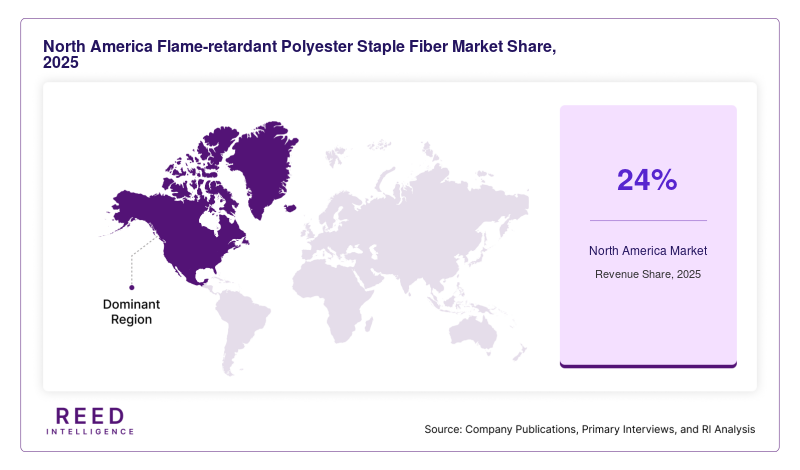
North America accounted for 24% of the Flame-retardant Polyester Staple Fiber Market share in 2025 and is expected to grow at a CAGR of 5.9% during the forecast period. The region’s growth is influenced by strict fire safety standards in residential and commercial construction, as well as strong demand from the automotive and aerospace sectors.
The United States dominated the regional market due to its advanced manufacturing capabilities and high adoption of safety-compliant materials. The presence of established textile and automotive industries supports steady demand for flame-retardant fibers. Additionally, investments in infrastructure modernization are contributing to market growth.
Europe
Europe held a 21% share in 2025 and is projected to grow at a CAGR of 5.7% through 2034. The region’s market growth is supported by stringent environmental and safety regulations, which encourage the use of eco-friendly flame-retardant materials.
Germany emerged as the dominant country, driven by its strong automotive and industrial base. The country’s focus on sustainable manufacturing and high-performance materials is fostering demand for flame-retardant polyester staple fibers.
Asia Pacific
Asia Pacific led the market with a 42% share in 2025 and is anticipated to grow at a CAGR of 6.8% during the forecast period. Rapid industrialization, urbanization, and infrastructure development are key factors contributing to market expansion in the region.
China dominated the regional market due to its large-scale textile production and growing construction sector. The country’s increasing focus on fire safety standards and export-oriented manufacturing is driving demand for flame-retardant fibers.
Middle East & Africa
The Middle East & Africa accounted for 7% of the market in 2025 and is expected to grow at a CAGR of 7.3%, making it the fastest-growing region. The growth is driven by increasing investments in construction and infrastructure projects across the region.
The United Arab Emirates is the dominant country, supported by rapid urban development and the adoption of advanced building materials. The emphasis on fire safety in commercial and residential projects is boosting demand for flame-retardant polyester staple fibers.
Latin America
Latin America held a 6% share in 2025 and is projected to grow at a CAGR of 6.1% during the forecast period. The region’s growth is supported by expanding construction activities and increasing industrialization.
Brazil emerged as the leading country, driven by its growing textile and automotive industries. The rising awareness of fire safety standards and the adoption of advanced materials are contributing to market growth in the region.
Competitive Landscape
The Flame-retardant Polyester Staple Fiber Market is moderately fragmented, with key players focusing on product innovation, sustainability, and strategic partnerships. Leading companies are investing in research and development to produce eco-friendly and high-performance fibers that meet evolving regulatory standards.
A major market leader is Trevira GmbH, known for its advanced flame-retardant fiber technologies. The company has recently introduced new halogen-free fiber solutions to address environmental concerns and enhance product performance.
Other prominent players include Reliance Industries Limited, Toray Industries, Inc., and Indorama Ventures Public Company Limited, which are expanding their production capacities and strengthening their global presence. Collaborations with end-use industries and investments in advanced manufacturing technologies are key strategies adopted by market participants.
Key Players List
- Trevira GmbH
- Reliance Industries Limited
- Toray Industries, Inc.
- Indorama Ventures Public Company Limited
- Huvis Corporation
- Alpek Polyester
- Tongkun Group Co., Ltd.
- Sinopec Yizheng Chemical Fibre Company Limited
- Far Eastern New Century Corporation
- Jiangsu Sanfangxiang Group
- Shandong Hailong Chemical Fibre Co., Ltd.
- Zhejiang Hengyi Group Co., Ltd.
- Xinda Corp.
- Bombay Dyeing & Manufacturing Company Limited
Recent Developments
- In 2024, Trevira GmbH launched a new range of eco-friendly flame-retardant polyester fibers.
- In 2024, Indorama Ventures expanded its production capacity for specialty polyester fibers in Asia.
- In 2023, Toray Industries introduced advanced high-strength flame-retardant fibers for industrial use.
- In 2023, Reliance Industries invested in sustainable fiber technologies to reduce environmental impact.
- In 2024, Huvis Corporation developed innovative fibers with enhanced durability and fire resistance.
Flame-retardant Polyester Staple Fiber Market Segments
By Type
- Hollow Fiber
- Solid Fiber
By Application
- Home Furnishing
- Industrial Textiles
- Protective Clothing
- Automotive Interiors
By End-Use Industry
- Construction
- Automotive
- Textile Manufacturing
- Industrial
By Distribution Channel
- Direct Sales
- Distributors
- Online Channels
By Region
- North America
- Europe
- APAC
- Middle East and Africa
- LATAM