Flame Spectrometers Market Size, Share & Demand Report By Product Type (Atomic Absorption Flame Spectrometers, Flame Emission Spectrometers, Portable Flame Spectrometers), By Application (Environmental Testing, Pharmaceutical Analysis, Food & Beverage Testing), By End-Use Industry (Healthcare & Pharmaceuticals, Environmental Laboratories) By Region & Segment Forecasts, 2026–2034
USD 3950
Market Overview
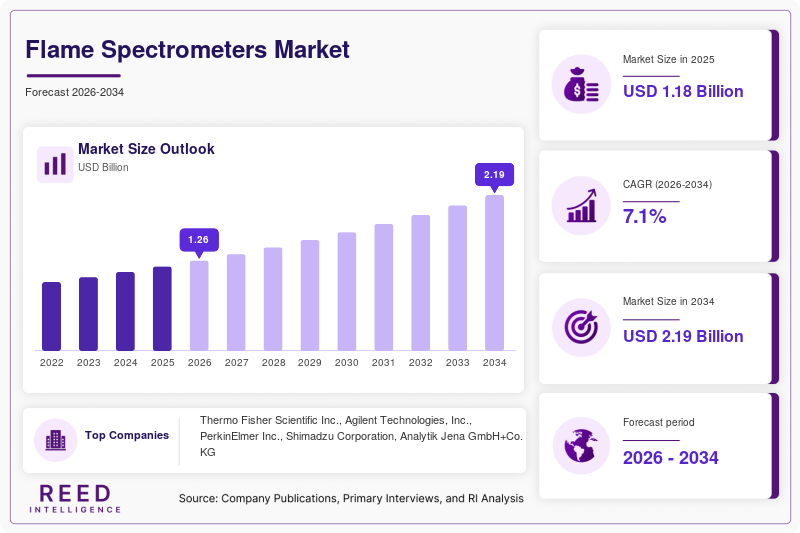
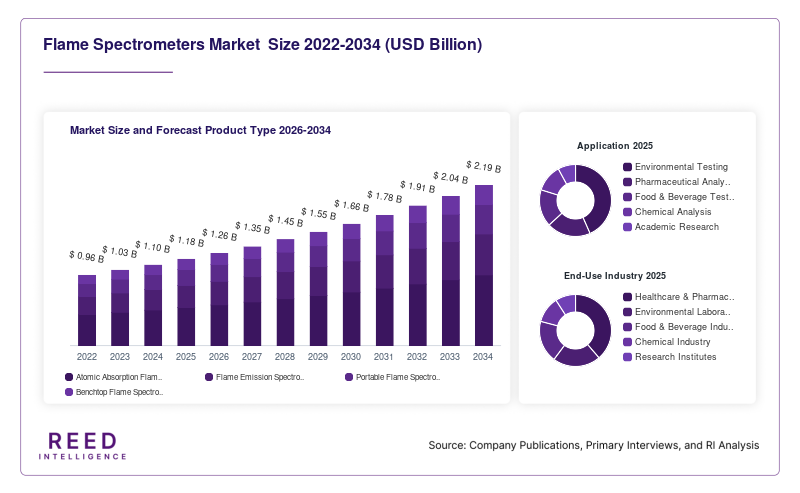
The global Flame Spectrometers Market size was valued at USD 1.18 billion in 2026 and is projected to reach USD 2.04 billion by 2034, expanding at a CAGR of 7.1% during the forecast period of 2026–2034. The market growth is being driven by increasing demand for analytical instrumentation across pharmaceutical, environmental testing, food safety, petrochemical, and academic research sectors. Flame spectrometers are widely used for elemental analysis and chemical composition testing due to their high accuracy, operational efficiency, and cost-effective analytical performance.
One of the major global factors supporting the growth of the Flame Spectrometers Market is the increasing emphasis on quality control and regulatory compliance in industrial manufacturing and laboratory operations. Industries such as pharmaceuticals, food processing, mining, and chemicals have strengthened testing standards for product quality, contamination control, and environmental safety. This has significantly increased the adoption of advanced flame spectrometry systems in laboratories and industrial testing facilities worldwide.
Key Highlights
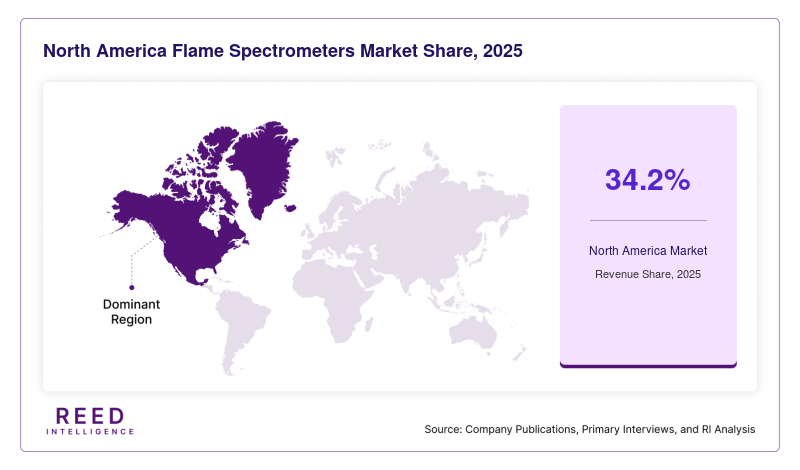
- North America accounted for 34.2% of the global Flame Spectrometers Market share in 2025 and remained the dominant regional market.
- Asia Pacific is projected to register the fastest CAGR of 8.2% during 2026–2034.
- By product type, atomic absorption flame spectrometers held the largest market share of 43.5% in 2025.
- Portable flame spectrometers are expected to witness the fastest CAGR of 8.7% during the forecast period.
- By application, pharmaceutical analysis accounted for 28.6% of the global market share in 2025.
- Environmental testing applications are projected to expand at the fastest CAGR of 8.5% between 2026 and 2034.
- By end-use, industrial laboratories dominated the market with 39.8% share in 2025.
- Research institutes are expected to witness the fastest growth rate during the forecast period.
- The United States remained the dominant country market and was valued at USD 278 million in 2024 and USD 293 million in 2025.
Market Trends
Increasing Adoption of Portable Analytical Instruments
The growing demand for field-based testing and real-time analysis has accelerated the adoption of portable flame spectrometers. Industries such as environmental monitoring, mining, and food safety are increasingly using compact analytical instruments for on-site testing applications. Portable systems provide faster results, improved operational flexibility, and reduced dependency on centralized laboratories. Manufacturers are developing lightweight and battery-operated flame spectrometers to support mobile testing requirements across industrial and research applications.
Integration of Automation and Digital Software Platforms
Automation and digital integration have become key trends shaping the Flame Spectrometers Market. Modern systems are increasingly equipped with cloud-based data management software, automated calibration systems, and touch-screen interfaces. Laboratories are focusing on workflow optimization and reducing manual errors through automated sample handling technologies. The integration of artificial intelligence and advanced analytics is further improving instrument efficiency and data interpretation capabilities.
Market Drivers
Rising Demand for Quality Control Across Industries
The growing need for accurate quality control testing in pharmaceuticals, chemicals, food processing, and manufacturing industries is a major driver for the Flame Spectrometers Market. Regulatory agencies worldwide have introduced stricter testing standards for product safety and purity. Flame spectrometers are widely used to detect trace elements and contaminants in industrial products and raw materials. This demand for reliable analytical testing solutions has significantly supported market growth.
Expansion of Environmental Monitoring Programs
Increasing environmental concerns and pollution monitoring initiatives have strengthened the demand for flame spectrometers in environmental testing applications. Governments and environmental agencies are investing in laboratory infrastructure to monitor water quality, soil contamination, and industrial emissions. Flame spectrometers are extensively used in environmental laboratories for elemental analysis and compliance testing. This factor has contributed to the expansion of the market across both developed and emerging economies.
Market Restraint
High Maintenance and Calibration Costs
The high maintenance and calibration costs associated with advanced flame spectrometers remain a significant restraint for market growth. Analytical instruments require periodic servicing, skilled operation, and calibration to maintain analytical accuracy. Small laboratories and research institutions with limited budgets often face challenges in adopting high-end flame spectrometry systems due to these operational expenses.
Market Opportunities
Growth in Pharmaceutical Research and Development
The expansion of pharmaceutical research and drug development activities is expected to create significant opportunities for the Flame Spectrometers Market. Pharmaceutical companies are increasingly investing in analytical testing systems to ensure product quality and regulatory compliance. Rising clinical research activities and formulation testing requirements are likely to support demand for advanced flame spectrometers during the forecast period.
Increasing Investments in Laboratory Modernization
Governments and private organizations are investing heavily in laboratory modernization projects across healthcare, environmental, and industrial sectors. These investments are supporting the replacement of outdated analytical instruments with advanced automated systems. Emerging economies are particularly focusing on strengthening analytical testing infrastructure, which is expected to generate new growth opportunities for market participants.
Segmental Analysis
By Product Type
Based on product type, the Flame Spectrometers Market is segmented into atomic absorption flame spectrometers, flame emission spectrometers, portable flame spectrometers, and hybrid flame spectrometers.
Atomic absorption flame spectrometers dominated the market with a 43.5% share in 2025 due to their high sensitivity and broad application range in elemental analysis. These systems are extensively used in pharmaceutical testing, chemical analysis, and environmental monitoring laboratories. Their ability to deliver precise quantitative analysis supported strong adoption across industrial applications.
Portable flame spectrometers are projected to witness the fastest CAGR of 8.7% during the forecast period. The growth of this segment will be driven by increasing demand for field-based analysis and on-site testing applications. Compact design, operational flexibility, and rapid testing capabilities are expected to strengthen demand for portable systems.
By Application
Based on application, the market is segmented into pharmaceutical analysis, environmental testing, food and beverage testing, petrochemical analysis, mining analysis, and academic research.
Pharmaceutical analysis accounted for the largest market share of 28.6% in 2025. Pharmaceutical manufacturers increasingly adopted flame spectrometers for raw material testing, formulation analysis, and quality assurance processes. Rising regulatory requirements regarding product purity and contamination testing supported strong demand from this segment.
Environmental testing is expected to witness the fastest CAGR of 8.5% during the forecast period. Increasing investments in water quality monitoring, pollution control, and industrial emissions testing are anticipated to support growth in this segment. Government agencies and environmental laboratories are expected to increase procurement of advanced analytical instruments.
By End-Use
Based on end-use, the Flame Spectrometers Market is segmented into industrial laboratories, research institutes, academic laboratories, healthcare laboratories, and government testing facilities.
Industrial laboratories dominated the market with a 39.8% share in 2025 due to widespread use of flame spectrometers in manufacturing quality control and industrial process testing. Chemical, pharmaceutical, and food processing industries extensively relied on analytical instruments to maintain product consistency and regulatory compliance.
Research institutes are projected to witness the fastest CAGR during the forecast period. The increasing focus on scientific innovation, material analysis, and environmental research is expected to support demand for advanced flame spectrometry systems in research facilities worldwide.
By Technology
Based on technology, the market is divided into single-beam spectrometers, double-beam spectrometers, and automated spectrometry systems.
Double-beam spectrometers accounted for the largest market share in 2025 due to their improved analytical stability and accuracy. These systems reduce background interference and enhance testing precision, making them suitable for high-performance laboratory environments.
Automated spectrometry systems are expected to register the fastest CAGR during 2026–2034. Increasing demand for workflow automation and reduced manual intervention in laboratories is anticipated to drive adoption of automated systems with integrated software capabilities.
By Distribution Channel
Based on distribution channel, the market is categorized into direct sales, third-party distributors, online sales channels, and laboratory equipment suppliers.
Direct sales dominated the Flame Spectrometers Market with a 47.2% share in 2025. Large laboratories and industrial facilities preferred direct procurement from manufacturers due to better technical support, warranty services, and customized installation solutions.
Online sales channels are projected to witness the fastest CAGR during the forecast period. The increasing adoption of digital procurement systems and e-commerce platforms for laboratory equipment purchasing is expected to strengthen this segment.
Regional Analysis
North America
North America accounted for 34.2% of the global Flame Spectrometers Market share in 2025. The region benefited from strong investments in pharmaceutical research, environmental monitoring, and industrial testing infrastructure. The United States remained the dominant country market due to the presence of advanced laboratory networks and high adoption of analytical technologies. Increasing quality control requirements in pharmaceutical manufacturing and food testing industries further supported market growth. The regional market is projected to expand at a CAGR of 6.8% during 2026–2034.
Europe
Europe held 27.5% of the global Flame Spectrometers Market share in 2025. The region experienced stable demand due to strict environmental regulations and growing industrial testing activities. Germany emerged as the leading country market owing to its strong analytical instrument manufacturing sector and advanced research infrastructure. Laboratories across Europe increasingly adopted automated analytical systems to improve testing efficiency and regulatory compliance. The market in Europe is anticipated to grow at a CAGR of 6.6% during the forecast period.
Asia Pacific
Asia Pacific dominated as the fastest-growing regional market and accounted for 24.8% share in 2025. Rapid industrialization, expanding pharmaceutical production, and increasing research investments supported market growth across the region. China remained the dominant country market due to rising laboratory modernization initiatives and growing environmental testing activities. The expansion of chemical manufacturing and food safety testing programs also contributed to higher adoption of flame spectrometers. The regional market is expected to register the fastest CAGR of 8.2% during 2026–2034.
Middle East & Africa
The Middle East & Africa represented 7.1% of the global Flame Spectrometers Market share in 2025. The market growth was supported by increasing investments in petrochemical testing and environmental monitoring infrastructure. Saudi Arabia remained the dominant country market due to expanding industrial testing activities in oil refining and chemical sectors. Governments in the region are increasingly investing in laboratory capabilities to improve industrial quality standards. The market is forecast to grow at a CAGR of 6.4% during the forecast period.
Latin America
Latin America accounted for 6.4% of the global Flame Spectrometers Market share in 2025. The region experienced rising demand from mining laboratories, food testing facilities, and environmental monitoring agencies. Brazil remained the dominant country market due to expanding pharmaceutical manufacturing and agricultural testing activities. Increasing investments in industrial quality control systems supported the adoption of advanced analytical instruments across the region. The market is expected to witness a CAGR of 6.9% during 2026–2034.
Competitive Landscape
The Flame Spectrometers Market remains moderately competitive with the presence of several international analytical instrument manufacturers. Companies are focusing on technological innovation, automation integration, and strategic partnerships to strengthen market position.
Thermo Fisher Scientific Inc. remained one of the leading players in the market due to its extensive analytical instrumentation portfolio and strong global distribution network. The company has focused on developing advanced flame spectrometry systems with enhanced automation and digital integration capabilities. Its investments in laboratory workflow optimization technologies have supported continued market leadership.
Agilent Technologies Inc. has strengthened its market presence through product innovation and expansion in pharmaceutical testing applications. PerkinElmer Inc. continues to focus on environmental and industrial testing solutions with improved analytical sensitivity. Shimadzu Corporation has expanded its analytical instrument offerings in Asia Pacific markets. Analytik Jena GmbH has maintained strong market positioning through specialized laboratory testing solutions.
Industry participants are increasingly investing in artificial intelligence-based software integration and cloud-enabled laboratory systems to improve analytical performance and data management efficiency. Strategic collaborations with research institutions and industrial laboratories are also supporting product development initiatives.
Key Players List
- Thermo Fisher Scientific Inc.
- Agilent Technologies Inc.
- PerkinElmer Inc.
- Shimadzu Corporation
- Analytik Jena GmbH
- Hitachi High-Tech Corporation
- HORIBA Ltd.
- Bruker Corporation
- Spectro Analytical Instruments GmbH
- GBC Scientific Equipment
- Aurora Biomed Inc.
- Buck Scientific Inc.
- Teledyne Technologies Incorporated
- Jenway Ltd.
- PG Instruments Limited
Recent Developments
- Thermo Fisher Scientific Inc. launched an upgraded flame spectrometry platform with automated calibration and cloud-based data management features.
- Agilent Technologies Inc. expanded its pharmaceutical analytical testing portfolio with advanced flame spectrometry systems for trace element analysis.
- Shimadzu Corporation introduced portable flame spectrometers designed for field-based environmental testing applications.
- PerkinElmer Inc. strengthened its laboratory automation capabilities through integration of artificial intelligence-based analytical software.
- HORIBA Ltd. announced investments in analytical instrument manufacturing expansion to support increasing demand from Asia Pacific laboratories.
Flame Spectrometers Market Segments
Product Type
- Atomic Absorption Flame Spectrometers
- Flame Emission Spectrometers
- Portable Flame Spectrometers
- Benchtop Flame Spectrometers
Application
- Environmental Testing
- Pharmaceutical Analysis
- Food & Beverage Testing
- Chemical Analysis
- Academic Research
End-Use Industry
- Healthcare & Pharmaceuticals
- Environmental Laboratories
- Food & Beverage Industry
- Chemical Industry
- Research Institutes
Technology
- Single Beam Systems
- Double Beam Systems
- Digital Spectrometers
- Hybrid Analytical Systems
Distribution Channel
- Direct Sales
- Distributors & Dealers
- Online Procurement Platforms
- Scientific Equipment Suppliers
By Region
- North America
- Europe
- APAC
- Middle East and Africa
- LATAM