Flare Gas Recovery System Market Size, Share & Demand Report By Component (Compressors, Control Systems, Monitoring Systems), By Application (Refineries, Petrochemical Plants, Natural Gas Processing Plants), By Capacity (Low-Capacity Systems, Medium-Capacity Systems), By End Use (Oil & Gas, Chemical Processing, Energy & Power, Industrial Manufacturing), By Deployment Type (Onshore, Offshore), By Region & Segment Forecasts, 2026–2034
USD 3950
Market Overview
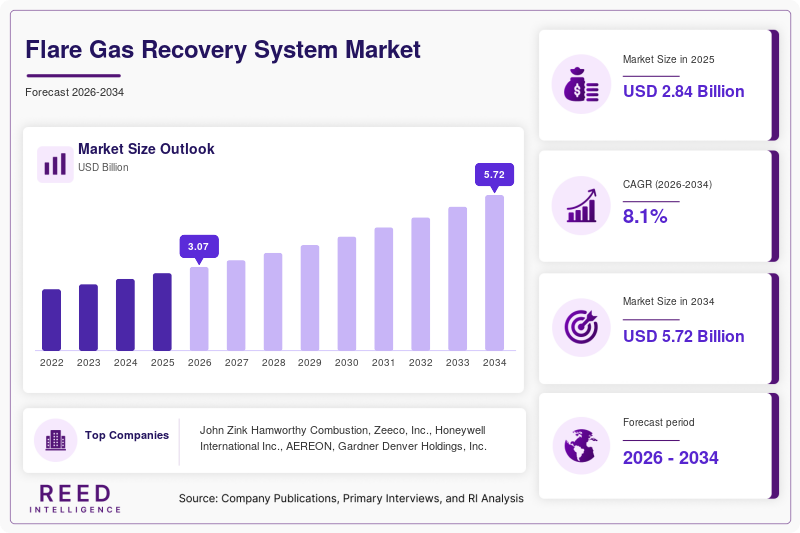
The global Flare Gas Recovery System Market size was valued at USD 2.84 billion in 2026 and is projected to reach USD 5.31 billion by 2034, expanding at a CAGR of 8.1% during the forecast period from 2026 to 2034. The market growth has been supported by the increasing global focus on reducing greenhouse gas emissions and improving operational efficiency across oil & gas, petrochemical, and refinery industries. Governments and regulatory bodies worldwide have implemented stricter flaring reduction policies, encouraging industries to adopt flare gas recovery systems for capturing and reusing waste gases.
The Flare Gas Recovery System Market has experienced significant expansion due to the rising need for sustainable energy utilization and carbon emission management. Industries are increasingly deploying flare gas recovery systems to minimize hydrocarbon losses and improve fuel efficiency within industrial operations. These systems capture gases that would otherwise be burned through flaring and redirect them for productive applications such as fuel generation, reinjection, and petrochemical feedstock processing.
Key Highlights
- North America accounted for 36.8% of the global Flare Gas Recovery System Market share in 2025, while Asia Pacific is projected to register the fastest CAGR of 9.4% during the forecast period.
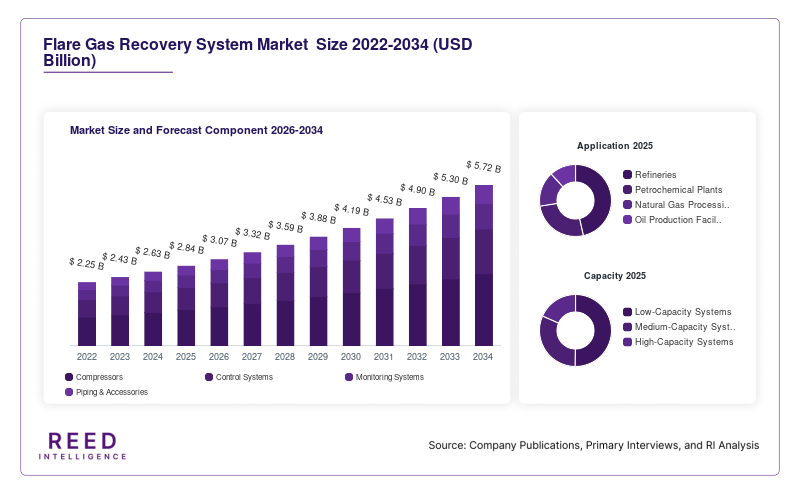
- By component, compressors held the dominant market share of 44.9% in 2025, while monitoring and control systems are expected to expand at a CAGR of 10.2% through 2034.
- By application, refineries accounted for 39.7% of the market share in 2025, whereas petrochemical plants are forecast to grow at a CAGR of 9.1%.
- By capacity, medium-capacity systems dominated with 47.5% share in 2025, while high-capacity systems are anticipated to witness a CAGR of 8.8%.
- By end use, oil & gas facilities represented 51.2% of the global demand in 2025, while chemical processing facilities are expected to record a CAGR of 8.9%.
- The United States remained the dominant country market and was valued at USD 702 million in 2024 and USD 751 million in 2025.
Market Trends
Integration of Digital Monitoring and Automation Technologies
The Flare Gas Recovery System Market is increasingly witnessing the integration of digital monitoring platforms and automation technologies. Industrial operators are deploying advanced sensors, remote monitoring software, and predictive maintenance systems to improve flare gas management efficiency. These technologies help facilities optimize gas recovery performance, reduce operational downtime, and maintain compliance with environmental regulations. Automated systems are also improving real-time leak detection and process control capabilities.
Increasing Adoption of Modular Recovery Systems
The market is experiencing rising demand for modular flare gas recovery systems due to their flexibility and cost efficiency. Modular systems simplify installation processes and reduce operational disruptions during facility upgrades. Oil & gas companies and petrochemical operators are increasingly preferring scalable solutions that can be customized according to plant capacity requirements. This trend is particularly gaining traction in offshore production facilities and remote industrial operations.
Market Drivers
Stringent Environmental Regulations on Gas Flaring
Governments and environmental agencies across several countries have introduced strict regulations aimed at reducing industrial gas flaring activities. Industries are required to minimize greenhouse gas emissions and improve energy efficiency within operations. This regulatory environment has significantly accelerated the adoption of flare gas recovery systems across refineries, petrochemical plants, and upstream oil production facilities.
Rising Focus on Energy Recovery and Operational Efficiency
Industrial operators are increasingly prioritizing energy recovery initiatives to improve profitability and reduce fuel wastage. Flare gas recovery systems allow facilities to capture and reuse waste gases as fuel or feedstock, reducing operational losses. Rising energy costs and the need for efficient hydrocarbon utilization have further strengthened market demand for advanced gas recovery technologies.
Market Restraint
High Initial Installation and Maintenance Costs
The installation of flare gas recovery systems requires significant capital investment for compressors, piping infrastructure, control systems, and maintenance operations. Smaller industrial facilities often face budget constraints associated with implementing advanced recovery technologies. Maintenance complexity and operational downtime during system integration also limit market adoption in certain regions.
Market Opportunities
Expansion of LNG and Natural Gas Processing Infrastructure
The increasing development of LNG terminals and natural gas processing facilities is creating growth opportunities for flare gas recovery system providers. These facilities require efficient gas management systems to reduce product losses and improve operational sustainability. Rising global investments in natural gas infrastructure are expected to support long-term market expansion.
Growth of Carbon Emission Reduction Initiatives
Global carbon reduction programs and net-zero emission targets are encouraging industries to invest in sustainable gas handling technologies. Companies are increasingly implementing flare gas recovery systems to reduce carbon footprints and align with environmental compliance requirements. This trend is expected to generate strong growth opportunities across both developed and emerging economies.
Segmental Analysis
By Component
Compressors
Compressors accounted for 44.9% of the global market share in 2025. These components remained dominant because they play a critical role in capturing, compressing, and transporting flare gases for reuse within industrial systems. Oil refineries and gas processing facilities widely adopted advanced compressor technologies to improve operational efficiency and reduce hydrocarbon losses.
Monitoring and Control Systems
Monitoring and control systems are projected to expand at a CAGR of 10.2% during the forecast period. Growth will be driven by increasing adoption of industrial automation and digital gas management technologies. Operators are expected to invest in advanced monitoring platforms to improve system performance tracking and predictive maintenance capabilities.
By Application
Refineries
Refineries accounted for 39.7% of the Flare Gas Recovery System Market share in 2025. This segment dominated because refinery operations generate substantial flare gas volumes during hydrocarbon processing activities. Operators continued deploying recovery systems to improve fuel efficiency and comply with environmental regulations.
Petrochemical Plants
Petrochemical plants are forecast to grow at a CAGR of 9.1% through 2034. Increasing petrochemical production capacity and rising demand for process optimization technologies are expected to strengthen segment growth. Recovery systems will gain adoption as facilities seek to reduce operational losses and improve resource utilization.
By Capacity
Medium-Capacity Systems
Medium-capacity systems held the leading market share of 47.5% in 2025. These systems remained dominant because they are widely suitable for standard refinery and petrochemical operations. Industrial facilities preferred medium-capacity solutions due to balanced installation costs and operational efficiency.
High-Capacity Systems
High-capacity systems are anticipated to witness a CAGR of 8.8% during the forecast period. Growth will be supported by rising investments in large-scale refining and LNG processing projects. These systems are expected to gain traction in facilities managing high gas flow volumes and complex industrial operations.
By End Use
Oil & Gas Facilities
Oil & gas facilities represented 51.2% of the global market share in 2025. The segment maintained dominance because upstream production sites and hydrocarbon processing plants generated high flare gas volumes requiring recovery solutions. Energy operators increasingly adopted recovery systems to improve operational sustainability and reduce environmental impact.
Chemical Processing Facilities
Chemical processing facilities are projected to record a CAGR of 8.9% during the forecast period. Growth will be driven by increasing industrial energy efficiency programs and rising demand for emission control technologies within chemical manufacturing operations.
By Deployment Type
Onshore Facilities
Onshore facilities accounted for the largest market share in 2025 due to extensive refinery infrastructure and large-scale industrial processing operations. Recovery systems were widely deployed across onshore oil production sites and petrochemical facilities to improve gas utilization efficiency.
Offshore Facilities
Offshore facilities are expected to grow at a CAGR of 8.5% through 2034. Rising offshore exploration projects and increasing environmental compliance requirements will support segment growth. Operators are anticipated to adopt compact modular recovery systems suitable for offshore operational environments.
Regional Analysis
North America
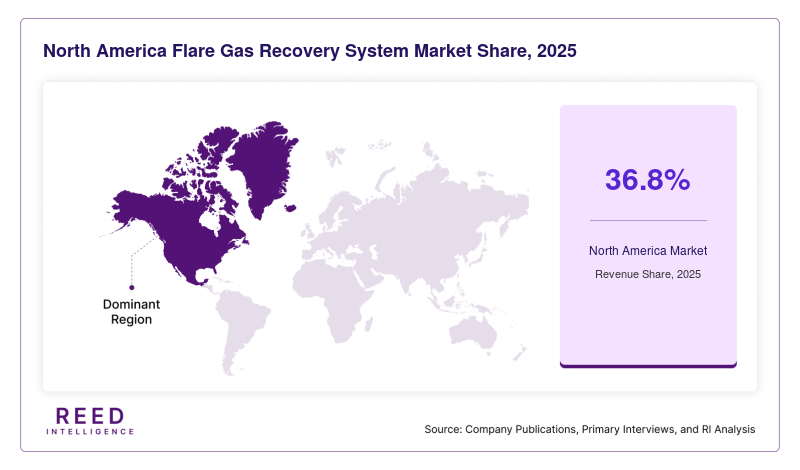
North America accounted for 36.8% of the global Flare Gas Recovery System Market share in 2025 and is projected to grow at a CAGR of 7.4% during the forecast period. The region maintained market leadership due to stringent environmental regulations and extensive shale oil & gas production activities. The United States dominated the regional market because refinery operators and upstream producers continued investing in emission reduction technologies and energy recovery systems.
Europe
Europe held 24.5% of the global Flare Gas Recovery System Market share in 2025 and is anticipated to expand at a CAGR of 7.7% through 2034. The region experienced steady growth due to strong industrial sustainability initiatives and increasing investments in refinery modernization projects. Germany emerged as the dominant country market owing to rising adoption of industrial energy efficiency technologies and stricter carbon emission management standards.
Asia Pacific
Asia Pacific represented 27.3% of the global Flare Gas Recovery System Market share in 2025 and is forecast to register the fastest CAGR of 9.4% between 2026 and 2034. Rapid industrialization and increasing refinery expansion projects accelerated market demand across the region. China dominated the regional market because the country expanded petrochemical production capacity and implemented industrial emission reduction policies to improve environmental performance.
Middle East & Africa
The Middle East & Africa accounted for 7.2% of the global market share in 2025 and is expected to grow at a CAGR of 8.0% during the forecast period. The region witnessed stable market growth due to rising investments in oil production infrastructure and flare reduction initiatives. Saudi Arabia remained the leading country market because energy operators continued upgrading hydrocarbon processing facilities with advanced gas recovery technologies.
Latin America
Latin America captured 4.2% of the Flare Gas Recovery System Market share in 2025 and is projected to witness a CAGR of 7.1% through 2034. Brazil dominated the regional market as offshore oil exploration projects and refinery capacity enhancement programs increased demand for flare gas recovery solutions. Expanding industrial energy management initiatives also supported regional market growth.
Competitive Landscape
The Flare Gas Recovery System Market remains moderately competitive with the presence of multinational industrial equipment manufacturers and specialized gas recovery solution providers. Companies are focusing on compressor technology advancements, digital monitoring integration, and customized industrial gas management systems to strengthen their market position.
John Zink Hamworthy Combustion remained one of the leading market participants due to its diversified flare gas recovery portfolio and strong global presence in refinery and petrochemical applications. The company recently introduced an upgraded gas recovery compressor solution featuring enhanced energy efficiency and predictive monitoring capabilities for industrial processing facilities.
Major industry participants are also emphasizing strategic partnerships, regional expansion initiatives, and technology innovation to improve operational performance and strengthen customer relationships across global markets.
Key Players List
- John Zink Hamworthy Combustion
- Zeeco, Inc.
- Honeywell International Inc.
- AEREON
- Gardner Denver Holdings, Inc.
- Siemens Energy
- Mitsubishi Heavy Industries Ltd.
- Wärtsilä Corporation
- UOP LLC
- Schlumberger Limited
- Baker Hughes Company
- Cimarron Energy, Inc.
- Koch Engineered Solutions
- GBA Flare Systems
- Petrogas Systems
Recent Developments
- In February 2026, John Zink Hamworthy Combustion launched an upgraded flare gas compressor platform with integrated predictive analytics for refinery applications.
- In November 2025, Zeeco, Inc. expanded its flare gas recovery engineering services across Middle Eastern energy infrastructure projects.
- In August 2025, Honeywell International Inc. introduced advanced industrial monitoring software for real-time flare gas recovery optimization.
- In June 2025, Baker Hughes Company partnered with regional LNG operators to deploy modular flare gas recovery systems for offshore facilities.
- In March 2025, Siemens Energy announced the expansion of its industrial gas management solutions portfolio with energy-efficient recovery compressor technologies.
Flare Gas Recovery System Market Segments
Component
- Compressors
- Control Systems
- Monitoring Systems
- Piping & Accessories
Application
- Refineries
- Petrochemical Plants
- Natural Gas Processing Plants
- Oil Production Facilities
Capacity
- Low-Capacity Systems
- Medium-Capacity Systems
- High-Capacity Systems
End Use
- Oil & Gas
- Chemical Processing
- Energy & Power
- Industrial Manufacturing
Deployment Type
- Onshore
- Offshore
By Region
- North America
- Europe
- APAC
- Middle East and Africa
- LATAM