Flash Dryers Market Size, Share Demand Report By Type (Spin Flash Dryers, Fluidized Bed Flash Dryers, Pneumatic Flash Dryers), By Application (Chemical Processing, Food Processing, Pharmaceuticals, Minerals & Fertilizers), By End-Use Industry (Industrial Manufacturing, Food & Beverage, Pharmaceutical, Chemical) By Region & Segment Forecasts, 2025–2034
USD 3950
Market Overview
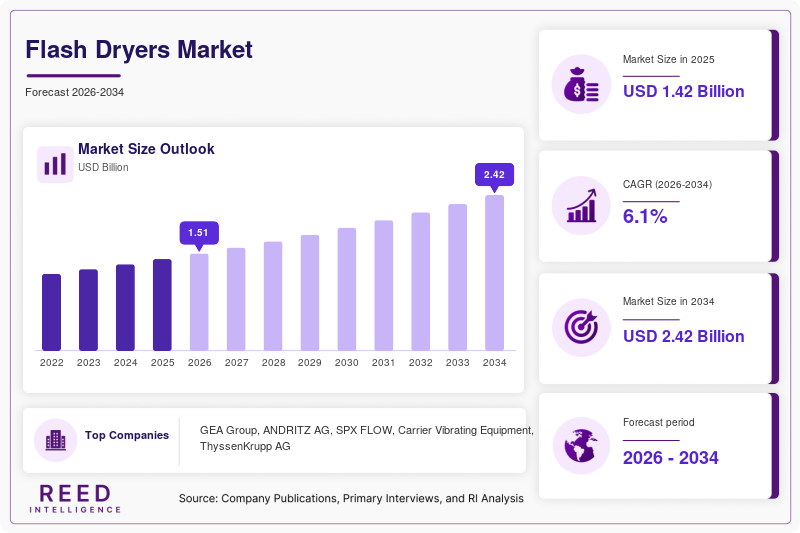
The Flash Dryers Market size is estimated at USD 1.42 billion, and it is projected to reach approximately USD 1.52 billion in 2026. Over the forecast period from 2025 to 2034, the market is expected to grow at a compound annual growth rate (CAGR) of 6.1%, reaching nearly USD 2.53 billion by 2034.
Flash dryers are widely used for rapid moisture removal from powders, granules, and pastes, making them essential in high-throughput industrial operations. The increasing need for efficient drying technologies that reduce processing time and energy consumption is a major factor fueling market expansion. Additionally, industries are prioritizing continuous production systems, which aligns well with the operational efficiency of flash dryers.
Key Highlights
- Market size projected to reach USD 2.53 billion by 2034, reflecting steady expansion across industrial processing sectors.
Growth is supported by increasing demand for high-efficiency drying solutions in global manufacturing. - CAGR of 6.1% from 2025 to 2034, driven by consistent adoption across key industries.
The market shows stable long-term growth with rising investments in advanced processing technologies. - Asia Pacific dominated the market with a 32% share in 2025 due to strong industrial activity.
The region benefits from large-scale manufacturing and expanding chemical and food sectors. - Asia Pacific is the fastest-growing region with a CAGR of 7.2% during the forecast period.
Rapid industrialization and export-oriented production are key factors driving this growth. - Strong demand from chemical, food, and pharmaceutical industries continues to support market expansion.
These sectors rely on flash dryers for efficient moisture removal and consistent product quality.
Market Trends
Integration of Automation and Smart Control Systems
The Flash Dryers Market is increasingly witnessing the integration of automation and smart control technologies. Modern flash dryers are equipped with sensors, programmable logic controllers (PLCs), and real-time monitoring systems that allow operators to control temperature, airflow, and moisture levels with precision. This trend is driven by the need for consistent product quality and reduced human intervention in industrial processes. Automation also helps minimize energy waste and operational errors, which is crucial in large-scale manufacturing environments. Industries such as pharmaceuticals and specialty chemicals are particularly adopting these systems to comply with strict quality standards and regulatory requirements. As Industry 4.0 adoption expands globally, the demand for intelligent drying systems is expected to increase steadily.
Shift Toward Energy-Efficient and Sustainable Drying Solutions
Sustainability has become a central focus across industrial sectors, and the flash dryers market is no exception. Manufacturers are developing energy-efficient flash dryers that consume less power while delivering high drying performance. This includes innovations such as heat recovery systems, optimized airflow designs, and low-emission operations. Companies are also exploring alternative energy sources to power drying systems, reducing reliance on conventional fuels. This trend is particularly strong in regions with stringent environmental regulations, where industries are required to lower their carbon footprint. As energy costs continue to rise, end-users are increasingly investing in sustainable drying solutions that offer long-term cost savings and environmental benefits.
Market Drivers
Rising Demand from the Chemical Processing Industry
The chemical processing industry is a major driver of the Flash Dryers Market, as these systems are widely used for drying chemical powders, pigments, and intermediates. Flash dryers provide rapid drying with uniform results, which is essential for maintaining product quality and consistency. The growing demand for specialty chemicals and advanced materials has increased the need for efficient drying technologies. Additionally, chemical manufacturers are expanding their production capacities to meet global demand, further boosting the adoption of flash dryers. The ability of these systems to handle large volumes and operate continuously makes them a preferred choice in chemical plants.
Expansion of the Food and Pharmaceutical Industries
The growth of the food and pharmaceutical industries is significantly contributing to the expansion of the flash dryers market. In the food sector, flash dryers are used to process ingredients such as starch, proteins, and flavoring agents, ensuring extended shelf life and quality preservation. In the pharmaceutical industry, these dryers are essential for producing dry powders and granules used in drug formulations. The increasing demand for processed foods and medicines, coupled with strict quality standards, is driving the need for advanced drying technologies. Flash dryers offer the speed, efficiency, and reliability required to meet these industry demands.
Market Restraint
High Initial Investment and Maintenance Costs
One of the primary restraints in the Flash Dryers Market is the high initial investment required for installation and setup. Flash drying systems involve complex engineering, including high-capacity fans, heating systems, and control mechanisms, which significantly increase capital expenditure. Small and medium-sized enterprises often find it challenging to adopt such technologies due to budget constraints. Additionally, maintenance costs can be substantial, as these systems require regular inspection, cleaning, and replacement of components to ensure optimal performance.
The impact of this restraint is particularly evident in developing regions, where cost sensitivity is high. For example, small-scale food processing units may opt for conventional drying methods instead of investing in flash dryers. Furthermore, unexpected downtime due to maintenance issues can disrupt production schedules, leading to financial losses. While large enterprises can absorb these costs, smaller players may hesitate to invest, limiting overall market penetration. Addressing this challenge requires manufacturers to develop cost-effective solutions and offer flexible financing options to attract a broader customer base.
Market Opportunities
Growing Adoption in Emerging Economies
Emerging economies present significant growth opportunities for the Flash Dryers Market. Rapid industrialization in countries across Asia, Latin America, and Africa is driving demand for efficient processing equipment. Governments in these regions are investing in infrastructure and manufacturing, creating a favorable environment for industrial equipment suppliers. Flash dryers are increasingly being adopted in sectors such as food processing, chemicals, and minerals, where production volumes are rising. The availability of low-cost labor and raw materials further supports industrial expansion, making these regions attractive markets for flash dryer manufacturers.
Technological Advancements and Product Innovation
Continuous innovation in flash dryer technology is creating new opportunities for market growth. Manufacturers are focusing on developing compact, energy-efficient, and customizable systems that cater to specific industry requirements. Innovations such as modular designs, improved heat transfer mechanisms, and advanced control systems are enhancing the performance and versatility of flash dryers. These advancements enable end-users to achieve better drying efficiency while reducing operational costs. Additionally, the integration of digital technologies, such as IoT and predictive maintenance, is expected to open new avenues for market expansion. Companies that invest in research and development are likely to gain a competitive advantage in the evolving market landscape.
Segmental Analysis
By Type
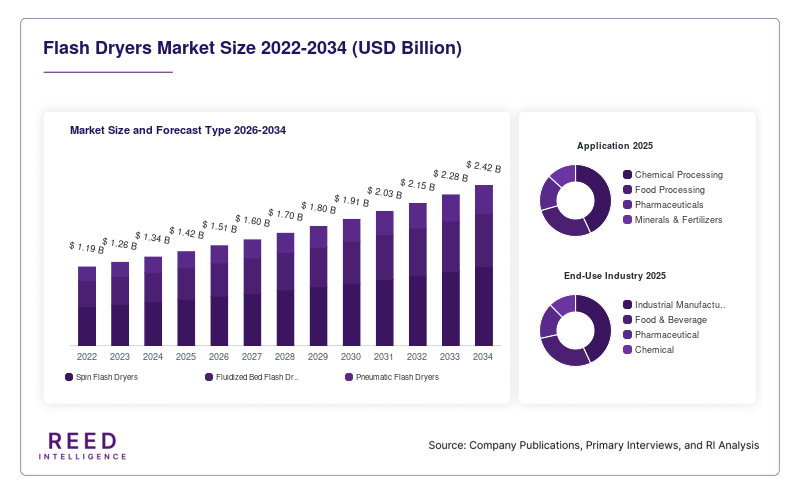
The spin flash dryers segment dominated the market in 2024, accounting for approximately 48% of the total market share. These dryers are widely used due to their ability to handle a variety of materials, including powders and pastes, with high efficiency. Spin flash dryers offer rapid drying and uniform moisture removal, making them suitable for industries such as chemicals and pharmaceuticals. Their compact design and continuous operation capabilities further enhance their adoption. The demand for these dryers is particularly strong in large-scale industrial applications where consistent performance is critical.
The fluidized bed flash dryers segment is expected to be the fastest-growing, with a projected CAGR of 6.8% during the forecast period. These dryers offer improved heat transfer and energy efficiency, making them suitable for applications requiring precise drying conditions. The growing emphasis on energy conservation and sustainability is driving the adoption of fluidized bed systems. Additionally, their ability to handle heat-sensitive materials makes them increasingly popular in the food and pharmaceutical industries.
By Application
The chemical processing segment held the largest share in 2024, accounting for around 42% of the market. Flash dryers are extensively used in this segment for drying chemical powders, pigments, and intermediates. The need for consistent product quality and efficient processing drives the adoption of flash dryers in chemical manufacturing. The expansion of the chemical industry, particularly in emerging economies, further supports market growth.
The food processing segment is expected to grow at the fastest rate, with a CAGR of 6.5%. The increasing demand for processed and packaged foods is driving the need for efficient drying technologies. Flash dryers are used to process ingredients such as starch, proteins, and flavoring agents, ensuring quality and shelf stability. The growing focus on food safety and quality is further boosting the adoption of flash dryers in this segment.
By End-Use Industry
The industrial manufacturing segment dominated the market in 2024, accounting for approximately 45% of the total share. Flash dryers are widely used in industrial manufacturing processes for drying raw materials and intermediates. The need for high efficiency and continuous operation drives their adoption in this segment. The expansion of manufacturing activities globally further supports market growth.
The pharmaceutical segment is projected to be the fastest-growing, with a CAGR of 6.9%. The increasing demand for medicines and healthcare products is driving the need for advanced drying technologies. Flash dryers are used to produce dry powders and granules for drug formulations, ensuring consistent quality. The growing focus on research and development in the pharmaceutical industry is further boosting the adoption of flash dryers.
Regional Analysis
North America
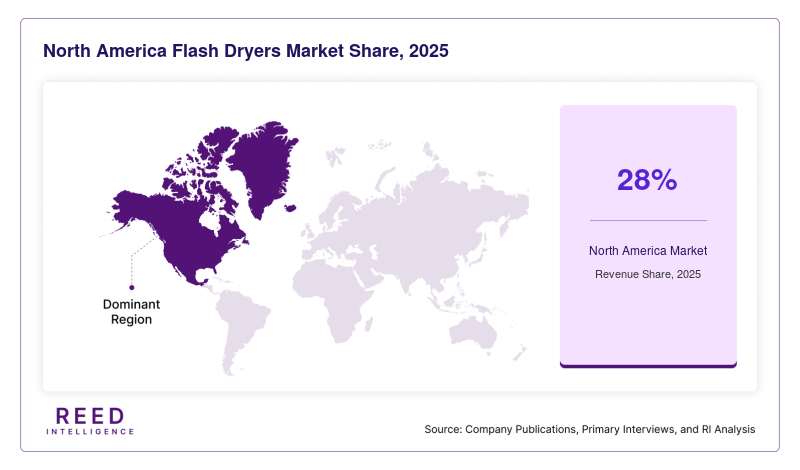
North America accounted for approximately 28% of the Flash Dryers Market share in 2025, with a projected CAGR of 5.4% during the forecast period. The region benefits from a well-established industrial base, particularly in chemicals, pharmaceuticals, and food processing. The presence of advanced manufacturing technologies and high adoption of automation contributes to steady market growth. Additionally, stringent environmental regulations are encouraging the adoption of energy-efficient drying systems, further supporting market expansion.
The United States dominates the regional market due to its strong industrial infrastructure and high demand for advanced processing equipment. A unique growth factor in this region is the increasing focus on sustainability, with companies investing in eco-friendly drying technologies to reduce emissions and energy consumption. This trend is driving the adoption of modern flash dryers across various industries.
Europe
Europe held around 24% of the market share in 2025 and is expected to grow at a CAGR of 5.1% through 2034. The region is characterized by strict environmental regulations and a strong emphasis on energy efficiency. Industries are increasingly adopting advanced drying systems to comply with regulatory standards and reduce operational costs. The presence of established manufacturing sectors further supports market growth.
Germany is the leading country in the European market, driven by its robust industrial base and focus on technological innovation. A unique growth factor in Europe is the emphasis on circular economy practices, which encourages the use of efficient and sustainable processing technologies. This has led to increased adoption of flash dryers in various industries.
Asia Pacific
Asia Pacific is the fastest-growing region, accounting for 32% of the market share in 2025 and projected to grow at a CAGR of 7.2%. Rapid industrialization, urbanization, and increasing investments in manufacturing are driving demand for flash dryers. The region’s expanding chemical, food, and pharmaceutical industries are major contributors to market growth.
China dominates the Asia Pacific market due to its large manufacturing sector and high demand for industrial equipment. A unique growth factor in this region is the rising export of processed goods, which requires efficient drying technologies to maintain product quality. This trend is boosting the adoption of flash dryers.
Middle East & Africa
The Middle East & Africa region held approximately 8% of the market share in 2025 and is expected to grow at a CAGR of 4.8%. The market is driven by the expansion of the oil and gas, chemical, and food processing industries. Investments in industrial infrastructure are supporting the adoption of advanced processing equipment.
Saudi Arabia is a key market in this region, driven by its focus on diversifying the economy beyond oil. A unique growth factor is the increasing investment in industrial development projects, which is creating demand for efficient drying technologies, including flash dryers.
Latin America
Latin America accounted for around 8% of the market share in 2025, with a projected CAGR of 5.6%. The region is experiencing growth in the food processing and chemical industries, which is driving demand for flash dryers. Economic development and increasing industrial activities are contributing to market expansion.
Brazil leads the Latin American market due to its large agricultural and industrial base. A unique growth factor in this region is the growing demand for processed agricultural products, which requires efficient drying systems. This is expected to drive the adoption of flash dryers in the coming years.
Competitive Landscape
The Flash Dryers Market is moderately competitive, with several global and regional players focusing on product innovation and expansion strategies. Key companies are investing in research and development to enhance the efficiency and performance of their drying systems. The market is characterized by strategic partnerships, mergers, and acquisitions aimed at strengthening market presence.
One of the leading players in the market is GEA Group, which has established a strong presence through its advanced drying technologies and global distribution network. The company focuses on developing energy-efficient solutions and expanding its product portfolio to meet diverse industry needs. A recent development includes the launch of a new range of compact flash dryers designed for small and medium-sized enterprises, offering improved efficiency and reduced operational costs.
Other major players are also focusing on expanding their product offerings and entering emerging markets to capitalize on growth opportunities.
Key Players List
- GEA Group
- ANDRITZ AG
- SPX FLOW
- Carrier Vibrating Equipment
- ThyssenKrupp AG
- Dedert Corporation
- VetterTec GmbH
- Hosokawa Micron Group
- Yamato Sanko
- Acmefil Engineering Systems
- Swenson Technology
- Technodry System Engineering
- SiccaDania Group
- Changzhou Fanqun Drying Equipment
- Shandong Tianli Energy
Recent Developments
- In 2024, a major manufacturer introduced an energy-efficient flash dryer with integrated heat recovery technology to reduce energy consumption.
- In 2025, a leading company expanded its production facility in Asia Pacific to meet rising regional demand.
- In 2025, a new partnership was formed between two industry players to develop advanced drying solutions for the pharmaceutical sector.
Flash Dryers Market Segments
Type
- Spin Flash Dryers
- Fluidized Bed Flash Dryers
- Pneumatic Flash Dryers
Application
- Chemical Processing
- Food Processing
- Pharmaceuticals
- Minerals & Fertilizers
End-Use Industry
- Industrial Manufacturing
- Food & Beverage
- Pharmaceutical
- Chemical
By Region
- North America
- Europe
- APAC
- Middle East and Africa
- LATAM