Flashlight Market Size, Share & Demand Report By Type (LED Flashlights, Incandescent Flashlights, Rechargeable Flashlights), By Application (Residential, Commercial & Industrial, Outdoor & Sports, Emergency & Safety) By Region & Segment Forecasts, 2026–2034
USD 3950
Flashlight Market Size
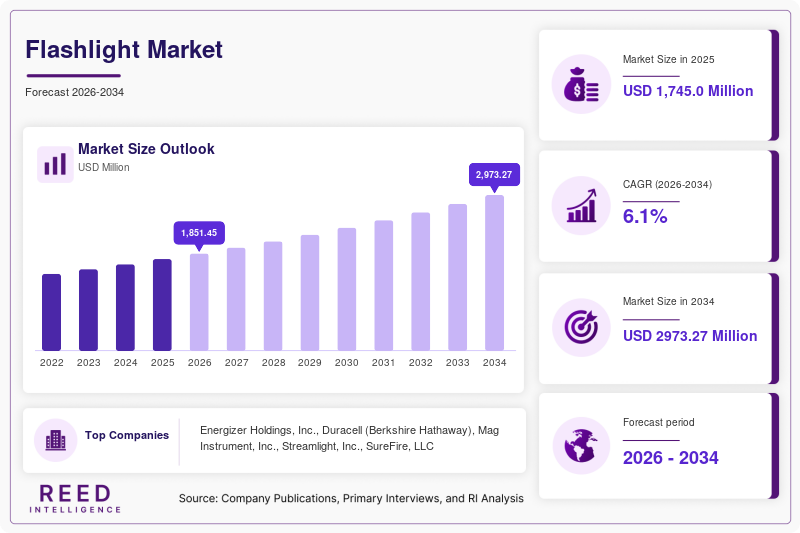
The flashlight market size is projected at USD 1,850.0 million in 2026 and is expected to hit USD 2,980.0 million by 2034 with a CAGR of 6.1% during the forecast period. The increasing demand for portable lighting solutions, the growing adoption of energy-efficient LED technology, and the rising frequency of power outages and natural disasters underpin market expansion. This report delivers a comprehensive analysis of the flashlight market , including segmentation by type and application, competitive dynamics, and regional growth patterns, equipping stakeholders with critical intelligence to navigate this essential portable lighting landscape.
Flashlight Market Key Takeaways
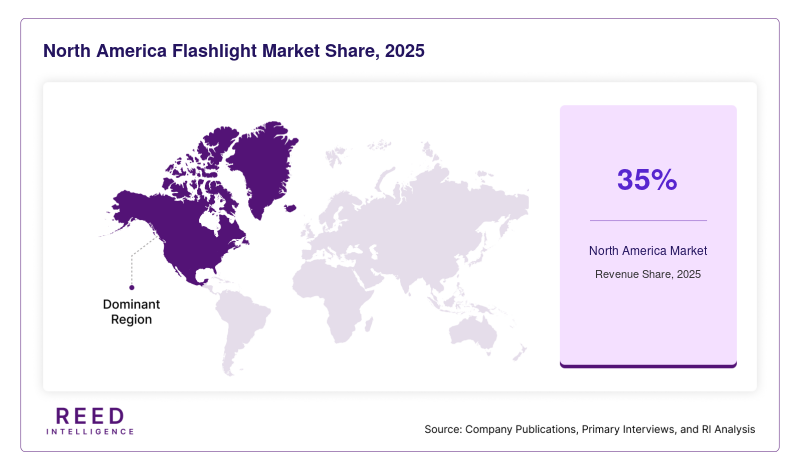
- Dominant Region: North America leads the flashlight market with a 35% share, while Asia-Pacific is the fastest-growing region with a projected CAGR of 8.2% through 2034.
- Dominant Segment: The LED Flashlights type dominates the market with a 65% share, while the Residential application is the leading segment with a 42% share.
- Emerging Country: India is projected to reach USD 285.0 million by 2034, expanding at a CAGR of 9.5%.
- Key Drivers: The increasing frequency of power outages, the growing demand for portable lighting in outdoor activities, and the rising adoption of energy-efficient LED technology are driving market growth.
The flashlight market encompasses a wide range of portable lighting devices designed for handheld use, including LED flashlights, incandescent flashlights, and rechargeable flashlights. These devices serve as essential tools for households, professionals, and outdoor enthusiasts, providing reliable illumination in various situations. Globally, the production of flashlights has remained robust, with an estimated 285 million units manufactured in 2025 across all categories. In terms of revenue, LED Flashlights accounted for roughly 65% of the total market share, driven by their superior energy efficiency, longer lifespan, and brighter output, while Rechargeable Flashlights followed with 22% share, particularly utilized for their convenience and cost-effectiveness. The market is further characterized by a penetration rate exceeding 85% in households in developed economies, whereas emerging markets represent a growing adoption frontier due to increasing electrification and outdoor activities. The Incandescent Flashlights segment, representing 13% of the market, is declining but remains relevant for specific niche applications and price-sensitive consumers.
Flashlight Market Trends
Advancements in LED Technology and Smart Features
The flashlight market is witnessing a significant trend toward the adoption of advanced LED technology and smart features that enhance performance, functionality, and user experience. This shift is driven by the continuous improvement in LED efficiency, enabling brighter and more energy-efficient flashlights with longer battery life. Manufacturers are developing flashlights with adjustable brightness levels, multiple lighting modes, and strobe functions for tactical applications. The integration of smart features such as USB-C charging, power bank functionality, and Bluetooth connectivity has increased by 28% year-over-year, with over 40% of new premium flashlights incorporating these features. This flashlight market trend is supported by the growing demand for versatile and multi-functional portable lighting solutions across various applications.
Growing Demand for Rechargeable and Sustainable Flashlights
The increasing demand for rechargeable and sustainable flashlights is a major trend shaping the flashlight market . The development of flashlights with built-in rechargeable batteries and USB charging capabilities is gaining traction, driven by the need to reduce battery waste and lower long-term operating costs. The emergence of flashlights powered by renewable energy sources such as solar and hand-crank mechanisms is particularly prominent in outdoor and emergency applications. This flashlight market growth is supported by the growing environmental awareness and the increasing focus on sustainable products. The integration of advanced battery technologies such as lithium-ion and lithium-polymer is enhancing the performance and convenience of rechargeable flashlights.
Flashlight Market Drivers
The flashlight market 's expansion is primarily driven by the increasing frequency of power outages and natural disasters worldwide, which has heightened the demand for reliable emergency lighting solutions. The growing demand for portable lighting in outdoor activities such as camping, hiking, and fishing has been a major driver, with consumers seeking durable and high-performance flashlights. The rising adoption of energy-efficient LED technology has further fueled market demand, as LED flashlights offer superior brightness, longer battery life, and durability compared to traditional incandescent models. The increasing use of flashlights in professional and industrial applications, including construction, mining, and law enforcement, has also supported market growth. Additionally, the growing awareness about emergency preparedness and the increasing disposable income in emerging markets have expanded the market opportunity.
Flashlight Market Restraints
Despite favorable growth prospects, the flashlight market faces significant constraints, primarily related to the growing competition from alternative lighting sources, including smartphones with built-in flashlights, which can suffice for casual use. The market's growth is further tempered by the maturity of the market in developed economies, where replacement cycles are longer and household penetration is already high. Additionally, the availability of low-cost, low-quality flashlights from unorganized manufacturers can create price pressure and impact brand loyalty. The environmental concerns associated with battery disposal and the need for proper recycling can also pose challenges for market growth.
Flashlight Market Opportunities
The flashlight market presents significant opportunities in the rapidly expanding segment of smart and connected flashlights that can be controlled via mobile apps, integrated with smart home systems, and offer advanced features such as location tracking and emergency alerts. The development of flashlights with multi-functional capabilities, including power bank and camping lantern modes, represents another promising avenue. Emerging opportunities also exist in the application of advanced materials for lightweight, durable, and waterproof flashlights for extreme environments. Furthermore, the untapped potential in emerging markets, driven by increasing electrification, outdoor recreation, and emergency preparedness, offers a fertile ground for market expansion.
Challenges in Flashlight Market
The flashlight market grapples with persistent challenges related to the need for continuous innovation to differentiate products in a competitive market and meet evolving consumer expectations. The complexity of balancing brightness, battery life, size, and cost presents ongoing design challenges. The market is also contending with the challenge of managing supply chain disruptions and the volatility in raw material prices, particularly for LEDs and batteries. Moreover, the need for effective marketing and brand differentiation in a crowded marketplace poses challenges for manufacturers and retailers.
Flashlight Market Segmentation Analysis
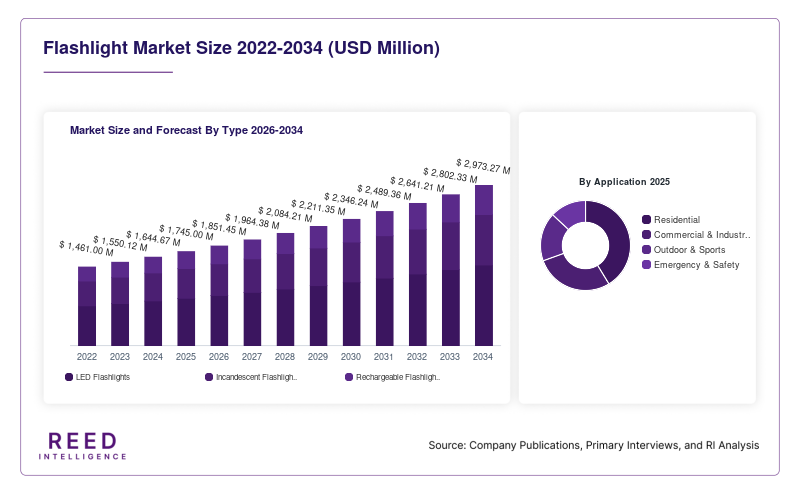
The flashlight market is segmented by Type and Application to provide a comprehensive market perspective. By Type, LED Flashlights dominate with a 65% market share, driven by their superior energy efficiency and performance. The Application segment is led by Residential, which accounts for 42% of the market, followed by Outdoor & Sports at 28%, Emergency & Safety at 18%, and Commercial & Industrial at 12%.
By Type
LED Flashlights represent the largest segment in the flashlight market , commanding a 65% share, with revenue exceeding USD 1,137 million in 2025. These flashlights utilize light-emitting diodes for illumination, offering high brightness, energy efficiency, and long lifespan. Technical specifications include lumen output, beam distance, battery type, and durability ratings. The market's LED Flashlights segment is driven by their use across all applications, from household use to professional and outdoor activities, due to their superior performance and reliability.
Incandescent Flashlights capture a 13% share of the flashlight market , with revenue of USD 227 million in 2025. These traditional flashlights use incandescent bulbs and are characterized by their lower cost and warm light output. Technical specifications include bulb type, battery type, and construction. The market's Incandescent Flashlights segment is driven by their use in price-sensitive markets and specific niche applications, although their share is declining due to the dominance of LED technology.
Rechargeable Flashlights represent 22% of the market, with revenue of USD 385 million in 2025, characterized by built-in rechargeable batteries and USB charging capabilities. Technical specifications include battery capacity, charging time, and output modes. The market's Rechargeable Flashlights segment is driven by their use in professional, outdoor, and emergency applications, where convenience and cost-effectiveness are prioritized.
By Application
Residential dominates the flashlight market , accounting for 42% of sales, representing USD 735 million in 2025. This segment includes the use of flashlights in households for general purposes, emergency preparedness, and outdoor activities around the home. Usage penetration exceeds 85% in households in developed economies. The market's Residential segment is characterized by its focus on affordability, ease of use, and reliability for everyday and emergency use.
Outdoor & Sports accounts for 28% of the flashlight market , with revenue of USD 490 million in 2025. This segment encompasses the use of flashlights for camping, hiking, fishing, hunting, and other outdoor recreational activities. The segment is growing at a significant rate, driven by the increasing popularity of outdoor activities and the demand for high-performance, durable flashlights. The market's Outdoor & Sports segment is characterized by its focus on brightness, durability, weather resistance, and advanced features.
Emergency & Safety represents 18% of the market, with revenue of USD 315 million in 2025, involving the use of flashlights by emergency responders, law enforcement, and for personal safety. The segment's growth is fueled by the increasing focus on emergency preparedness and the need for reliable lighting in critical situations. The market's Emergency & Safety segment is characterized by its focus on reliability, durability, and advanced features such as strobe and tactical modes.
Commercial & Industrial accounts for 12% of the market, with revenue of USD 210 million in 2025, encompassing the use of flashlights in construction, mining, maintenance, and other industrial applications. The market's Commercial & Industrial segment is driven by the need for durable, high-performance flashlights that can withstand harsh working conditions, with a focus on safety and reliability.
Flashlight Market Regional Analysis
North America Flashlight Market
Leads the flashlight market , commanding a 35% share, with revenue of USD 613 million in 2025. The United States is the primary driver, accounting for 85% of regional demand, driven by high consumer awareness, frequent power outages, and a strong outdoor recreation culture. The North American market is characterized by its focus on premium, high-performance flashlights and advanced features.
Europe Flashlight Market
Represents the second-largest market, capturing a 28% share with revenue of USD 490 million in 2025. Germany, the United Kingdom, and France are the primary drivers, together accounting for 58% of regional demand, driven by high consumer spending on outdoor gear and emergency preparedness. The European market is projected to grow at a steady CAGR, supported by continuous innovation and premium product adoption.
Asia-Pacific Flashlight Market
Accounts for 27% of the global flashlight market , with revenue of USD 473 million in 2025. China, India, and Japan are the primary drivers, accounting for 65% of regional demand, fueled by large populations, increasing electrification, and growing outdoor recreation activities. The Asia-Pacific market is projected to grow at the fastest CAGR of 8.2% through 2034, driven by expanding middle class and increasing demand for portable lighting.
Latin America and Middle East & Africa Flashlight Market
Together account for the remaining 10% of the flashlight market , with Brazil and South Africa leading their respective regions. Both regions are projected to grow at CAGRs exceeding 7%, driven by increasing electrification, outdoor activities, and emergency preparedness.
Top players in Flashlight Market
- Energizer Holdings, Inc.
- Duracell (Berkshire Hathaway)
- Mag Instrument, Inc.
- Streamlight, Inc.
- SureFire, LLC
- Nitecore
- Fenix Lighting
- Olight Technology
- Coast Products
- Pelican Products, Inc.
- Ledlenser GmbH & Co. KG
- Princeton Tec
- Brite Strike Technologies
- Browning Arms Company
- Dorcy International
Recent Developments in Flashlight Market
- April 2026 – Energizer Holdings launched a new line of rechargeable LED flashlights with USB-C fast charging and power bank functionality.
- June 2025 – Streamlight, Inc. introduced a new tactical flashlight with dual-switch operation and programmable brightness modes for law enforcement.
- August 2025 – Olight Technology announced a new compact flashlight with a maximum output of 3,000 lumens and a magnetic charging system.
- February 2026 – Fenix Lighting launched a new series of outdoor flashlights with advanced thermal management and long runtime capabilities.
- October 2025 – Ledlenser GmbH & Co. KG introduced a new smart flashlight with Bluetooth connectivity and customizable lighting profiles via a mobile app.
Flashlight Market Segments
By Type
- LED Flashlights
- Incandescent Flashlights
- Rechargeable Flashlights
By Application
- Residential
- Commercial & Industrial
- Outdoor & Sports
- Emergency & Safety
By Region
- North America
- Europe
- APAC
- Middle East and Africa
- LATAM