Flexible Flat Cable Market Size, Share & Trends Analysis Report By Type (Standard FFC, Shielded FFC, High-Temperature FFC, High-Speed FFC, Custom & Other FFC), By Pitch (0.5 mm & Below, 1.0 mm, 1.25 mm, 2.54 mm & Above), By Application (Consumer Electronics & Display, Automotive, Computers & Telecommunications, Industrial & Automation, Medical, Others) and By Region (North America, Europe, APAC, Middle East and Africa, LATAM) Forecasts, 2026–2034
USD 3950
Flexible Flat Cable Market Size
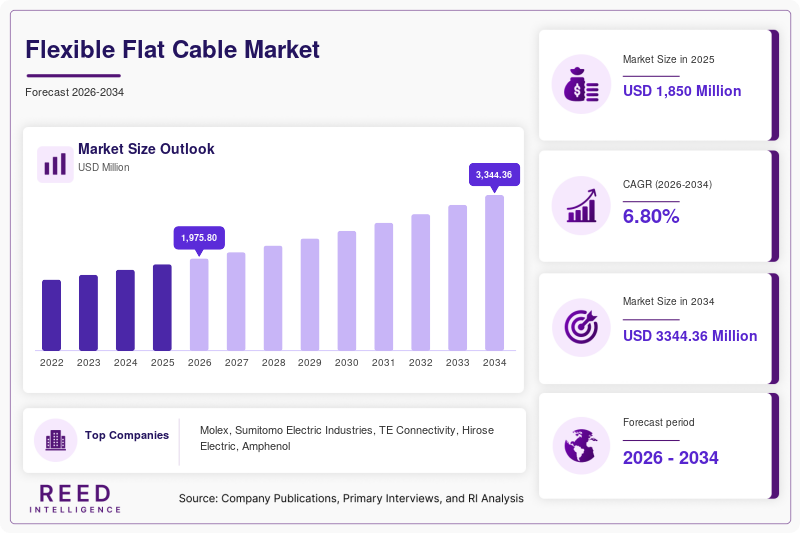
The global flexible flat cable market is valued at USD 1,850 Million in 2025 and USD 1,975.80 Million in 2026. The market is projected to reach USD 3,344.36 Million by 2034, registering a 6.80% CAGR during the forecast period.
The flexible flat cable market comprises thin, flat electrical cables formed from parallel conductors laminated or otherwise insulated within a flexible film. Flexible flat cables provide dense electrical routing while using less space than conventional round-wire assemblies, making them suitable for compact equipment, moving mechanisms, displays, automotive electronics, computers, printers, medical equipment and industrial systems. Sumitomo Electric describes FFC as a wiring material formed from parallel flat conductors laminated with insulating film and highlights high-density wiring and sliding characteristics as core advantages.
The market is increasingly moving toward higher-density, lower-profile and higher-performance FFC designs. Molex's Premo-Flex portfolio spans pitches from 0.25 mm to 1.25 mm and includes customized cable constructions, ZIF and LIF connector options, high-temperature designs and high-speed LVDS solutions. Molex also states that selected Premo-Flex solutions can withstand up to five million flex cycles and support high-speed data transmission in compact applications.
Flexible Flat Cable Market Drivers
Electronics miniaturization is increasing demand for dense, low-profile interconnects
The strongest structural driver is the continued reduction in equipment size combined with rising circuit density. FFC enables multiple conductors to be arranged in a thin, flexible structure rather than using individually routed wires, allowing designers to reclaim space and simplify internal routing.
Molex offers Premo-Flex cables in pitches ranging from 0.25 mm to 1.25 mm, while JST and other connector suppliers support compact 0.5 mm and 1.0 mm FFC interfaces. JST's FMS connector, for example, uses a 1.0 mm pitch and 2.8 mm mounting height for FFC applications requiring high-density packaging.
This is particularly important in notebooks, displays, cameras, wearables, printers, medical instruments and other equipment where boards and components must fit within increasingly constrained mechanical envelopes.
As device architectures become more compact, the cable itself becomes part of the mechanical design. Custom folds, varying cable lengths, exposed-contact geometries and carefully controlled bending paths allow FFC assemblies to route around components without introducing the bulk associated with conventional harnesses.
Vehicle electrification and software-defined architectures are increasing the number and complexity of electronic connections
The automotive sector is becoming a major source of demand for compact flex interconnects. EVs incorporate extensive electronic content across battery management, displays, infotainment, sensing, power electronics and cabin systems.
The IEA's 2026 outlook indicates that global EV sales exceeded 20 million in 2025 and could reach approximately 23 million in 2026. China, Europe and several emerging markets are continuing to expand EV adoption, broadening the potential installed base for automotive electronic interconnects.
Automotive electronics also require interconnects capable of working in vibration, temperature and limited-space conditions. Hirose's FH51 Series, released in September 2026, is an automotive FPC/FFC connector with 0.5 mm pitch, a one-action locking mechanism and 125°C heat resistance. Molex similarly markets automotive-grade Flexi-Latch+ connectors using flat cable architecture for EV and battery systems.
As vehicle architectures move toward centralized computing and zonal electrical/electronic architectures, compact high-density connections become increasingly important around displays, control modules, sensors and localized electronics.
High-speed internal data transmission is expanding FFC beyond basic signal wiring
FFC adoption is increasingly tied to signal-integrity requirements rather than physical routing alone. High-speed displays, automotive infotainment, communications systems and sensor modules require predictable impedance, EMI management and reliable transmission at higher data rates.
Sumitomo Electric offers shielded and high-frequency Sumicard products and states that its FFC technology is being developed for high-speed internal wiring, including 5G base stations, automotive displays and automotive batteries.
CviLux's 2026 FFC/LVDS portfolio is designed around high-speed data transmission and signal integrity for automotive infotainment, medical equipment, displays and industrial sensor modules. Molex also provides high-speed LVDS FFC assemblies and intermateable FFC solutions for automotive LCD displays and virtual cockpit applications.
This is increasing demand for shielded, impedance-controlled and high-frequency FFC rather than relying exclusively on conventional low-speed flat cables.
Flexible Flat Cable Market Restraints
Fine-pitch FFC requires tighter manufacturing and mating tolerances
As conductor pitches become smaller, manufacturing consistency becomes more demanding. Cable alignment, contact geometry, conductor dimensions and connector tolerances all become more critical to reliable assembly.
Molex, Hirose and JST each offer increasingly compact FFC/FPC interface systems, illustrating the precision required at smaller pitches. Hirose's FH51 uses a 0.5 mm pitch and 0.3 mm applicable cable thickness, while JST's compact FFC products similarly support 0.5 mm and 1.0 mm interfaces.
For manufacturers, tighter tolerances can increase process-control requirements, inspection costs and tooling complexity, particularly for high-volume custom designs.
Mechanical fatigue and environmental requirements limit some applications
FFC offers excellent flexibility, but repeated bending, improper routing, excessive mechanical stress, heat, humidity and vibration can affect electrical reliability depending on cable construction.
Suppliers therefore increasingly differentiate products by flex-life, temperature resistance, shielding, reinforcement and application-specific locking systems. Molex highlights FFC solutions with flex-cycle performance, while automotive connector suppliers such as Hirose and JST incorporate locking and environmental-resistance features for vehicle applications.
This can increase the engineering effort needed to qualify FFC assemblies for high-motion, high-temperature or high-vibration applications.
Flexible Flat Cable Market Opportunities
EV battery, display and zonal-electronics applications can expand the automotive FFC addressable market
Automotive electrification is creating opportunities for flat flexible interconnects in battery-management systems, display systems and compact electronic modules.
TE identifies FFC/FPC technologies within compact automotive electronics and specifically references EV battery-management applications, while Molex's Flexi-Latch+ architecture is designed to replace more complicated round-wire combinations with flat-cable systems in EV and battery environments.
Hirose's 2026 FH51 release further illustrates the direction: the connector combines 0.5 mm pitch, top and bottom contacts, one-action locking and 125°C resistance specifically for automotive FPC/FFC applications.
The resulting opportunity extends beyond cable supply into customized automotive cable assemblies, shielded designs, battery interconnects and application-specific connector ecosystems.
High-speed, shielded and specialized FFC can capture higher-value applications
Commodity FFCs compete primarily on cost and manufacturing efficiency, while high-speed and shielded designs compete on performance.
Sumitomo Electric offers shielded, high-frequency and 150°C-resistant Sumicard variants. CviLux has continued developing FFC/LVDS solutions for high-speed applications, and Axon Cable offers standard and custom FFC designs including shielded versions, high-voltage constructions and integrated fiber-optic configurations.
This broadens the opportunity into medical devices, telecommunications, aerospace, industrial electronics and high-performance computing environments where design value depends on signal integrity, environmental resistance or specialized geometry rather than cable price alone.
Flexible Flat Cable Market Type Analysis
Standard FFC remains the dominant product type because cost-efficient dense wiring still represents the broadest application base
Standard FFC remains the largest type because it satisfies the requirements of high-volume consumer electronics, displays, office equipment, computers and general industrial electronics without requiring the specialized shielding, thermal materials or signal-control architecture of premium designs.
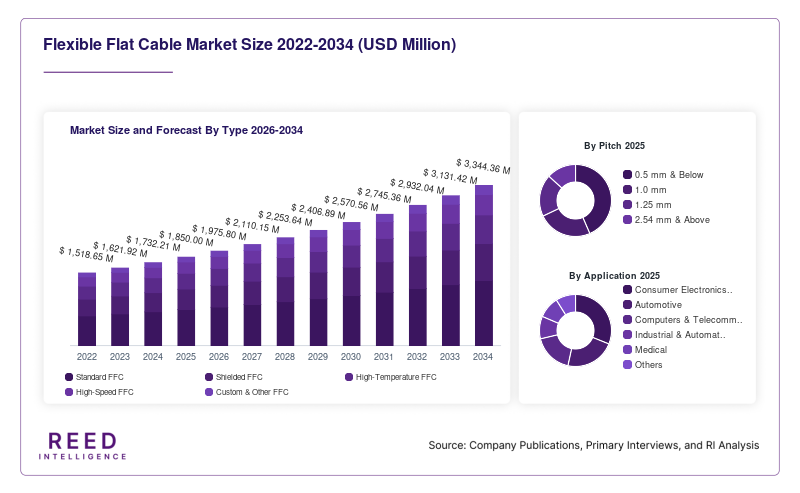
The Standard FFC segment accounts for 44% of the global market in 2026 and is projected to register a 6.20% CAGR.
Molex and Sumitomo Electric both maintain broad standard FFC portfolios serving compact board-to-board and internal-wiring applications. Sumitomo identifies office equipment, PCs and consumer devices as established applications, while Molex provides a broad range of standard and custom FFC assemblies.
High-Speed FFC is the fastest-growing product type as display and data requirements increase
High-speed FFC is gaining demand as equipment moves toward faster internal data links, especially in automotive displays, infotainment systems, medical electronics, industrial sensors and communications equipment.
The High-Speed FFC segment accounts for 24% of the global market in 2026 and is projected to register an 8.30% CAGR, making it the fastest-growing major product category.
Sumitomo Electric describes high-speed FFC for 5G and automotive applications, while CviLux's 2026 FFC/LVDS solutions target high-speed automotive infotainment, medical and industrial applications.
Flexible Flat Cable Market Application Analysis
Consumer Electronics & Display remains the dominant application because FFC is embedded throughout compact device architectures
Consumer electronics and display applications account for the largest portion of FFC consumption due to the extensive use of thin internal wiring in televisions, notebooks, gaming equipment, printers, cameras, mobile equipment and display modules.
The Consumer Electronics & Display segment accounts for 39% of the global market in 2026 and is projected to register a 5.80% CAGR.
Sumitomo Electric identifies gaming equipment, office equipment and PCs as established FFC applications, while CviLux lists LCD displays, televisions, notebooks, mobile equipment and other consumer-electronics applications.
Automotive is the fastest-growing application as electronic content and EV adoption accelerate
Automotive is becoming one of the most important expansion areas for FFC as vehicles add displays, cameras, control modules, infotainment systems, battery electronics and high-density internal connections.
The Automotive segment accounts for 24% of the global market in 2026 and is projected to register an 8.60% CAGR, making it the fastest-growing major application.
The IEA's 2026 outlook shows the scale of EV expansion, while TE, Molex and Hirose are all developing or expanding automotive interconnect solutions around compact, high-reliability architectures.
Flexible Flat Cable Market Regional Analysis
APAC Flexible Flat Cable Market
APAC remains the dominant regional market because it combines the world's largest consumer-electronics manufacturing base with major automotive, display, telecommunications and electronics-component manufacturing ecosystems.
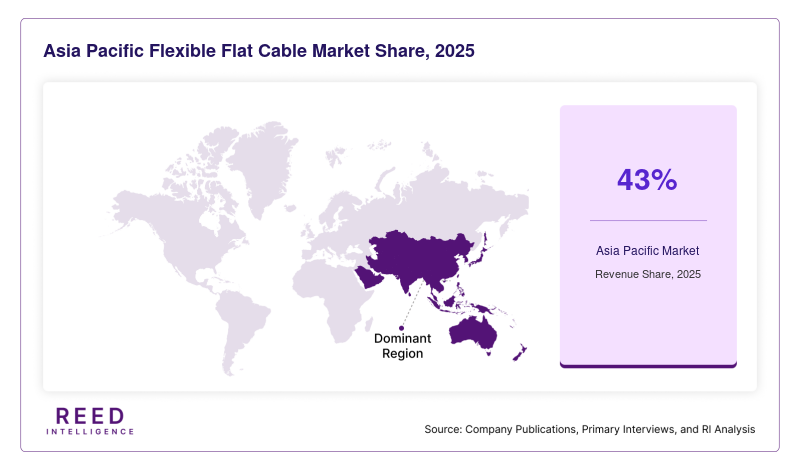
The APAC region accounts for 43% of the global market in 2026 and is projected to register a 7.50% CAGR, making it the fastest-growing regional market.
China, Japan, South Korea and Southeast Asia host major FFC, connector, PCB and electronics manufacturing activity. Sumitomo Electric operates FFC production in Asia, while CviLux maintains multiple Asian factories and supplies connectors and FFC assemblies to electronics, communications and automotive customers.
India is also becoming increasingly important within the automotive electronics supply chain. Hirose announced in March 2026 that it would establish a new manufacturing site in Chennai, Tamil Nadu, with partial operations scheduled to begin in summer 2027, specifically to strengthen automotive supply capacity in India and surrounding markets.
North America Flexible Flat Cable Market
North America is supported by automotive electronics, industrial automation, aerospace, medical equipment, computing and communications infrastructure.
The region is projected to register a 6.80% CAGR, with demand increasingly influenced by EV electronics, advanced vehicle architectures and high-speed connectivity.
Molex and TE Connectivity continue to expand automotive connectivity portfolios serving electrification, zonal architectures, advanced driver-assistance systems and compact electronic modules.
The U.S. market also retains a strong specialized-electronics base where high-performance FFC is used in medical, industrial and computing equipment.
Europe Flexible Flat Cable Market
Europe is projected to register a 6.20% CAGR, supported by automotive manufacturing, industrial automation, medical technology and specialized electronics.
The region has strong demand for application-specific interconnects requiring environmental resistance, miniaturization and high reliability. Automotive electrification is an important structural factor, with the IEA reporting that European electric-car sales increased substantially in 2025 and projecting further EV expansion in 2026.
European engineering activity is also supported by specialized suppliers such as Axon Cable, which develops custom FFC systems for demanding technical applications.
Middle East and Africa Flexible Flat Cable Market
The Middle East and Africa market is projected to register a 5.90% CAGR, supported by electronics distribution, automotive systems, industrial equipment, telecommunications and expanding technology infrastructure.
Demand remains concentrated in imported electronics and specialized equipment, although localized industrial and automotive investments are creating additional opportunities for compact interconnect technologies.
LATAM Flexible Flat Cable Market
LATAM is projected to register a 6.30% CAGR, supported by consumer-electronics manufacturing, automotive production, industrial equipment and telecommunications.
Brazil and Mexico provide important manufacturing and assembly centers, while the increasing digitization of industrial and consumer equipment supports demand for compact internal connections.
Flexible Flat Cable Market Competitive Landscape
The flexible flat cable market is characterized by competition among diversified interconnect manufacturers, specialized cable suppliers and connector companies offering FFC as part of broader connectivity portfolios.
Molex is a major FFC supplier through its Premo-Flex portfolio, which includes standard and custom FFC/FPC options, multiple pitches, LVDS solutions, high-flex designs and high-temperature products. The company also connects its cable offerings to automotive, medical, industrial, computing and display applications.
Key Market Players
Flexible Flat Cable Market Recent Developments
September 2026 – Hirose expanded its FFC/FPC product activity with continued miniaturized connector development. Its global product news during September 2026 includes the FH51 automotive FPC/FFC connector alongside additional compact connectivity products, reflecting the supplier's continued focus on high-density interconnect technology.
May 2026 – CviLux promoted its FFC and LVDS solutions for high-speed interconnect applications. The company highlighted high-speed data transmission, compact space-saving construction, signal integrity and flexible configurations for automotive infotainment, medical equipment, ultra-thin displays and industrial sensor modules.
Flexible Flat Cable Market Segments
By Type
- Standard FFC
- Shielded FFC
- High-Temperature FFC
- High-Speed FFC
- Custom & Other FFC
By Pitch
- 0.5 mm & Below
- 1.0 mm
- 1.25 mm
- 2.54 mm & Above
By Application
- Consumer Electronics & Display
- Automotive
- Computers & Telecommunications
- Industrial & Automation
- Medical
- Others
By Region
- North America
- Europe
- APAC
- Middle East and Africa
- LATAM