Flexible Graphite Bipolar Plate Market Size, Share & Demand Report By Material Type (Expanded Graphite Plates, Composite Graphite Plates), By Application (PEM Fuel Cells, Solid Oxide Fuel Cells, Direct Methanol Fuel Cells, Phosphoric Acid Fuel Cells), By End-Use Industry (Automotive, Stationary Power Generation, Portable Power Systems, Industrial Applications), By Plate Thickness (Thin Plates, Ultra-Thin Plates, Standard Thickness Plates), By Distribution Channel (Direct Sales, Distributors and
USD 3950
Market Overview
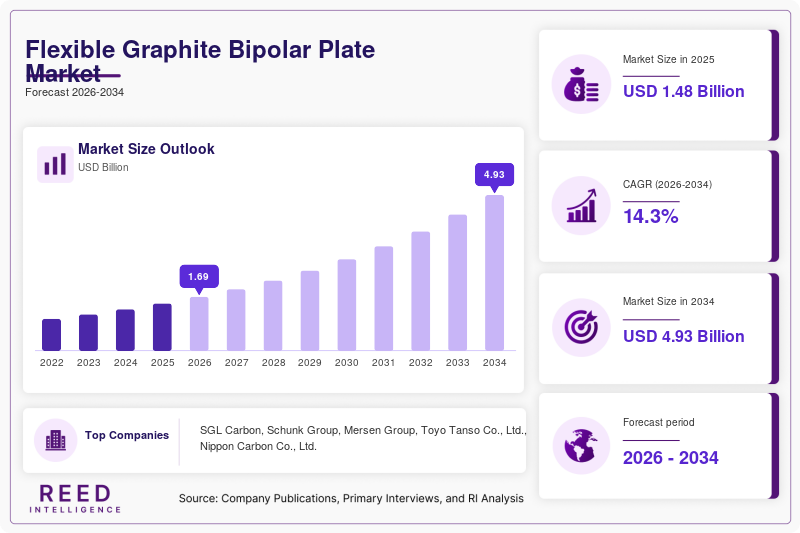
The global Flexible Graphite Bipolar Plate Market size was valued at approximately USD 1.48 billion in 2025 and is projected to reach USD 4.92 billion by 2034, expanding at a CAGR of 14.3% from 2025 to 2034. The market growth is primarily driven by the increasing adoption of fuel cell technologies across transportation, stationary power generation, and portable energy applications. Flexible graphite bipolar plates are critical components in proton exchange membrane (PEM) fuel cells due to their high electrical conductivity, corrosion resistance, and mechanical flexibility.
A major global factor supporting market expansion is the accelerating shift toward low-emission energy systems. Governments and private stakeholders are increasingly investing in hydrogen infrastructure, which has significantly enhanced the demand for fuel cell components, including flexible graphite bipolar plates. Additionally, ongoing advancements in material engineering have improved plate durability and reduced production costs, further strengthening the market outlook.
Key Highlights
- Asia Pacific dominated the market with a 42.6% share in 2025, while it is expected to register the fastest CAGR of 15.2% during the forecast period.
- By application, PEM fuel cells held the largest share at 58.4%, while automotive fuel cells are projected to grow at the fastest CAGR of 15.8%.
- By material type, expanded graphite plates dominated, while composite graphite plates are expected to grow at a CAGR of 15.6%.
- China remained the dominant country with market values of USD 420 million in 2025 and USD 470 million in 2026.
Market Trends
Integration of Lightweight and High-Performance Materials
The Flexible Graphite Bipolar Plate Market is witnessing a strong trend toward the development of lightweight and high-strength materials. Manufacturers are focusing on reducing plate thickness while maintaining conductivity and durability. This trend is particularly relevant in automotive applications, where reducing vehicle weight directly improves fuel efficiency and performance. Enhanced manufacturing processes, such as precision molding and advanced coating techniques, are further supporting this shift.
Expansion of Hydrogen Infrastructure Projects
The rapid expansion of hydrogen production, storage, and distribution infrastructure is influencing the market landscape. Countries are investing in hydrogen refueling stations and fuel cell-based power systems, which is increasing the demand for reliable bipolar plates. Flexible graphite plates are gaining traction due to their ability to withstand harsh operating conditions and maintain consistent performance. This trend is also encouraging partnerships between material suppliers and fuel cell manufacturers, leading to improved supply chain efficiency and technological advancements.
Market Drivers
Rising Demand for Fuel Cell Electric Vehicles (FCEVs)
The increasing adoption of fuel cell electric vehicles is a key driver for the Flexible Graphite Bipolar Plate Market. FCEVs require efficient and durable bipolar plates to ensure optimal performance and longevity. As automotive manufacturers expand their fuel cell vehicle portfolios, the demand for high-quality graphite plates is rising steadily. This demand is further supported by government incentives and emission reduction targets.
Technological Advancements in Graphite Processing
Continuous innovations in graphite processing technologies are enhancing the performance characteristics of flexible bipolar plates. Improved conductivity, reduced permeability, and enhanced thermal stability are making these plates more suitable for diverse applications. Advanced manufacturing techniques are also enabling mass production at reduced costs, which is encouraging wider adoption across industries.
Market Restraint
High Manufacturing Costs and Material Limitations
One of the primary challenges in the Flexible Graphite Bipolar Plate Market is the relatively high cost associated with manufacturing. The production process involves specialized equipment and high-purity graphite materials, which increases overall costs. Additionally, maintaining uniform quality and structural integrity during large-scale production remains a technical challenge. These factors can limit adoption, particularly among small and medium-sized enterprises, and may slow down market growth in cost-sensitive regions.
Market Opportunities
Growth in Stationary Power Generation Systems
The increasing deployment of fuel cells in stationary power applications presents significant opportunities for market growth. Flexible graphite bipolar plates are well-suited for these systems due to their durability and efficiency. As industries seek reliable backup power solutions, demand for these plates is expected to increase.
Emerging Applications in Portable Energy Devices
The rising demand for portable and compact energy solutions is opening new avenues for the Flexible Graphite Bipolar Plate
Market. These plates are being integrated into small-scale fuel cells used in consumer electronics and remote power systems. Continuous innovation in miniaturization and performance optimization is expected to support this emerging segment.
Segmental Analysis
By Material Type
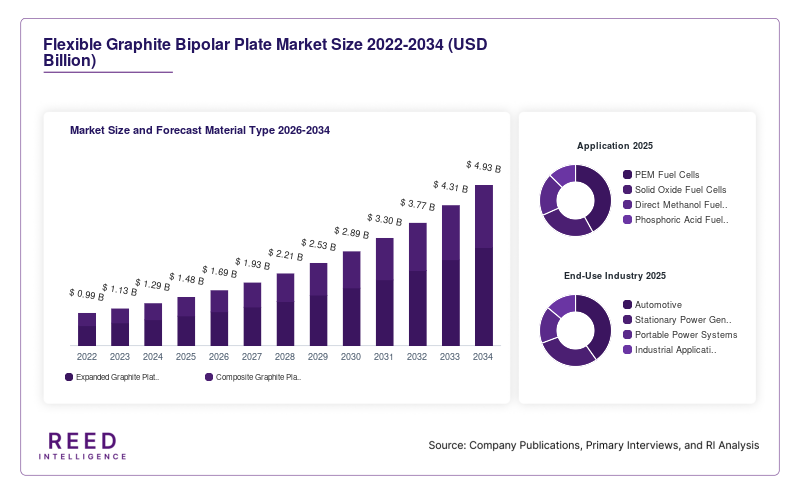
Expanded graphite plates dominated the market, accounting for 61.2% of the share in 2025. Their superior conductivity and flexibility made them suitable for various fuel cell applications.
Composite graphite plates are expected to grow at the fastest CAGR of 15.6%, driven by their enhanced mechanical strength and improved durability. These materials are increasingly used in demanding applications requiring long operational life.
By Application
PEM fuel cells held the largest share of 58.4% in 2025, as they are widely used in transportation and portable power systems. Their efficiency and reliability have driven widespread adoption.
Solid oxide fuel cells are projected to grow at a CAGR of 14.9%, supported by their high efficiency and suitability for stationary power generation.
By End-Use Industry
The automotive sector dominated the market with a 47.5% share in 2025, driven by the increasing production of fuel cell vehicles.
The stationary power generation segment is expected to grow at a CAGR of 15.1%, fueled by rising demand for backup power and distributed energy systems.
By Plate Thickness
Thin plates dominated with a 54.3% share in 2025, as they offer improved efficiency and reduced material usage.
Ultra-thin plates are projected to grow at a CAGR of 15.7%, driven by the need for compact and lightweight fuel cell systems.
By Sales Channel
Direct sales accounted for 63.8% of the market share in 2025, as manufacturers prefer direct engagement with large clients.
Distributor-based sales are expected to grow at a CAGR of 13.8%, supported by expanding global supply chains and increasing market accessibility.
Regional Analysis
North America
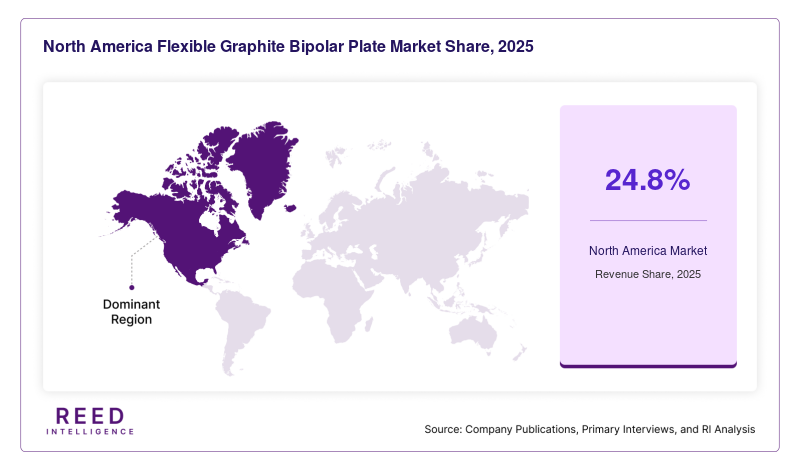
North America accounted for 24.8% of the market share in 2025 and is expected to grow at a CAGR of 13.7% during the forecast period. The region’s growth is supported by increasing investments in clean energy technologies and strong research capabilities. The presence of established fuel cell manufacturers has also contributed to market expansion.
The United States dominated the regional market due to its advanced hydrogen infrastructure initiatives. The country’s focus on integrating fuel cell systems into transportation and industrial applications has created a steady demand for flexible graphite bipolar plates.
Europe
Europe held 21.3% of the market share in 2025 and is projected to grow at a CAGR of 13.9%. The region has been focusing on reducing carbon emissions through renewable energy adoption. Strong regulatory frameworks and sustainability goals are driving the demand for fuel cell components.
Germany led the European market, supported by its robust automotive sector and emphasis on hydrogen mobility. The country’s initiatives to develop fuel cell vehicles and infrastructure have significantly contributed to market growth.
Asia Pacific
Asia Pacific dominated the Flexible Graphite Bipolar Plate Market with a 42.6% share in 2025 and is expected to grow at the fastest CAGR of 15.2%. Rapid industrialization and increasing investments in clean energy projects are key growth factors in this region.
China emerged as the leading country due to its large-scale production capabilities and government-backed hydrogen initiatives. The country’s focus on expanding fuel cell vehicle adoption has driven significant demand for graphite bipolar plates.
Middle East & Africa
The Middle East & Africa region held 6.5% of the market share in 2025 and is projected to grow at a CAGR of 12.8%. The region is gradually adopting renewable energy technologies to diversify its energy mix.
The United Arab Emirates led the regional market, driven by its investments in sustainable energy projects and hydrogen production. The country’s efforts to reduce reliance on fossil fuels have supported market growth.
Latin America
Latin America accounted for 4.8% of the market share in 2025 and is expected to grow at a CAGR of 12.5%. The region is witnessing increased interest in alternative energy solutions, particularly in industrial applications.
Brazil dominated the regional market due to its expanding renewable energy sector and growing focus on clean energy technologies. The country’s initiatives to adopt fuel cell systems have contributed to the demand for flexible graphite bipolar plates.
Competitive Landscape
The Flexible Graphite Bipolar Plate Market is moderately consolidated, with several key players focusing on innovation and strategic collaborations. The leading companies are investing in advanced manufacturing technologies to improve product performance and reduce costs.
One of the prominent market leaders is SGL Carbon, which has been actively expanding its product portfolio and production capabilities. The company recently introduced advanced graphite solutions designed for high-performance fuel cells, strengthening its market position.
Other players are focusing on partnerships with fuel cell manufacturers to enhance their market reach. Continuous research and development activities are shaping the competitive landscape, enabling companies to differentiate their offerings and maintain a competitive edge.
Key Players List
- SGL Carbon
- Schunk Group
- Mersen Group
- Toyo Tanso Co., Ltd.
- Nippon Carbon Co., Ltd.
- Graphite India Limited
- Ballard Power Systems
- Plug Power Inc.
- Hyundai Rotem
- Doosan Fuel Cell
- Panasonic Corporation
- Toray Industries
- Cabot Corporation
- Hexagon Composites
- Bloom Energy
Recent Developments
- 2024: SGL Carbon expanded its production facility to meet rising demand for fuel cell components.
- 2024: Mersen Group introduced a new range of high-durability graphite bipolar plates.
- 2023: Toyo Tanso developed advanced composite graphite materials for improved performance.
- 2023: Ballard Power Systems partnered with automotive OEMs to enhance fuel cell integration.
- 2023: Plug Power Inc. increased investment in hydrogen infrastructure projects.
Flexible Graphite Bipolar Plate Market Segments
Material Type
- Expanded Graphite Plates
- Composite Graphite Plates
Application
- PEM Fuel Cells
- Solid Oxide Fuel Cells
- Direct Methanol Fuel Cells
- Phosphoric Acid Fuel Cells
End-Use Industry
- Automotive
- Stationary Power Generation
- Portable Power Systems
- Industrial Applications
Plate Thickness
- Thin Plates
- Ultra-Thin Plates
- Standard Thickness Plates
Distribution Channel
- Direct Sales
- Distributors and Suppliers
- Online Sales Channels
By Region
- North America
- Europe
- APAC
- Middle East and Africa
- LATAM