Flexible Intermediate Bulk Containers Market Size, Share, Demand & Industry Growth Report By Product Type (Type A FIBCs, Type B FIBCs, Type C FIBCs, Type D FIBCs), By End-Use Industry (Chemicals & Fertilizers, Food & Agriculture, Construction Materials, Pharmaceuticals, Mining & Metals), By Capacity (Up to 500 kg, 500–1000 kg, 1000–1500 kg, Above 1500 kg), By Region Forecasts, 2026–2034
USD 3950
Market Overview
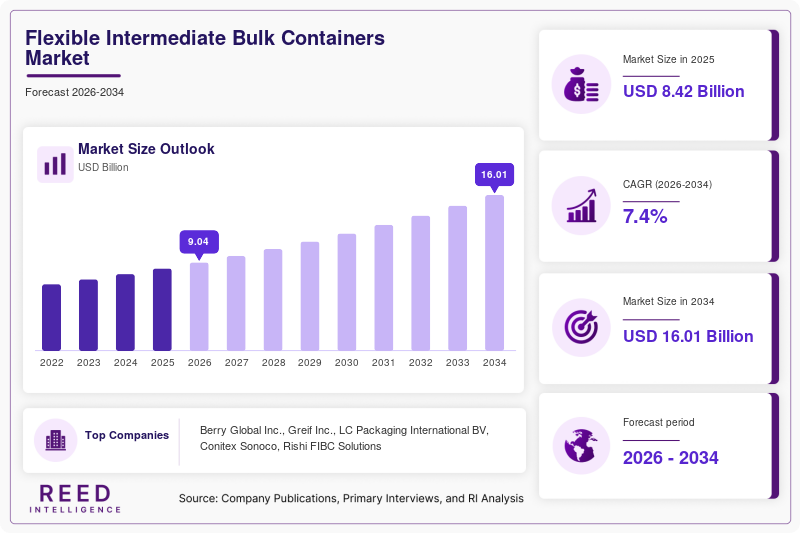
The global Flexible Intermediate Bulk Containers Market size is valued at approximately USD 8.42 billion in 2026 and is projected to reach USD 14.87 billion by 2034, expanding at a CAGR of 7.4% during the forecast period 2026–2034. Growth is primarily supported by the rapid expansion of bulk material handling across agriculture, chemicals, food processing, and construction industries. Increasing global trade of raw materials and packaged commodities has further strengthened demand for flexible and cost-efficient packaging solutions such as FIBCs.
A major global factor contributing to market growth is the increasing shift toward sustainable and reusable packaging systems. Industries are prioritizing lightweight, recyclable, and space-efficient packaging to reduce logistics costs and carbon emissions. Flexible Intermediate Bulk Containers provide high durability, reduced material waste, and improved storage efficiency, making them highly suitable for modern supply chain optimization strategies across both developed and emerging economies.
Key Highlights
- North America dominated the market with a 33.8% share in 2025.
- Asia Pacific is expected to grow at the fastest CAGR of 11.6% during 2026–2034.
- By product type, Type A FIBCs accounted for the largest share of 39.2%, while conductive FIBCs are projected to grow at a CAGR of 12.1%.
- By application, chemicals and fertilizers handling led with a 42.5% share, whereas food-grade bulk packaging is expected to expand at a CAGR of 10.9%.
- The United States remained the dominant country, with market values of USD 1.12 billion in 2024 and USD 1.23 billion in 2025.
Market Trends
Increasing Adoption of Sustainable Bulk Packaging Solutions
One of the most significant trends shaping the Flexible Intermediate Bulk Containers Market is the growing adoption of sustainable packaging materials. Manufacturers are increasingly shifting toward recyclable polypropylene-based FIBCs to comply with environmental regulations and corporate sustainability goals. Industries such as agriculture and chemicals are focusing on reducing plastic waste by integrating reusable bulk containers into logistics systems. Additionally, advancements in polymer engineering have enabled the production of high-strength yet lightweight FIBCs that reduce carbon emissions during transportation. This trend is further supported by global initiatives aimed at reducing single-use plastics and improving circular economy practices across industrial supply chains.
Rising Integration of Smart Tracking and RFID-Enabled FIBCs
Another major trend is the integration of smart tracking technologies such as RFID tags and IoT-based monitoring systems in FIBCs. These innovations allow real-time tracking of bulk materials during transportation and storage, improving inventory management and reducing product loss. Logistics companies and manufacturers are increasingly adopting smart FIBCs to enhance transparency in supply chain operations. This trend is particularly strong in pharmaceutical and food-grade applications where traceability and compliance are critical. The combination of digitalization and packaging innovation is expected to redefine operational efficiency across global bulk handling systems.
Market Drivers
Expansion of Industrial Manufacturing and Global Trade Activities
The expansion of industrial manufacturing and global trade is a primary driver of the Flexible Intermediate Bulk Containers Market. Industries such as chemicals, construction materials, and agriculture rely heavily on efficient bulk packaging solutions for raw material storage and transportation. The increasing cross-border movement of commodities has significantly boosted demand for durable and cost-effective packaging systems. FIBCs offer advantages such as high load capacity, reduced handling time, and lower transportation costs, making them ideal for large-scale industrial applications. Moreover, rapid urbanization and infrastructure development in emerging economies have further strengthened demand for bulk material logistics solutions.
Cost Efficiency and Operational Advantages of FIBCs
Another key driver is the cost efficiency and operational flexibility offered by FIBCs compared to traditional packaging methods. These containers are lightweight, reusable, and require minimal storage space when not in use, leading to reduced warehousing and logistics costs. Industries are increasingly adopting FIBCs to optimize supply chain efficiency and minimize packaging expenses. Additionally, advancements in material strength and design customization have enabled manufacturers to cater to diverse industry requirements. The ability of FIBCs to handle hazardous and non-hazardous materials safely further enhances their adoption across chemical, food, and pharmaceutical sectors.
Market Restraint
Regulatory Compliance and Quality Standard Challenges
A major restraint affecting the Flexible Intermediate Bulk Containers Market is the increasing complexity of regulatory compliance and quality standards across different regions. FIBCs used in food and pharmaceutical applications must meet strict hygiene and safety certifications, which increases production costs and operational complexity. Variations in international standards for load capacity, contamination control, and material composition also pose challenges for manufacturers operating in multiple markets. Smaller producers often struggle to meet these requirements, limiting market entry and expansion. Additionally, failure to comply with regulations can lead to product recalls and reputational damage, affecting overall market growth stability.
Market Opportunities
Expansion of Food-Grade and Pharmaceutical Bulk Packaging Applications
The growing demand for safe and hygienic packaging in the food and pharmaceutical industries presents a significant opportunity for the Flexible Intermediate Bulk Containers Market. Increasing consumption of processed food and bulk ingredient transportation has driven the need for contamination-free packaging solutions. Food-grade FIBCs with anti-static and moisture-resistant properties are gaining traction in global supply chains. Similarly, pharmaceutical companies are adopting high-purity bulk containers for raw material handling. This expansion is expected to create new revenue streams for manufacturers focusing on specialized and certified FIBC solutions.
Growth Potential in Emerging Economies and Infrastructure Projects
Emerging economies present substantial growth opportunities due to rapid industrialization and infrastructure development. Countries in Asia Pacific, Latin America, and parts of Africa are witnessing increased demand for construction materials, fertilizers, and industrial chemicals, all of which require bulk packaging solutions. Government investments in manufacturing hubs and logistics infrastructure further support market expansion. Local production of FIBCs is also increasing, reducing dependency on imports and improving supply chain efficiency. These factors collectively create a strong growth environment for market participants targeting high-volume industrial applications.
Segmental Analysis
By Product Type
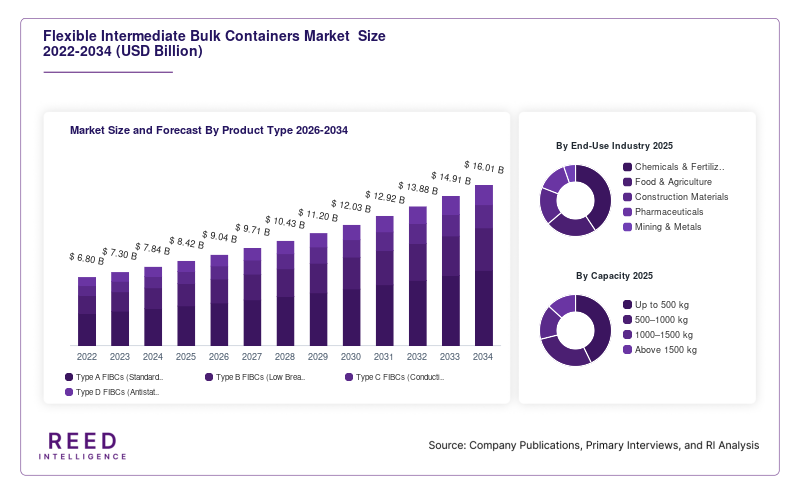
The Type A Flexible Intermediate Bulk Containers segment dominated the Flexible Intermediate Bulk Containers Market, accounting for approximately 39.6% share in 2024. This dominance is attributed to their extensive use in non-hazardous material handling applications such as agriculture, construction, sand, cement, and food grains. Type A FIBCs are cost-effective, lightweight, and easy to manufacture, making them widely preferred in price-sensitive markets. Their simple polypropylene woven structure without electrostatic protection also makes them suitable for industries where flammable dust risks are minimal. Growing demand for bulk packaging in developing economies and increasing agricultural output continue to reinforce the strong position of this subsegment across global supply chains.
The fastest-growing category within the product type segment is expected to be Type C and Type D FIBCs, which are projected to expand at a CAGR of 10.9% during 2026–2034. This growth is driven by rising demand from industries dealing with combustible powders, chemicals, pharmaceuticals, and fine granules where electrostatic discharge control is critical. Type C conductive bags require grounding during filling and discharge, while Type D antistatic bags provide inherent static dissipation without grounding. Increasing regulatory compliance requirements, workplace safety standards, and awareness regarding explosion hazards in industrial environments are significantly boosting adoption. Technological improvements in conductive yarns and fabric engineering are also enhancing performance reliability, further accelerating market penetration in high-risk industrial applications.
By End-Use Industry
The chemicals and fertilizers segment held the largest share of 36.4% in 2024 in the Flexible Intermediate Bulk Containers Market. This dominance is driven by the high-volume transportation needs of raw chemical powders, industrial additives, and agricultural fertilizers. These materials require safe, durable, and moisture-resistant packaging to ensure product integrity during long-distance transportation and storage. FIBCs provide an efficient solution due to their high load capacity, stackability, and resistance to tearing under heavy loads. Increasing global fertilizer demand for agriculture productivity enhancement and rising chemical manufacturing output in industrialized regions continue to support strong consumption in this segment. Additionally, export-oriented chemical industries heavily rely on standardized bulk packaging formats to optimize logistics efficiency.
The food and agriculture segment is projected to be the fastest-growing application area, expanding at a CAGR of 9.8% during 2026–2034. This growth is supported by increasing demand for hygienic, contamination-free, and food-grade certified packaging solutions. Flexible intermediate bulk containers used in this segment are often lined with food-safe coatings to ensure compliance with international food safety standards. Rising global consumption of processed food, grains, sugar, and flour has significantly boosted demand for efficient bulk storage and transportation systems. Furthermore, expansion of global food supply chains, increasing agricultural exports, and modernization of food processing facilities are further accelerating adoption. The ability of FIBCs to reduce packaging waste and improve storage efficiency is also contributing to strong market growth.
By Capacity Type
The 1,000 kg to 1,500 kg capacity FIBCs segment accounted for the dominant 41.2% share in 2024 in the Flexible Intermediate Bulk Containers Market. This capacity range is widely preferred across industries due to its optimal balance between load efficiency and handling convenience. It is extensively used in construction materials, agriculture, chemicals, and industrial manufacturing sectors. These medium-capacity FIBCs offer high durability while maintaining ease of transportation using forklifts and cranes. Their adaptability to standard shipping containers and warehouse systems further enhances their demand across global logistics networks. Increasing industrial production and growing demand for standardized bulk packaging formats continue to support the dominance of this segment.
The above 1,500 kg capacity segment is expected to grow at the fastest CAGR of 9.6% during 2026–2034, driven primarily by mining, metallurgy, and large-scale construction industries. These sectors require high-load packaging solutions for transporting heavy raw materials such as ores, minerals, and aggregates. The ability of high-capacity FIBCs to reduce handling frequency and improve operational efficiency makes them highly attractive for bulk industrial operations. Advancements in fabric strength, stitching technology, and load-bearing design are enabling safer handling of ultra-heavy loads. Additionally, increasing infrastructure development projects and mining expansion activities in emerging economies are further contributing to the accelerated growth of this segment.
Regional Analysis
North America
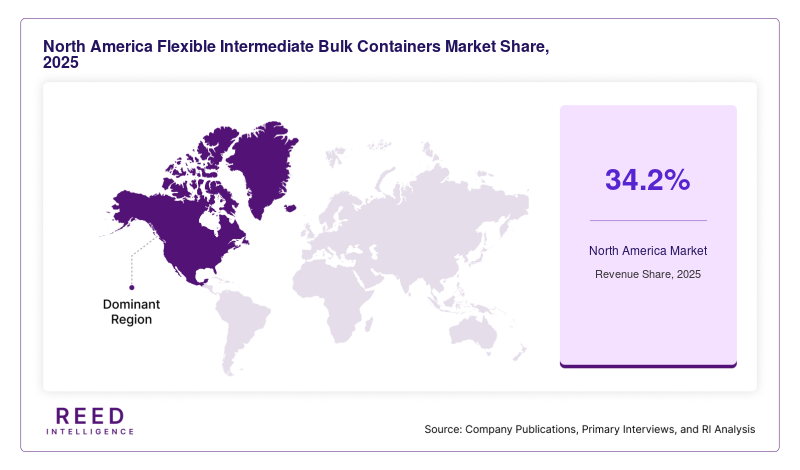
North America accounted for approximately 34.2% share in 2025 in the Flexible Intermediate Bulk Containers Market and is projected to expand at a CAGR of 6.1% during 2026–2034. The region’s strong industrial infrastructure, advanced logistics systems, and high adoption of standardized packaging solutions contribute significantly to its leading position. The market is characterized by high demand from chemical processing, agriculture, and food manufacturing industries, all of which require efficient bulk packaging systems for domestic distribution and export operations. Increasing automation in warehousing and supply chain optimization further strengthens demand for flexible intermediate bulk containers across the region.
The United States is the dominant country in North America due to its extensive industrial base and well-developed export ecosystem. A key growth factor is the rising adoption of sustainable packaging materials driven by corporate environmental commitments and regulatory pressure to reduce plastic waste. Additionally, growing investments in agricultural productivity and fertilizer distribution networks are increasing reliance on bulk packaging solutions. Expansion of chemical manufacturing hubs and modernization of logistics infrastructure further support long-term demand growth in the country.
Europe
Europe held around 27.8% market share in 2025, with a projected CAGR of 5.9% during 2026–2034 in the Flexible Intermediate Bulk Containers Market. The region benefits from a strong regulatory framework emphasizing environmental sustainability, circular economy practices, and packaging waste reduction. Demand is primarily driven by the chemical, pharmaceutical, and food processing industries, which require high-quality, compliant bulk packaging solutions. The presence of well-established industrial economies and cross-border trade within the European Union further supports steady demand for standardized FIBCs.
Germany leads the European market due to its strong manufacturing sector and export-oriented industrial structure. A major growth factor is the increasing adoption of recyclable and reusable packaging solutions in alignment with stringent EU environmental regulations. Additionally, Germany’s advanced chemical production industry and growing emphasis on logistics efficiency are driving demand for high-performance bulk containers. Technological innovation in packaging design and material engineering is also enhancing product efficiency and supporting regional market growth.
Asia Pacific
Asia Pacific accounted for approximately 25.6% share in 2025, and is expected to grow at the fastest CAGR of 11.2% during 2026–2034 in the Flexible Intermediate Bulk Containers Market. Rapid industrialization, urbanization, and expansion of manufacturing activities are key factors driving strong demand across the region. Countries in this region are increasingly investing in infrastructure development, logistics modernization, and export-oriented manufacturing, all of which contribute to rising adoption of bulk packaging systems.
China dominates the Asia Pacific market due to its large-scale manufacturing ecosystem and strong presence in chemical, agricultural, and industrial production sectors. A key growth factor is the expansion of global export activities supported by advanced logistics networks and port infrastructure. Additionally, increasing domestic consumption, rising fertilizer demand in agriculture, and government initiatives supporting industrial efficiency are significantly boosting demand for flexible intermediate bulk containers in the country.
Middle East & Africa
The Middle East & Africa region accounted for approximately 7.1% share in 2025, with a projected CAGR of 7.4% during 2026–2034 in the Flexible Intermediate Bulk Containers Market. Growth in this region is supported by expanding construction activities, mining operations, and increasing industrial diversification efforts. Demand for bulk packaging solutions is rising steadily as countries invest in infrastructure development and manufacturing sector expansion.
Saudi Arabia leads the regional market due to its ongoing economic diversification initiatives under national development programs. A key growth factor is the rapid expansion of construction and infrastructure megaprojects requiring large-scale material handling solutions. Additionally, increasing chemical production capacity and investments in industrial logistics infrastructure are further driving adoption of flexible intermediate bulk containers across the country.
Latin America
Latin America held approximately 5.3% market share in 2025, with a CAGR forecast of 6.6% during 2026–2034 in the Flexible Intermediate Bulk Containers Market. The region’s growth is primarily driven by agricultural exports, mining activities, and expanding industrial production. Countries in this region rely heavily on bulk packaging solutions for efficient transportation of raw materials and agricultural commodities.
Brazil is the leading country in the Latin American market due to its strong agricultural output and large-scale fertilizer consumption. A key growth factor is the rising export of soybeans, grains, and other agricultural products requiring efficient bulk handling solutions. Additionally, growth in mining operations and industrial manufacturing activities is further strengthening demand for flexible intermediate bulk containers across the country.
Competitive Landscape
The Flexible Intermediate Bulk Containers Market is moderately fragmented with strong participation from global and regional manufacturers focusing on product innovation, sustainability, and capacity expansion. Key players are investing in advanced fabric technology, automated manufacturing systems, and customized bulk packaging solutions.
Leading companies include Greif Inc., Berry Global Inc., Conitex Sonoco, Bulk-Pack, and RDA Bulk Packaging Ltd. Greif Inc. holds a leading position due to its extensive global manufacturing network and diversified product portfolio. A recent development includes expansion of recyclable FIBC production capacity to meet rising demand from sustainable packaging markets.
Key Players
- Greif Inc.
- Berry Global Inc.
- Conitex Sonoco
- RDA Bulk Packaging Ltd.
- Bulk-Pack Inc.
- LC Packaging International BV
- Taihua Group
- Mini Bulk Bags
- Global-Pak Inc.
- Intertape Polymer Group
- Rishi FIBC Solutions
- Halsted Corporation
- Big Bag International
- Langston Companies Inc.
- SIA Flexitanks
Recent Developments
- In 2025, several manufacturers expanded production facilities in Asia Pacific to meet growing demand for cost-efficient bulk packaging solutions. This expansion focused on enhancing output capacity and reducing lead times for international supply chains.
- In early 2026, companies introduced next-generation conductive FIBCs designed with improved electrostatic discharge protection for hazardous material handling. These innovations aim to enhance safety standards across chemical logistics operations.
- Additionally, sustainability-focused initiatives increased, with leading players launching recyclable polypropylene FIBC lines to align with global circular economy goals and reduce environmental impact across packaging lifecycles.
Flexible Intermediate Bulk Containers Market Segments
By Product Type
- Type A FIBCs (Standard Bulk Bags)
- Type B FIBCs (Low Breakdown Voltage Bags)
- Type C FIBCs (Conductive/grounded Bags)
- Type D FIBCs (Antistatic Dissipative Bags)
By End-Use Industry
- Chemicals & Fertilizers
- Food & Agriculture
- Construction Materials
- Pharmaceuticals
- Mining & Metals
By Capacity
- Up to 500 kg
- 500–1000 kg
- 1000–1500 kg
- Above 1500 kg
By Region
- North America
- Europe
- APAC
- Middle East and Africa
- LATAM